BMW Neon Signs: The Roundel & the Ultimate Garage Wall
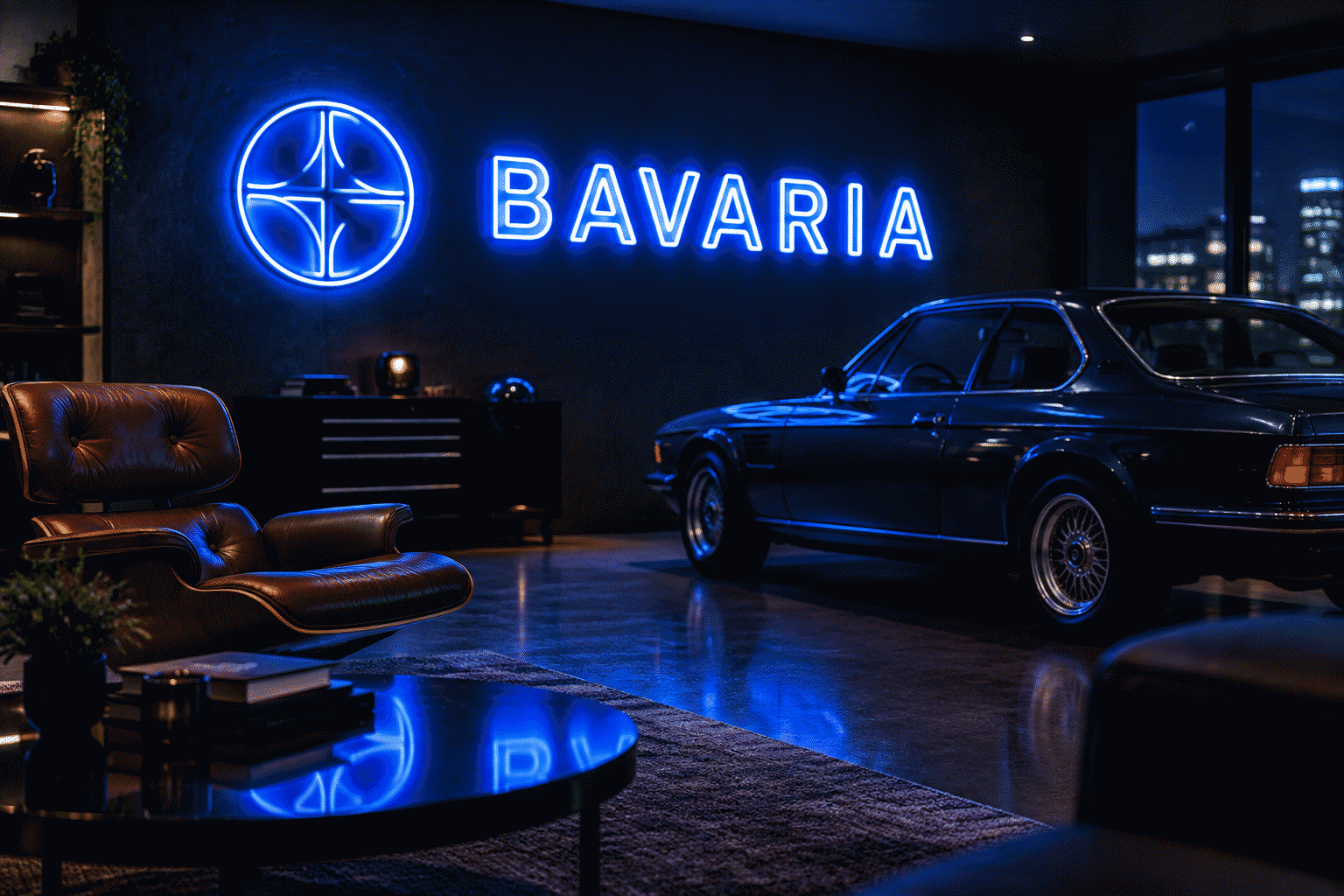
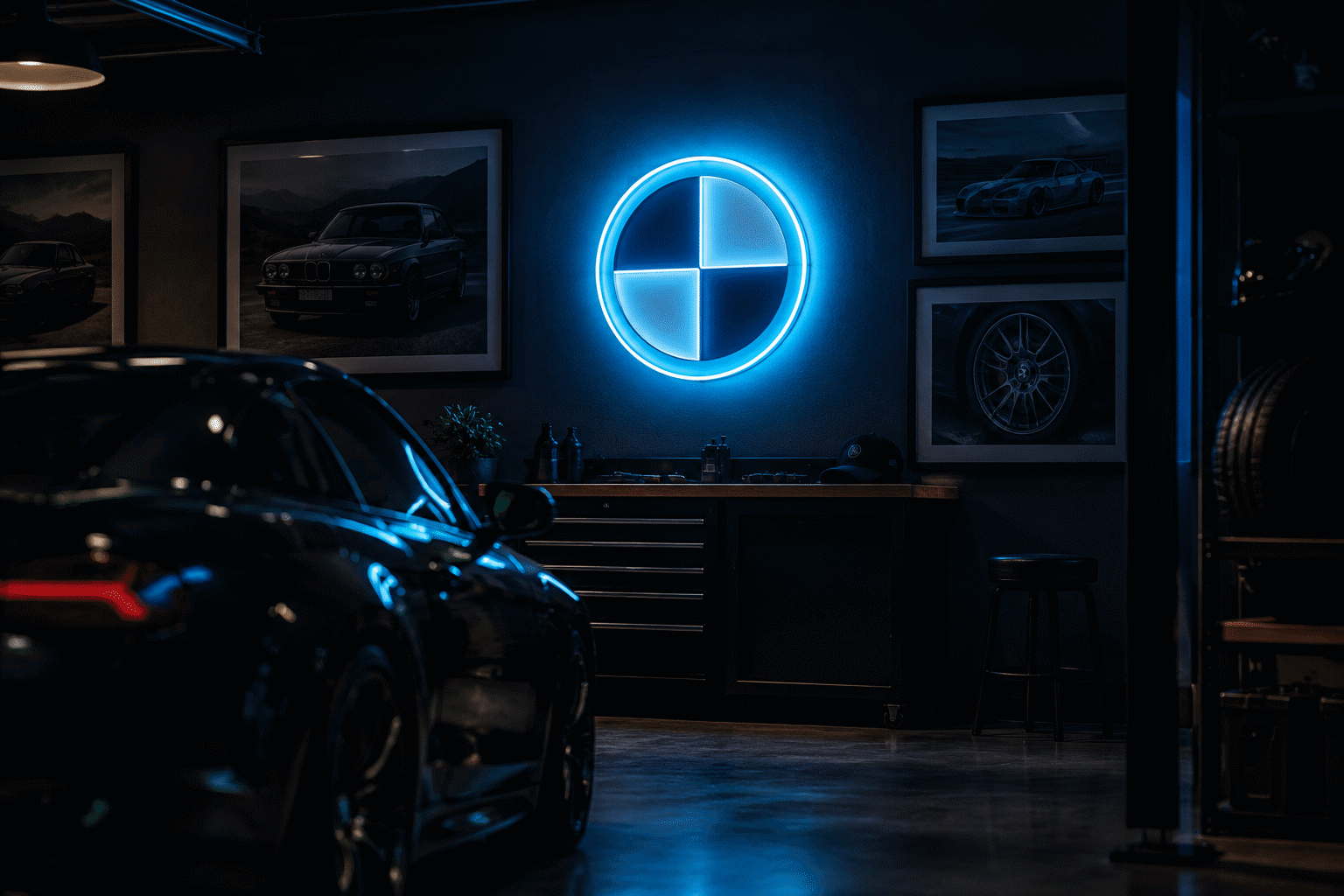
The BMW roundel is the oldest continuously used car logo on earth — registered in 1917, the year after the company’s 1916 founding, and barely changed since. The quartered blue-and-white circle (the Bavarian state flag’s colors, arranged in a rotating circle after the trademark law of the era forbade putting state symbols in commercial marks) has outlived every rival’s redesigns. For the enthusiast wall — the garage, the detail bay, the poster room — the roundel in glow is the German-engineering tier of car decor.
The guide to the BMW wall: the icon, the M-factor, and the fan-styled route.
The Roundel: Why It Glows Right
The logo’s geometry is neon-friendly by design: a circle quartered into alternating blue and white fields, with the ring’s lettering. In glow form:
- Blue-and-white reads instantly. The blue and white families cover both fields — the deep BMW blue against clean white, on dark garage walls.
- The circle renders natively. A roundel is exactly the shape a bent tube makes — no corners, no fine detail.
- A century of continuity. The mark on your wall is the same mark on a 1930s Dixi — the heritage registers of very few brands survive like this.
The M-Factor: The Performance Register
For many enthusiasts, BMW means M — the motorsport division founded in 1972, whose tri-color roundel edge (light blue, dark blue, red) became performance culture’s own flag. The M-styled tier:
- The M tricolor piece — the three-color stripe register, the performance wall’s signature.
- “M Power” registers — the letter-and-power text tier, in the tricolor or single-red accents.
- The M-car silhouettes — the E30, the E46, the E92, the G80 — the generation-you-loved outline, custom territory par excellence.
The BMW Wall’s Habitats
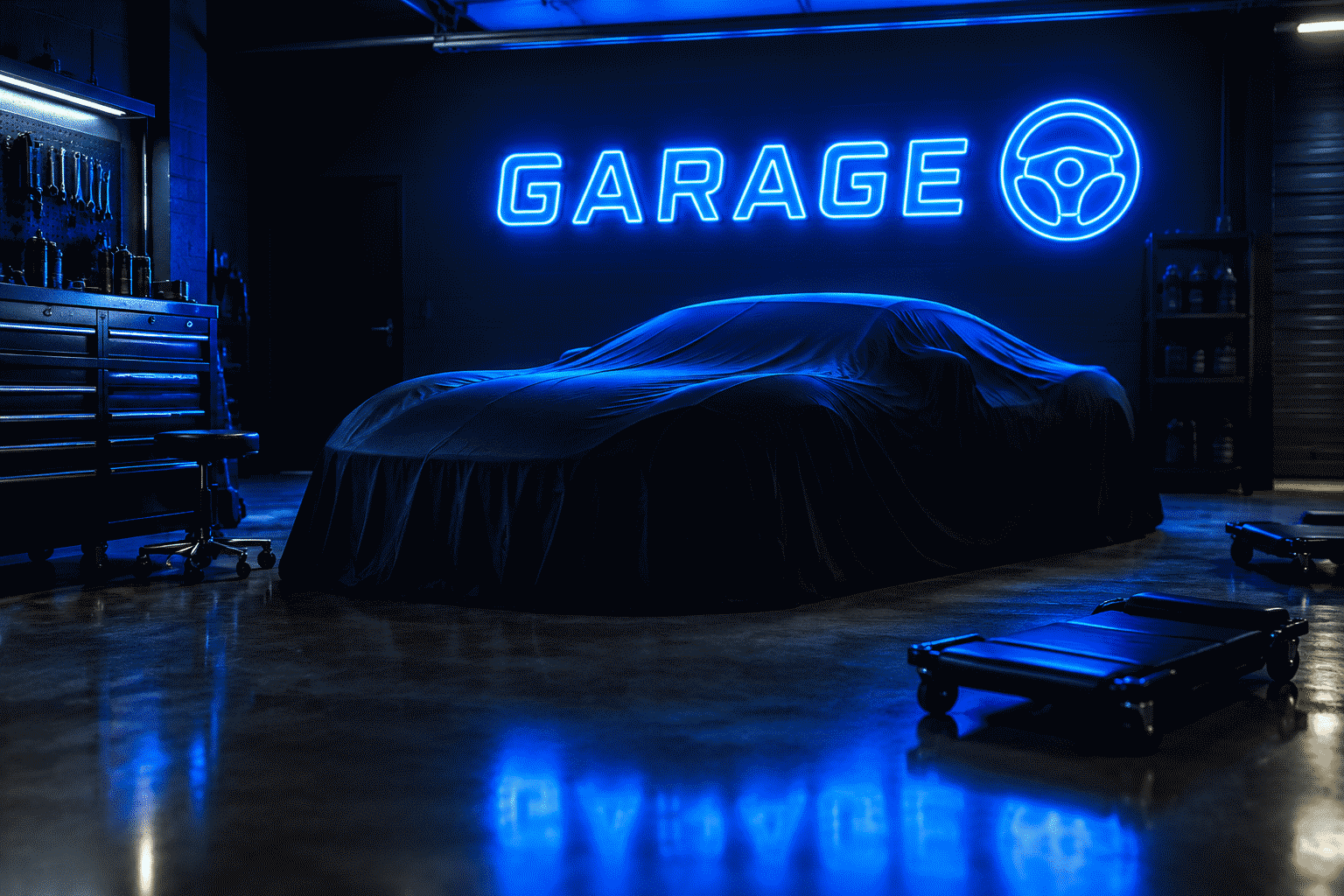
The garage and detail bay. The roundel over the workbench or the lift — the oil-and-torque register. Full architecture in the man cave guide’s garage tier.
The poster room, grown up. The E30-poster wall’s adult version: the roundel plus the generation outline in glow. The 1980s-90s poster era’s cars (the E30 M3 above all) are the nostalgia tier now.
The home office of the engineer. The roundel reads precision — the desk wall’s declaration of the driving-and-engineering personality.
The bimmer-family household. The multi-car garage with the family fleet — the roundel plus the model codes (E, F, G generations) in numerals, the enthusiast’s shorthand wall.
The Honest Trademark Note
The roundel, the M marks, and the model names are BMW’s protected property — enforced professionally. The consistent picture: gray-market pieces circulate; custom builders decline the exact roundel; what builds cleanly is the register — your own garage text (“German Engineering Only,” the garage’s name), original car silhouettes of your own, and the tricolor-accent customs that carry the performance energy without the protected marks. Mock yours in the custom builder — live pricing, blue-white register.
The Build: The Enthusiast’s Playbook
- The anchor: the roundel-styled circle or your garage text at 30+ inches, blue glow on dark walls.
- The generation tier: your car’s silhouette or its chassis code in numerals — the personal register.
- The M-accent: the tricolor stripe or a single red accent element — the performance tier, kept to one piece.
- The discipline: blue-dominant with white accents, one red-accent piece maximum — the roundel’s restraint is the aesthetic.
The Century Timeline: 1916 to the Wall
The marque’s compressed history — the lore the roundel carries:
- 1916-17: the aircraft-engine origins. BMW (Bayerische Motoren Werke) began as an aircraft-engine manufacturer — the roundel’s quartered blue-white officially representing the Bavarian colors (the “spinning propeller” interpretation came later, from advertising, and persists as the popular story). The company’s first decades built engines for planes, motorcycles, then cars.
- The motorcycle lineage (1923-). The R32 and the flat-twin boxer tradition — BMW Motorrad’s century of the horizontally-opposed engine, the connoisseur’s motorcycle register. The bike-tier wall runs its own roundel pieces.
- The pre-war-and-recovery era. The 328 roadster (the thirties’ competition legend), the post-war survival (the Isetta microcar era — the cute counterpoint the marque half-acknowledges), the Neue Klasse sixties sedans that defined the modern brand.
- The 1972 M founding. BMW Motorsport GmbH — the M1 supercar (the late-seventies legend), the E30 M3 (the most-collected BMW ever — the eighties’ touring-car homologation legend), the M lineage to today. The M-tricolor’s origin era.
- The modern era. The E39/E46 golden-age consensus (the peak-BMW decades per the enthusiast canon), the i-series EV tier, the G-chassis present. The wall’s generational shorthand: every enthusiast’s decade has its chassis code.
The Enthusiast’s Wall: The Chassis-Code Culture
The BMW-specific register the roundel anchors — the insider tier:
- The E/F/G generations. The enthusiast’s naming system — the chassis codes (E30, E46, E39, E90, F80, G80) that stand for entire eras of the brand. The custom numerals tier (your chassis code in glow) is the BMW wall’s signature piece — the shorthand that says “you know” to everyone who knows. Mock yours in the custom builder.
- The “sheer driving” register. The Freude am Fahren tier — the driver’s-car identity (the manual-transmission loyalists, the inline-six canon, the wagon cult). The wall that says the machine matters more than the badge’s resale.
- The track-day tier. The motorsport register — the M colors at the track, the HPDE culture, the DE-car garage. The gym-wall logic transfers: the sign over the tools that support the passion.
- The wrenching wall. The DIY-mechanic tier — the roundel over the lift and the tool chest, the garage that works on its own cars. The most authentic BMW wall there is: the badge glowing over the oil changes it inspired.
The German Three: The Wall’s Sibling Architecture
The category’s default comparison — the three-register wall:
- BMW (the driver’s tier). Blue-white roundel — the handling-first identity.
- Mercedes-Benz (the engineering tier). The three-pointed star — the land-sea-air ambition, the comfort-and-engineering identity.
- Audi (the technology tier). The four rings (the Auto Union heritage) — the quattro-and-technology identity.
- The three-register wall: the German-engineering display — all three badges in a row, the collector’s overview. The one-register wall: the loyalist’s choice — and the BMW loyalists are the segment’s most likely to also own a wrench set. The car-logo guide covers the full multi-marque logic; the man cave architecture carries the layout.
The Neue Klasse Note: The Era That Made Modern BMW
The brand’s pivot decade — the connoisseur’s chapter:
- The sixties survival. The near-death-and-recovery era: the late-fifties crisis (the company’s sale-and-rescue drama) followed by the Neue Klasse sedans — the New Class compacts (the fifteen-hundred-through-2002 lineage) that defined the modern brand’s identity: the sports sedan, the driver’s compact, the precision register. Every BMW since descends from the decision.
- The 2002 cult. The Neue Klasse’s sporting tier — the compact that founded the enthusiast canon. The classic-outline custom (the vintage silhouette in white glow) is the vintage-BMW wall’s signature piece.
- The three-letter era. The CSL-and-M lineage (the seventies’ touring cars, the 1972 M founding, the M1’s supercar statement) — the motorsport identity that the tricolor carries.
- The driver’s-car philosophy. The era’s product doctrine — the front-engine-rear-drive balance, the inline-six smoothness, the ultimate-driving-machine positioning (the slogan that ran for decades) — the philosophy the roundel on the wall stands for. The badge IS the doctrine, distilled.
FAQ: BMW Neon Signs
What is a BMW neon sign? A glow piece rendering BMW iconography — the quartered blue-white roundel, the M tricolor registers, or generation silhouettes. The German-engineering tier of the garage and enthusiast wall.
What do the BMW logo’s colors mean? The blue and white are the Bavarian state flag’s colors — arranged in quartered rotation because the trademark law of the 1910s forbade commercial use of state coats of arms. The roundel dates to 1917 and is the longest-continuously-used mark in the auto industry.
Can I buy a BMW roundel neon sign? Gray-market pieces circulate; the marks are actively enforced. Custom builders decline the exact roundel and build the register instead — your own text, original silhouettes, tricolor-accent customs — through the custom builder.
What’s the M tricolor? The motorsport division’s colors — light blue (BMW), dark blue, and red (motorsport, traditionally credited to the Texaco partnership era) — the stripe register of the performance tier.
What colors for a BMW wall? The roundel register: deep blue and clean white on dark walls. The M register adds the tricolor accent — one piece maximum. Shade mechanics on the blue page.
Where does the sign go? Garages, detail bays, the grown-up poster room, the engineer’s office — the man cave guide carries the full architecture.
Glühen the Garage
The oldest logo in cars, the youngest medium on the wall: your roundel-register piece — garage text, generation silhouette, tricolor accent — glowing blue in the custom neon maker tonight. Freude am Fahren, indoors.
What is the difference between the roundel registers in glow?
The blue-white quartering renders two ways: the full-color register (the deep BMW blue against clean white, the faithful version) and the outline register (the circle-and-quartering in a single blue line, the minimalist version). The full-color reads at distance and in photos; the outline reads design-forward on gallery walls. The faithful version’s shade sits in the blue family’s deep end — the color-matching note per the custom builder’s palette.
Sources & Further Reading
- Neon sign (Wikipedia) — the consolidated public record of neon-sign history and technology.