Blog
Guitar Neon Sign Ideas: Walls That Rock
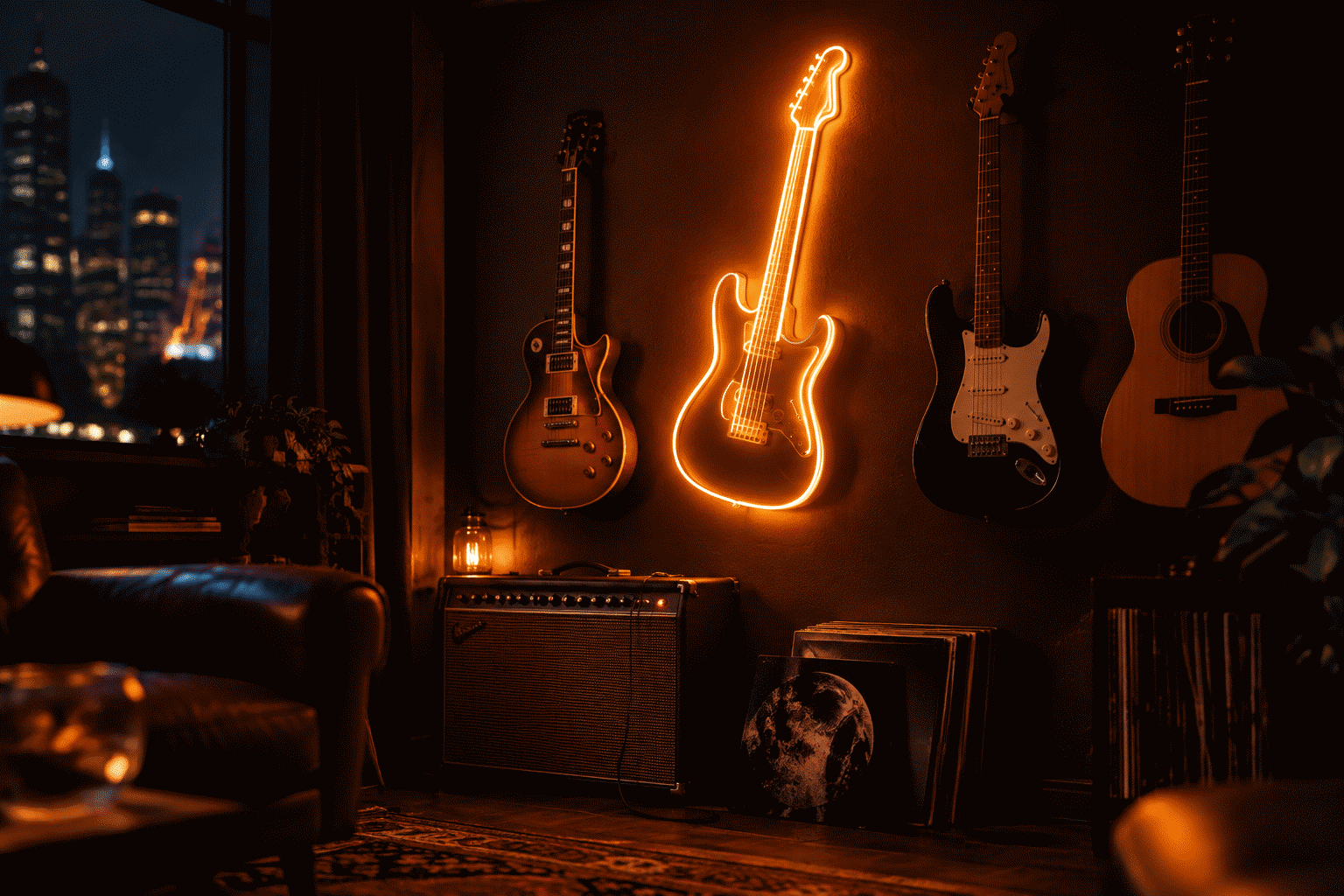
The guitar is the one object that already lives on walls — hung instruments are the classic decor of practice rooms, studios, and bars everywhere. The guitar neon sign is that tradition’s evolution: the wall-hung guitar reduced to its silhouette, in light. It works for the player (the practice-corner talisman), the fan (the rock wall), and the room that just wants the shape’s attitude.
This guide covers the three ways a guitar renders in neon, the three walls it owns, the register’s brand crossovers, and the gift logic — plus the fan-band tiers for the walls that need a name, not just a shape.
Three Ways the Shape Renders
The guitar silhouette in neon comes in three treatments, each with a different personality:
- The single-line outline. The minimalist rendering — one continuous tube tracing the instrument’s iconic profile (the curves are the point; a guitar is recognizable from its waist alone). The cleanest read, the modern choice, the piece that survives any room’s decor. This is neon’s native style: the instrument as line drawing.
- The detail silhouette. The fuller rendering — headstock, strings suggested, pickups, the f-holes on the acoustic variant. More specific, more machine-like; reads best at 24 inches and up where the detail can resolve.
- The flame-and-flying-V register. The attitude tier: the flames lapping the body, the flying-V or explorer silhouette, the hair-metal and hot-rod aesthetic. The loudest version — the piece for the garage-band wall and the man cave’s music corner.
An honest sizing note: guitars are tall, narrow objects, and their neon renders follow — most pieces run 20–32 inches in height on a 14–20 inch width. They want vertical wall slots (beside doorways, between windows, flanking a larger piece) where wide signs fight for room.
The Three Walls
The practice corner (the player’s wall). The setup: the real instruments hung on the wall, the amp in the corner — and the neon guitar above, the corner’s night light and its self-portrait. The single-line outline at 18–24 inches, in the player’s register of choice (the red classic, the ice-blue modern). The practical magic: the glow at 20% is enough light to put the guitar away after a late session without turning on the room.
The fan wall (the listener’s wall). The music den’s tier: the neon guitar beside the vinyl shelf and the concert posters. This wall wants the attitude versions — the flame treatment, the brand crossovers — and it’s where the band-name customs live (the Grateful Dead and Metallica tiers are covered in their own guides; the generic music-wall planning is in our music ideas guide).
The teaching room and the shop (the professional wall). The music store’s window and the teaching studio’s wall — the commercial register. The guitar in the window is the shop’s own icon, the piece that says what’s sold inside. The teaching studio runs it dimmed during lessons — the room’s identity at conversation brightness. Our shop-window planning logic applies: the sign as the store’s face, sized to read from the street.
The bonus tier: the bar and man-cave crossover. The guitar and the beer sign share a wall naturally — the bar-band wall. The Budweiser guitar piece is exactly this crossover: the brand and the instrument in one sign, the register’s classic SKU.
The Register’s Colors
- Red. The rock classic — the stage-light register, the color of the concert’s afterimage. Red guitar glow on a dark wall is the genre’s default image, and it earns it (the full red behavior is in our red sign guide).
- Ice blue and white. The modern-vintage register — the studio look, the piece that reads equipment rather than attitude.
- Amber and warm white. The acoustic and Americana register — the whiskey-bar tier, the warm wall.
- The custom pairing. The two-register build: outline in one hue, flame or detail accents in a second — the custom tier’s signature order (two colors, one shape).

The Custom Tiers
The fan-styled custom route, for the text the shape can’t carry:
- The band-name tier. Your band’s name in the flame register — the garage’s own marquee. The custom builder prices text by width; the flame treatments add a color count.
- “LIVE MUSIC” and the venue phrases. The bar and house-concert tier — the phrase that turns a room into a venue. The man cave layouts cover the wall integration.
- The player’s own tier. The guitar outline with the player’s name across the body, or the est.-year of the first band (“JAMMING SINCE 2009”) — the personal documentation register.
- The song-title tier. One line of the song that started it all — the lyric register, the most-gifted music custom after the band name.
Everything prices live in the custom builder — shape, text, flame count, done.
The Sizes, Honestly
Guitar signs render tall, and the tiers behave differently than wide-format pieces:

| Tier | Size | Price range | The tier is for |
|---|---|---|---|
| Desk and shelf outline | 14-18 in tall | $70-$110 | Desks, studios, gifts |
| The practice-corner standard | 20-26 in tall | $110-$180 | Practice corners, fan walls |
| The detail and flame tier | 26-32 in tall | $180-$260 | The attitude wall, bars |
| Two-color customs | any | $200+ | The one-of-one piece |
Two placement rules that follow from the shape: hang the piece so its center of mass sits at seated eye level (the practice corner is a seated room), and give it a vertical slot with eight inches of clearance above — a guitar silhouette crowded under a ceiling or shelf reads as clipped mid-solo.
The Gift Logic
The guitar sign is the rare gift that works at every relationship depth:
- For the player: the outline piece in their color — the practice-corner upgrade they’d never buy themselves. The $90–$150 tier at 18–24 inches.
- For the teen musician: the flame treatment for the bedroom band cave — the piece that says the hobby is real.
- For the dad with the guitar he never plays anymore: the neon version, hung where the real one used to be. The register’s most touching deployment.
- For the music teacher: the studio piece — the professional tier, warm white or amber.
The December note: music-room pieces run the standard gift calendar — order customs by early December for the holidays.
FAQ: Guitar Neon Signs
What does a guitar neon sign cost? The single-line outline runs $90–$150 at 18–24 inches; detail silhouettes and flame treatments $150–$250; two-color customs above that. Height drives the price — guitars render as tall pieces.
Which guitar design works best for a practice room? The single-line outline at 18–24 inches — the minimalist profile that reads as the instrument itself, dimmable to the 20% night-session tier. Save the flame treatments for the fan wall.
Are there guitar signs that combine brands? The register’s classic crossover is the beer-and-guitar piece — the Budweiser guitar carries it. The bar-band wall runs this tier naturally.
What color guitar sign for a dark room? Red for the rock register — the genre’s own image. Ice blue or white for the modern-studio look, amber for the acoustic-Americana wall. One hue per piece; the two-register builds are the custom tier.
Can I get my band’s name in a guitar neon design? Yes — the custom tier’s bread and butter: the name across the body or above the outline, flame treatments by request, priced live by width and color count in the builder.
Is a guitar neon sign a good gift for a guitar player? Yes — the register’s gift logic runs from the outline piece (the upgrade they would never buy themselves) to the flame treatment for the teen band cave. The safest version: their color, the single-line outline, 18-24 inches — the piece that flatters the hobby without competing with the instrument.
Where does the guitar sign go if my instruments already hang on the wall? Above them — the neon guitar as the wall’s caption, centered over the hung instruments. The practice corner’s complete look: the real wood below, the light above.
The Practice Corner, Assembled
For the player building the corner from zero, the assembly order that works:
- The real instruments first. Wall hangers at standing reach — the working collection, hung where they can actually be taken down and played (a guitar hung too high is a painting, not an instrument).
- The amp and cable tier. The corner’s working furniture; cable discipline from day one — the practice corner lives or dies by its wire run.
- The sign above. The neon guitar centered over the hung instruments, its bottom edge eight to ten inches above the highest hanger — the wall’s caption layer, in the player’s color at the 20-40% evening register.
- The accessory shelf. Picks, capos, the pedal tier below the hangers — the corner’s working surface, kept deliberately lower than the sign line.
The result: a corner that works as an instrument room in daylight and a stage in the evening — which is, in the end, what every practice corner wants to be when it grows up.
Play the Wall
The instrument that hangs on walls anyway, translated to its purest form: the curve, the light, the attitude. Outline or flame, red or ice blue — build yours and hang it where the real one can see it.
More music walls: music room ideas, Grateful Dead tier, Metallica tier, man cave layouts.
Sources & Further Reading
- Neon sign (Wikipedia) — the consolidated public record of neon-sign history and technology.
Pricing based on CustomNeon’s current catalog (2026); custom quotes come live from the sign builder.