15 Smoke Shop Neon Signs for the Trade
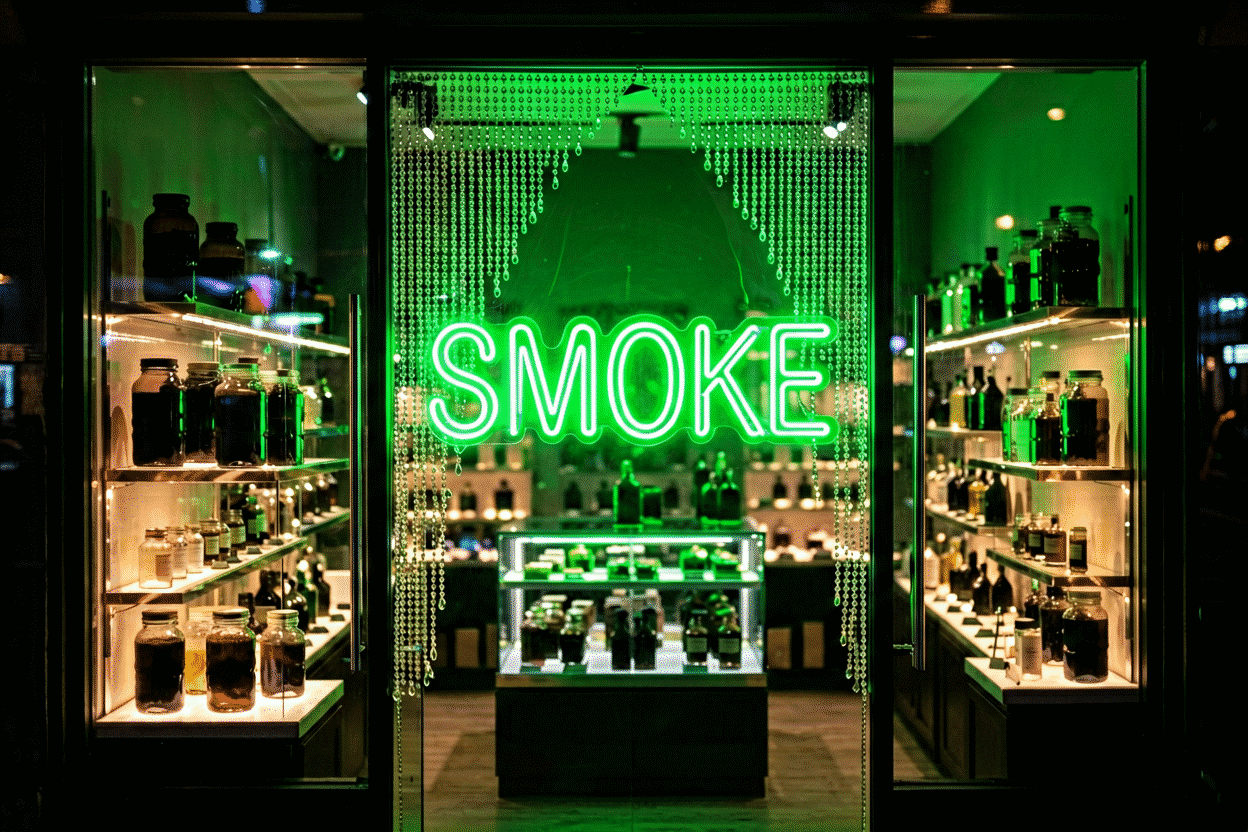
The smoke shop is one of neon’s most dependable trades: the customer base skews young, the purchase is discretionary and visual, and the shop’s glow is often the difference between a walk-by and a walk-in. But the trade carries a regulatory layer most don’t — age-gating rules, local sign codes, and product-class restrictions that vary by state and municipality — so the smoke shop’s sign program pairs the standard playbook with compliance discipline.
Here are 15 ideas by tier, with the trade’s rules noted inline. The C-end counterpart (the home smoke-corner canon) lives at weed neon signs; the standard playbook at small business neon signs.
The Street Tier: Ideas 1–4
- “SMOKE SHOP” in the trade’s bold — the identity piece (the B-end canon): green-and-white the tradition, ice-blue the modern vape register (the color logic).
- The open sign — the status tier every trade runs, with the smoke shop’s late-evening hours making the glow’s after-dark work count double.
- “VAPE • CBD • GLASS” — the offering tier: the category list that pre-qualifies the customer from the sidewalk — the format that answers the door’s question before it’s asked.
- “OPEN LATE” — the hours-tier: the smoke shop’s evening trade is the trade — the sign that wins it.
The Trade-Icon Tier: Ideas 5–8
- The leaf icon — the seven-point shorthand (the C-end canon for the register’s palette): legibility and legal context both checked locally — the piece that’s a trade standard in legalized states and a compliance question elsewhere.
- The glass piece — the pipe-or-bottle silhouette: the category shorthand without the botanical specificity — the conservative register for the mixed-regulation markets.
- The smoke-wisps piece — the abstract curl: the category tier’s most regulation-proof icon — the suggestion without the substance.
- The vape-cloud register — the modern tier’s iconography: the vape trade’s own visual language, distinct from the legacy botanicals.
The Compliance Tier: Ideas 9–11
The trade’s real layer: the rules that shape every piece.

- The age-gate piece — “21+ / ID READY”: the functional tier that does the door’s work — the sign that reads as professionalism rather than friction.
- The regulation-aware palette — the coded registers where the explicit icons are restricted (the C-end logic‘s coded tier): “BOTANICAL,” “WELLNESS,” the apothecary script — the vocabulary that works within the lines.
- The code-check discipline — the municipal sign-code call before the mount (the B-end logic): smoke shops face above-average sign regulation (product-class rules stacked on standard code) — the ten-minute call is the trade’s cheapest insurance.
The Interior & Content Tier: Ideas 12–15
- The product-wall glow — the shelving’s accent light (the merchandising logic): the glass cases and display walls that sell by looking premium — the tier that photographs.
- The brand piece — the shop’s own name and logo (preview): the identity tier that builds the regulars’ landmark (“the neon shop on the corner”).
- The trade-humor tier — “HIGH QUALITY” / “BLAZE IT”: the register the customer base quotes and posts — the content tier, run within the compliance line (the case).
- The loyalty-and-events tier — the deal-day glow (“HAPPY HOUR 4:20”): the calendar tier that moves the slow afternoons.
The Compliance Map: What Changes Where
The smoke shop’s sign rules vary by jurisdiction, and the variations matter enough to map. The product-class rules (the icon restrictions – the botanicals that some states’ sign codes treat like product advertising, with size and placement limits; the coded registers that evolved as the industry’s workaround – the coded tier). The age-gate rules (the 21+ signage requirements – the states’ specific language and placement mandates, the compliance tier that’s also the door’s professionalism). The municipal sign codes (the standard tier – area caps, brightness, animation – stacked on the product-class layer, the permit logic). The dispensary’s additional layer (the state licensing’s signage rules – the product claims, the medical statements, the format restrictions that the dispensary tier carries and the traditional smoke shop doesn’t).

The map’s use: the ten-minute call to the city (and the state’s licensing board, for the dispensary tier) before the purchase – the compliance verification that precedes the creative tier everywhere, but doubly here (the B-end logic). The coded palette (the apothecary script, the “BOTANICAL” registers) exists precisely for the jurisdictions where the explicit icons don’t clear – the industry’s own compliance-grade creative tier.
The Trade’s Program
The smoke shop’s working program: the street trio first (the identity, the open sign, the offering list – $200-500, the walk-in conversion); the compliance pair second (the age-gate piece, the regulation-aware palette – the professionalism tier that reads as maturity to the customer and as diligence to the inspector); the interior glow third (the product-wall accent, the brand piece – the premium-shelf merchandising that the discretionary purchase runs on (the merchandising logic)).
The program’s honest note: the smoke shop’s customer base skews young and posts heavily – the content tier (the case) runs as strong here as in any trade, and the photographed case-wall is the shop’s best marketing at every budget (the trade-specific pieces above).
The budget lands $400–800 for the working program (the playbook) — repaid in walk-ins and the photographed case-wall.
FAQ About Smoke Shop Neon Signs
What’s the best neon sign for a smoke shop? The “SMOKE SHOP” identity piece plus the offering list (“VAPE • CBD • GLASS”) — the street tier that pre-qualifies the walk-in (the canon). The open sign and “OPEN LATE” for the evening trade.
Are smoke shop neon signs legal? The sign is; the specifics vary — product-class icon rules, age-gating requirements, and municipal sign codes stack on this trade more than most (the compliance tier). The city call precedes the mount; the coded palette covers the restricted registers.
What colors work for smoke shops? Green-and-white the tradition, ice-blue the vape-modern (the trade logic); the coded registers run warm amber and apothecary script where the explicit icons don’t clear (the C-end palette).
Do dispensary signs differ from smoke shop signs? By regulation more than register: dispensaries carry state-specific signage rules (product claims, icon restrictions) that the traditional smoke shop doesn’t — the same playbook, the compliance tier tuned to the state (the tier above).
What neon sign does a smoke shop need? The street trio: the “SMOKE SHOP” identity in the trade’s bold, the open sign for the late-evening conversion, and the offering list (“VAPE – CBD – GLASS”) that pre-qualifies the walk-by (the trade playbook above). The compliance pair (the age-gate piece, the regulation-aware palette) runs the professionalism tier; the interior glow (the product-wall accent) runs the premium-shelf merchandising the discretionary purchase demands. The trio-plus-pair lands $400-800 and covers the trade’s street, discipline, and shelf.
How much does a smoke shop neon program cost? The street trio (the identity, the open sign, the offering list) plus the compliance pair (the age gate, the coded palette) lands $400-800 (the trade program above); the interior glow (the product-wall accent, the brand piece) adds by the merchandising ambition. The trade’s content returns run strong (the case): the customer base photographs heavily, and the glowing case-wall is the shop’s best marketing at every budget tier.
What color neon sign for a smoke shop? Green-and-white (the tradition) or ice blue (the vape-modern) – the trade’s two leading registers (the trade palette above): the green serving the legacy botanicals’ vocabulary, the blue serving the modern hardware’s. The coded registers (the amber apothecary, the warm “Botanical”) run the restricted jurisdictions’ palettes – the vocabulary that clears where the explicit icons don’t. The compliance-colored decision: the jurisdiction’s rules (the ten-minute call) before the palette’s preference – the color that reads right and clears right is the color that glows right, and the trade’s two traditions both work when the code agrees (the compliance map above).
How do smoke shop signs differ between recreational and medical states? Recreational markets run the coded-mainstream register (“WELLNESS,” botanical outlines) that banks landlords and ad platforms all approve; medical markets add the pharmacy register — green crosses, “RX” marks, certification numbers that some states literally require on exterior signage. The trap is importing a look across state lines: the palette and claims that read compliant in one regime can be a violation one state over, which is why multi-state operators keep a sign program per state, not per brand.
What’s the signage risk when a shop adds vape or CBD lines? Product-class rules, not sign codes, become the binding constraint: several states treat vape and hemp signage differently from glass and accessories, with restrictions on product imagery, health claims, and even the word choices on exterior pieces. The safe architecture separates the shop’s identity sign (permanent, product-neutral) from the product-line signs (swappable panels for the regulated tiers), so a rule change costs a panel, not the storefront.
The Compliance Comparison: Explicit vs Coded Registers
The smoke shop’s two display registers, side by side:
| Decision axis | The explicit register | The coded register |
|---|---|---|
| The icons | The leaf, the “420,” the Bud Bar | The outline, “Botanical Society,” the apothecary |
| Where it clears | The legalized states, the friendly codes | Everywhere the explicit tier doesn’t |
| The read | The trade’s full statement | The connoisseur’s subtlety |
| The risk profile | The jurisdiction-dependent review | The plausible-deniability default |
| The customer signal | Loud-and-proud welcome | The knowing-nod welcome |
| The budget | The same brackets at both tiers | The same brackets at both tiers |
The two registers’ division of labor: the explicit tier serves the markets where it clears (the legalized states’ shops running the full vocabulary) and the coded tier serves everywhere the review lands harder – the industry’s oldest tradition, still doing its work (the coded logic above).
The register decision’s inputs: the jurisdiction’s rules (the ten-minute call – the compliance map above), the block’s tolerance (the strip-mall versus the high-street reading), and the owner’s own register (the shop’s voice, said the way the owner says it). The tier that matches all three is the tier that glows right – and both tiers, run well, read professional at the same brackets (the cost logic).
Sources & Further Reading
- Mercury (U.S. EPA) — federal guidance on mercury exposure and safe handling.
- Neon sign (Wikipedia) — the consolidated public record of neon-sign history and technology.
Pricing based on CustomNeon’s current catalog (2026); custom quotes come live from the sign builder.