Food Truck Neon Signs: Glow on Wheels
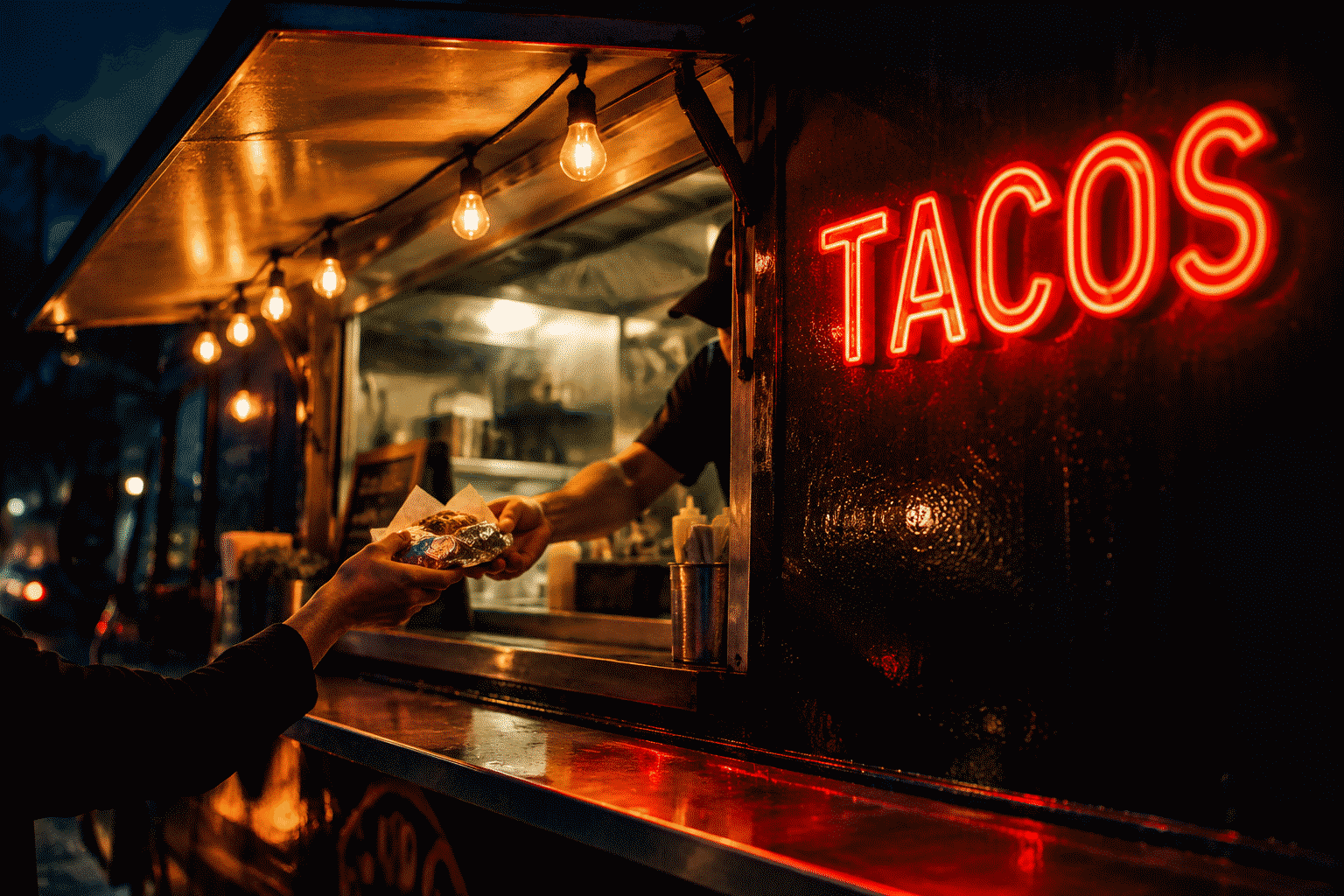
A food truck is the only restaurant whose sign travels with the kitchen — and the only one whose customers decide from fifty feet away, at night, in a row of competitors doing the same thing. The truck rally at dusk is a sign war: every vehicle lit as hard as its generator allows, because the truck that glows warmest at 8 p.m. eats best at 9. Neon — LED neon, with its low draw and dimmer — is the food truck’s most efficient weapon in that war.
This guide covers the rolling glow: why trucks need glow more than buildings do, the five constraints mobile operation adds, the three-piece truck kit, the power engineering (12V, battery banks, the dimmer as fuel gauge), and the custom route. The short version for the owner already parked at a rally: the name piece in red at the window top, the short-menu build beneath, the warm strip under the awning – a 40-watt kit that wins the row.
Why Trucks Need Glow More Than Buildings
The economics are structural:
- No fixed address. A restaurant’s sign works 24/7 at one location; a truck’s sign works only when the truck does — and the truck’s location changes daily. Every setup is a new first impression, which means the sign has to win the crowd cold, every time, with no street memory to help.
- The rally problem. Food trucks cluster — rallies, breweries, festivals, night markets — by design, which means the competition is parked thirty feet away, every time. In a row of trucks, the difference between the queue and the empty window is largely the difference between the truck that reads warmly at distance and the one that reads as a white box with a menu.
- The evening business. The truck economy peaks after 5 p.m. — the brewery slot, the night market, the concert-adjacent lot. The format’s best hours are exactly the hours glow matters.
- The social-media math. The truck’s sign is in every photo: the customer’s taco shot frames the menu board, the line’s overflow frames the brand piece. A photogenic glow is free marketing in a way no stationary restaurant’s sign manages.
The Five Mobile Constraints
LED neon on a truck is not the same install as on a wall — five constraints define the whole category:
- Power. The truck’s electrical budget is fixed: the generator or battery bank runs the fridge, the fryer, the POS. LED neon’s single-digit-to-low-double-digit wattage is the entire reason the category works — a 40-watt brand piece is a rounding error; the glass-neon equivalent (with its transformer draw and fragility) never made sense on wheels.
- Weather and vibration. The piece lives behind the service window or under an awning — the semi-protected zone. Rain-driving wind and 60-mph highway vibration are the design enemies: the rigid acrylic-backed LED build handles both; flexible-strip builds handle vibration better than rigidity suggests but want the covered mount.
- The open-close cycle. The window opens, the awning deploys, the sign goes live — the daily setup ritual. The sign’s mounting wants tool-free or one-tool operation (the magnetic and hook mounts), because the piece that slows the line setup gets unplugged within a month.
- Regulation. County health and sign codes apply to mobile units too, and some jurisdictions cap exterior light output. The dimmer is the compliance tool: full for the rally, the compliant register for the regulated lot.
- The brand-portability question. Trucks rebrand — the menu changes, the concept pivots, the partnership wraps the vehicle. The sign that reads “TACOS” in red survives every concept pivot in the genre; the sign with the full menu board needs the changeable tier (below).
The Three-Piece Truck Kit
The working truck’s glow system, in assembly order:

- The brand piece. The truck’s name — the top of the service window or the awning’s leading edge, the piece that reads at fifty feet. Script if the brand is friendly, block if the brand is bold; 24–40 inches; the truck’s one anchor color (the red register dominates the genre for appetite reasons — the full color logic is in our restaurant guide).
- The menu board. The order-point piece — the illuminated menu frame or the “ORDER HERE” marker above the window. The changeable-menu problem is real (prices move, items rotate); the working solutions are the LED menu frame (the sign lights the board, the board holds the changeable inserts) and the two-tier build (fixed neon header + changeable lower panel).
- The atmosphere strip. The under-awning or interior-window strip — the warm glow that makes the service window read as hospitality rather than machinery. The cheapest piece and the one the photos love: the strip that puts the golden light on the food itself.
The Power Engineering
The truck’s DC world, in practical terms:
- 12V is the native tongue. Trucks run 12-volt DC systems; the LED neon world sells both 12V-native and adapter-driven pieces. The 12V-native build (or a quality converter at the distribution point) is the clean install — no inverter hum, no vampire draw.
- The battery-bank era. The lithium-bank trucks (the generator-free setups) changed the math again: every watt is now visibly banked, and the sign’s 20-40 watts is budgeted like everything else — which LED neon wins and glass neon never could.
- The dimmer as fuel gauge. The dimmer isn’t just mood on a truck — it’s runtime. The piece dimmed to 60% at the two-hour mark of a four-hour rally is fuel in the bank for the fryer.
- The wiring discipline. The truck’s service window is a wet zone by regulation and by physics; the sign’s wiring runs the dry-side route, grommeted at every pass-through. The mobile wiring standard is higher than the wall standard — the truck shakes for a living.
The Custom Route
The truck-tier customs, all built for the road:

- The name piece at 12V — the brand in any font, sized to the window or awning, live-priced in the custom builder.
- The short-menu build. “TACOS” / “BIRRIA” / “ELotes” — the three-word menu that doesn’t change, in neon, with the changeable board beneath for everything else. The truck genre’s most-ordered custom.
- The OPEN-and-social pair. The “OPEN” marker (the open sign guide covers the format) plus the handle piece — the truck’s social handle in small neon at the order point, the piece that converts the queue to followers.
- The wrap-integration tier. The sign designed into the vehicle wrap — the glow element the wrap art frames. The highest-effort tier and the one the rally crowds photograph.
Two more stops for the street kitchen: our are neon signs a fire hazard walkthrough covers the inspection question every food-truck build eventually faces, and the neon sign cost guide prices the full menu-board budget.
FAQ: Food Truck Neon Signs
Can a food truck run a neon sign? Yes – the LED neon category made it practical: single-digit-to-40-watt draw on the truck’s 12V or battery system, rigid builds that handle road vibration, covered mounting behind the service window. Glass neon never made sense on wheels; LED neon was practically invented for them.
How much power does a neon sign use on a truck? A brand piece runs 20-40 watts – a rounding error against the fridge and fryer, and a visible line-item on the battery-bank trucks. The dimmer doubles as a fuel gauge: dim at hour two, and the bank carries the fryer home.
What should the truck’s neon sign say? The name (the fifty-foot read) and the short menu that never changes – TACOS, BIRRIA, the three words of the genre – in neon, with the changeable board beneath for everything else. The full menu in neon is a rebrand waiting to hurt.
How do you mount a neon sign on a food truck? Behind the service window or on the awning’s leading edge – the semi-protected zone – with magnetic or one-tool mounts that survive the daily setup cycle. The wiring runs the dry-side route, grommeted at every pass: the truck shakes for a living, and the mobile wiring standard is higher than the wall standard.
How much does a food truck neon sign cost? Name pieces run $120-$250 by width; the short-menu builds $150-$300; the under-awning strip under $100. The full three-piece kit – name, menu tier, strip – assembles for $300-$550 and pays for itself in rally queues.
Do food trucks need sign permits? Sometimes – county codes apply to mobile units, and some jurisdictions cap exterior light. The dimmer is the compliance tool: the same piece runs full at the brewery rally and the compliant register at the regulated lot. Check the county before the install.
Roll the Glow
The kitchen that advertises itself, the sign that travels with the stove. Name, menu, and the golden strip on the food — build the kit and win the rally at dusk.
More commercial glow: restaurant signs, the open format, sizing guide.
Sources & Further Reading
- Solid-State Lighting (U.S. Department of Energy) — DOE reference on LED efficacy and lifetime.
- Neon sign (Wikipedia) — the consolidated public record of neon-sign history and technology.
Pricing based on CustomNeon’s current catalog (2026); custom quotes come live from the sign builder.