Blog
Witchy Room Decor: Moody Glow for the Modern Coven
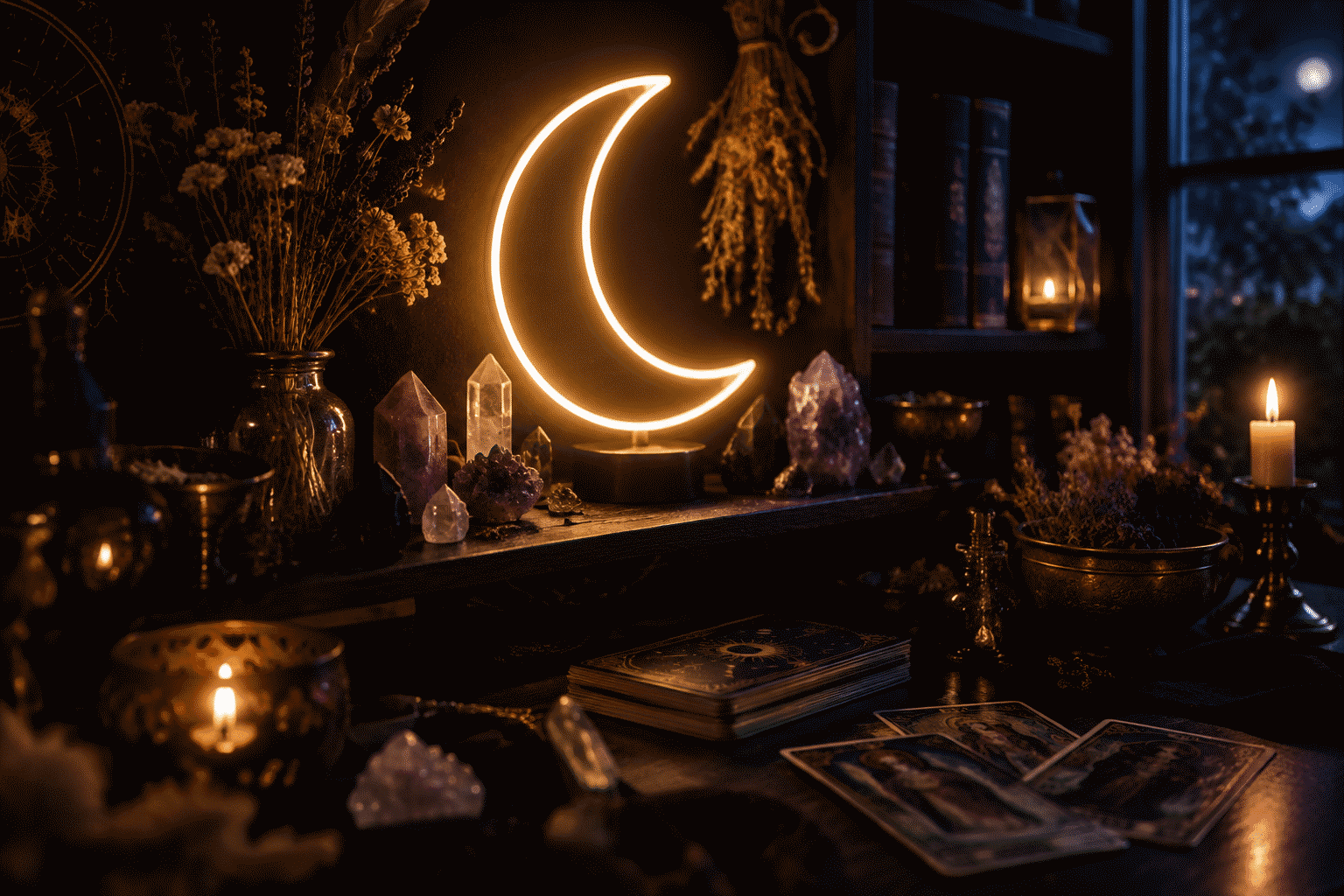
Witchy decor is the rare aesthetic that knows exactly what it is: a room designed for evening. Dark walls, natural materials, candles, crystals, and one unmistakable rule — nothing fluorescent, nothing cheerful by force. The style runs on atmosphere, and atmosphere runs on light.
That is the exact spot where a neon piece belongs in the witchy room. The misconception is that neon is cheerful — but cheerfulness was never in the tube, it was in the color and the font. A crescent moon in spectral violet, a starfield in ice blue, an eye in deep green: neon renders the witchy iconography better than any other medium, because it is light that looks like it arrived on its own. This guide builds the witchy room around that glow — the palette, the symbols, the layout, and the difference between a room that reads “witchy” and one that reads “halloween store.”
The Three Pillars of a Witchy Room
Every good witchcore space stands on the same three supports:
- The dark base. Deep paint (charcoal, aubergine, forest) or dark textiles if the walls must stay neutral. The base’s job is to make light meaningful — glow needs somewhere dark to land.
- The natural layer. Wood, dried botanicals, crystals, ceramic, bone-white candles. The material honesty that keeps the room mystical rather than costume-y.
- The luminous symbols. The icon set that declares the register: moon phases, stars, eyes, hands, snakes, celestial charts. Historically this layer was candles and string lights. Neon is its upgrade — symbol and light source in one object, with none of the candle’s supervision.
A room with only pillars one and two reads “rustic.” A room with all three reads “witchy.” The neon piece is the fastest possible route to pillar three, because the medium itself does the declaring.
The Icon Set: What Glows on a Witchy Wall
The witchy catalog in neon, strongest first:
The moon. The register’s anchor symbol — crescent, full, or the eight-phase lunar cycle strip. A crescent in violet over the bed is the single most coherent witchy statement a wall can make; the moon’s own lighting schedule is the whole aesthetic. The full lunar treatment (phases, colors, placement by bedroom zone) is our moon sign guide.
Stars and constellations. A single star, a scatter, or an accurate constellation run. The celestial chart register — pairs with the moon at one scale tier down. See the star sign ideas page for the full set.
The eye. The mystic’s symbol — the eye in deep green or violet, the one piece in the catalog that looks back. Smaller than the moon tier, made for the reading corner or the altar wall; the eye sign guide covers its placements.
The hand and the serpent. Hamsa-style hands, snake coils, tarot-inspired borders — the custom tier of the icon set. These render beautifully in single-color neon (the line-art medium suits them exactly) and carry the room into one-of-one territory.
The word. “Blessed,” “Manifest,” “Selenite & Salt” — the witchy text canon is short, lowercase, and in script. One rule: the word should be a practice or a state, never a brand of mysticism. Lowercase script keeps it spell, not sign.
The Palette: Two Tracks and One Warning
Violet — the ceremonial register. The witchy default, and the right one: violet glow on a dark wall reads as moonlight with intent. Deep purple rather than bright; the shade’s full behavior is in our purple sign guide.
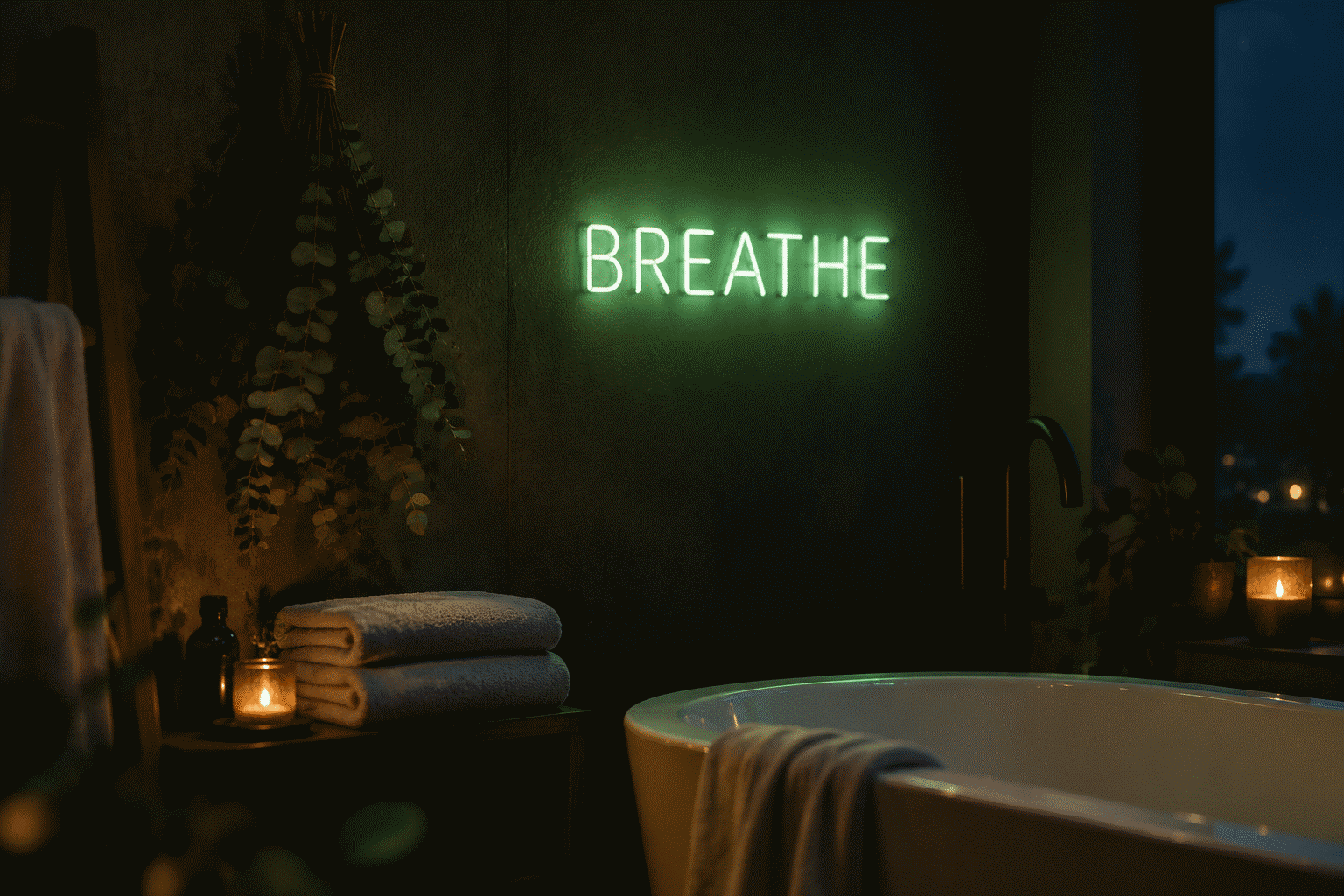
Green — the hedge register. Deep forest green — the herbalist’s track. Green glow among plants and wood reads as the room’s own undergrowth; the shade logic lives in the green sign guide.
The warning track: orange and green together. The purple room reads witch; the orange-and-green room reads October. Orange is not banned — it is seasonal, and its season is explicit. The Halloween guide is orange’s native habitat; the year-round witchy room keeps to the cool registers and borrows orange only for the weeks it means it.
The pairing law for both tracks: one glow color per room. A violet moon and a green eye in one space splits the spell — the icons agree, the light argues.
The Layout: Where the Glow Lives
The bed wall (the altar tier). The moon over the headboard, alone or with a starfield secondary — the room’s ceremonial center. The general bed-wall mechanics (heights, dimmer habits) are in our bedroom guide; the witchy variant runs the moon at 20–40% output, the register where the glow reads as lunar rather than electrical.
The reading corner. The eye or the hand symbol at chair height, beside the bookshelf and the candle tier — the corner where the room does its actual work. Small scale, deep green.
The altar or shelf wall. The crystal and tarot shelf with a constellation strip running above it — the display tier. This is the room’s one place for a multi-element layout: icons at different scales along the shelf line.
The doorway. The underused register: a small symbol above the door frame — the threshold ward, as the aesthetic would have it. The accent tier that makes the room feel composed rather than decorated.
Building It: The Custom Route
Most of the witchy icon set is custom territory — the symbols render from line art, which is what custom neon builders do best. The custom builder takes a moon phase strip, a constellation, or a hamsa at any width; the pricing runs on width and color count, and the two-color builds (violet moon, green stars) are the register’s most-ordered custom effect.

The honest sizing note: witchy pieces run smaller than mainstream decor — the aesthetic is intimate, not billboard. A 14–20 inch moon over the bed, a 10–14 inch eye in the corner: the glow should feel discovered, not installed.
The Wheel of the Year: A Room That Turns With the Seasons
The witchy register is the one aesthetic with a built-in calendar, and the glow can follow it:
- The dark half (October through March). The room at full witch: moon and eye pieces at their deepest settings, dried botanicals, the candle tier at maximum. The months the aesthetic was designed for.
- The growing half (April through September). The same room, lightened: the green register takes over from the violet, fresh plants replace the dried tier, the symbols stay and the palette rotates. The room that only works in October is a costume; the room that turns with the year is a practice.
- The four spikes. The solstices and equinoxes — the calendar’s own holidays, when the moon piece moves or the altar tier gets rearranged. The room’s participation costs nothing and keeps it alive.
The decor implication: choose the anchor pieces (moon, eye, star) for year-round service, and let the perishable layer (botanicals, seasonal accents) do the turning. The neon tier never needs replacing — which is exactly why it anchors the style.
FAQ: Witchy Room Decor
What makes a room witchy rather than just dark? Three pillars: the dark base, the natural layer (wood, crystals, botanicals), and luminous symbols that declare the register. Dark walls alone are moody; the icon layer is what makes it witchy.
What color neon for a witchy room? Violet for the ceremonial register, deep green for the herbalist track — one glow color per room. Orange is the October exception; run it seasonally and the room stays a coven year-round.
What symbols work best in neon? The moon (the anchor), stars and constellations (the secondary), the eye (the reading corner), hands and serpents (the custom tier). Line-art symbols are neon’s native style — the medium was made for single-stroke icons.
Is witchy decor just Halloween decor? No — and the difference is the color discipline. Halloween runs orange and green at full saturation; the year-round witchy room runs cool violet and green at low brightness. Same icons, different liturgy.
What plants fit the witchy room? The register’s own catalog: moon cactus and snake plant (the low-water survivors that forgive a dark room), pothos and ivy (the trailing tier for shelf edges), lavender and rosemary (the dried botanicals that double as scent). The green layer should look gathered rather than gardened.
How do I light a witchy room without candles everywhere? The neon symbol tier: the moon or eye piece at 20–40% output replaces the candle grid’s ambient role (keep one or two real flames for ritual, not for light). The bedroom guide covers the dimmer habits.
Where does the moon sign go in a witchy bedroom? Over the headboard, centered, at 14–20 inches for most rooms — the ceremonial anchor position. The full phase-strip layouts and placement zones are in the moon guide.
Light the Circle
The witchy room was always a lighting design problem — symbols, dark base, glow that feels sent rather than switched. Pick the icon, pick the track (violet or green), and build the piece — the modern coven’s hearth, one tube at a time.
More by mood: moon signs, star signs, the eye register, Halloween season.
Sources & Further Reading
- Neon: Strong Lines (NIST Physical Reference Data) — the standard reference for neon’s emission wavelengths.
- Neon sign (Wikipedia) — the consolidated public record of neon-sign history and technology.