Blog
One Piece Neon Sign: The Pirate Wall Guide
Twenty-five years of sailing made One Piece the best-selling manga in history — and made its iconography some of the most wall-worthy in anime: the straw hat, the skull-and-crossbones with its unmistakable grin, the crew’s jolly roger. The designs read instantly to a fandom that spans continents and generations, and in neon they do what pirate flags always did: mark the territory.
This is the One Piece canon — the icons, the formats, and the room logic. The wider collection at anime neon signs; our One Piece build carries the shop tier.
The Icons
The straw hat — the protagonist’s hat, alone: the fandom’s purest icon — a simple dome-and-brim that means the whole voyage to anyone who knows it (the shop build runs the register).
The Jolly Roger — the crew’s skull-and-hat flag: the pirate-mark that defines the story — the icon that reads as both anime and classic piracy, the crossover piece that works even on walls that don’t run fandom.
The character commissions — the captain’s grin, the crew’s silhouettes: the figure tier, custom-built (preview) — the pieces that carry the specific devotion.
The gear-and-form tier — the transformed registers, the iconic poses: the era pieces — the tiers that date themselves to the arc the household lived through.
The phrase tier — the voyage’s lines (“I’m gonna be King of the Pirates”): the quote pieces — the declaration wall’s register (the quote logic).
The Formats
The icon tier — the hat and jolly roger at 18–30 inches: the entry pieces, the flags of the territory (the gaming-corner logic).
The map-and-voyage customs — the Grand Line’s map, the wanted-poster treatment: the commission tier’s storytelling formats — the pieces that carry the voyage rather than a moment (preview).
The wanted-poster piece — the bounty poster rendered in glow: the story’s most iconic in-world object, wall-mounted — the format the fandom photographs hardest.
The Room Logic
The One Piece wall runs the anime-room system with this fandom’s specifics: the adventure palette (the story runs warm blues, reds, and straw-golds — the maritime register that works in bedrooms and gaming rooms equally), the flag placement (the jolly roger belongs at the door or the wall’s crown — the territory-marking logic the pirate flag carries), and the multi-shrine crossover (the deep anime households run the Naruto and Dragon Ball walls beside it — the Big Three rooms, each with its anchor icon).
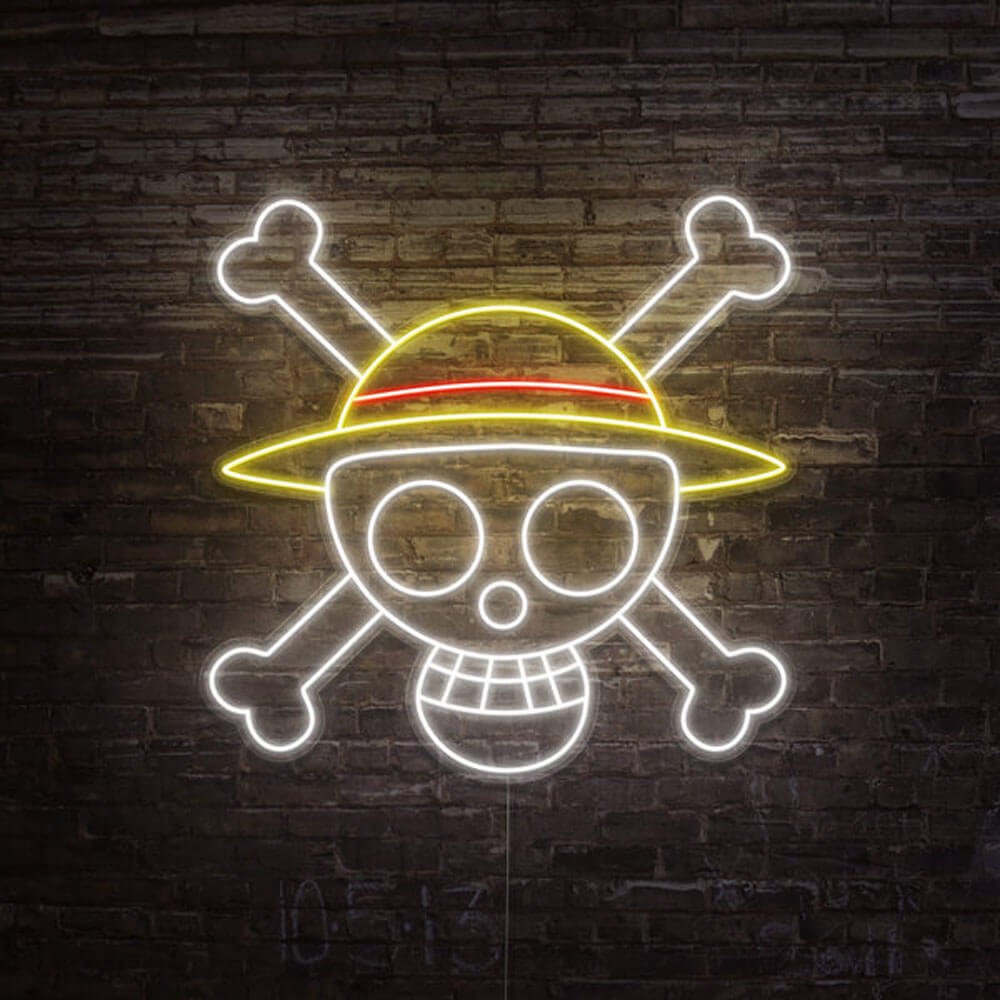
The gaming crossover carries the game-era households; the hanging logic covers the mounting.
The Gift Logic
The One Piece gift tier runs the anime canon‘s widest international span: the straw hat icon for every tier (the icon that can’t miss), the wanted-poster piece for the mid-deep fan, the commission for the one who’s caught up (the gift logic). The fandom’s quarter-century means the gift lands across ages 10 to 45 — the widest span in the anime category.
The Voyage Wall: The Canon’s Compositions
The One Piece wall composes around its icons, and the voyage’s length gives it range. The flag wall: the Jolly Roger as the anchor (the crew’s mark – the territory’s flag), the straw hat flanking – the canon’s essence in two pieces (the shop build runs the register). The wanted-poster wall: the bounty pieces as the composition (the crew’s posters in their tiers – the captain’s at center, the crew’s descending) – the story’s own iconography as the wall’s structure, the format the fandom photographs hardest. The voyage wall: the map commission and the island markers – the story’s geography as the room’s decoration, the long-reader’s wall (preview).

The compositions’ shared physics: the maritime palette (the warm blues, the straw golds, the red accents) reads in bedrooms and gaming rooms equally – the story’s own colors, working (the palette logic). The flag’s placement tradition (the door or the wall’s crown – the territory-marking logic the pirate flag carries) gives the Jolly Roger its specific mount (the placement logic).
The Fandom’s Span and the Gift Tiers
The One Piece fandom’s quarter-century spans the widest age range in anime – the readers who started in 1999, the streamers discovering it now, the international tiers (the fandom’s strongest markets) – and the gift logic spans them: the hat icon (the tier that can’t miss – every generation, every market, every devotion depth), the wanted-poster piece (the mid-deep fan’s commission – the format that means the fandom’s fluency), the arc-specific customs (the deep reader’s commission – the moment, the reveal, the chapter that ended them). The three tiers at $60-100, $150-300, and $200-450 (the brackets) cover the whole quarter-century fandom (the anime canon).
The multi-shrine wall (the Big Three compositions – Naruto and Dragon Ball beside it) runs one anchor icon per fandom, the palette-disciplined composition that keeps three fandoms reading one wall (the display logic).
FAQ About One Piece Neon Signs
What’s the best One Piece neon sign? The straw hat or the Jolly Roger — the two icons that carry the whole voyage (the shop tier; the anime canon). The wanted-poster format for the piece the fandom photographs hardest.
Can I get a custom One Piece sign? Yes — the characters, the map formats, the arc moments (preview): the commission tier the flagship walls run.
Where should the jolly roger go? The door-side or the wall’s crown — the territory-marking placement the pirate flag’s whole tradition carries (the placement logic).
Is an One Piece sign a good gift? The quarter-century, continent-spanning fandom makes it the anime category’s safest gift (the logic): the hat icon for any tier, the poster piece for the deep fan.
What is the best One Piece neon sign? The straw hat or the Jolly Roger – the two icons that carry the whole voyage (the guide above): the simple dome-and-brim that means the story to anyone who knows it, and the crew’s flag that marks the territory. The wanted-poster piece runs the format the fandom photographs hardest (the shop tier context); the map and voyage commissions (preview) run the long-reader’s wall. The quarter-century fandom makes the hat the anime category’s safest gift – the icon that spans ages ten to forty-five (the gift logic).
How much does a One Piece neon sign cost? The icon tier runs $60-150 (the straw hat, the Jolly Roger – the shop build runs the register); the wanted-poster tier runs $120-300 (the format the fandom photographs hardest); the commissions run $200-450 (the map builds, the crew customs – preview). The quarter-century fandom’s age span (ten to forty-five) makes the hat icon the anime category’s safest gift at the entry price (the gift logic).
Which One Piece symbols work best as neon? The Jolly Roger’s skull-and-crossbones reads instantly and bends cleanly into tubing; Luffy’s straw hat silhouette is the fan-favorite commission for its simplicity; and the Going Merry’s head profile carries the emotional register for manga readers. Wordmarks like “ONE PIECE” or a wanted-poster bounty number (the personalization tier — your name, your bounty) round out the register; complex crew symbols with fine detail are the ones that lose fidelity at neon’s line widths.
Is One Piece neon a kids’ room piece or an adult’s? Both markets are real and they buy differently: kids’ rooms take the bright simple icons (the hat, the flag) as decor, while the adult collector tier runs moody — bounty posters, darker palettes, display-case mounting alongside figures and volumes. The 25-year run means the fandom spans generations; the only wrong read is treating it as a children’s property, which the fan who grew up on it and now owns the wall will politely correct.
The Flag Placement vs the Hat Placement
The One Piece wall’s two signature icons, compared:
| Decision axis | The Jolly Roger (the flag) | The straw hat (the icon) |
|---|---|---|
| The statement | The crew’s mark (the territory’s flag) | The captain’s piece (the journey’s emblem) |
| The placement | The door or the wall’s crown (the flag’s tradition above) | The wall’s center or the shelf’s anchor |
| The scale | The larger format (the flag’s read) | The compact (the hat’s geometry) |
| The palette | The classic registers (the mark’s colors) | The straw-and-warm (the hat’s tones) |
| The universal read | The piracy (the general public reads it too) | The specific (the fandom’s own emblem) |
| The budget | $100-280 | $60-180 |
The two icons’ working combination – the flag at the wall’s crown with the hat at the center – runs the voyage wall’s standard composition (the canon above): the territory marked above, the journey emblemized at center, and the wanted-poster tier completing the wall’s iconography.
The flag’s placement tradition deserves its explanation: the pirate flag’s whole history is the territory’s announcement (the mark that says whose waters these are), and the fandom’s wall inherits the grammar – the Jolly Roger at the door or the crown reads the room’s claim; the same piece at the sofa’s height reads merely a decoration. The placement IS the statement (the placement logic for the mechanics).
Sources & Further Reading
- Neon sign (Wikipedia) — the consolidated public record of neon-sign history and technology.
Pricing based on CustomNeon’s current catalog (2026); custom quotes come live from the sign builder.