Blog
Moon Neon Sign Ideas: Lunar Glow for Any Room
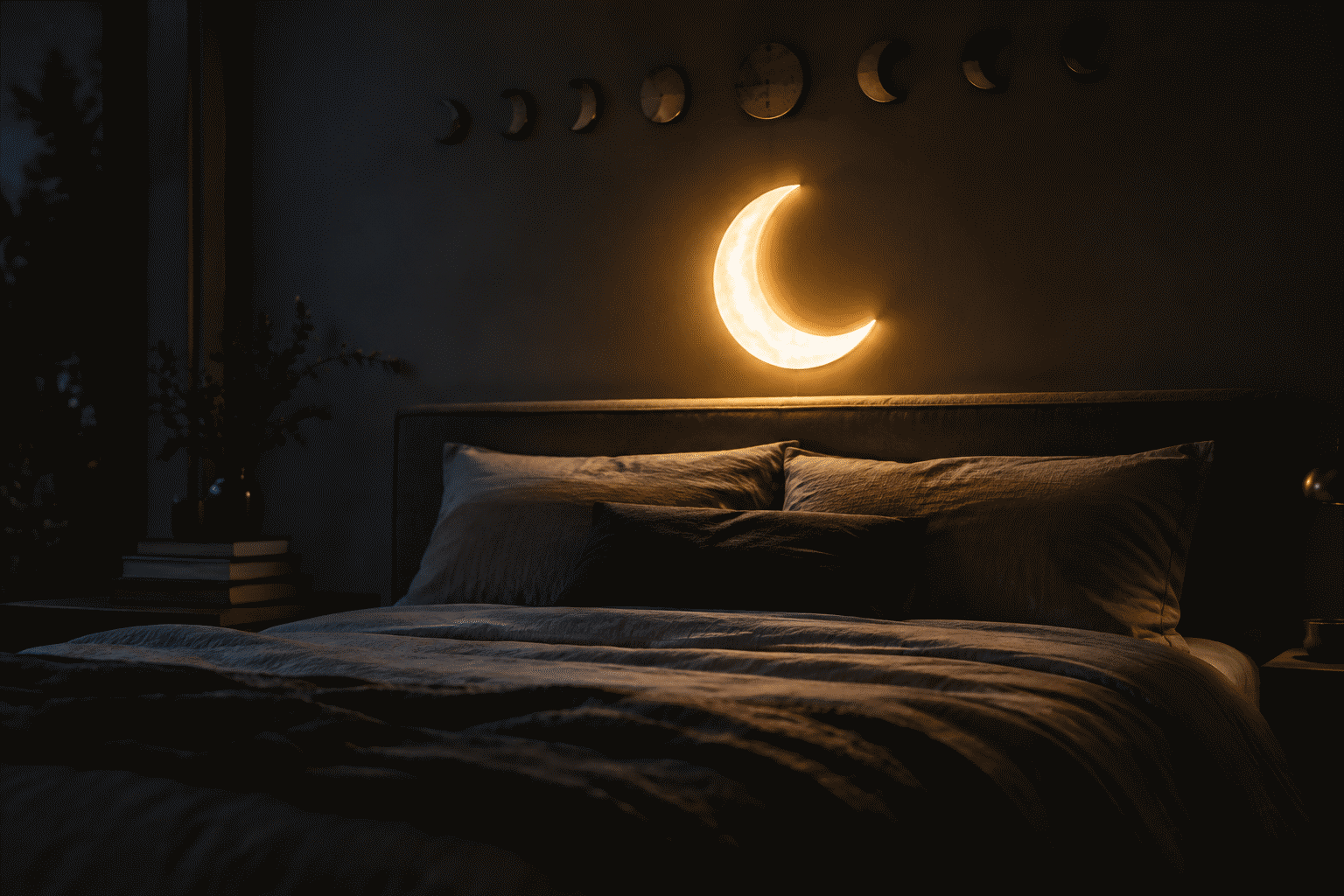
Long before there were lamps, there was the moon — the original night light, the ceiling light of every human who ever looked up. Hanging a moon on the wall is the oldest decor idea there is, and the neon version is its modern form: the crescent or the full disc in a single continuous curve, glowing at exactly the register the real one does — dim, patient, and slightly silver.
This guide covers the moon in neon: the phases and which to pick, the color registers, the three rooms the moon owns, the phase-strip custom, and the sky-family combo wall it anchors.
The Phases: Which Moon to Hang
The moon comes in eight phases, and three of them dominate the wall:
- The crescent. The classic wall moon — the curved sliver with its two sharp points, the shape every culture drew before astronomy had a word for it. In neon it is a single arc of tube: the medium’s purest possible subject. The crescent reads as “night” in a way the full disc never quite does — it is the moon of stories, of windows, of sleeping rooms.
- The full disc. The complete circle, optionally with the crater-dotted surface suggested. The full moon is the statement tier: calmer than the crescent, more abstract, the piece that reads as modern design as easily as lunar. A full-disc moon in ice white on a dark wall is one of the best minimal pieces in the entire catalog.
- The gibbous and quarter moons. The in-between phases — the deep cuts. A custom gibbous is the astronomer’s joke; the quarter moon with its straight terminator line is the modernist’s variant.
- The phase strip. All eight phases in a row — the lunar month as a horizontal band. The register’s signature custom (more below): the strip runs 30–60 inches and turns the wall into a calendar.
The design rule: one moon per wall. The sky family tolerates multiple stars but only one moon — the real one set that precedent, and the wall inherits it.
The Color Registers
- Spectral violet and purple. The mystical register — the witchy and celestial walls’ native hue. The violet crescent over an altar or bed is the witchcore classic; the full behavior lives in our purple guide and the witchy room guide.
- Warm white. The candle register — the moon as lantern. Warm white reads softer than ice white and pairs with wood, linen, and the bedroom’s evening palette. The default for sleep-adjacent walls.
- Ice blue. The lunar register — the actual color of moonlight as cameras record it. The coldest read, the modern choice, the one that reads “the actual moon” to anyone who has looked at one through a window at 2 a.m.
- The duo-tone custom. Outline crescent in warm white with a violet star or cloud beside it — the sky-family pieces love a two-color build.
The Three Rooms the Moon Owns
The bedroom (the night-light tier). The moon’s native deployment: the crescent or disc over the headboard, at the dimmer’s 15–25% register after dark. The moon sign is the bedroom’s most functional decor — the piece that replaces the bedside lamp for the last look of the night. The general bed-wall mechanics are in our bedroom guide; the moon variant runs dimmer than almost any other subject (it is the one icon that is supposed to look like night).

The witchy and celestial corner. The altar wall’s anchor: the violet moon above the crystals and tarot shelf, flanked by the star tier. The witchy guide covers the full icon stack; the moon is its first icon.
The nursery and kid’s room. The gentlest piece in the catalog — the moon at low output is the nursery’s night light, the shape every children’s book already taught the room’s occupant. The crescent at 12–16 inches in warm white is the standard build; the dimmer is the whole product.
The bonus tier: the reading nook. The moon over the reading chair, with the cloud tier (cloud guide) — the nighttime corner assembled from the sky family’s gentler members.
The Moon in Culture: Why the Wall Wants It
Every decor icon carries a freight of association, and the moon carries the most of all – which is exactly why the piece works in rooms that would never tolerate a louder subject:
- The oldest symbol there is. Every human culture drew the crescent before it had writing. The moon on the wall is the one piece of decor that needs no explanation in any language, to any guest, from any tradition – the shape is pre-literate.
- The sleep association. The culture taught everyone the moon means night, rest, and the world slowing down. That association is the piece’s functional engine: the crescent at 15% output reads as a sleep cue the way a lamp never quite does.
- The feminine-and-mystical registers. The moon’s long association with the feminine and the mystical (every tradition again) is why the violet crescent anchors the witchy and celestial walls – the witchy guide builds its whole icon stack from the moon downward.
- The science register. The moon is also the one celestial object everyone has seen with detail – the piece that means both the myth and the landing, the lullaby and the rocket. The full-disc moon in ice white carries both readings at once, which no other icon in the catalog can do.
The Phase-Strip Custom
The register’s signature build deserves its own section: the eight-phase strip, new moon to full and back, as a horizontal run of small moons.

- The standard strip runs 36–48 inches wide at 8–10 inches tall — the lunar month across a wall section, usually above a bed or a shelf.
- The color logic runs two ways: all phases in one hue (the modern read), or the phases shifting from warm white toward violet and back (the “lunar month as mood” read — the custom tier’s showcase build).
- The placement rule: the strip wants height — mounted at the 72–84 inch tier, above the wall’s other content, where it reads as the sky above the room’s landscape.
- The pairing: the strip plus one larger crescent below it is the moon wall’s complete architecture — the calendar and the moment, the month and the night.
Priced by width in the custom builder — the strip is a width-driven piece, and the eight phases render small enough that even the standard run stays in the $150–$220 tier.
The Sky-Family Combo Wall
The moon anchors the catalog’s most cohesive combo set — the sky family, with the rest of the family in this batch’s guides:
- Moon + stars. The core pair — the crescent with a starfield secondary, the celestial wall’s classic two-piece.
- Moon + clouds. The dreamscape tier — both in warm white or soft blue, the gentlest wall the catalog can build.
- Moon + galaxy. The cosmic statement — the moon in the foreground register with the galaxy tier behind it, the wall as a scale model.
- Moon + clouds + stars. The full night sky — three elements, three scales, the family’s complete deployment.
The combo discipline: one moon, stars as the scatter, clouds as the soft layer — and a single dominant hue with one accent. The night sky has a palette discipline of its own; the wall should honor it.
FAQ: Moon Neon Signs
What does a moon neon sign cost? Crescents run $70-$130 at 14-20 inches; full discs $90-$160; the eight-phase strip $150-$220 by width. The moon is a small-to-mid piece by nature — it reads best intimate rather than billboard.
What color moon sign is best? Warm white for bedrooms and nurseries (the candle register), ice blue for the modern minimal read, spectral violet for the witchy and celestial walls. One moon, one color — the duo-tones belong to the combos.
Which moon phase looks best in neon? The crescent is the classic — a single arc that reads as “night” instantly. The full disc is the modernist’s choice; the eight-phase strip is the signature custom. One moon per wall, whichever phase you pick.
Is a moon sign good for a bedroom? It is the bedroom’s most functional piece — the night-light tier, run at 15-25% output as the room’s last light of the night. The bedroom guide covers the wider wall; the moon runs dimmer than any other subject on it.
What is a moon phase strip? The eight phases in a horizontal row — the lunar month as a 36-48 inch wall band, the register’s signature custom. Mounted high, above the wall’s other content, where it reads as the sky above the landscape.
What pairs with a moon neon sign? The sky family: the star tier (the core pair), clouds (the gentle tier), and the galaxy pieces (the cosmic scale). The family runs one dominant hue plus one accent — covered in the star guide and the galaxy guide.
Hang the Night
The original night light, in the medium that finally matches its register. Pick the phase, pick the temperature, dim it to lunar — build the moon and give the wall its quietest, oldest glow.
More sky glow: stars, clouds, the galaxy tier, the witchy register.
Sources & Further Reading
- Neon: Strong Lines (NIST Physical Reference Data) — the standard reference for neon’s emission wavelengths.
- Neon sign (Wikipedia) — the consolidated public record of neon-sign history and technology.
Pricing based on CustomNeon’s current catalog (2026); custom quotes come live from the sign builder.