20 Dorm Room Neon Signs That Survive Move-Out
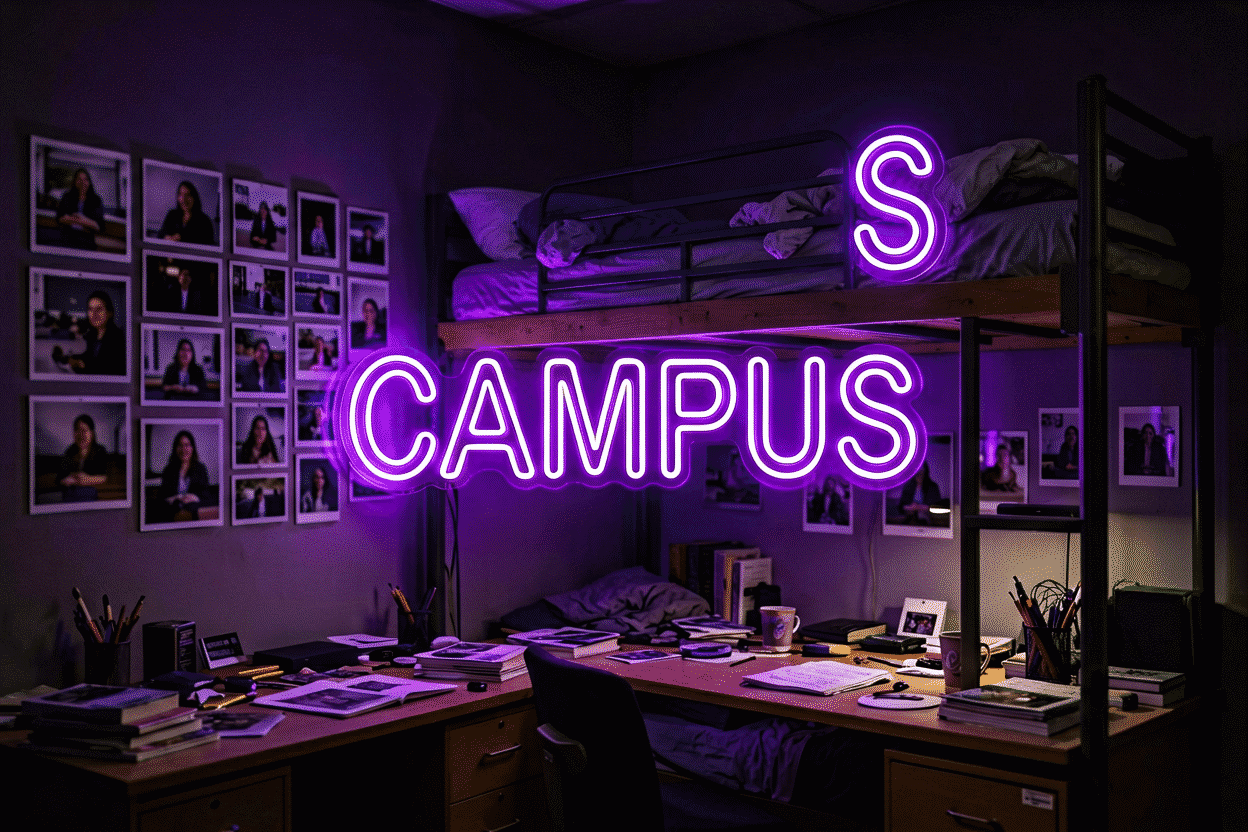
The dorm room is the first room you decorate with your own judgment and someone else’s rules: no nails in the cinderblock, a shared outlet budget, and a move-out inspection in nine months. Neon is the dorm’s highest-leverage decor because it solves the room’s actual problems — bad overhead lighting, identical layouts, and the need to make 90 square feet feel like an address — while drawing less power than the mini fridge.
Here are 20 ideas by dorm zone and register, with the no-nails and power-strip engineering that keeps the RA happy. The full bedroom canon lives at bedroom neon sign ideas.
The Core Pieces: Ideas 1–7
- Your name or nickname — the door-side nameplate (free preview): the room’s identity in the hallway, and the piece that survives four years and three dorms.
- Good Vibes Only — the dorm’s default blessing; reads as personality without picking a fight with a roommate’s aesthetic.
- Hello — the greeting-tier classic; the two-word opener for the room that hosts the floor.
- Your school’s name or initials — the spirit tier: “ROLL TIDE” or the block monogram in school colors; strongest during orientation week and never wrong after.
- A moon or wave shape — the roommate-neutral tier: warm and stylish without claiming a side; the shape pieces end more roommate negotiations than they start.
- “It Was All A Dream” — the first-semester register (the piece): the caption that carries the whole year’s photos.
- An astronaut — the space tier for the major-undeclared era; the piece that glows over the desk where the deciding gets done.
The Loft & Bed Zone: Ideas 8–12
- The under-loft glow — a small piece mounted on the lofted bed’s underside: the reading cave’s light, invisible by day, essential by night.
- The headboard-alternative piece — dorm beds have no headboard; a neon shape on the wall at pillow height becomes one — the composition that makes the room read bedroom instead of barracks.
- The privacy-screen accent — the divider wall’s glow: your half of the room, lit as yours (the students’ tier develops the shared-room logic).
- The clip-light upgrade — replace the clamp lamp with a small neon: same footprint, infinitely better mood, and the power draw is lower than the lamp it replaces.
- The constellation set — three or four small stars arranged over the bed: the night-light that freshmen won’t admit they still want and seniors won’t remove.
The Desk & Study Zone: Ideas 13–16
- “Study” or “Focus” — the desk’s label; the piece that shames you gently at 11 p.m.
- The bias-glow strip — neon behind the monitor: less eye strain during the all-nighter, and the room’s best-looking light during the video calls home.
- “Coffee First, Then Function” — the engineering-major register; the joke that doubles as a schedule.
- A major-themed shape — the molecule, the treble clef, the scales: the piece that answers “what’s your major?” before anyone asks.

The Social Tier: Ideas 17–20
- “Chill Zone” — the room that becomes the floor’s living room needs the label; the piece that makes it official.
- A game or music piece — controller shape, vinyl record, headphones: the piece that collects the people who play and listen.
- “Send Snacks” — the care-package register; the funniest possible thing for the family group chat to photograph.
- The birthday piece — “Happy Birthday” runs four times a year in a dorm (the tier): the room becomes the floor’s party venue, which was the plan all along.
The Engineering: No Nails, Low Watts, Move-Out
Mounting: cinderblock and dorm drywall prohibit penetration almost everywhere — the working system is damage-free: heavy command strips rated for the piece’s weight, over-door hooks for the vertical pieces, and freestanding mini-easels for the desk tier (the hanging guide covers the no-drill methods in full). The piece that needs screws stays home.

Power: the dorm outlet runs a mini fridge, a laptop, a phone, and the neon — and the neon is the cheapest of all of them (the math): a small piece at dorm brightness costs about a dollar a month. The surge protector’s neon slot is earned.
Brightness: the shared-room etiquette tier — dimmers (or the two-brightness pieces) keep the roommate treaty intact: full for the pregame, 20% for the roommate’s 8 a.m. The dimmer is the best $10 in the whole dorm kit.
Move-out: command strips peel clean; the original box survives under the bed; and the namepiece transfers to the apartment year with its reputation intact.
The Dorm Kit: What Survives Move-Out
The dorm room’s neon program optimizes for three constraints: the no-nails rule, the shared-outlet reality, and the June move-out. The kit that respects all three becomes the four-year companion.
The no-nails toolkit: heavy command strips (rated for the piece’s weight – the two-strip-per-piece rule the RA-hall learns by October), the over-door hooks for the verticals, and the leaning pieces for the shelves and desk. The four-year kit’s pieces all mount damage-free – the deposit that survives four Junes is the kit’s real ROI (the no-drill methods).
The power strip etiquette: the dorm’s single outlet runs the fridge, the laptop, the phone, and the neon – and the neon is the strip’s cheapest citizen (the math: a dollar a month at student brightness). The etiquette: the neon’s adapter in the strip (not the wall, where the roommate’s vacuum habit lives), the cords in the channel (the fire-inspection tier the hall runs every October), and the surge protector’s neon slot earned by its wattage.
The move-out discipline: the pieces in their original boxes (stored under the bed from day one – the box that’s thrown away in September is bought again in June), the command strips peeled clean (the hair-dryer trick for the stubborn ones), and the four-year plan visible: the namepiece transfers to the apartment, the phrase pieces rotate yearly, and the school-spirit piece retires at graduation with honors (the name logic).
The Dorm Budget by Year
Freshman year ($60-150): the name or nickname (the identity piece), one shape (the roommate-neutral tier), the strip glow – the kit that makes the 90 square feet an address. Sophomore-junior ($100-250 cumulative): the upgrades as the roommate situation stabilizes – the phrase pieces, the bias-glow for the study hours, the social tier that makes the room the floor’s destination. Senior year ($100-200): the apartment-pipeline pieces – the purchases that move to the first lease’s walls (the namepiece’s third home, the kitchen piece, the office-tier word for the job search’s corner).
The four-year math: the $300-500 total (spread across the years) buys the room’s identity, the study hours’ light, the social floor’s gravity, and the apartment’s founding pieces – the best per-dollar decor run in the entire college budget (the bedroom canon takes over at the first lease).
FAQ About Dorm Room Neon Signs
What’s the best neon sign for a dorm room? Your name or “Good Vibes Only” — identity without roommate conflict. The namepiece is the four-year keeper (preview); the phrase tier is the flexible one.
How do I hang a neon sign in a dorm without nails? Heavy command strips on the backing board, over-door hooks for verticals, easels for the desk tier — the full no-drill system is in the hanging guide.
Will a neon sign use too much power in a dorm? No — it’s the cheapest thing in the outlet (the math): about a dollar a month at student brightness. The mini fridge won’t even notice it’s there.
Are neon signs allowed in college dorms? Almost always – the LED tiers clear the three objections residence halls actually care about: the cool-running tubing (the heat facts), the minimal draw (the power math), and the no-glass construction. The rule that bites is wall penetration, and the no-drill toolkit handles it: the heavy command strips, the over-door hooks, the leaning pieces (the dorm kit above). The handbook check (every school’s specific rules – the candle-tier prohibitions sometimes sweep broadly) takes five minutes and prevents the September confiscation that ruins the room’s plan.
How do I pack a neon sign for a dorm move-out? The original box, stored under the bed since September – the piece’s travel case was free and stays that way (the move-out discipline above). The pieces without their boxes: the soft-wrap method (the backing wrapped, the tubes protected, the power supplies bagged separately) and the rigid bin for the shapes. The command strips peel clean with the hair-dryer trick for the stubborn ones; the wall’s touch-up (the magic eraser’s pass) returns the surface. The four-year kit that packs right every June travels to the apartment year with its namepiece intact and its budget already spent.
Do dorm signs survive four years of summer storage? The ones boxed properly do: adapter out and coiled separately, the sign flat in its original packaging (a flattened Amazon box cut to size works), nothing stacked on the acrylic. The graveyard of dorm neon is mostly tubes cracked by under-bed crushing, not electronics that failed — a $70 piece that survives sophomore-to-senior moves beats replacing a $30 one every fall, and the math only works with the five-minute packing ritual each May.
Will an older dorm’s wiring handle a neon piece? Pre-war buildings shrug at a 12-20 watt LED sign the same way they shrug at a laptop charger — the load is trivial next to the mini-fridge everyone pretends isn’t a problem. The real constraint in old dorms is outlet count, which the power-strip question settles, and flickering hallway circuits that predate your sign by ninety years; if the outlet sparks for anything, report it and pick a different wall.
The Freshman Kit vs the Senior Kit
The dorm program’s four-year arc, compared:
| Decision axis | The freshman kit | The senior kit |
|---|---|---|
| The pieces | The name, the roommate-neutral shape, the strip glow | The apartment-pipeline pieces (the kitchen word, the office tier) |
| The budget | $60-150 (the entry year) | $100-200 (the transition year) |
| The mounting | The full command-hook discipline (the kit above) | The same (the dorm’s rules run all four years) |
| The wall politics | The negotiated (the roommate’s treaty) | The owned (the single’s freedom) |
| The photography | The orientation-era posts | The graduation’s archives |
| The afterlife | The pieces that survive to sophomore year | The pieces that move to the first lease |
The four-year arc’s compounding: the freshman kit’s survivors (the namepiece, the neutral shapes) ride the whole arc, and each year’s additions (the social tier, the study pieces, the senior transition) build toward the apartment – the program that ends with the first lease’s founding pieces already owned (the budget-by-year logic above).
The arc’s honest economics: the four-year total ($300-500 spread across the budgets) buys the room’s identity, the floor’s social gravity, the study hours’ glow, and the apartment’s start – the best decor run in the college’s whole expensive ledger, and the one the graduate still glows from.
Sources & Further Reading
- Solid-State Lighting (U.S. Department of Energy) — DOE reference on LED efficacy and lifetime.
- Mercury (U.S. EPA) — federal guidance on mercury exposure and safe handling.
Pricing based on CustomNeon’s current catalog (2026); custom quotes come live from the sign builder.