18 Bar Neon Signs for Businesses: The Trade Playbook
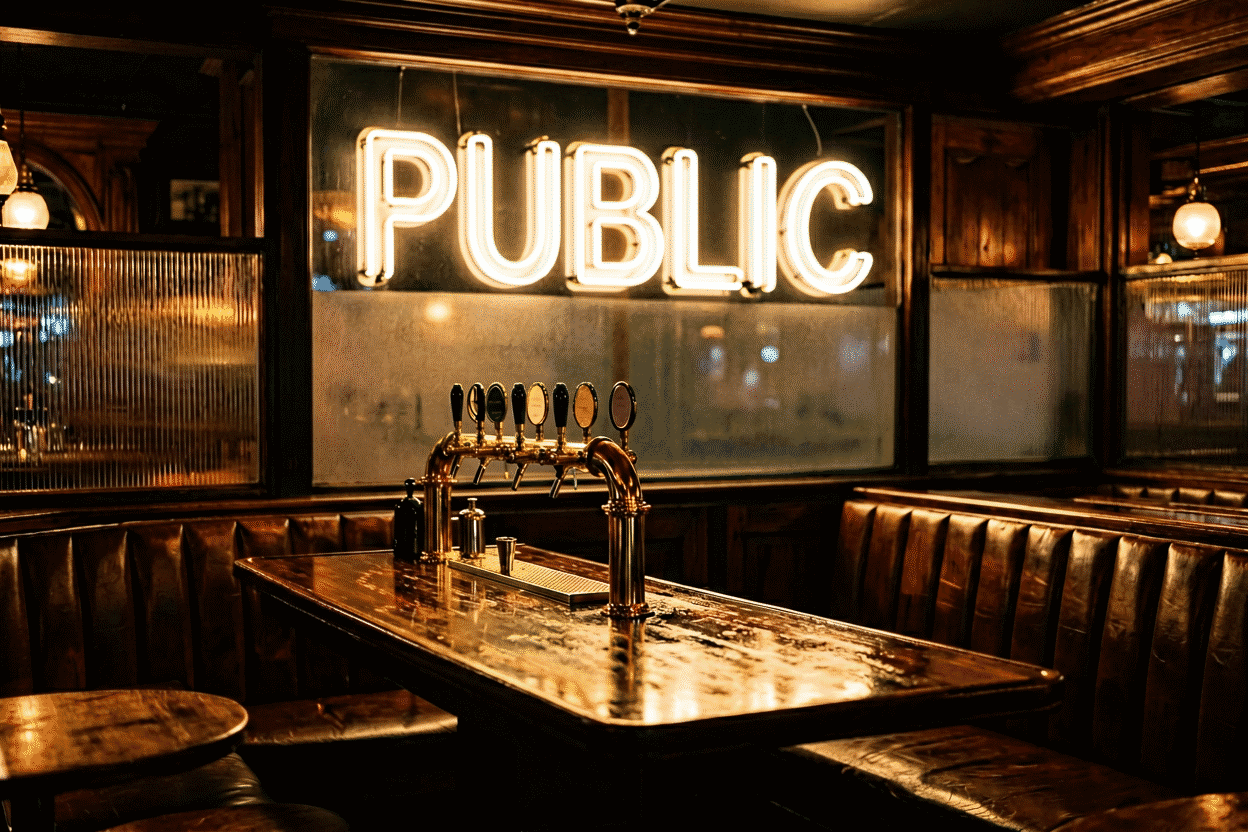
The bar is neon’s founding client — the trade that built the medium’s first century and still runs its deepest canon. A bar’s sign program has three audiences (the street, the room, the camera) and a century-proven playbook for each; the bars that work the whole playbook are the ones whose rooms photograph and whose streets convert.
Here are 18 ideas organized by the program’s tiers. The home-bar version of this canon lives separately (here); this is the commercial tier.
The Street Tier: Ideas 1–5
What the passerby and the regular both navigate by.
- The name-in-neon — the bar’s name over the entrance or in the window (the landing tier): the identity piece the street learns by glow. The single highest-value sign a bar buys.
- BAR OPEN — the status pair: the trade’s blue-red or the house’s amber, converting the walk-by into the walk-in.
- The trade icon — the glass, the tap handle, the bottle: the zero-word shorthands that say “bar” at distance (the B-end logic).
- The type-of-bar marker — “COCKTAILS,” “CRAFT BEER,” “WHISKEY”: the format that pre-qualifies the customer before the door.
- The neighborhood piece — the bar’s nickname or the corner’s landmark joke: the piece that makes the bar a place (“the neon joint on 5th”).
The Room Tier: Ideas 6–11
What makes the room a destination rather than a premises.
- The back-bar anchor — the big script or brand piece behind the bottles (the bar-wall logic): the room’s focal point and every photo’s background.
- The house rules piece — “NO TABS OVER $50” / “BE NICE OR LEAVE”: the humor-and-policy tier that doubles as content.
- The era script — the 1930s-through-70s registers (the vintage archive): the authenticity tier that glass serves best — the craft commission for the heritage bar.
- The bathroom journey piece — the hallway sign (“You’re still beautiful”): the tier that generates the venue’s most-shared posts.
- The DJ-or-live tier — LIVE ON AIR adjacent or “LIVE MUSIC TONIGHT”: the calendar’s street-adjacent signal (the music canon).
- The shot-and-special board — the glowing menu item (“$5 SHOTS”): the transaction tier that moves the night’s inventory.
The Brand & Beer Tier: Ideas 12–15
- The brewery scripts — the taps’ brands in their own glows (the beer canon): the beer wall’s architecture, negotiated with distributors (many supply their pieces).
- The house-brand piece — the bar’s own logo or crest (preview): the merch-preview tier — if they’d wear it, light it.
- The signature-drink piece — the house cocktail’s name in glow: the menu’s marketing tier that orders itself.
- The sports-wall tier — the team pieces and the “GAME DAY” flip (the sports canon): the calendar content that fills the slow nights.

The Atmosphere & Craft Tier: Ideas 16–18
- The dimmer program — the room’s three moods: full for the early crowd, half for the conversation hours, glow for the last call (the home-bar logic scales up): the lighting plan that keeps the room right all night.
- The color discipline — amber-warm dominant, ice-blue accents, red for appetite and urgency (the business palette): the bar-specific ratios that made every classic room work.
- The glass commission — real bent neon for the heritage register (the craft tier): the premium bar’s authenticity anchor, and the piece the regulars name the place by.
The Program’s Economics
The bar’s sign budget runs the playbook‘s jobs-per-piece logic with the trade’s specifics: the street tier converts (walk-ins), the room tier photographs (posts), the brand tier merchandises — and every tier compounds on the evening street, when the glow is the only marketing the bar has. The working program: name and status first (the tier one), back-bar anchor second, the content pieces as the room’s identity grows — and the glass commission when the bar’s earned it.

The Bar Program’s Economics
The bar’s sign program deserves its own math, because the bar’s economics amplify the general case: the evening street (the bar’s customer is walking past after dark – the glow’s capture physics at their most direct), the photographed room (the bar’s marketing IS the patron’s post – the content tier compounding nightly), and the establishment’s identity (the bar’s brand is its room – the signage IS the brand).
The walk-in math: the bar’s walk-in traffic is the evening street’s entire population – the sign that converts 2% more of it pays for itself in the first month’s covers. The content math: the photographed back-bar appears in every patron’s post – the organic reach the paid channels can’t buy, running nightly. The identity math: the bar that glows its name on the street becomes the neighborhood’s landmark – the “neon place on 5th” that directions use and habits form around.
The program’s sequence: the name and the open tier first (the street’s conversion – $200-500), the back-bar anchor second (the room’s identity – $300-800), the content pieces as the room’s personality crystallizes – and the glass commission when the bar’s earned it (the tier above).
The Compliance and Craft Notes
The bar’s specific rules: the exterior tier (the sign code’s brightness and animation limits – the bar districts’ specific rules, the permit logic); the distributor economy (the beer-brand pieces: many supplied, the layout discipline that turns supply into design – the beer canon); the glass commission’s electrician (the heritage tier’s wiring and code – the craft piece installed right).
The craft tier’s honest note: the glass neon bar (the real tubes, the bent artistry – the comparison) is the premium register’s choice, and the bar whose identity IS the craft justifies it; the bar whose identity is the value runs the LED tier proudly. Both glow; only one breaks in a bar fight – the fact that decides it for most owners.
FAQ About Bar Neon Signs for Businesses
What’s the best neon sign for a bar? The name-in-neon — the identity piece the street and the regulars both navigate by. BAR OPEN converts; the back-bar anchor photographs; the era glass anchors heritage (the full tiers).
Should a bar buy glass or LED neon? Glass for the heritage register — the craft signal the premium bar’s identity runs on (the vintage archive). LED for everything else: the durability, the power math, and the color range serve the volume tiers better.
How do beer-brand signs work for bars? The distributor economy: many brands supply their pieces — the bar’s job is the layout discipline (one wall, odd-numbered, era-consistent) that turns supply into design (the beer canon).
What’s the bar’s minimum viable sign program? Name + open sign + one back-bar anchor: the trio that converts the street, brands the room, and photographs the night — $400–700 at commercial grade (the brackets).
What neon signs do bars need? The working trio: the name-in-neon over the entrance (the street’s landmark), BAR OPEN in the window (the conversion piece), and the back-bar anchor (the room’s focal and every photo’s background) (the trade playbook above). The trio lands $400-700 at commercial grade and covers the street, the room, and the camera – the three audiences the bar’s program serves. The era glass (the vintage tier) and the beer-brand wall complete the heritage rooms; the dimmer program runs every room’s night.
How much does a bar neon program cost? The minimum viable program – the name, BAR OPEN, and the back-bar anchor – lands $400-700 at commercial grade (the trade economics above); the full program (the beer-brand wall, the content pieces, the era glass) runs $1,000-3,000 by ambition. The distributor economy discounts the brand tier (many breweries supply their pieces), and the glass commissions (the vintage lane) run the heritage premium. The bar’s ROI lines: the walk-in conversion, the photographed room, and the after-hours glow – the three returns that fund the program (the case).
What does annual upkeep on a bar’s neon program look like? Budget one service visit a year for glass (transformer check, tube gas top-off if a section dims) and essentially nothing for LED flex beyond a wipe-down during deep cleans — the working reality for most bars is a $0-150 annual line item against a $600-1,200 install. The adapters are the replace-on-schedule part: at 12-hour daily service, swapping them proactively every four years costs less than one emergency call on a Friday.
Do health inspectors flag neon behind the bar? Glass tubes over prep surfaces or taps can draw notes in stricter counties — keep any traditional neon mounted high and away from food contact zones, and the question rarely comes up. LED flex sidesteps the category entirely (no gas, no broken-glass scenario), which is why kitchens and back-bar installations have mostly migrated that direction; the wiring still needs to follow cord-discipline rules like any appliance (the mounting logic).
The House Program vs the Beer-Brand Wall
The bar’s two signature programs, compared:
| Decision axis | The house program (the establishment’s own) | The beer-brand wall (the distributors’ tier) |
|---|---|---|
| The anchors | The name, the charter, the signature pour | The brewery scripts, the brand icons |
| The funding | The bar’s budget | The distributor economy (many supplied) |
| The identity weight | The establishment’s (the permanent) | The inventory’s (the taps’ rotation) |
| The era register | The house’s own heritage | The brands’ decades |
| The composition | The back-bar anchor at center | The odd-numbered flanks (the collection logic) |
| The keeper rate | Total (the name outlives everything) | Partial (the brands’ market shares) |
The two programs’ working relationship: the house program leads (the name and the charter – the bar’s own identity) and the beer wall supports (the brands’ glow around the house’s center) – the composition every classic bar converged on, the establishment’s voice first and the inventory’s second (the trade playbook above).
The beer wall’s economics deserve their restatement: many distributors supply their pieces free or discounted – the bar’s job is the layout discipline (one wall, odd numbers, era-consistent) that turns the supply into design, and the house program’s budget freed by the supplied tier (the beer canon covers the collection logic the bar borrows).
Sources & Further Reading
- Neon sign (Wikipedia) — the consolidated public record of neon-sign history and technology.
Pricing based on CustomNeon’s current catalog (2026); custom quotes come live from the sign builder.