25 Kids Room Neon Sign Ideas They’ll Actually Love
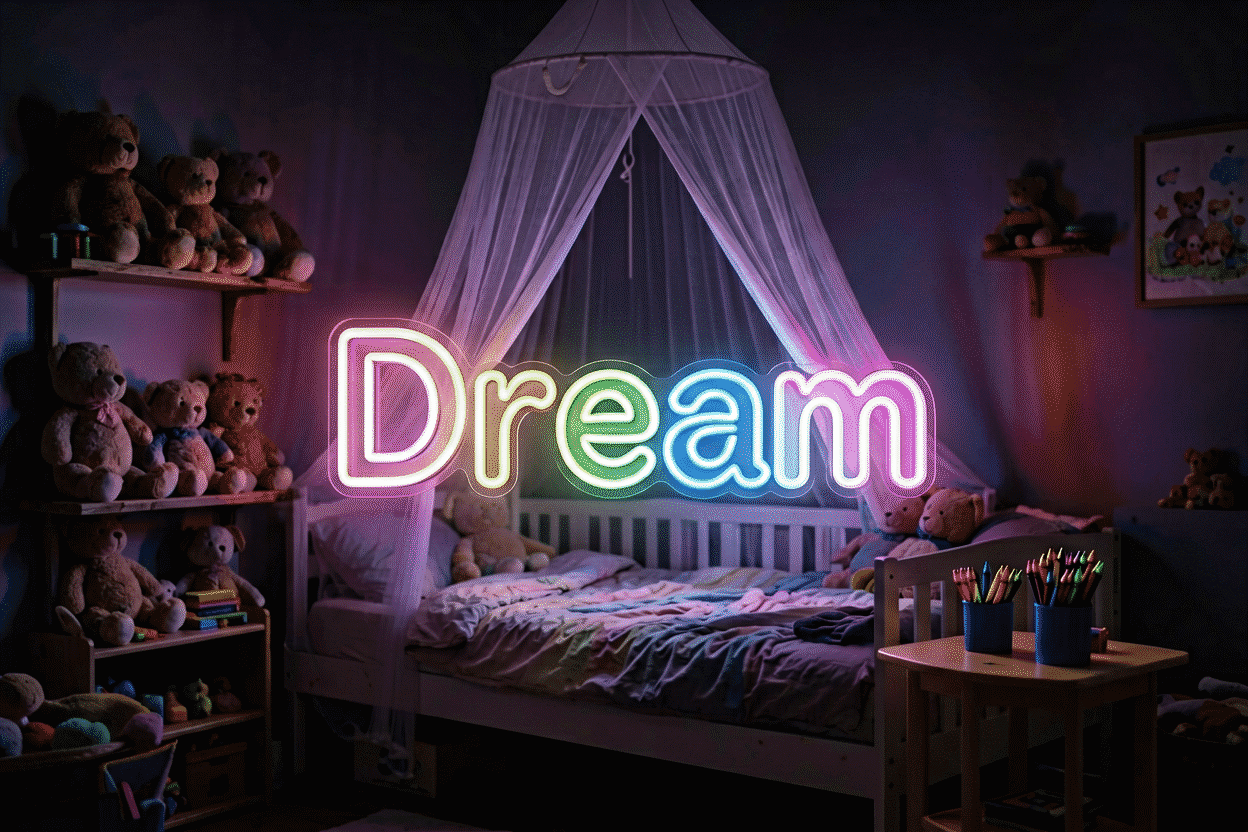
A kids room is the one place where neon does exactly what the child needs it to do: make the room feel alive at lights-out. The right piece is a night light, a nameplate, and a play cue in one — and the modern LED build — flexible polymer tubing that stays warm rather than hot, wattage a nightlight would yawn at, zero glass anywhere in the construction — has quietly made this the safest wall in the house for glow.
Here are 25 ideas by age band — nursery to teen — with the safety notes parents actually ask about and the placement calls that survive a childhood. The shopping tier lives at kids room neon signs.
Nursery: Ideas 1–6
Soft glow, low wattage, zero sharp anything.
- The baby’s name in soft script — the nursery’s centerpiece: warm white or blush script above the crib wall (not directly over the crib — placement notes below). Every name previews free in the customizer.
- “Oh Baby” — the shower-gift classic that moves from party wall to nursery wall; the phrase build tier’s most-gifted cousin.
- A moon and stars set — the sleep-theme tier: crescent moon in warm white, three small stars scattered; doubles as the night feed’s soft light.
- “Twinkle Twinkle” — the lullaby’s first line in script; the piece that belongs to the parent as much as the baby.
- A cloud shape — the nursery’s zero-word option; pairs with the moon tier or hangs alone.
- “Dream Big” — the blessing register; grows with the child better than any theme piece.
Ages 3–8: The Play Years: Ideas 7–13
- A rainbow arc — the single most-built kids piece of the decade; works over the bed, the toy shelf, or the reading corner.
- A dinosaur — T-rex in green for the dino-obsessed year (there’s always a dino-obsessed year).
- An astronaut — space themes run from age 4 to forever; the astronaut build leads the category.
- A rocket + planet set — the two-piece space wall; glow-in-the-dark paint stars underneath complete the mission.
- The child’s initial, oversized — the monogram tier: one big letter in the room’s accent color; survives every phase change because it’s just their letter.
- “Adventure” or “Explore” — the play-room register for the climbing years; arrow shapes optional.
- Their favorite animal shape — unicorn (pink), shark (ice blue), fox (orange): the phase-piece tier, bought with the understanding that phases pass.
Ages 8–12: The Identity Years: Ideas 14–18
- The sports piece — their number, their team, their sport; the first piece they pick themselves (sports room guide).
- A gaming piece — controller shape or “GAME ON” for the gaming corner; the gaming room guide has the full canon.
- Pink room register — the pink-year kitchen-sink: name + hearts + clouds in layered pinks; the linked treatment shows the palette system.
- “Good Vibes Only” — the tween’s first phrase piece; soft white or multi-color.
- The hobby flex — ballet shoes, soccer ball, horse, microscope: the piece that says the room’s owner has a thing.
Teen Rooms: Ideas 19–23
- Sweet 16 — the birthday that earns its own sign; the milestone tier’s flagship.
- “Boss Babe” / “Focus” / “Create” — the motivational register for the study years; see the quote archive for the full canon.
- Their name in a modern font — the teen upgrade from the nursery script: block, neon-outline, or edgy script in their chosen color; input required, opinions guaranteed.
- An aesthetic piece — sunset gradients, y2k shapes, or the room aesthetic guide tier for the room that now photographs.
- The music piece — headphones shape or their artist’s lyric; the identity tier that sticks until college.
The Functional Pieces: Ideas 24–25
- The dimmable night light — any of the above on a dimmer: full for play, 20% for sleep. The night-light function is why kids neon beats a lamp — it glows without lighting, and it never gets knocked off a nightstand. The power cost of an all-night 20% dim is pennies a month.
- “READ” over the book nook — the cue piece: glow marks the reading corner, habit follows the cue. Parents report this one working; the literature is on their side.

Safety and Placement: The Parent Questions
The three questions every parent asks, answered straight. Heat: the surface stays in warm-to-the-palm territory — the temperature measurements put it far below anything that could scald a curious hand. Power: a kid-size piece sips single-digit wattage, less than the television’s standby light (the full math). Glass: the construction skips it entirely — silicone-jacketed tubing on an acrylic board, so a dropped piece cracks its backing at worst, never rains shards.
Placement: above the crib means on the wall the crib faces, with the sign’s bottom edge at least 24 inches above the crib rail (out of reach of the standing toddler years, which arrive fast). For kids 3+, eye level when sitting on the bed — about 42 to 54 inches — keeps it in their world. Cords run behind furniture to the outlet, secured with the clips from the hanging guide; the dimmer goes where the parent can reach it, not the child. And the teen’s piece is their piece: hardware choices included.
The Age Transitions: Buying for the Room’s Future
The kids room reinvents itself every three to four years, and the sign budget that respects the cycle spends differently than the one that doesn’t.
The keeper pieces – the name, the initial, the monogram – are bought once, at the best quality, and they ride every transition: nursery script at birth, the same piece restyled at eight (moved from over the crib to over the bed), the teen upgrade to a new font at thirteen (the name logic). The keeper’s economics: one $200-300 piece across eighteen years beats four $80 phase pieces, and the namepiece’s emotional compounding (it becomes the room’s constant) is worth more than the math.
The phase pieces – the dinosaur, the unicorn, the mermaid, the fandom tiers – are bought cheap and retired gracefully. The phase runs twelve to twenty-four months; the piece that outlives its phase becomes the room’s clutter rather than its decor. The discipline: phase pieces at the entry tier ($50-120), retired to the playroom or the memory box when the phase turns, never re-gifted downward within the household (the younger sibling wants their own phase, not the hand-me-down version of a dead one).
The transition calendar runs roughly: nursery (0-3) the soft tier; early childhood (3-7) the magic tier (rainbows, unicorns, dinosaurs); the identity years (7-12) the hobby and sport tier; the teen years (13+) the aesthetic and name-restyle tier (the teen guide takes over from here). The budget’s center of gravity moves from the parents’ choice to the child’s across the calendar – the teen room’s pieces are collaborations or they’re conflicts (the style decoder).
The Safety Layer, In Full
The questions that go past the basics: cords are the genuine risk item in a child’s room — routed behind furniture to the outlet, anchored with the clip systems from the hanging guide, and never crossing floor or crib-zone traffic. Mounting follows the child’s stage — the nursery’s out-of-reach buffer (24+ inches above the crib rail) descends to seated eye level once the bed becomes headquarters, and the wall anchor upgrades accordingly. The dimmer lives on the parent’s side of the room until the teen earns remote privileges, and the overnight bill for a dimmed night-light piece rounds to about a dollar a month — the answer to the question grandparents reliably ask.
Variations and Pairings
The kids canon’s variants. The word-face variants: “kids room neon sign ideas,” “neon signs for kids room,” and “childrens room neon” serve the tier; the age-band faces (nursery, playroom, teen room) each skew their registers – the teen face carrying the aesthetic tier, the nursery face carrying the soft tier. The gendered faces: the girls’ room carries its own treatment; the boys’ face runs the sports and gaming tiers – the split canon serving the households that shop by it.
The pairing logic: the kids room pairs the keeper with the phase – the namepiece (bought once, at quality) anchoring every phase layer that rotates around it. The phases pair among themselves by age-band: the magic tier (rainbows, unicorns) never pairs with the identity tier (the number, the hobby) on one wall – they belong to different childhoods, and the room reads the age it’s dressed for.
The night-light pairing: the room that runs the night-light function pairs the dimmer with every piece – the day’s decor becoming the night’s glow without a second purchase, the dual-job logic that justifies the keeper tier’s budget (the night-light guide).
FAQ About Kids Room Neon Signs
What age is appropriate for a neon sign in a kids room? Any age, with placement doing the work: nursery pieces mount out of reach, toddler rooms keep cords secured, and from school age on it’s just wall decor. The safety profile of LED neon — cool, low-power, no glass — is exactly why the category exploded for kids.
Can a neon sign work as a night light? Yes, and it’s the best version of one: dimmed to 15–25%, a small piece gives enough glow to navigate by without waking anyone, runs all night for pennies, and never gets replaced because the child “grew out of the rocket.”
What’s the best first sign for a child’s room? Their name or initial. It survives every phase (unlike the dinosaur), belongs to them specifically, and moves meaningfully to dorm rooms and first apartments. Theme pieces come and go; the name is the keeper.
How do I pick a piece that lasts more than one phase? Name, initial, rainbow, moon, or “Dream Big” — the abstract pieces outlive the obsessions. Buy the obsession pieces small and cheap; buy the name piece right.
When should I switch from nursery signs to big-kid signs? The room tells you – usually between three and four, when the crib converts and the child’s opinions arrive. The switch runs selective: the namepiece stays (it rides every phase – the keeper logic), the sleep tier stays (the moon works at every age), and the nursery-specific pieces (the “Oh Baby,” the cloud tier) retire to the memory box. The big-kid replacements arrive at the child’s pace: the rainbow when the color obsession hits, the dinosaur when the year-of-the-dinosaur arrives, the first “their choice” piece when the choosing becomes the point (the age-band logic above maps the transitions).
How much does a kids room neon sign cost to run every night? As a night light at 15-20% brightness: about a dollar a month (the power math) – the cheapest sleep aid the childhood market offers, and the one that never gets outgrown as quickly as the plug-in ducks. At full brightness for the daytime-play hours, the piece still draws less than the bedroom’s lamp; the whole kids-neon program (the name, the shapes, the night tier together) costs less per month than a single streaming subscription. The parents who run the numbers usually stop worrying about the electric bill and start worrying about which phase piece is next.
At what age does a kid actually pick their own sign? Around four to five the preference is real enough to matter — before that, the parents are decorating their own memory of the room, which is legitimate but different. The transition move is a jointly chosen piece (the kid picks the icon, the parent picks the palette) so the wall keeps both signatures; the fully kid-driven commission can wait until the preferences survive a full year.
How do you retire a nursery piece without a meltdown? Frame the change as promotion, not removal: the night-light moon “graduates” to the reading nook or the sibling’s room with a small ceremony, and the new big-kid piece goes up the same weekend. Kids handle glow transitions badly only when the old light disappears into a closet mid-nap with no explanation — the swap they watch and participate in becomes their story, not their loss.
Sources & Further Reading
- Mercury (U.S. EPA) — federal guidance on mercury exposure and safe handling.
- Neon sign (Wikipedia) — the consolidated public record of neon-sign history and technology.
Pricing based on CustomNeon’s current catalog (2026); custom quotes come live from the sign builder.