20 Neon Room Decor Ideas for a Whole-Room Glow

Room decor is a system, not a purchase: the sign, the strips, the wall color, and the bedding either compose or they don’t. Neon is the system’s most powerful component and its most common failure — powerful because it brings light and color in one object, a failure when it’s bought as an object instead of planned as a layer. The rooms that glow coherently (the ones the internet saves by the millions) are built as systems.
Here are 20 ideas organized as the system actually assembles: the glow layer, the color system, the style registers, and the finishing moves. The aesthetic deep-dive lives at neon room aesthetic ideas, and the room-by-room canon at home decor.
The Glow Layer: Ideas 1–5
The room’s lighting architecture, neon-first.
- The anchor piece — one statement sign (phrase or shape) that the room orbits; chosen first, sized to the furniture, hung focal. Every other decision follows it.
- The halo tier — strips behind the headboard or sofa: the ambient layer that makes the anchor feel installed. The wall lights guide covers the strip engineering.
- The accent corner — a small second piece (shape, moon, monogram) in the room’s corner: the depth that keeps a one-sign room from feeling sparse.
- The reflection play — neon placed to double in a mirror or glossy surface: the free second piece every room with a mirror can claim.
- The dimmer stack — brightness as the room’s clock: full by day, half by evening, quarter by night. The system’s cheapest upgrade and its most-lived-with.
The Color Systems: Ideas 6–9
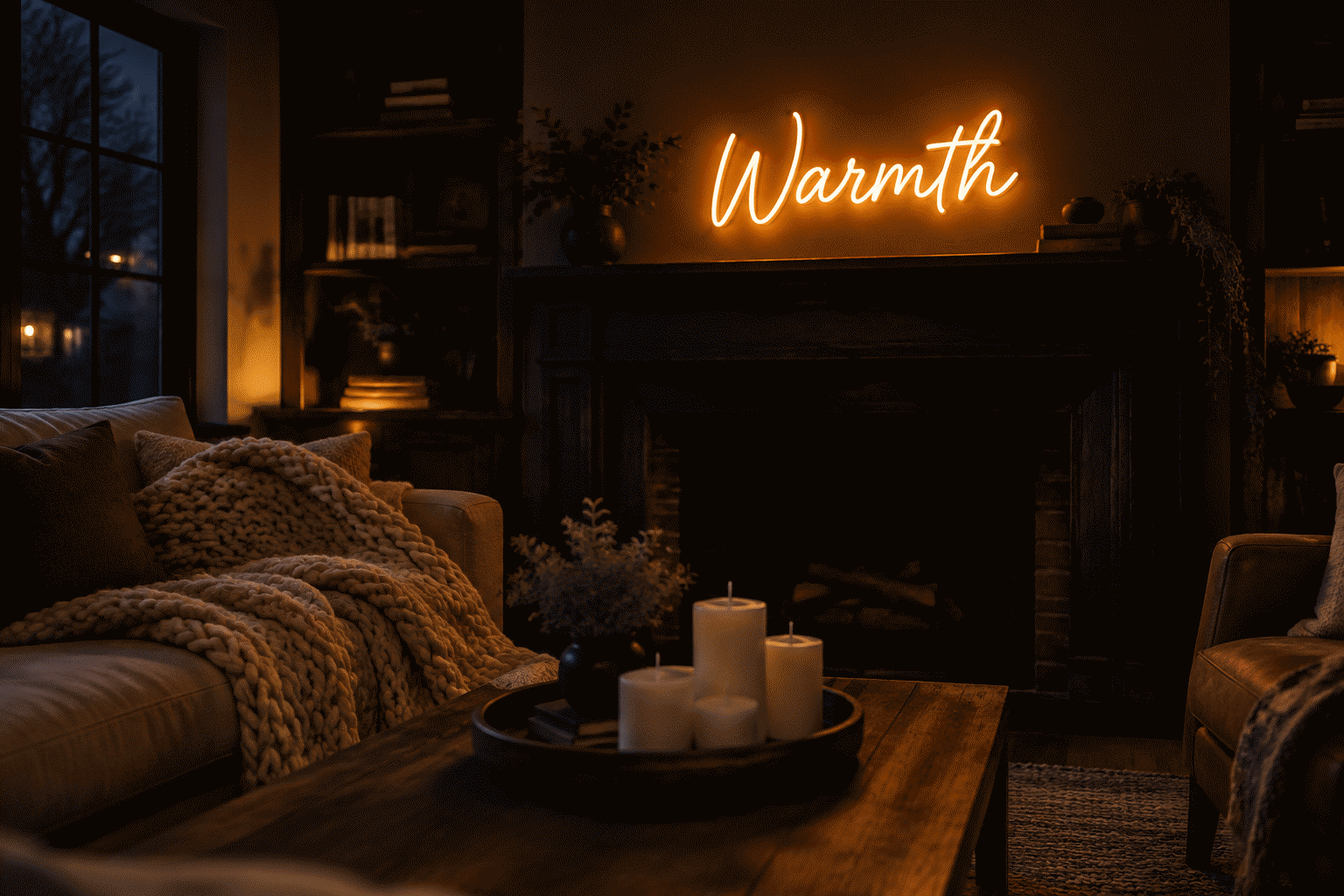
- The warm-white room — one warm piece plus neutral bedding: the minimalist’s system, the photographer’s favorite, the hardest to get wrong.
- The pink system — layered pinks (anchor in blush, accents hot): the soft-aesthetic standard (the full treatment).
- The purple-blue room — the moody registers: grays and darks, glow at 30%, the late-night room (the color decoder maps all twelve).
- The multi-color room — one rainbow or color-changing anchor with neutral everything else: the system that wants variety without chaos (the RGB logic).
The Style Registers: Ideas 10–14
- The aesthetic room — script + shape + strip in one palette: the layered look that defined the decade’s room decor (the deep-dive).
- The minimalist room — one line-art piece, warm white, done: the system’s discipline play.
- The boho room — botanical shapes, earth tones, texture on texture: the glow that warms without going electric (the style map).
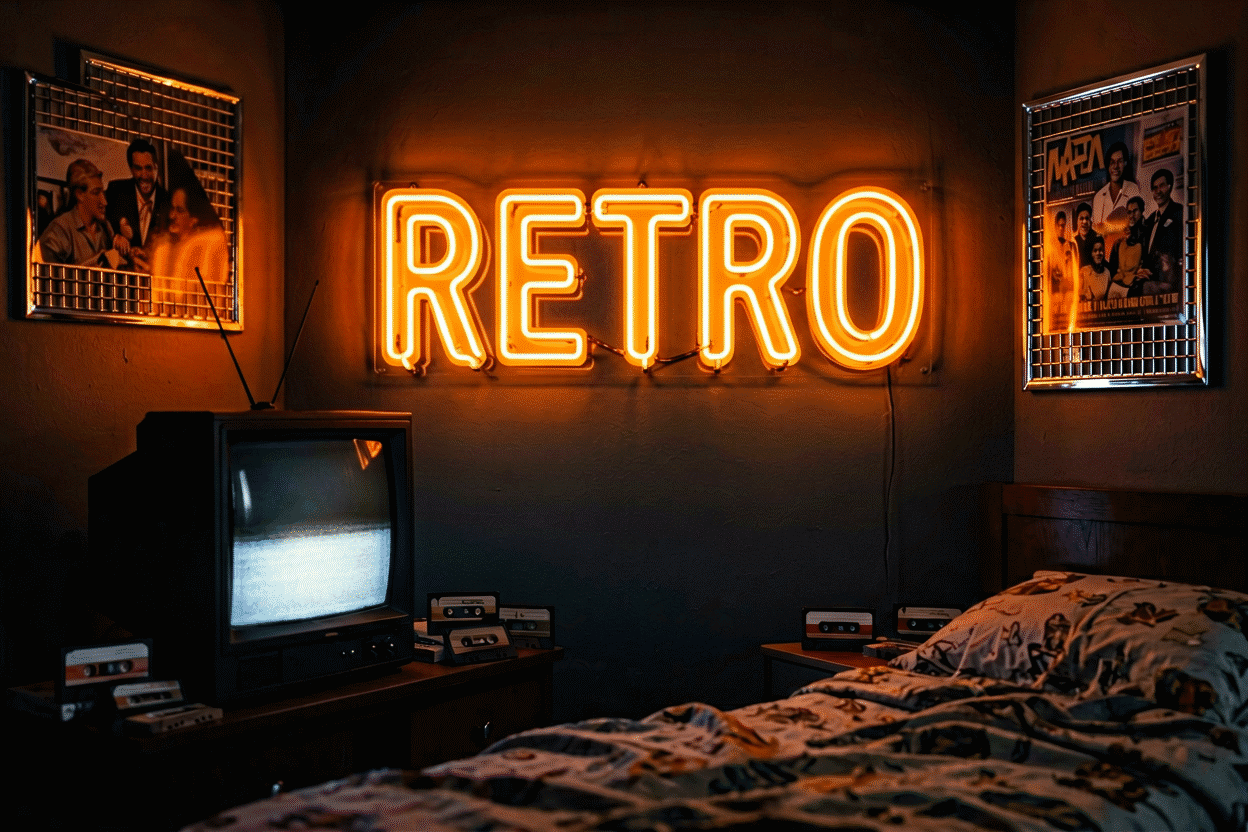
- The dark room — dark walls, amber and purple glow, curtains heavy: the moody system, which photographs best of all.
- The kids’ system — name anchor plus phase pieces: the two-layer approach that survives childhood (the kids canon).

The Feature Walls: Ideas 15–17
- The headboard wall — the bedroom’s classic: anchor centered, halo behind, width matched to the bed. The system’s most-repeated composition because it works.
- The gallery-fusion wall — neon among frames and prints: the anchor as one element in a grid; glow softens the whole arrangement (the composition math).
- The shelf wall — glow behind the shelf’s objects: the display tier that turns clutter into curation.
The Finishing Moves: Ideas 18–20
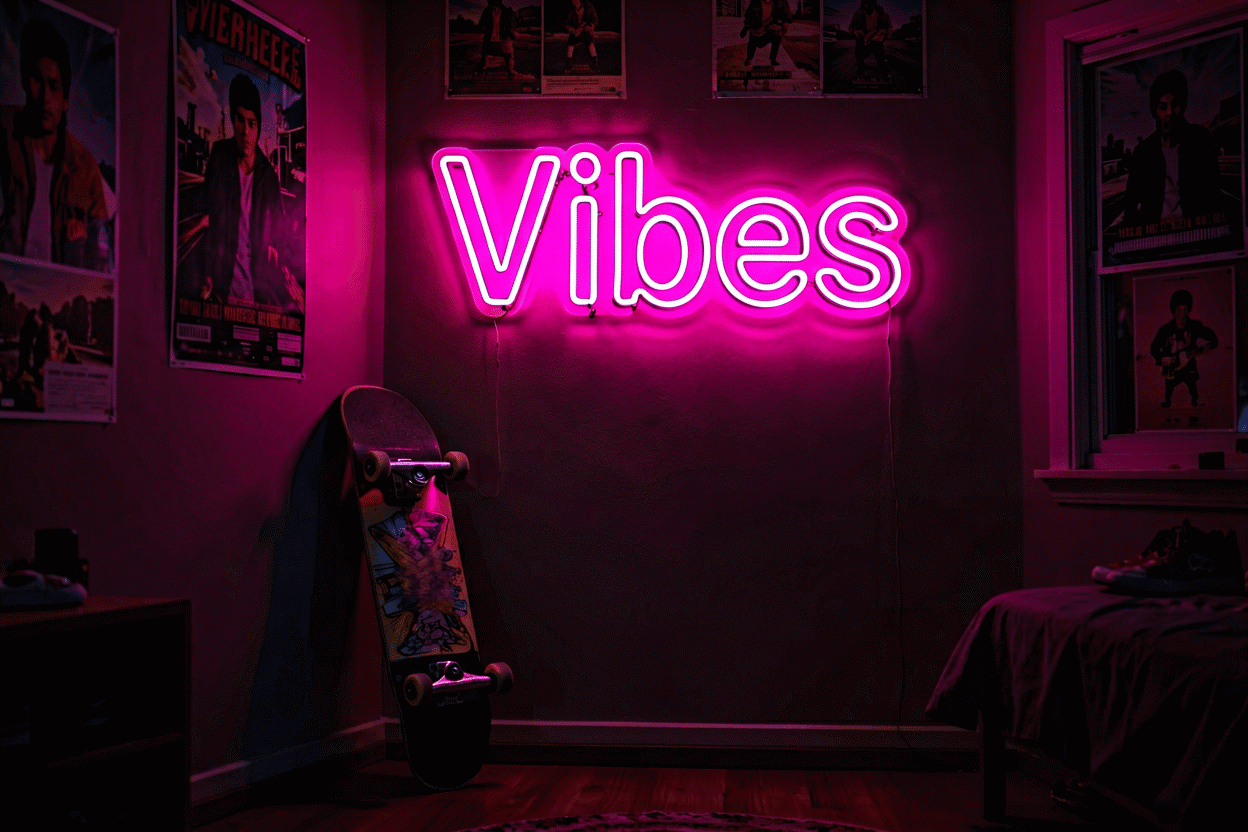
- The Good Vibes default — the phrase that survives every system change; the piece to buy when the room’s register isn’t decided yet.
- The plant-glow pairing — neon placed to backlight living plants: the room’s oxygen and its glow in one composition; the silhouettes do half the decorating.
- The season-rotation hook — one anchor mount, three seasonal pieces (the holiday tier for December): the system that stays fresh without re-commissioning.

Assembling the System
The order matters: anchor first (the room’s statement — phrase or shape, budget-weighted), palette second (the anchor’s color becomes the room’s accent; bedding and walls adjust to it, never the reverse), halo third (the strips that install the anchor), accents last (the corner piece, the reflection play, the finishing moves). Rooms assembled in this order land; rooms assembled by accumulation don’t, no matter how good the individual pieces are (the aesthetic logic).
The engineering runs underneath: dimmers everywhere, the hanging guide’s cord-invisible mounts, and the discipline of one focal per sightline. The glowing rooms that get saved a million times are not the ones with the most neon — they’re the ones where the system is legible at a glance: one voice, one palette, one clock of brightness, and a hundred small decisions agreeing with each other.
The System Audit: Is the Room Working?
The room-decor system’s five-point audit – run it on any room, any budget.
One: the anchor test. From the doorway, what piece reads first? The room with a clear anchor (one piece the eye lands on) passes; the room with three competing pieces fails – and the fix is demotion, not addition (smaller, dimmer, off-axis for the losers) (the hierarchy logic).
Two: the palette test. Do the glow’s colors agree with the room’s existing colors? The sign that argues with the bedding (the cool piece in the warm room) fails silently – the room reads unsettled, and no one knows why (the decoder maps the agreements).
Three: the clock test. Does the room have three brightness settings? The room with full-only reads one-note (and unbearable after ten); the room with the day’s arc (full, half, quarter) lives in its evenings – the dimmer’s absence is the system’s most common silent failure (the protocol).
Four: the reflection test. Seated at the room’s primary position, what glows in the screens and glass? The ghosts that pass this test stay; the ghosts that glare (the piece opposite the TV) need the six-inch shift (the method).
Five: the cord test. Can you find a visible cord? The room that passes this test (all cords channeled, routed, or hidden – the guide) reads installed; the room that fails reads hung – and the difference compounds nightly.
The System Budgets by Ambition
The one-anchor system ($100-250): the anchor piece and the dimmer – the room’s voice and its volume control, the minimum viable glow. The layered system ($250-600): the anchor, the halo, the corner accent – the room’s depth and hierarchy, the look the saves-folders run. The full system ($600-1,300): the anchor, the layers, the seasonal rotation, the wall-lights architecture – the room that glows as infrastructure (the whole-house logic).
The system’s economics in one line: the anchor is 50-60% of any budget, the halo is 20%, the accents share the rest – the ratio that makes any budget read designed rather than accumulated (the composition math develops the full case).
FAQ About Neon Room Decor
How do I decorate my room with neon? Anchor, palette, halo, accents — in that order. One statement piece the room orbits, a color system that follows it, strips that install it, small pieces that finish. The aesthetic guide develops the full system.
What’s the best neon sign for room decor? The anchor piece: a phrase or shape that names the room’s register — “Good Vibes” for the undecided, the namepiece for permanence, the wave or moon for the wordless (preview).
How many neon pieces should one room have? One anchor plus one or two supports: three working pieces per sightline is the ceiling. The system reads by hierarchy, not quantity.
What color neon is best for a room? The one your room’s palette confirms: warm white for neutrals, pink for the soft registers, purple for moody, blue for tech (the decoder). The room picks; the sign agrees.
How do I start decorating a room with neon? The anchor first: one statement piece (the phrase or shape) chosen for the room’s register, sized to the anchor furniture, hung focal – the room’s voice before any of its accents (the assembly logic above). The palette locks second (the anchor’s color becomes the room’s accent – the bedding and walls agree rather than argue), the halo third (the strips that install the anchor), and the accents last (the corner piece, the reflection play). The room that starts with the anchor builds around a center; the room that starts with the accents accumulates around a hole – the difference that shows at every budget level.
How do I make my neon room look aesthetic? The layered system, in the order that works: one anchor (the phrase or shape the room orbits – the statement bought at quality), one halo (the strip behind the headboard or sofa – the wall-lights engineering), and one or two accents (the corner piece, the reflection play) – the three-piece structure that the saved-a-million-times rooms run (the system logic above). Then the palette lock (the anchor’s color becomes the room’s accent), the dimmer stack (the day’s three brightnesses), and the photography hour (the dusk fifteen minutes when the room glows its best). The aesthetic room is three pieces, one palette, and one clock – the system the saves-folder screenshots, executed at any budget.
What’s the rule for mixing neon with lamps and string lights? Assign each light source a job and a height band: the neon piece owns eye-level statement duty, table lamps own the seated-reading pool, string lights own the perimeter’s upper edge. Collisions happen when two sources compete for the same job at the same height — the fix is dimming one tier or moving it a band up or down, not adding more light. Rooms with all three working their own zones read layered; rooms with three sources at one height read like a showroom.
How do you style neon into a room that wasn’t built around it? Steal a trick from gallery design: give the piece a landing zone — a solid-color wall section free of vents, switches, and competing frames, sized about twice the sign’s footprint. In busy rooms that zone might mean painting one wall section or rehanging two prints, which sounds like a favor to the sign but is actually the room gaining a focal point it never had.
The Anchor-First Room vs the Accreted Room
The room’s two assembly histories, compared:
| Decision axis | The anchor-first room | The accreted room |
|---|---|---|
| The first purchase | The statement (the room’s voice) | The gift, the sale piece, the phase |
| The wall’s center | Exists from week one | Emerges or never does |
| The palette’s logic | The anchor picks it (the system above) | The accumulation’s average |
| The budget’s efficiency | Full (every piece serves the center) | Partial (the pieces compete) |
| The audit’s result (the five-point test above) | Passes by construction | Fails by accumulation |
| The rescue | None needed | The demotion protocol (the anchor arrives late) |
The comparison’s rescue path – the accreted room’s fix: the anchor’s late arrival (the statement piece the room never bought) and the demotions that follow (the competing pieces shrinking to accents) – the five-point audit’s findings reversed in one purchase and an afternoon of re-hanging.
The two histories’ shared physics: the system’s rules (one focal, one palette, one clock) work at both histories’ budgets – the anchor-first room runs them from the start, the accreted room runs them from the rescue, and the rooms that converge on the system read designed regardless of how they began (the aesthetic logic).
Sources & Further Reading
- Neon sign (Wikipedia) — the consolidated public record of neon-sign history and technology.
Pricing based on CustomNeon’s current catalog (2026); custom quotes come live from the sign builder.