Neon Sign Quality Check: Is Your Sign Good?
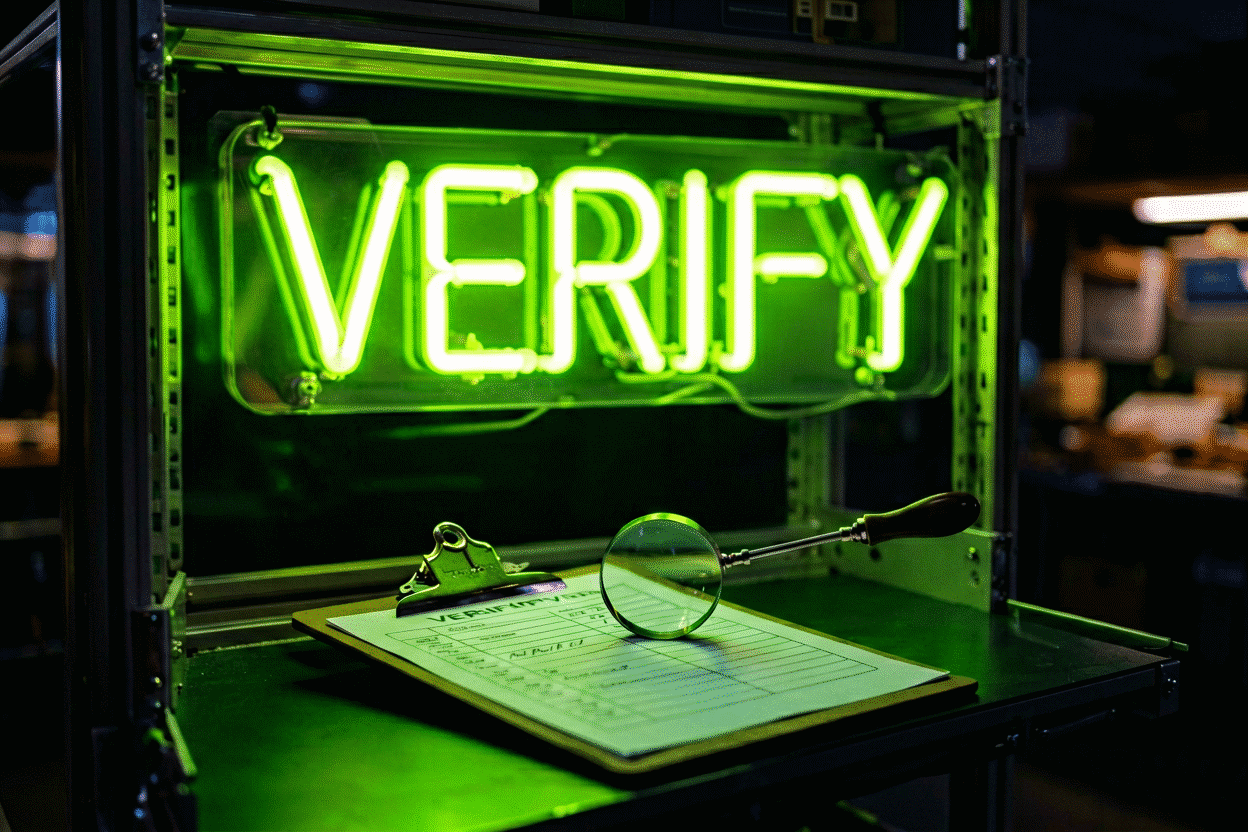
You can judge a neon sign’s quality in about ten minutes with your senses and a dark room: evenness of glow (no dark spots, no visible dot-patterns at arm’s length), clean letter joints, accurate color against what you ordered, solid backing, and certification marks on the electricals. Quality signs announce themselves — and cheap ones confess under the same inspection. Here’s the full protocol: what to check when a sign arrives, how to read the three quality tiers, and what the first week of ownership tells you.
This is the arrival-and-assessment companion to the buying guide and the pre-order checklist — those pages prevent bad purchases; this one evaluates what showed up.
The Ten-Minute Arrival Inspection (Five Senses, In Order)
See — the glow test in a dark room. Power on, lights off, two minutes of looking:
- Evenness: brightness consistent along every letter — no dim patches, no hot spots, no sections that lag a half-shade behind
- The dot test at arm’s length: quality flex reads as a continuous line even up close; cheap low-density flex resolves into visible LED points — the single fastest quality tell
- Letter joints: where flex segments meet, good signs hide the transitions; bad ones show dark gaps, brightness steps, or sloppy glue
- Color accuracy: the glow matches the color you ordered (check against the preview you approved — screen-to-eye needs the comparison, not memory; hex references at the color codes)
- Backing examination: acrylic edges clean-cut, mounting holes properly placed, no stress cracks at bends or holes
Touch. The backing rigid without creaks; the flex secured evenly along its runs (no loose segments that shift under a finger — gently, powered off); no rough silicone with flash-lines from cheap molds.
Hear. Nothing. Quality LED signs are silent — the adapter may hum faintly at the ear, the sign itself never. Buzzing from the sign means controller or connection faults (diagnosis).
Smell. Nothing, or a faint new-silicone trace that fades in days. Persistent chemical odor means uncured or low-grade jacketing — a genuine return-it signal.
Test electrically. Run the dimmer through its full range: smooth steps, no flicker zones (what flicker means); on RGB builds, cycle the primary colors and check each at full brightness; verify the certification marks on the adapter brick (the marks that matter).
Photograph everything — lit full-frame and close — the same session. It’s the delivery documentation for any warranty conversation (the claims file).
Reading the Three Tiers (What Quality Looks Like)
| Observable | Premium | Standard | Cheap |
|---|---|---|---|
| Glow at arm’s length | Continuous line | Continuous at 3+ ft | Dots visible anywhere |
| Section transitions | Invisible | Findable if you hunt | Obvious steps/gaps |
| Color vs. ordered | Exact | Faithful | Drifted (orange “pink,” teal “blue”) |
| Backing | Clean-cut, thick acrylic | Fine | Thin, stress-marked, rough edges |
| Flex mounting | Even, secured | Mostly even | Loose segments, glue blobs |
| Electricals | Certified, sealed | Certified | Unmarked bricks |
| Dimming behavior | Full range, smooth | Good | Flicker zones, coarse steps |
| Silent operation | Yes | Yes | Buzzes or clicks |
| The week-one smell | None | Fades fast | Lingers |
The honest calibration: standard tier is fine for most homes — the market’s middle delivers genuinely good signs. Premium buys longevity polish (component tiers); cheap is the only tier with real regrets attached.
The “Legit or Scam” Screen (For Online Sellers)
The question behind half this SERP — “is this seller real?” — has a five-minute answer using the same observables, applied to listings instead of boxes:

- Real photography of actual installs (consistent lighting across the gallery) vs. renders and stock mockups
- Specs that survive questions: density, adapter certification, warranty terms in writing (what honest terms look like)
- Review archaeology: photo-attached reviews, longitudinal stories (month-six reviews, not day-one unboxings), and — decisive — the seller’s behavior in the bad ones
- The marketplace pricing smell: identical signs under five brand names at prices that math can’t support (channel economics)
- Contact reality: pre-sale questions answered like a business (questions worth asking)
Scam-adjacent sellers fail these fast; real ones pass them boringly. Boring is what you want.
The First-Week Protocol
Days 1–7, three checks:
- Daily power-on consistency — any flicker, section lag, or startup hesitation developing in week one is a warranty claim now, not a quirk to watch
- The dimmer at your real evening level for real hours — problems that only show at low duty cycles surface here
- Connector warmth check (careful, powered off) — the adapter runs warm-to-comfortable, never hot; connectors stay cool. Heat at joints means resistance faults (the failure map)
A sign that passes week one cleanly tends to years — the infant-mortality window is real, and it’s exactly what the burn-in testing exists to catch before shipping. Week one is your verification that the maker actually did it.
Keeping It That Way
Quality maintenance is modest: the monthly wipe (the routine), the annual connector-and-hardware inspection (the schedule), surge protection always (the $15 insurance). Quality is purchased once at order and then simply not sabotaged.

The Quality Tiers Across Time: Longevity Expectations
What each quality tier delivers in years — the longevity projections the arrival inspection predicts:
The premium tier (certified, dense, sealed, warrantied 24 months). Projection: 5–10 years of daily service before meaningful fade, with the realistic failure events being the adapter (year 3–5, $25 to fix (the repair math)) and connectors in high-handling installs. The tier’s burn-in and component selection remove the infant-failure cliff — the quality premium is literally pre-paid reliability (the QC layer).
The standard tier (certified, honest density, 12-month warranty). Projection: 3–7 years of daily service — the same failure profile with slightly higher frequency, the same adapter-centric economics. The market’s middle holds value honestly: most home signs in this tier outlive their owners’ interest in the room they were bought for, which is the practical durability bar (the lifespan math).
The cheap tier (the dot test failures). Projection: 1–3 years to first significant fault — patchy sections, adapter deaths, jacket yellowing in sun (the tier table) — with each fault unserviceable at the price point. The tier’s honest use case: novelty timelines (one event, one season, one gag gift) where the sign’s job ends before the failure clock runs.
The usage variables that move every projection. Daily hours (nightly-at-100% versus evening-at-30% changes the clock by years — the dimming dividend); environment (sun exposure, humidity, grease — the environmental layer); and the maintenance floor (annual inspections catch the drift while it’s cheap (the schedule)). Same sign, three owners, three different lifespans — the variables are the owner’s.
The projection’s practical use: match the tier to the timeline. The forever-wall buys premium (the spec levers); the apartment-era sign rents the standard tier’s economics; the one-night party piece takes the cheap tier honestly. Quality frustration is mostly timeline mismatch — the buyer who wanted years from a tier priced in seasons. The arrival inspection tells you which clock you actually bought.
FAQ: Neon Sign Quality
How can I tell if a neon sign is good quality? Ten minutes with senses: even glow with no dim patches, a continuous line at arm’s length (no visible LED dots), invisible letter joints, accurate color, clean-cut backing, silent operation, and certified electricals — the full inspection protocol above.
What’s the fastest quality tell on an LED neon sign? The dot test: at arm’s length, quality flex reads as one continuous glowing line; cheap low-density flex resolves into visible points. Five seconds, decisive.
How do I know if a neon sign seller is legit? Real photography (not renders), written specs and warranty terms, photo-attached and longitudinal reviews, professional pre-sale answers, and coherent pricing — the legit-or-scam screen walks it in five minutes.
Do cheap neon signs last? Often long enough to feel like a deal, then not: thin acrylic cracks, unsealed connectors corrode, unmarked adapters die (the failure map) — and each failure is unserviceable at the price point. Standard-tier signs from real makers are the durable middle.
What should I check in the first week after delivery? Daily power-on consistency, the dimmer at your real evening level for real hours, and (powered off) that connectors stay cool while only the adapter runs warm — week one is when manufacturing faults declare themselves, while warranty windows are widest.
Can I return a neon sign that fails quality checks? Delivery-documented faults (lit photos, close-ups, the box condition) are replacement cases inside the reporting window; week-one electrical faults go through warranty. The photography from your arrival inspection is the whole case file. The quality assessment’s summary: ten minutes with senses and a dark room tells you the tier (the inspection protocol); the three tiers price their longevity honestly (the projections); and the week-one protocol catches what the factory’s burn-in should have. Quality in this category is visible, testable, and pre-paid at the spec sheet — the rare consumer category where diligence literally shows up in the glow.
The Quality Verdict, Pre-Purchase Edition
Everything the arrival inspection tests can be pre-tested at the listing stage: density is visible in the photos (the dot test works on product photography — the tell), certification is printable or absent, warranty length is stated, and review longitudinality is searchable (the pre-purchase screens). The inspection at the door then verifies what the listing promised — and the gap between promised and delivered, if you find one, is your documentation for the claim. Quality assessment is a loop, not an event: screen, inspect, document, and the loop’s cycles compound into a household that never keeps a bad sign.
Sources & Further Reading
- Mercury (U.S. EPA) — federal guidance on mercury exposure and safe handling.
- Neon sign (Wikipedia) — the consolidated public record of neon-sign history and technology.