How Long Do Neon Signs Last? LED vs. Glass Lifespan

A quality LED neon sign lasts 30,000 to 50,000 hours — that’s 10 to 17 years at 8 hours a day, or about 4 to 6 years running 24/7. A real glass neon sign lasts roughly 30,000 to 40,000+ hours of tube life (often quoted as 8–15 years of typical use), though its transformer usually needs replacing once or twice along the way. Neither type dies suddenly the way an old light bulb did; they fade, and the fade is predictable.
The honest answer has two layers: the rated number on paper, and the five things that decide whether your sign hits that number or dies at year two. Both layers below.
The Numbers at a Glance
| Sign type | Rated lifetime | If run 24/7 | If run 8 hrs/day |
|---|---|---|---|
| Quality LED neon | 40,000–50,000 hrs | ~4.5–6 years | ~14–17 years |
| Budget LED neon | 20,000–30,000 hrs | ~2–3.5 years | ~7–10 years |
| Glass neon tube | 30,000–40,000+ hrs | ~3.5–4.5 years | ~10–14 years |
| Glass neon transformer | 50,000–100,000 hrs | 6–11 years | usually outlives the tube |
Two takeaways worth internalizing. First, the LED in a decent sign will almost certainly outlast your ownership of it — people replace bedroom decor faster than diodes fade. Second, with glass neon the tube is rarely what kills the sign; the transformer is a wear part, and replacing one is routine repair, not a funeral.
Why LED Signs Last So Long
LED longevity comes from what’s missing. There’s no filament to burn through, no gas slowly disappearing, no electrodes being eroded by plasma. The LED chip itself degrades only when it runs hot, and a neon-style sign dissipates its modest heat (an entire medium sign draws 15–30 watts) through its silicone jacket and acrylic backing.
Quality variation is real, though, and it concentrates in one component: the power adapter. Cheap adapters deliver unstable current, and unstable current is what actually kills most “dead” LED signs — not the diodes. A sign with a quality adapter at 20 watts will outlive a sign with a bargain one by years. When a sign does fail early, replacing the adapter fixes it surprisingly often; the diagnosis steps are in how to fix a neon sign.
LED vs. Glass: Two Different Aging Clocks
The two technologies don’t just have different lifespans — they age in different ways, and knowing the difference tells you what to watch for.
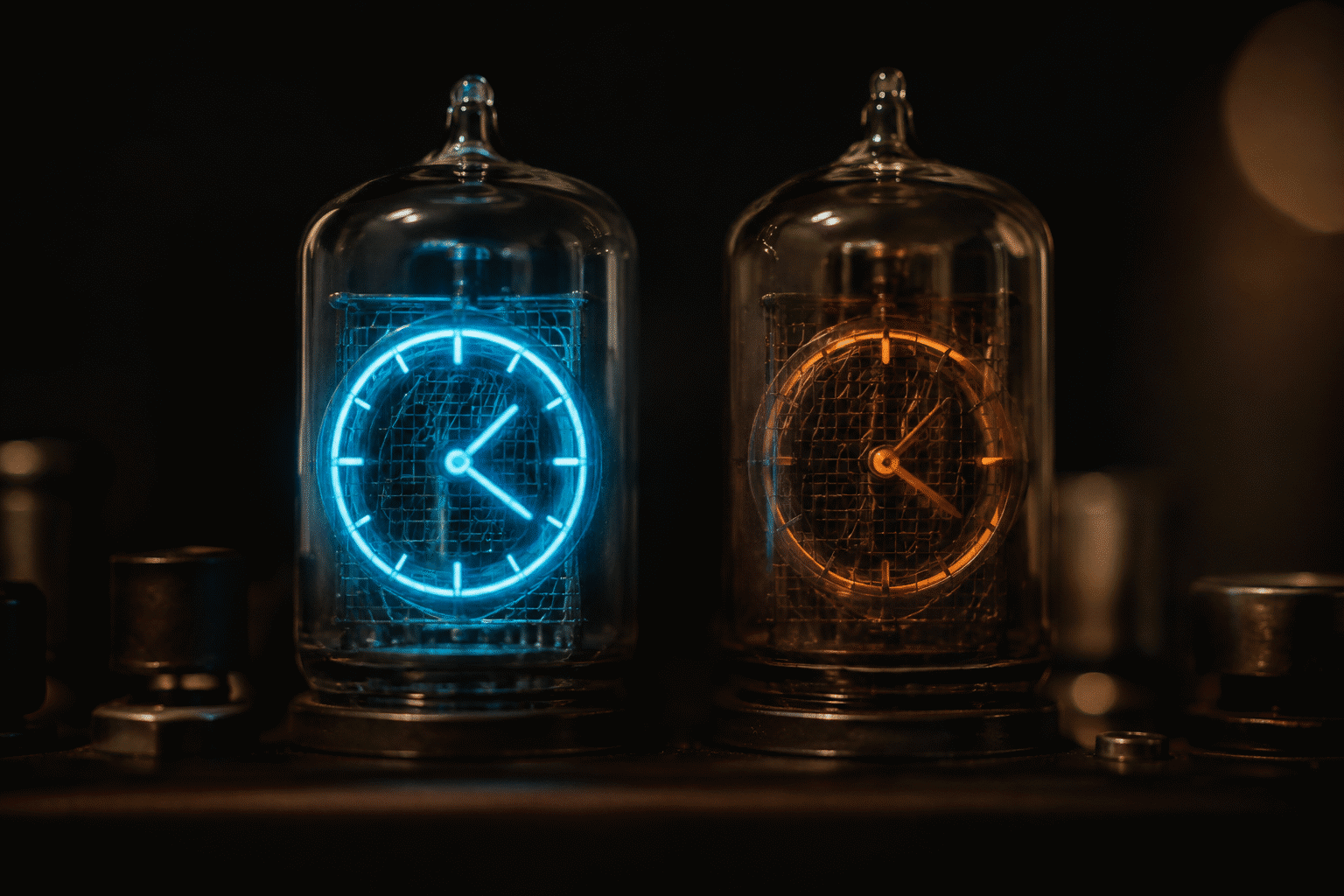
LED neon fades on a gentle slope. Diodes don’t burn out; they lose output gradually in a process called lumen depreciation. A quality LED rated at 50,000 hours reaches roughly 70% of original brightness at that mark (this is actually what the rating means — the industry’s L70 standard, not the day the sign dies). For the first several years the change is invisible to the eye. Around 70% brightness, most people notice in side-by-side photos, not in the room. The slope is steepened by exactly one thing: heat. That’s why placement matters more than hours.
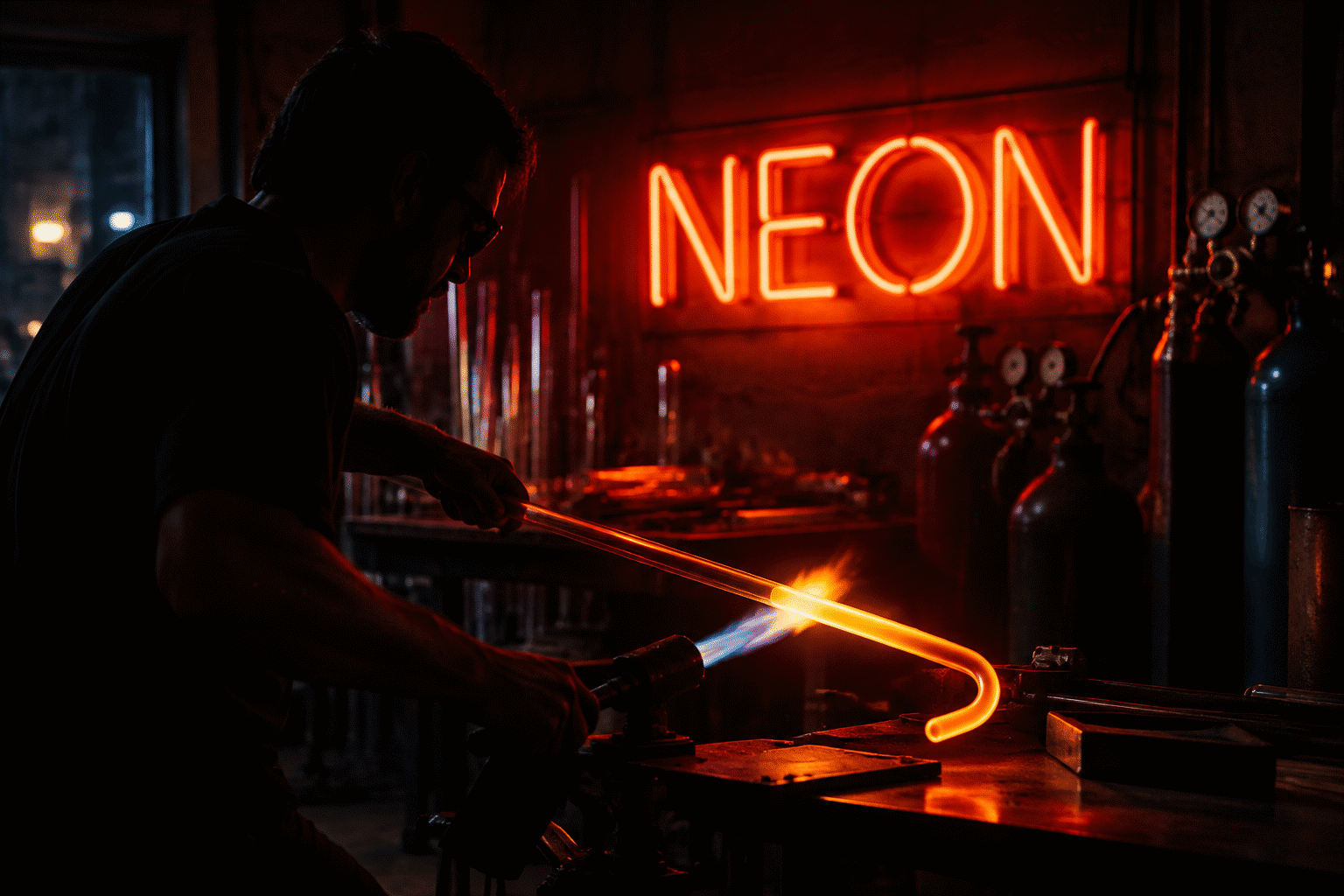
Glass neon ages in stages. The gas inside a tube slowly disappears — not by leaking, but by being absorbed into the tube walls and electrodes, a process sign makers call gas cleanup. As pressure drops, the glow shifts (reds can drift toward pink or violet), the tubes dim at the ends first, and eventually the transformer can’t sustain the discharge steadily. A well-made tube reprocessed with fresh gas by a sign shop can go another full lifecycle — glass neon is, in that sense, renewable in a way LEDs aren’t. The phosphor coatings age too: white and blue phosphors are the first to drift, which is why vintage white tubes so often read pinkish today.
The practical monitoring difference. For LED, take a phone photo on day one and re-photograph yearly from the same spot — brightness comparison is the only meaningful check. For glass, watch the tube ends and color purity; darkened electrodes and drifting hue are your service indicators. Neither type needs anything else from you day to day — the maintenance list is genuinely just the dusting covered later in this guide, plus keeping the adapter ventilated.
What Actually Kills a Neon Sign
Five things separate a 15-year sign from a 2-year one:
1. A cheap power supply. The #1 killer of LED signs, as above. Heat builds, capacitors dry out, output drifts, the strip starves or surges. If a deal looks too good, the adapter is usually where the money was saved.
2. Heat. LEDs age faster as junction temperature rises. A sign mounted in a sunny south-facing window, over a radiator, or against a warm appliance is aging several times faster than the same sign on a shaded wall. Glass neon tolerates heat better, but its wiring and transformer don’t love it either.
3. Frequent power cycling (mainly glass). Every start of a glass neon tube erodes its electrodes slightly. A tube switched on and off 30 times a day ages measurably faster than one switched twice. LED signs don’t care — cycle them freely.
4. Moisture. Indoor-rated signs in bathrooms, covered patios, or garage workshops collect condensation on connectors, which corrodes. If the location is genuinely damp, buy an outdoor-rated (IP-rated) design or keep the sign in conditioned air.
5. Physical impact. Glass neon is self-explanatory. LED flex survives bumps well, but the acrylic backing can crack at the mounting points if the sign is hung from one screw at an angle it wasn’t designed for. Mount through every provided hole, and a sign that travels (events, markets, trade shows) deserves a padded case — repeated transport vibration is the silent killer that shortens more event signs than any electrical fault.
Signs Your Neon Sign Is Aging
Neither type just drops dead. Watch for the early warnings:

- Gradual dimming. Both types lose output slowly. LED fade is even; glass fade often shows as the ends of tubing going duller than the middle.
- Color shift. Old phosphor coatings in glass tubes drift (whites go pinkish). Old LED strips can shift cooler or warmer as the phosphor layer ages.
- Flickering sections. In LED signs, usually a failing adapter or a damaged section; in glass, a sign of gas depletion or electrode trouble. Our repair guide separates the fixable from the professional jobs.
- Buzzing. A glass transformer that hums louder than it used to is announcing its retirement.
- Dark ends on glass tubes. Electrode sleeves darkening is normal at year 10+, alarming at year 2.
Can You Leave a Neon Sign On 24/7?
Yes — with the right sign. LED neon is genuinely indifferent to being left on: no warm-up, no electrode wear, negligible heat, and a monthly electric bill in the low single digits (the full math is in do neon signs use a lot of electricity?). Bars, gyms, and shops that run LED signs around the clock are simply reading the same 24/7 column in the table above — about 4.5–6 years of continuous service before noticeable fade.
Glass neon can also run continuously, and ironically it’s better for the tube than frequent switching. What you’re spending is electricity (roughly 3–5× an LED equivalent) and transformer life. A storefront glass sign running 24/7 should plan on a transformer service visit somewhere around year 6–10 — routine work for a sign shop.
Practical pattern for home: put the sign on a smart plug, run it evenings only, and the “8 hrs/day” column is your clock — most people will tire of the design before the sign tires of glowing.
How to Make Yours Last Longer
Six habits, roughly in order of payoff:
- Buy the sign with the better adapter, not the cheaper sign. Ask what the warranty covers.
- Keep it out of direct sun and away from heat sources. Heat is the only thing that meaningfully accelerates LED aging.
- Dust it monthly. Dust insulates, insulation warms, warmth ages. Two minutes with a dry microfiber cloth — full method in how to clean a neon sign.
- Use a smart plug or timer instead of manual switching for glass neon; set the schedule and stop thinking about it.
- Mount to all the provided holes. Signs hung from one point flex the acrylic and stress the nearest section.
- For damp locations, buy outdoor-rated. Retrofitting weatherproofing after the fact doesn’t work.
Warranty Reality
Industry standard for custom LED neon is a 12–24 month warranty, and what it covers matters more than its length: the good ones cover the adapter and workmanship; the thin ones cover only manufacturing defects in the LED strip, which almost never fails. Glass neon warranties typically run 12 months on tubes, with transformers treated as consumables after that.
Keep your order confirmation and the adapter’s voltage label photographed. Adapter replacement is the single most common warranty claim in the industry, and it’s a five-minute fix when the parts are on hand.
FAQ: Neon Sign Lifespan
How long do neon signs last? Quality LED neon signs last 30,000–50,000 hours (10–17 years at 8 hours/day). Glass neon tubes last 30,000–40,000+ hours, with transformers needing replacement every 6–10 years.
Do LED neon signs last longer than glass? Yes, in practice. A quality LED sign often outlives two glass tubes, and it has no transformer to service. Glass kept well still delivers decades — it’s artisan hardware, not disposable decor.
Can you leave a neon sign on 24/7? Yes. LED signs are unaffected by continuous running and cost only a few dollars a month. Glass neon also runs 24/7 fine — continuous operation is actually easier on the tubes than frequent switching.
Do neon signs burn out suddenly? Rarely. Both types fade gradually. When a sign goes dark abruptly, the cause is almost always the power supply (LED) or transformer (glass) — both replaceable.
Do neon signs fade? Yes, slowly. LEDs lose brightness gradually over tens of thousands of hours; glass tubes dim as gas is slowly absorbed by the tube walls and electrodes. Monthly dusting and avoiding heat slow both.
How do I know when a neon sign is dying? Dimming, color shift, flickering sections, buzzing (glass), or darkened electrode ends. Flickering and dead sections are diagnosable — see how to fix a neon sign before assuming the worst.
Start With a Sign Built to Last
Lifespan is decided at purchase: quality diodes, a properly rated adapter, and a backing that mounts flush. The custom neon sign builder prices designs live, so you can see exactly what your budget buys at each size — and pick the configuration you’ll still be hanging in year ten. For inspiration on signs that earn their 24/7 keep, browse our neon bar signs and open signs collections.
Sources & Further Reading
- Solid-State Lighting (U.S. Department of Energy) — DOE reference on LED efficacy and lifetime.
- Neon sign (Wikipedia) — the consolidated public record of neon-sign history and technology.
- Mercury (U.S. EPA) — federal guidance on mercury exposure and safe handling.