What Are Neon Signs? Definition and Types
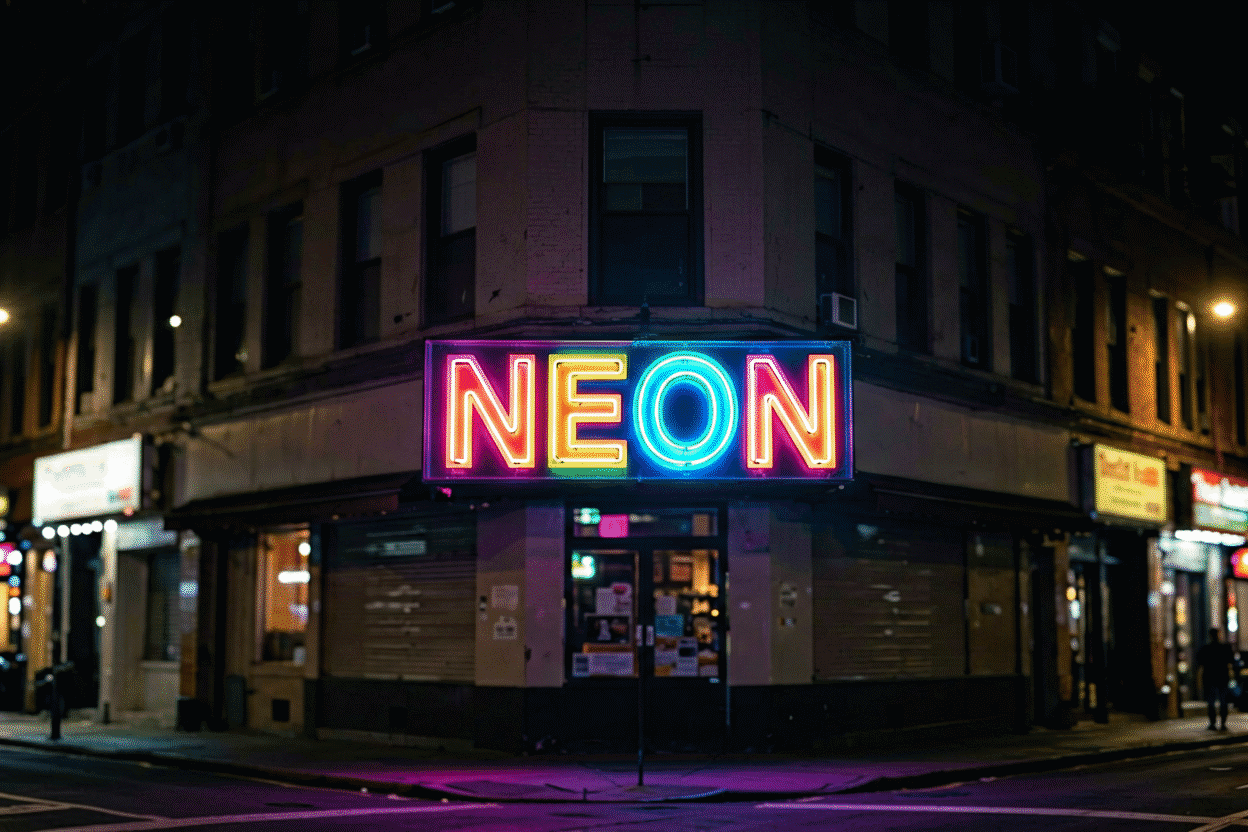
A neon sign is a display made from glowing tubes shaped into words, letters, or graphics — historically glass tubes filled with gas that emits light when electrified, and today usually LED strips in silicone tubing that replicate the same look. That’s the whole definition, and it hides a century of history and a full modern industry: signs that started as Parisian storefront spectacle in 1912 now glow over beds, bars, weddings, and storefronts worldwide, mostly wearing LEDs instead of gas.
This page answers the three questions people actually ask — what they are, what they’re made of, and how they work — then points to the deep dives for each. First-time buyer? It ends with where to start.
Question 1: What Exactly Is a “Neon Sign”?
Two technologies share the name, and using it precisely matters:
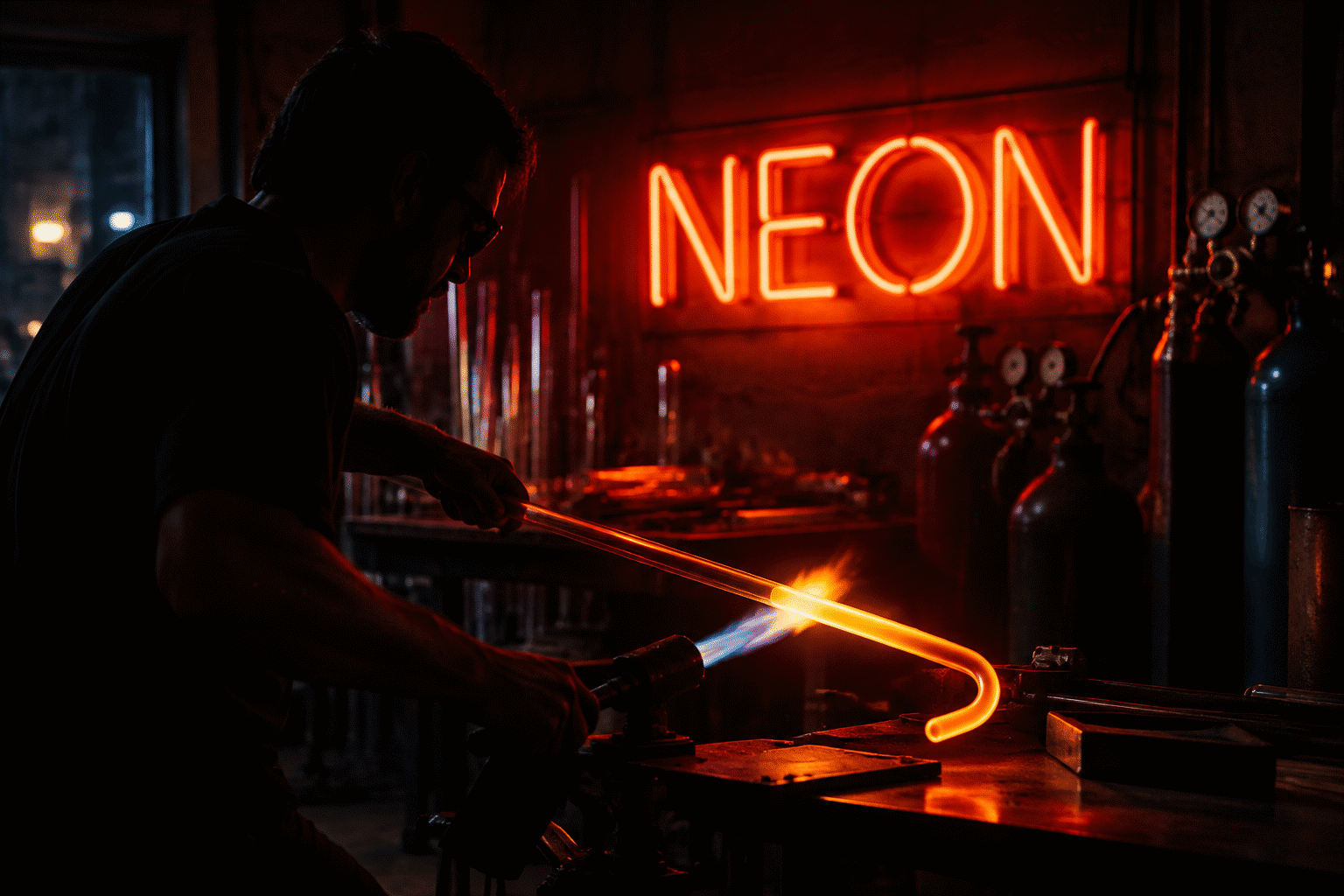
Glass neon (traditional) — the original: glass tubing bent by hand into letterforms, filled with noble gas (neon, argon, or kin) at low pressure, and lit by a transformer pushing thousands of volts through the gas, which glows in the signature colors. Real craft, real physics, real heritage (its story).
LED neon (modern) — the successor that most signs today actually are: flexible silicone tubing containing LED strips, cut and formed to letter shapes on an acrylic backing, powered at a safe 12–24 volts. Same silhouette, different physics (its anatomy).
The name stuck to the look rather than the contents — “neon” long ago became the word for the glow itself, regardless of what’s producing it (the full etymology). When you buy a “neon sign” online today, it’s LED unless stated otherwise; when you see a landmark sign downtown, it may well be glass.
Question 2: What Are They Made Of?
Glass signs: bent glass tubing, the noble gas fill, metal electrodes at each tube end, a high-voltage transformer, and a backing frame or panel. Plus, historically, mercury in some blue/white fills — largely engineered away in modern production, relevant for vintage pieces (details).
LED signs: light-emitting diodes on a flexible circuit strip, the silicone jacket that diffuses them into a continuous glow, an acrylic backing (cut-to-shape or full panel — the backing decision), and the low-voltage adapter/controller power chain (the power layer).
Five materials each, nothing exotic — the complete materials list with the owner-facing notes lives at what is neon made of.
Question 3: How Do They Work?
Glass: the transformer ionizes the gas into plasma; excited electrons falling back to lower energy states release photons — light. The gas’s identity sets the color (pure neon = red-orange; the rest of the palette comes from other gases and phosphor coatings). The full physics.
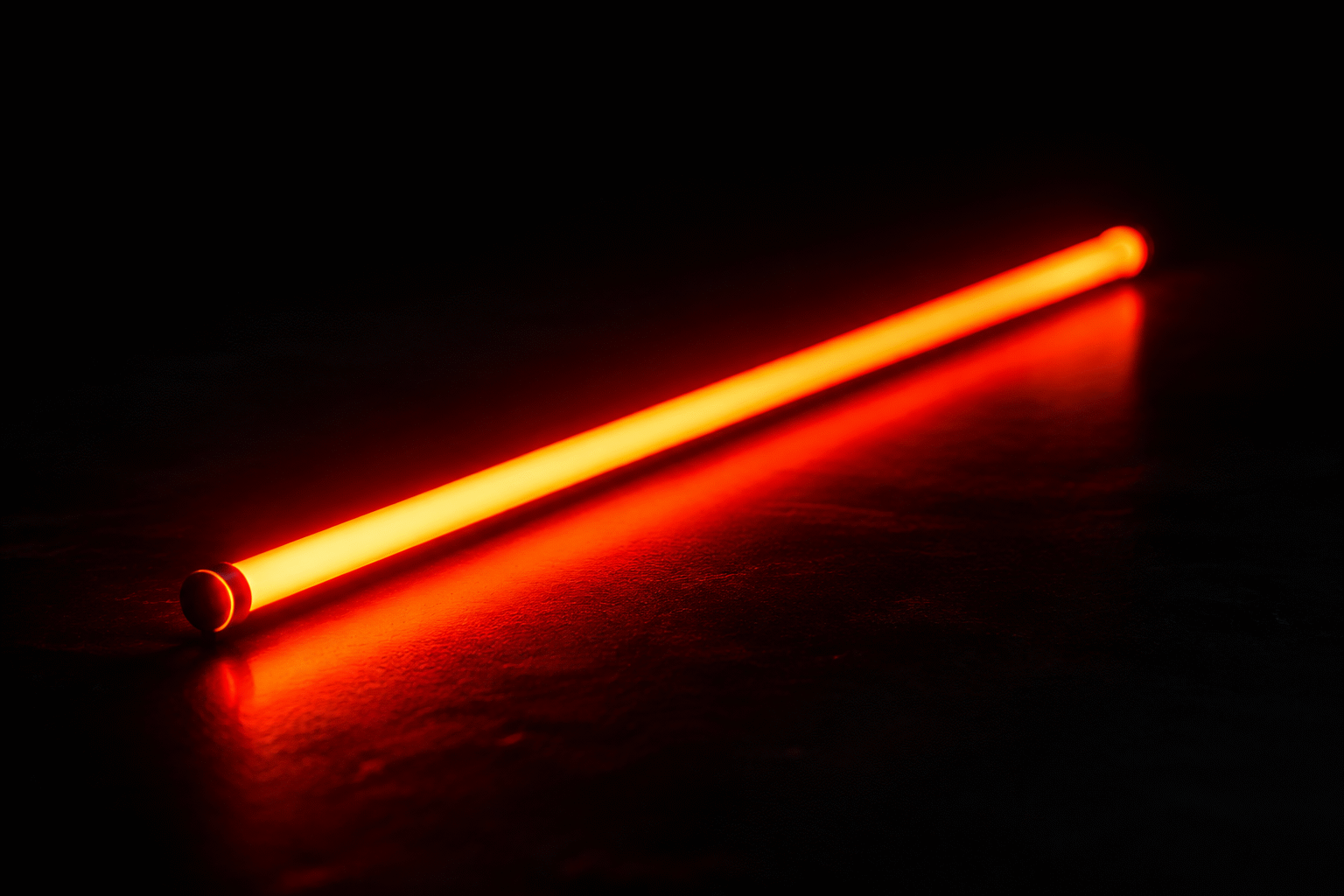
LED: current crosses semiconductor junctions that emit photons directly; the silicone jacket’s profile turns the line of point-lights into what reads as a continuous glowing tube. Dimming works by ultra-fast pulsing invisible to the eye. The full mechanism.
Both are “electricity makes something emit light” — one via gas atoms and kilovolts, one via semiconductors and phone-charger volts. That voltage difference is most of the practical difference between owning them.
The Short Version of Everything
| Question | Glass neon | LED neon |
|---|---|---|
| Light from | Gas discharge | Diode emission |
| Voltage | 2,000–15,000V | 12–24V |
| Typical custom cost | $500–2,000+ | $100–300 |
| Lifespan | Decades (serviced) | 30,000–50,000 hrs |
| Safe for bedrooms | Professional install territory | Yes, natively |
| Where it shines | Heritage, craft, landmark identity | Homes, events, business, everywhere else |
The complete comparison: LED vs glass neon.
Why They Exist At All (Sixty-Word History)
Georges Claude debuted neon signage in Paris, 1910–12; America turned it into the commercial vernacular by the 1930s (Times Square, Vegas, Route 66); war and plastic displaced it by mid-century; museums and artists rescued its heritage; and the 2010s’ LED flex repackaged the look at consumer prices — the bedroom-glow era you’re probably shopping in right now. The full arc: history of neon signs.
Types, Quickly
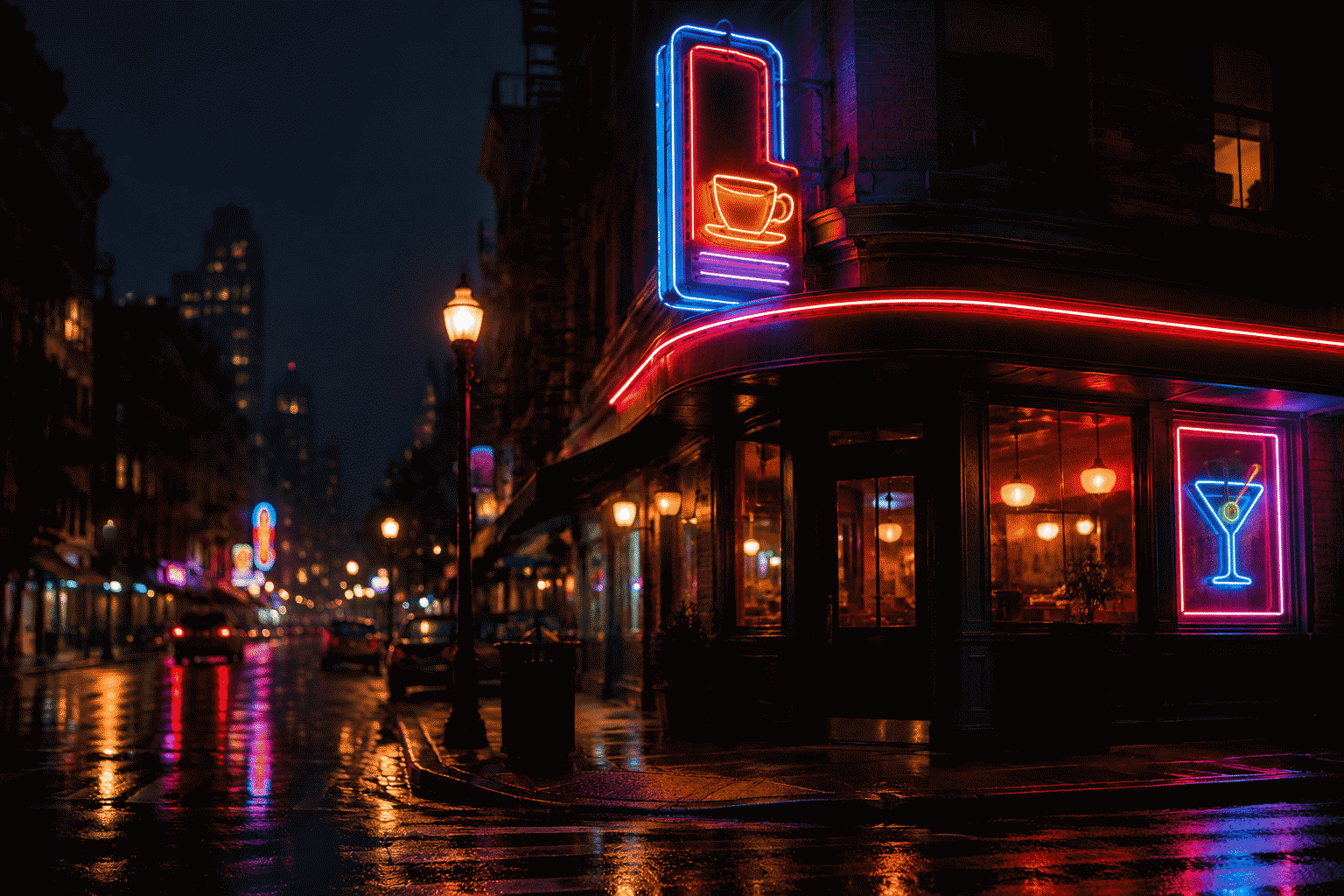
The formats worth knowing by name: custom wordmarks (the dominant modern format), shapes and icons, storefront and open signs (business line), event and wedding pieces, art and gallery work, and the vintage/collector tier. The complete typology with examples: types of neon signs.
First Sign? Start Here
- Decide the wall first — placement drives everything (the decision framework)
- Measure honestly — the measurement guide and its paper-mockup ritual
- Preview everything live — words, colors, sizes, real pricing in the custom builder
- Or browse finished designs — the collections at neon signs for sale, from bedroom to bar to business
Reading a Neon Sign Like an Insider
The definitional knowledge above, applied — how the fluent observer reads any sign they meet:
The technology tell. In the wild, glass vs. LED announces itself in seconds: the halo’s depth and the micro-flicker say glass (the visual physics); the perfectly even line and the dimmer’s smoothness say LED. The transformer hum, audible at close range, is glass’s signature. Restaurants and bars with authentic tubes tend to let you know it, too — the medium’s premium is part of the ambiance being sold.
The era read. On glass pieces: tube colors and construction date them (pre-war porcelain-button mounts and heavy transformers; postwar wire grids; modern acrylic) (the dating method). On LED: density and jacket quality place the build within the technology’s own decade — early flex (visible dots, warm-running) against current high-density builds (the quality tiers).
The design literacy. Typography tells you who commissioned it: era-script says heritage or heritage-nostalgia (the vintage vocabulary); clean sans says contemporary business; the aesthetic-era script says a bedroom or a feed (the current chapter). Iconography maps to industries (arrows for retail, steins for bars, scissors for salons — the commercial vernacular).
The placement grammar. Where a sign sits tells you its job: window height and street-facing angles are commercial optics (the B-end logic); over-headboard and content-corner placements are the domestic canon (the bedroom placements); museum and gallery contexts mark the art lineage (the institutional tier).
The full read, in one sentence: a sign’s technology, era, design, and placement together tell you who made it, who it was for, and what it was saying — the entire social history of the medium legible in one glowing object on a wall. That’s what “knowing what a neon sign is” actually buys: every sign you meet becomes a document, and the world’s glowing walls become a library you can read. Start your own chapter in the builder.
FAQ: What Are Neon Signs
What is a neon sign? A display made of glowing tubes shaped into words or graphics — traditionally glass tubes filled with electrified gas, and today usually LED strips in silicone tubing replicating the same look at safe low voltage.
What are neon signs made of? Glass versions: bent glass tubing, noble gas, electrodes, a high-voltage transformer, and a backing. LED versions: diode strips, silicone jacket, acrylic backing, and a low-voltage adapter — full lists in our materials guide.
How do neon signs work? Glass signs ionize gas into light-emitting plasma at kilovolts; LED signs emit light at semiconductor junctions at 12–24 volts. Both are covered in plain-language physics in our how-they-work guides.
Are modern neon signs actually neon gas? Mostly not — the majority of signs sold today are LED “neon,” containing no gas. Authentic glass gas-discharge signs remain available as craft and commercial work.
How much do neon signs cost? Custom LED signs run $100–300 for typical home sizes; glass neon runs $500–2,000+ for equivalent work; stocked designs start lower. The full price anatomy: neon sign cost.
Where should I start if I’m buying my first neon sign? Pick the wall, measure it, draft short personal words, and preview the design live in a custom builder — then order with confidence. Our choosing guide walks the seven decisions in order. And with the three questions answered, the definitional loop closes: a neon sign is glowing tubes shaped into meaning — glass or silicone, gas or diode, Claude’s century or your bedroom’s decade. Everything else this library covers (the physics, the materials, the types, the comparison) unpacks one clause or other of that single sentence. The definition was always simple; the century behind it is what needed the guides (start writing your own clause).
The Definition, One More Time
Glowing tubes, shaped into meaning: gas or diode, Paris 1910 or your wall this year, Claude’s transformers or your phone charger’s voltage class — the definition holds across all of it, and every page in this library unpacks one clause (physics, materials, types, economics). What the definition cannot capture is the reason people care: a neon sign is the rare object that is simultaneously lighting, art, and message — infrastructure with feelings. That triple duty is why the century-old medium needed a definition page at all, and why you read this far.
The tour continues from here: the physics next, the materials after, the types beyond that — or skip straight to the part where the definition gets personal (the builder).
Sources & Further Reading
- Cleaning Up a Broken CFL (U.S. EPA) — the federal mercury-spill cleanup procedure; we mirror it for broken glass-neon tubes.
- Neon: Strong Lines (NIST Physical Reference Data) — the standard reference for neon’s emission wavelengths.
- Argon: Strong Lines (NIST Physical Reference Data) — the standard reference for argon’s emission wavelengths.
- Solid-State Lighting (U.S. Department of Energy) — DOE reference on LED efficacy and lifetime.
Pricing based on CustomNeon’s current catalog (2026); custom quotes come live from the sign builder.