Neon Art History: From Signage to Fine Art
Neon art history is the story of advertising’s material becoming art’s language: a medium invented to sell Packards, mastered by commerce, and then — starting seriously in the 1960s — picked up by artists who discovered that a glowing tube could carry irony, critique, intimacy, and transcendence as well as it carried a brand. Today neon and its LED descendants hang in MoMA, sell at contemporary auctions, and anchor light-art as a recognized genre. The transformation took a century and had four distinct acts.
The commercial century behind this story lives at history of neon signs; this page is what happened when the artists arrived.
Act I: The Long Apprenticeship (1930s–1950s)
Before artists touched it, neon had already done the cultural work art would inherit: it defined the modern city’s nightscape, became the visual vocabulary of cinema noir and metropolitan modernity, and grew so associated with commerce that not being an advertisement meant something. The earliest gallery appearances — isolated experiments with luminous tubes in the 1930s–50s — read now as previews: the material’s artistic voltage was visible, but the institutions, the market, and the conceptual frame hadn’t arrived.
What made the wait productive: neon spent those decades acquiring exactly the associations its artistic era would trade on — the promise (the city, the future, desire) and, beneath it, the melancholy (the diner at 3 am, the transient, the commercial promise that fades). Light with a subtext: the raw material of an art movement.
Act II: Light Art Opens the Door (1950s–1960s)
The breakthrough came through the broader light-art movement rather than neon specifically: artists began working with fluorescent tubes as sculpture — Dan Flavin’s fluorescent installations (from 1961 onward) being the canonical case that taught the art world that industrial light could be a legitimate medium: material, not decoration. Flavin worked in fluorescent rather than bent neon, but the conceptual door he opened — light as form, hardware-store material as high art — is the direct ancestor of everything neon-specific that followed.
Contemporaneously, artists working closer to neon’s craft side began exploiting what fluorescents couldn’t do: the bent line, the scripted word, the drawn-in-light quality that connected the medium to handwriting and drawing. In this period neon’s specificity — its calligraphic character — arguably became the artistic hook; the following decades’ word-and-phrase works descend from it.
Act III: The Word Made Light (1960s–1990s)
Neon’s artistic identity crystallized around language and concept:
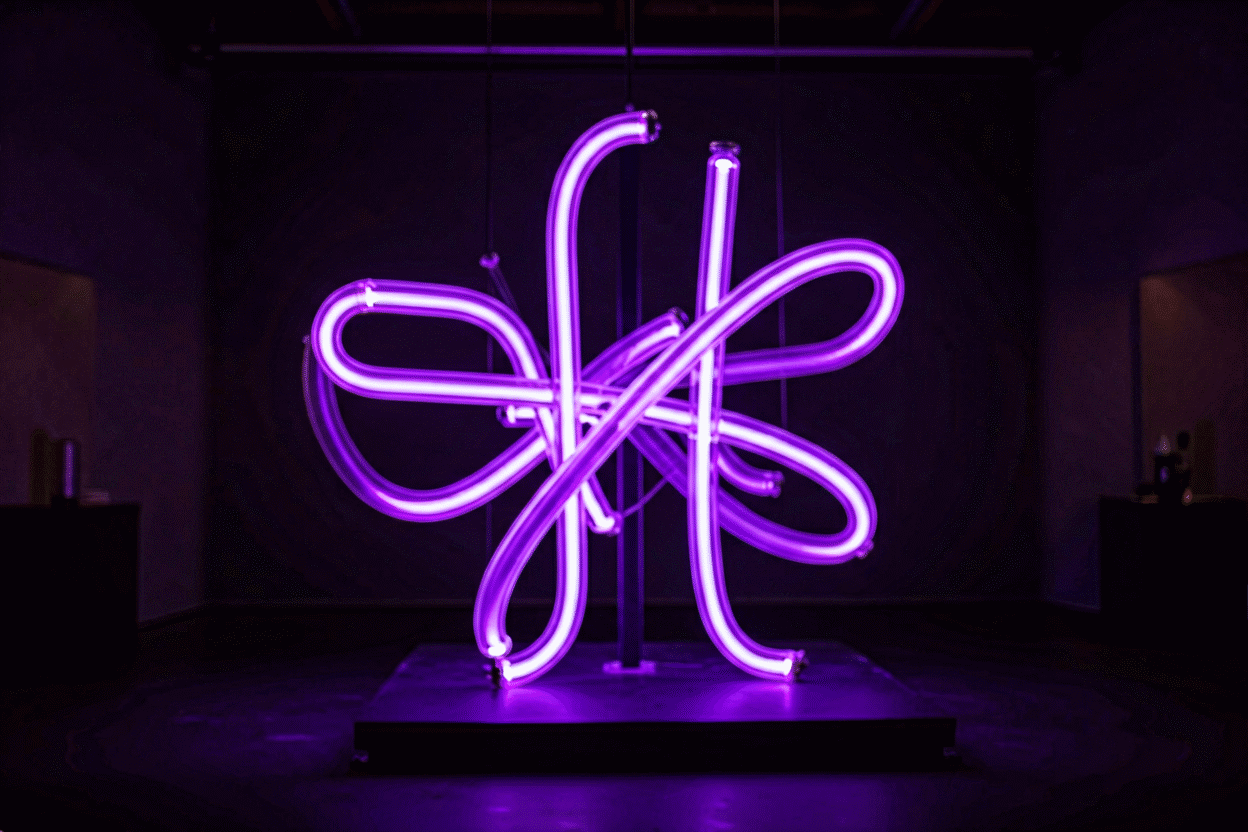
- Bruce Nauman — the pivotal figure: from the late 1960s, neon word-plays and spiraled phrases that turned the medium’s commercial cheer against itself — irony, discomfort, paradox in glowing script. Nauman’s neons taught two generations that the medium could think.
- Joseph Kosuth and the conceptualists — neon as one vehicle among linguistic media for ideas-about-ideas.
- Martial Raysse — European pop-era experiments with neon’s seduction mechanisms.
- The feminist line — most influentially Tracey Emin, whose handwritten neon confessions (1990s–2000s) made the medium intimate: the advertisement’s seduction script replaced by autobiography. Emin did as much as anyone to place neon in the contemporary canon and the auction record.
- Jung Lee and the photographers-and-phrases generation — word pieces in landscapes, the medium’s lyric register.
Through these decades the institutions followed the artists: museum acquisitions, gallery departments for light work, and — parallel to fine art — the preservation movement that treated historical signage itself as art (that story). By the 1990s the art history was institutionally real: neon appeared in permanent collections, monographs, and the curriculum.
Act IV: The Contemporary Field (2000s–Now)
Today’s neon-and-LED art world runs several distinct registers:
- The LED generation — artists adopting flex neon’s accessibility for scale and iteration (the technology shift); the craft threshold fell, the conceptual bar rose
- Word art as a genre — text-based neon spanning Emin’s confessional lineage to commodity irony; the commercial-grade phrase piece and the gallery piece share a vocabulary now
- Institutional embrace — MoMA’s holdings, dedicated museums (MONA, the Neon Museum), biennale light installations
- The commercial-fine collapse — hotel lobbies commission what galleries pioneered; the aesthetic’s migration into decor (the bedroom era) is the art history’s final irony: the advertising medium that became critique now also just… decorates, happily
- Preservation as art history — vintage signs collected, restored, and exhibited as the medium’s first-century corpus (the vintage world)
The Anchor Works (A Starter Chronology)
| Era | Work/Artist | What it changed |
|---|---|---|
| 1961 | Flavin’s first fluorescent “diagram” pieces | Industrial light = legitimate medium |
| 1960s–70s | Nauman’s neon word spirals | The medium thinks; irony enters |
| 1960s | Raysse’s pop neons | Seduction mechanisms as subject |
| 1980s–90s | Kosuth and the conceptual line | Neon as linguistic readymade |
| 1990s–2000s | Emin’s confessional neons | Intimacy; the auction canon |
| 2000s+ | The LED generation | Scale, access, iteration |
| Now | Museum collections & preservation | The first century institutionalized |
Why Advertising’s Material Became Art’s Language
The question worth answering directly, because it explains the whole arc: neon entered art carrying a complete double meaning no other medium offered — it was always promising something (a century of commerce trained everyone to read glowing script as an offer) and therefore, pointed somewhere other than a product, the promise itself became the subject. Add the craft intimacy of hand-bent script (drawing in light) and the medium’s mortality (glass, gas, flicker — the anti-monument), and you have a material practically engineered for the ironic-tender register that late-20th-century art lived in. The artists didn’t rescue neon from commerce; they recruited its entire commercial history as content.
Which loops the story back to the present: when a bedroom phrase glows tonight, it glows with all of that — the Packard dealership, the 3 am diner, Nauman’s spirals, Emin’s handwriting — whether its owner knows or not. Art history as ambient light. The contemporary mass adoption of neon aesthetics is arguably best read as the final chapter of this institutional-to-vernacular migration — the pattern every medium from photography to hip-hop has followed.
Commission your own small chapter — words, glow, and all the inheritance — in the custom builder.
Living With Light Art: The Collector’s Adjacent Market
The art history’s practical extension — the market where neon art and ownership meet:
The accessible editions tier. Below the canonical auction records sits the editions market: studio-made neon works in limited runs at the $500–5,000 band — gallery-represented artists’ smaller pieces, the word-art genre’s collectible tier, and the craft-artists’ numbered works (the contemporary field). This is the art market’s entry door for neon: real works, real artists, prices in furniture range rather than museum range.
The commission route. Bespoke neon art from working studios — the collector’s move from choosing to collaborating: your concept, the artist’s craft, one piece (the design collaboration model). Commissions run the band from custom-sign pricing (the craft end) to five figures (the gallery end), and the relationship is part of the work’s provenance.
The vintage crossover. The antique-sign market and the art market share a border — the best commercial pieces trade as folk art (the collecting world), and museums exhibit signage as art (the institutional line). The collector standing in both worlds gets the century’s full spectrum: commerce’s masterpieces and art’s commercial borrowings.
Displaying light art at home. The practical notes art-living teaches: dedicated circuits for larger works (the power planning); the dimming question resolved by the work’s intent (some pieces live at full; some were made to modulate); the placement physics of glow-on-wall (the black-background rules); and the conservation disciplines for glass works (the antique tier’s care). Light art asks more of rooms than paintings do — and gives rooms more back.
The market’s honest summary: neon art ownership spans a ladder from the custom builder’s accessible tier through editions to the canonical auction tier — the only art medium where the same aesthetic language runs continuously from a $150 bedroom piece to a seven-figure museum work. Every owner of the former holds a piece of the same history as the latter’s collectors; that continuity is the medium’s quiet distinction.
FAQ: Neon Art History
When did neon become art? The conceptual groundwork came with 1960s light art (Flavin’s fluorescents legitimized industrial light as medium); neon-specific art crystallized in the late 1960s–70s with Bruce Nauman’s word pieces, then expanded through conceptualism into the contemporary canon.
Who are the most famous neon artists? Bruce Nauman (ironic word works — the pivotal figure), Dan Flavin (fluorescents that opened the door), Martial Raysse (pop seduction), Joseph Kosuth (conceptual text), and Tracey Emin (confessional script — the contemporary canon and auction record).
What is the neon art movement? Less a formal movement than a medium’s adoption across existing ones: light art, conceptual art, pop, and feminist art all claimed neon from the 1960s onward — the shared discovery being that advertising’s glowing language could carry art’s subjects.
Is neon art valuable? Canonical neon works trade in the millions at contemporary auctions (Emin’s pieces notably); the broader text-neon market spans gallery editions to commissioned pieces. The commercial-signage antiques are a separate but related market (vintage guide).
Where can I see neon art? Institutional collections (MoMA among them), the dedicated museums — Los Angeles’s Museum of Neon Art and Las Vegas’s Neon Museum — and contemporary galleries’ light-art rosters (the museum guide).
Are modern LED signs part of neon art history? The latest chapter: LED flex dropped the craft threshold and raised the conceptual bar, enabling the scale works and the vernacular adoption that closes the institutional-to-everyday loop — the full technology story is in our LED-vs-glass comparison.
Sources & Further Reading
- Neon sign (Wikipedia) — the consolidated public record of neon-sign history and technology.