Neon Sign Timeline: Every Key Year

The neon sign’s 128-year timeline, compressed to the years that mattered — each entry is a date, an event, and one line on why it mattered. The narrative version of the same history (with the color and the characters) lives at history of neon signs; this is the scannable spine.
Stage 1: Discovery Era
1898 — William Ramsay and Morris Travers discover neon in liquefied-air fractions at University College London; the gas identifies itself by its red-orange discharge glow. Why it mattered: the light source enters the world — with no application (Ramsay’s Nobel for the noble gases follows in 1904).
1898–1910 — Neon remains a lab curiosity: glows beautifully, dies quickly, powers nothing commercially. Why it mattered: establishes that discovery ≠ deployment — the decade Claude would spend closing the gap.
Stage 2: Invention and Paris
1902 — Georges Claude co-founds Air Liquide, industrializing air liquefaction — putting him in control of neon as a byproduct stream. Why it mattered: the invention gets its fuel supply.
1902–1910 — Claude’s engineering campaign: sealed electrodes, gas purity processing, transformer-to-tube matching. Why it mattered: lifetimes extend from hours to thousands of hours — the difference between toy and industry (the full invention story).
December 1910 — Claude lights the Paris Motor Show at the Grand Palais with two ~40-foot neon tubes. Why it mattered: the public debut; advertising’s newest medium announces itself.
1912 — First commercial neon sign: a barbershop on the Boulevard Montmartre, Paris. Why it mattered: the first paying customer; the format (shopfront script) is set.
1913–1920s — Claude patents internationally; Claude Neon Lights franchises licensed cities and litigates competitors. Why it mattered: the industry is born structured — one company’s licensing map still visible in sign-trade genealogies.
Stage 3: American Golden Age
1923 — Earle C. Anthony’s two “Packard” signs installed in Los Angeles, reportedly $24,000. Why it mattered: America’s first neon — traffic-stopping, industry-creating (the scene).
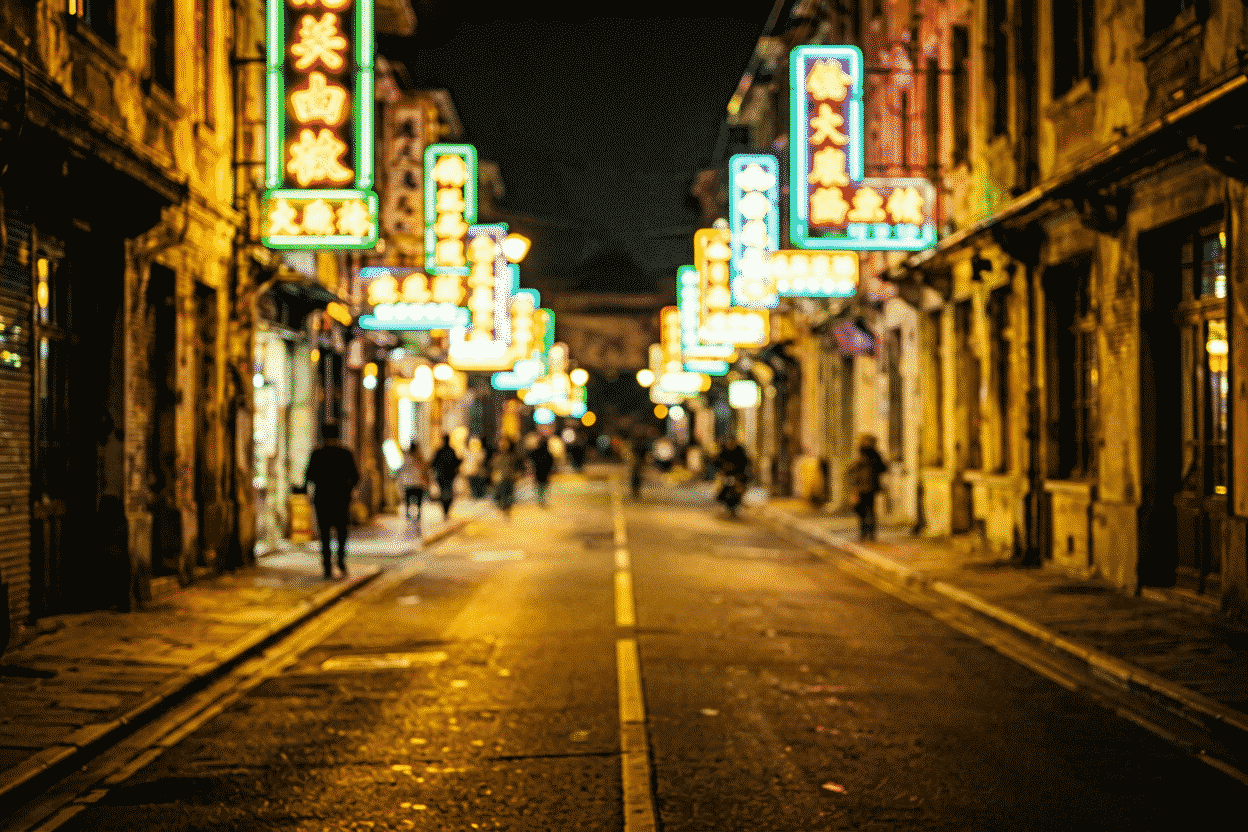
1924–1930 — Neon spreads through American cities: cinemas, drugstores, diners. Broadway’s bulb spectaculars convert to neon density — “The Great White Way” becomes literal. Why it mattered: the medium becomes the country’s commercial vernacular.
1931 — Las Vegas incorporates; Fremont Street builds its neon-first identity from the start. Why it mattered: the genre’s capital city co-founds itself with the medium.
Mid-1930s — Palette expansion era: argon-mercury blues, phosphor-coated whites and pastels, animated chasing borders. Why it mattered: neon grows from red-and-script to full-color motion — the vocabulary vintage collectors now chase (the collecting world).
Late 1930s (peak) — Thousands of neon sign shops operate in the US; Times Square’s block-scale spectaculars define urban spectacle. Why it mattered: the craft economy and the aesthetic both peak — nothing after WWII matches it.
Stage 4: Interruption and Decline
1941–1945 — WWII: materials rationing, blackout orders, signshops to war production. Why it mattered: the industry’s hard stop — and the pause during which alternatives mature.
1945–1955 — Postwar: backlit plastic channel letters (cheaper, mass-producible, daylight-friendly) take the mainstream. Why it mattered: neon’s cost and fragility lose the advertising mainstream it had owned.
1950s–1960s — Modernist architecture and urban renewal read neon as clutter; municipalities write restrictive sign codes. Why it mattered: the medium is regulated into its fortresses — Vegas, Times Square’s remnants, bar culture.
1960s–1970s — The trade ages; apprenticeships thin; glass benders become specialists. Why it mattered: the craft bottleneck that later makes authentic glass neon expensive — and eventually collectible.
Stage 5: Rescue and Art
1962 — The Tropicana’s neon era and the Vegas sign culture continues even as other cities decline. Why it mattered (retrospectively): one ecosystem keeps the trade alive at scale.
1981 — Museum of Neon Art (MONA) founded in Los Angeles — neon as art, formally. Why it mattered: the medium gains its art-historical standing (that story).
1982 — Blade Runner fuses neon with the permanent future on film. Why it mattered: the look decouples from the industry — cinema keeps the aesthetic alive while the physical medium declines.
1996 — The Neon Museum formally established in Las Vegas (its Boneyard collection had been rescuing signs for years). Why it mattered: preservation institutionalizes; the great signs become civic heritage.
1990s — Light art using neon-adjacent media becomes gallery-established; artists repurpose advertising’s language into critique and abstraction. Why it mattered: the second audience — art — stabilizes the craft at the high end.
Stage 6: LED Revival and Democratization
~2008–2012 — LED flex neon reaches commercial quality: silicone-clad diode strips that read as continuous glow. Why it mattered: the look decouples from glass, gas, and kilovolts (the comparison).
~2012–2016 — Custom LED sign e-commerce emerges; wedding names-and-dates signs become the era’s most-photographed decor. Why it mattered: the market’s center of gravity moves from storefronts to celebrations.
~2016–2020 — Social-feed aesthetics adopt the glowing phrase; “Instagram wall” businesses and aesthetic-room culture normalize neon in bedrooms (that layer). Why it mattered: the medium’s third audience — personal decor — becomes the biggest one.
2020s — Smart control, RGB, battery power standardize; custom signs at $100–300 democratize the format Claude built for department stores. Why it mattered: the timeline’s flattest, widest era — the glow is now a consumer staple, with glass neon settled into craft and heritage niches.
2026 — The market: majority-LED custom signage; glass neon as artisanal premium; museums, collectors, and restorers steward the first century. Why it matters: you can buy the last 128 years of this timeline for about the price of a nice dinner — here.
The Five-Sentence Version
Neon glowed in a London lab in 1898; Claude made it a Paris industry by 1912; America turned it into the commercial vernacular from 1923 to 1941; war and plastic buried it, until museums and artists rescued its heritage through the late century; and LED flex repackaged its look for everyone from the 2010s on. Full narrative with the characters in their scenes: history of neon signs.
Reading the Timeline: Three Patterns Worth Noticing
Scan the dates for the structures underneath — three patterns the chronology reveals:
The thirty-year adoption cycle. From invention (1910) to saturation (roughly 1940, the golden-age peak) — three decades from Paris Motor Show to American default. Compare LED’s arc: commercial-quality flex around 2010, market saturation by the early 2020s — roughly a decade, compressed. The adoption clock ran three times faster for the successor, which is the e-commerce-and-manufacturing delta between the two eras’ technologies (the production comparison).
War as the medium’s pivot point. WWII appears twice in the timeline’s logic: as the break that ended the first golden age (materials, blackouts, converted shops) and as the pre-condition for the decline (postwar plastic’s timing). Without the war, the medium’s trajectory plausibly runs differently — slower displacement, perhaps a longer craft plateau. The timeline’s single biggest “what if” sits in 1941–45 (the decline acts).
Rescue always followed decline by about thirty years, too. Golden-age peak ~1940; preservation movement’s founding institutions arriving 1981 (MONA) and 1996 (the Neon Museum) — the lag between a vernacular’s decline and its heritage recognition runs about a generation, long enough for nostalgia to mature and for the objects to become scarce (the rescue acts). The pattern predicts the vintage market’s current strength: the LED takeover of the 2010s is right on schedule to make 1990s-and-earlier pieces the appreciated tier now — which is exactly what the collector data shows (the vintage economy).
The timeline’s shape, summarized: a century of two S-curves (glass up then plateau-decline; LED up and ongoing) with a preservation bridge between them — a medium that died commercially and was resurrected twice, once as art and once as technology. The dates are the skeleton; these three patterns are the physiology. For the narrative version with the characters: the full history.
FAQ: Neon Sign Timeline
When was the first neon sign made? The public debut was December 1910 (Georges Claude, Paris Motor Show); the first commercial sign was a Paris barbershop in 1912 — both a dozen years after the element’s 1898 discovery.
When did neon signs become popular in America? 1923 onward — Earle Anthony’s Packard signs in Los Angeles triggered the spread, and by the late 1930s neon was America’s default commercial signage (the golden age, 1923–1941).
When did neon signs decline? The break was WWII (1941–45); the decline ran through the 1950s–70s as backlit plastic replaced it and sign codes restricted it — with Las Vegas as the great exception.
When did LED neon signs come out? LED flex neon reached commercial quality around 2008–2012, and the custom-sign e-commerce boom followed in the 2010s — putting “neon” in bedrooms and weddings at consumer prices.
What are the biggest dates in neon sign history? 1898 (discovery), 1910 (debut), 1912 (first commercial sign), 1923 (America), 1941–45 (the break), 1981 (MONA — neon as art), 1996 (Neon Museum), and the 2010s LED inflection.
Is this timeline the same everywhere? The shape is global with local accents: Paris invented, America scaled, Las Vegas and Hong Kong built signature dialects, and the LED revival ran worldwide through e-commerce — the regional stories thread through our history and art guides. Three patterns, one timeline, a century: the dates above reward rereading with the structures in mind — the adoption cycles compressing, the war’s pivot, the preservation lag (the patterns). And the timeline’s next entries are being written by the current era: the LED majority’s milestones (smart-control integration, the custom e-commerce boom) will read, in some future version of this page, as the seventh act’s opening dates.
Sources & Further Reading
- Cleaning Up a Broken CFL (U.S. EPA) — the federal mercury-spill cleanup procedure; we mirror it for broken glass-neon tubes.
- Neon: Strong Lines (NIST Physical Reference Data) — the standard reference for neon’s emission wavelengths.
- Argon: Strong Lines (NIST Physical Reference Data) — the standard reference for argon’s emission wavelengths.
- Neon sign (Wikipedia) — the consolidated public record of neon-sign history and technology.