Who Invented the Neon Sign? Claude’s Story
The neon sign was invented by Georges Claude, the French engineer and chemist who sealed neon gas in glass tubes, drove it with a practical transformer, and showed the result at the Paris Motor Show in December 1910. But invention has three fathers here, and honest history gives each a scene: William Ramsay and Morris Travers, who discovered the element in 1898; Claude, who engineered it into sealed, durable, commercial signage; and earl C. Anthony, the Los Angeles Packard dealer whose 1923 order dragged the technology across the Atlantic and into American legend.
The discovery-versus-invention distinction is the story’s spine, so it’s worth stating plainly: finding a glowing gas is not making a sign. What Claude contributed — sealed electrode systems, transformer matching, tube-processing that kept signs lit for thousands of hours instead of days — is precisely the engineering that turned a laboratory curiosity into an industry. The full century that followed has its own guide at history of neon signs; this page is the people.
Act One: The Discovery (1898)
William Ramsay — already famous for finding argon and helium — and his assistant Morris Travers were completing the noble-gas family at University College London. On freezing liquefied air and fractionating it, they reached the last volatile fraction, ran a discharge through it, and the tube lit the unmistakable red-orange. Travers’s account of the moment is science writing at its best: they broke off to stare, knowing no known substance glowed that color.
The gas got its name from Greek neos — “new” — at a celebration where Ramsay’s twelve-year-old son suggested it. Ramsay took the 1904 Nobel in Chemistry for the noble-gas work (shared with Rayleigh, for the argon discovery that started it). The element’s data sheet lives at neon the element.
What 1898 did not include: any application. Neon glowed; nobody could keep it glowing usefully.
Act Two: The Invention (1902–1910)
Enter Georges Claude — chemist, engineer, industrialist, and one of applied science’s more complicated biographies. Claude had co-founded Air Liquide in 1902, commercializing exactly the technology neon needed: the liquefaction of air and the separation of its fractions. His plants produced neon as a byproduct nobody wanted — and Claude, unlike the chemists, owned both the gas supply and the engineering instinct.
Between 1902 and 1910, Claude solved the problems that had kept discharge lighting a lab toy:
- Sealed electrodes that didn’t leak or sputter — the reason earlier tube lights died in hours
- Gas purity and pressure control that kept discharges stable and bright
- Transformer engineering matching drivable voltages to practical tube lengths
- Tube processing (outgassing, impurity management) that extended life from days to thousands of hours
In December 1910, at the Grand Palais, Claude lit the Paris Motor Show with two enormous (reportedly 40-foot) neon tubes of his red glow. It was an engineering demonstration disguised as decoration — and it worked as both. The 1912 install for a Montmartre barbershop became the first commercial neon sign; orders followed from cinemas and the Paris Opera. Claude patented the system internationally and built Claude Neon Lights into a licensing empire — franchising cities, litigating competitors, effectively controlling the medium’s first two decades.
The complicated footnote history requires: Claude’s later biography runs through collaboration with Vichy and a postwar prison sentence — a dark final act that French histories of the medium handle openly, and that the sign’s story neither cancels nor hides. The invention stands; the inventor was not a man to admire past his engineering.
Act Three: The American Debut (1923)
The neon sign’s conquest of America begins with a car dealer’s showmanship. Earle C. Anthony, Packard’s Los Angeles distributor — already famous for sponsoring radio’s first disc jockey program — bought two “Packard” signs from Claude Neon’s new US venture in 1923.
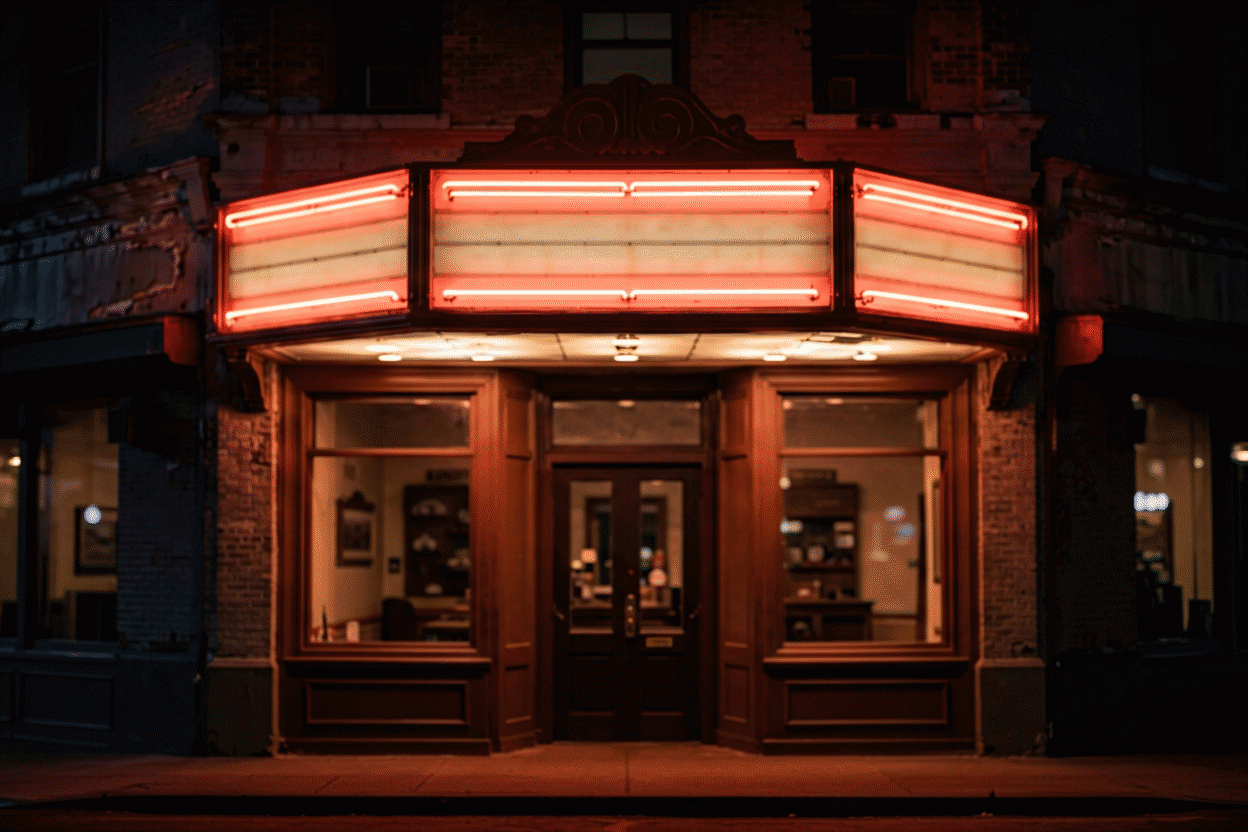
The numbers entered legend: reportedly $24,000 for the pair (contemporary accounts vary, but “the price of a house” is the honest ballpark). The return: traffic-stopping spectacle. Crowds gathered at his Wilshire and Hope Street showrooms nightly — the glow reportedly visible for miles, the rooftop reinforced to bear the sightseers. Competitors noticed; sign shops licensed; by the late 1920s neon was America’s fastest-growing advertising medium, and by the 1930s Times Square’s spectaculars were rewriting urban nights (that story).
The Cast List (For the FAQ Directly)
| Question | Answer |
|---|---|
| Who discovered neon (the element)? | William Ramsay & Morris Travers, 1898, London |
| Who invented the neon sign? | Georges Claude, engineering 1902–10, debut December 1910 |
| When was the first commercial neon sign? | 1912 — a Paris barbershop |
| Who brought neon to America? | Earle C. Anthony’s Packard dealership, Los Angeles, 1923 |
| What did the first US neon signs cost? | Reportedly ~$24,000 for the pair — a house-and-a-half in 1923 |
Why “Invention” Was the Hard Part
The lesson embedded in the story: discovery captures the imagination, but deployment captures the world. Ramsay’s gas sat unused for a decade because glowing wasn’t enough — it needed to glow reliably, safely, and profitably. Claude’s seals, transformers, and process control did that; Anthony’s $24,000 proved the profitability. Every technology’s path from lab to living room runs through the same three doors — and neon’s entire journey, from 1898 fraction to 2026 bedroom glow, is traced in the full history and its artistic aftermath at neon art history.

A century after Claude’s Grand Palais tubes, the glow he engineered is a design vocabulary anyone can commission — starting here.
The Invention’s Chain of Debt
The invention credited to Claude rests on a chain of predecessors worth knowing — the honest genealogy:
The Geissler tube (1850s). Heinrich Geissler’s mercury-pump vacuum tubes and their glowing gas excitations were neon’s direct ancestor: the first demonstration that rarefied gas plus electricity equals colored light. Every laboratory novelty of the next half-century — including Ramsay’s discovery work — ran on Geissler-tube logic (the discovery context).
The Moore tube (1890s–1900s). Daniel McFarlan Moore’s long glass tubes of glowing gas lit actual interiors — Carnegie’s library among them — a decade before Claude. Moore’s system (nitrogen and carbon dioxide fills, complex sustaining apparatus) proved commercial gas lighting and failed commercially on maintenance: the application existed, but the engineering economics didn’t. Claude’s contribution was, in large part, solving what Moore couldn’t (the invention distinction).
Ramsay and Travers (1898). The element itself, and the observation of its red-orange discharge — the light source entering inventory. Also, permanently: the naming convention (Ramsay’s family named helium, neon, argon, krypton, xenon — a dynasty of Greek).
The Air Liquide foundation (1902). Claude and Delorme’s industrial air-liquefaction venture — the infrastructure that made neon available by the cylinder. Without the byproduct stream, the discovery stays a curiosity; this is the supply-side invention that rarely gets credited in the story (the sourcing history).
The lesson the chain teaches: “who invented X” compresses a lattice into a point. Claude’s patents and his 1910 debut were the visible summit of a sixty-year slope — vacuum craft, gas discovery, industrial supply, prior commercial attempts. The compression isn’t wrong (his engineering genuinely closed the gap between demonstration and industry); it’s just incomplete, as every invention story is. The full neon chain is unusually legible because each link left named artifacts: Geissler’s tubes survive in collections, Moore’s installations in photographs, Ramsay’s samples in the periodic table itself, and Claude’s industry in every sign shop’s genealogy (the full history).
FAQ: Who Invented the Neon Sign
Who invented the neon sign? Georges Claude, the French engineer who between 1902 and 1910 solved the electrode sealing, gas processing, and transformer engineering that turned neon’s glow into durable commercial signage — debuted at the December 1910 Paris Motor Show.
Who discovered neon gas? William Ramsay and Morris Travers, June 1898, University College London — fractionating liquefied air. Ramsay won the 1904 Nobel Prize in Chemistry for the noble-gas discoveries.
When was the first neon sign made? Claude’s public debut was December 1910 (Paris Motor Show); the first commercial installation was a Paris barbershop in 1912.
Who brought neon signs to America? Earle C. Anthony, a Los Angeles Packard dealer, ordered the first American neon signs in 1923 — reportedly paying $24,000 for the pair, which stopped traffic so effectively his rooftop needed crowd reinforcement.
What did Georges Claude do besides neon? Founded Air Liquide (the industrial-gas giant whose air-liquefaction plants supplied the neon), advanced ocean thermal energy research, and — in his darker final chapters — collaborated with Vichy France, for which he was imprisoned after the war.
Why does the invention date matter more than the discovery? Because usefulness required engineering: sealed electrodes, stable gas processing, and matched transformers are what made the difference between a tube that glowed for hours in a lab and an industry that lit the century’s cities. Discovery found the light; Claude made it last.
The Invention FAQ, Extended
Did anyone else independently invent neon signage? Claude’s patents and priority hold — but the invention’s neighborhood was crowded: Moore’s gas tubes preceded it commercially (the genealogy above), other engineers experimented with discharge displays through the 1900s, and Claude’s genuine distinction was the engineering completeness (sealed electrodes, stable processing, matched transformers) that made the difference between demonstration and industry. Inventions that look solo rarely are; his looked solo because his worked.
How quickly did the invention spread internationally? Fast by any pre-digital standard: France 1910–12, licensing into the US by 1923 (Anthony’s Packard signs), and the major capitals of Europe and the Americas through the 1920s (the timeline) — roughly a decade from Paris debut to global signage vernacular, propelled by the franchise-licensing structure Claude built.
What did Claude earn from it? A fortune and an industry: Claude Neon Lights’ licensing empire made him wealthy and made the medium worldwide — though his biography’s final chapters (the Vichy collaboration and imprisonment) complicate the legacy the signs themselves never inherited (the honest biography). The invention outlived its inventor’s reputation, as they often do.
Sources & Further Reading
- Cleaning Up a Broken CFL (U.S. EPA) — the federal mercury-spill cleanup procedure; we mirror it for broken glass-neon tubes.
- Neon: Strong Lines (NIST Physical Reference Data) — the standard reference for neon’s emission wavelengths.
- Argon: Strong Lines (NIST Physical Reference Data) — the standard reference for argon’s emission wavelengths.
- Solid-State Lighting (U.S. Department of Energy) — DOE reference on LED efficacy and lifetime.
Pricing based on CustomNeon’s current catalog (2026); custom quotes come live from the sign builder.