You’re Like Really Pretty Neon Sign Meaning, Explained
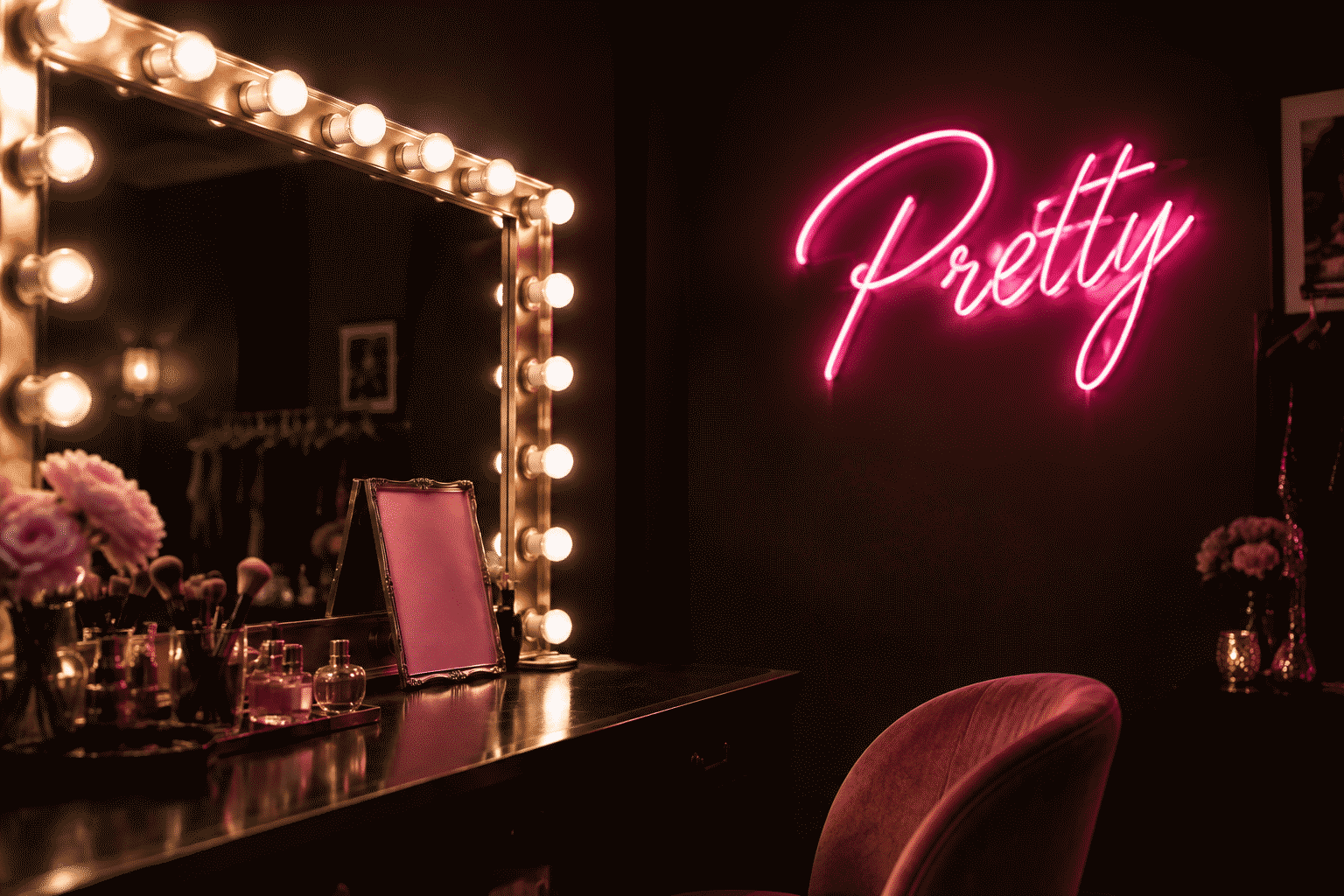
Some compliments age into venom; this one did the opposite. “You’re like really pretty” entered the culture in 2004 as the sweetest weapon in a high school hierarchy — and two decades later it survives as a genuine compliment between friends, quoted on vanity walls and gift bags with zero irony and full affection. If you’ve seen the pink script glowing above someone’s mirror and wondered what it means, the answer has layers, and they’re worth unpacking before you hang one.
Where the Line Comes From
The phrase belongs to Mean Girls (2004), the high school comedy that became one of the most-quoted films of its generation. In the scene, Regina George — the queen bee of the Plastics — delivers the line with a smile that is 60% sweet and 40% social strategy: a compliment engineered to remind the recipient who controls the compliments. The delivery was so perfectly balanced between sincere and sinister that audiences memorized it instantly.
The film itself was adapted from a nonfiction parenting book about clique dynamics, which is part of why the quotes stuck — the lines were drawn from real high school anthropology, and everyone recognized their own cafeteria in them. “You’re like really pretty” became shorthand for the specific experience of being complimented by someone whose approval came with terms and conditions.
But quotes detach from their contexts, and this one traveled furthest. Stripped of the power dynamics, the line’s structure is actually lovely: the “like” and the “really” are the filler words of genuine, unguarded speech — the way people actually compliment when they’re not composing a sentence. The stammer is the sincerity. That’s the register the sign captures.
What the Sign Means Now
On a wall in 2026, the sign means three things at once, and all of them are positive:
The friendship register. Between friends — especially the friend groups who quote the film at each other constantly — the sign is an in-joke that doubles as a real compliment. Every guest who reads it smiles twice: once at the reference, once at the sincerity underneath it. It’s the rare pop-culture sign that compliments the room it’s in.
The self-affirmation register. Above a vanity mirror, the line is addressed to the person looking in. The morning ritual of sitting down at the mirror becomes a scene with a script — and the script says something kind. This is why the vanity is the phrase’s natural habitat: it is, literally and originally, a line about looking at yourself.
The era register. For millennials and older Gen Z, the sign is a time capsule of the 2000s — the pink aesthetic, the burn book, the пластics. It signals the household’s comedy canon the way a vinyl wall signals its music canon. Guests who catch the reference quote the scene; guests who don’t just read the compliment. Both reactions are the sign working.
Pink vs White: What Each Colorway Says
The colorway changes the register more than most buyers expect:
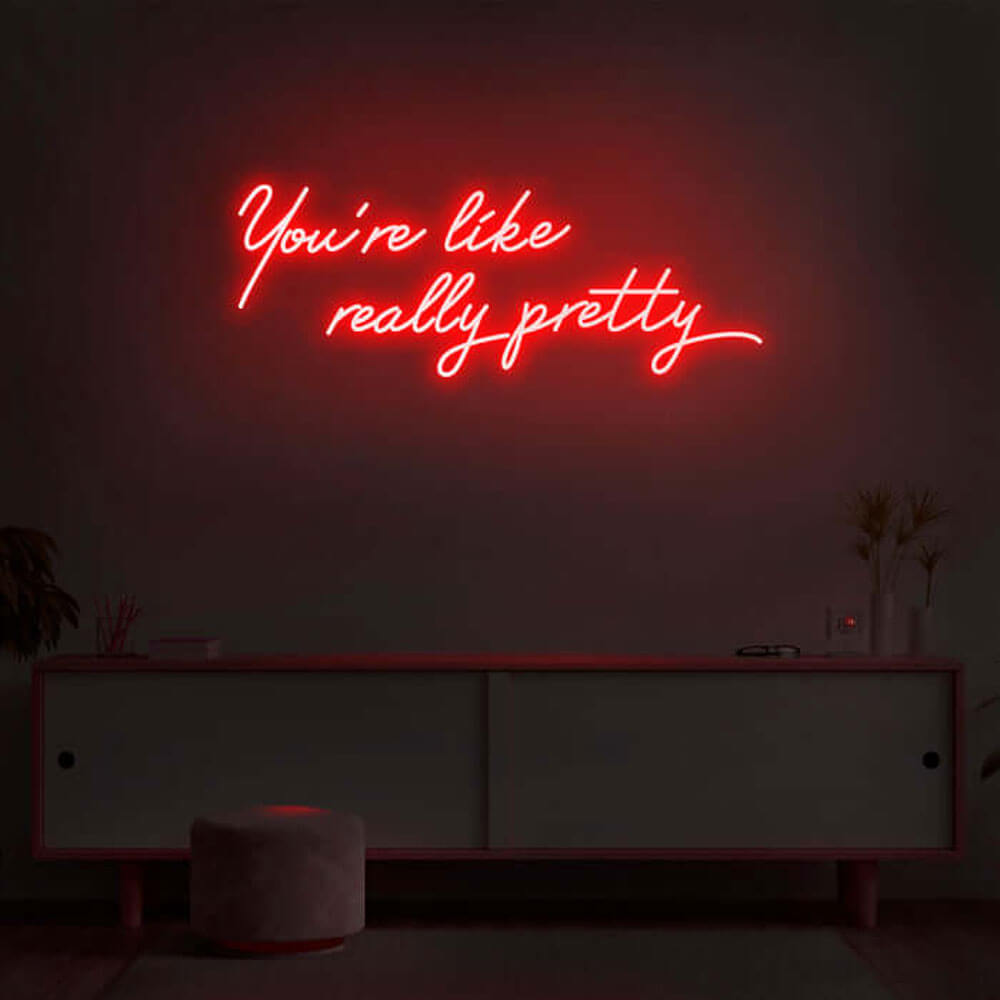
Hot pink is the canonical choice — it matches the film’s aesthetic of aggressive femininity and reads instantly in photos. Against white walls or neutral bedrooms, pink script is the statement piece; the full shade range is on our pink neon sign page.
Soft blush softens the joke into a whisper — the compliment without the weapon. Blush suits rooms already running pink in the bedding or the art, where hot pink would double up.
Warm white reverses the palette entirely: against a blush accent wall, white script looks editorial rather than costume. The quiet version of the line — for households that want the reference without the volume.
Custom colors — blue, purple, even green — suit rooms that already have a pink statement elsewhere. One pink piece per room is the rule; the custom neon sign builder previews every colorway free.
Where the Sign Belongs (and Where It Doesn’t)
The vanity table is the phrase’s home ground. Mount it above the mirror at a height where it frames your head in selfies, sized 10–20% wider than the mirror itself. The sign pays for itself in content — every mirror selfie composes better with a script crown.
Bedrooms take it above the headboard or over a polaroid wall; the bedroom sizing guide covers heights and widths across bed sizes. Dorm rooms and first apartments take the smaller 18–24 inch versions as the single statement piece that makes a rented space feel owned.
Bathrooms with good mirrors run the white version at low dimmer — the spa-register compliment.
Content studios — the ring-light-and-backdrop setups of beauty creators — run the pink at full output, where the sign functions as a permanent backdrop caption. The name-underneath custom (your handle in block letters beneath the script) is a common order for exactly this use.
Where it doesn’t belong: formal living rooms and offices, where the register reads confused rather than playful. This is a phrase with a smirk; it wants a room that smiles back.
The Sibling Phrases: Building a Compliment Wall
The line has a family, and the strongest vanity walls run two of them:
Hello Gorgeous is the greeting — the classic Old Hollywood compliment that opens every conversation with the mirror. Pair it with “You’re like really pretty” as the reply and the wall becomes a dialogue.
Babe You Look So Cool is the modern cousin — the indie-song compliment for households whose canon runs more recent than 2004. Same register, different decade.
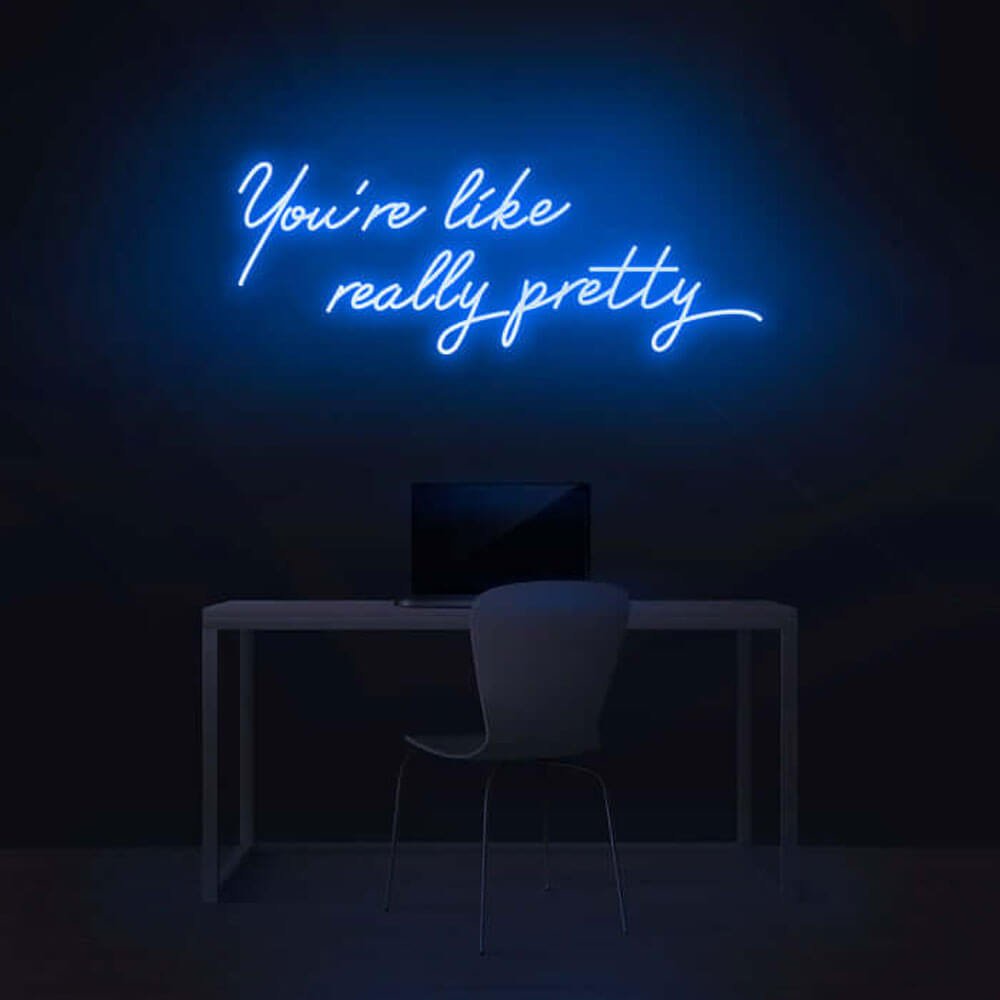
You’re like really pretty itself ($368, script, pink) is the anchor of the wall and the most-gifted piece in the family. Run one or two, never all three — a wall of compliments reads as insecurity; a dialogue reads as wit.
Sizing, Power and Placement Math
The compliment sign lives or dies by its geometry. Mirror math: size the sign 10–20% wider than the mirror it crowns — that ratio reads as a frame; narrower reads as an afterthought; dramatically wider reads as a marquee over a postcard. For the vanity’s standard 24-inch round mirror, that means a 28–32 inch sign; for a full-length mirror, 36–48. Selfie distance: if the sign’s primary job is the front-facing camera at arm’s length, 24–36 inches keeps the full phrase legible in the frame — under 20 inches, the words blur into a pink smudge no amount of ring light fixes. Height: center the sign 8–12 inches above the mirror’s top edge, close enough to compose in mirror shots, high enough that hair tools never reach it. Power: vanities already run ring lights and heated tools, so the sign’s few-watt draw is noise in the budget — but plan the outlet: a power strip inside the vanity drawer keeps the wall clean and the cord invisible, which matters more here than in any other room in the house. The full mounting walkthrough — including the strip types that hold on drywall — is in our hanging guide.
Finish the compliment shelf: the Hello Gorgeous neon sign ideas piece covers the classic greeter yours is remixing, and our pink neon sign page maps the palette both live in.
FAQ About the Sign’s Meaning
Is the sign an official Mean Girls product?
No — our design renders the phrase itself, which has outgrown the film and entered common speech. The sign is the words in your choice of color and font; the movie lives in the cultural reference, not in the product.
Is the line an insult or a compliment?
In the original scene, it’s a compliment with an agenda. In 2026 usage — and on walls — it’s a sincere compliment with a shared joke attached. The venom has aged out; the wordplay hasn’t. That double register is exactly why it works as decor.
What’s the best colorway?
Pink is canonical and photographs best; blush softens it; white reads editorial against pink walls. One pink statement per room is the rule — preview any colorway free in the customizer.
Does it work as a gift?
It’s one of the rare phrases that spans ages: teenagers who know the reference, twenty-somethings who grew up quoting it, and mothers who caught the reruns. Birthdays, graduations, and first apartments are the canonical occasions.
What size works over a vanity mirror?
10–20% wider than the mirror itself — 28–32 inches for the standard 24-inch round, 36–48 over full-length. For selfies at arm’s length, 24–36 inches keeps the phrase legible on camera; under 20 it blurs into a smudge. When torn between two sizes, take the larger: undersized script is the most common regret in compliment signs.
Is it a good gift for a teenager or college student?
One of the best in the family — the reference spans generations, and the 18–24 inch versions fit dorm rooms and first apartments. Pair it with the birthday playbook in the birthday guide if the occasion needs numbers; the compliment itself needs no occasion.
The Bottom Line
“You’re like really pretty” on a wall means the household has a sense of humor about its own sincerity — the compliment, quoted with affection, delivered in light. Hang the classic pink script above the mirror it was always meant for, or preview your colorway free in the customizer. The line was engineered to be remembered; the sign just keeps it that way.
Sources & Further Reading
- Mercury (U.S. EPA) — federal guidance on mercury exposure and safe handling.
- Neon sign (Wikipedia) — the consolidated public record of neon-sign history and technology.