Til Death Neon Sign Meaning: The Vow’s Edge, Explained
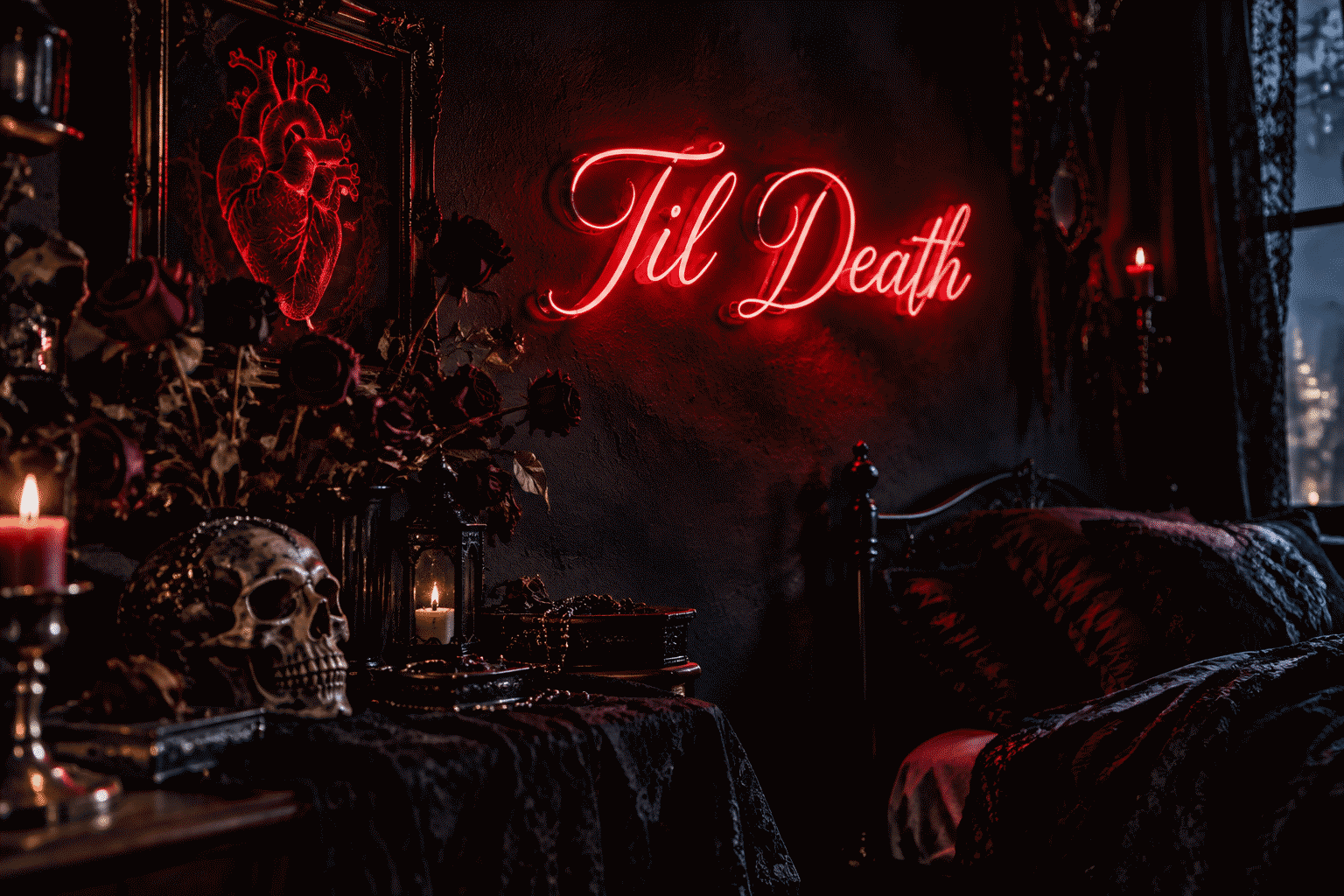
Every wedding phrase celebrates the beginning; this one mentions the end. “Til death” compresses the vow’s final clause — till death do us part — into two words with a pulse, and it has become the vow-sign for couples who find “happily ever after” insufficiently honest. Here’s what the line means, where its party variant came from, and how to hang the version with the right amount of teeth.
The Vow, Compressed
“Till death do us part” has closed English wedding vows since the sixteenth century — the line in the Book of Common Prayer that makes the promise dimensionally honest: not until feelings change, not until circumstances intervene, but until the only thing that actually ends marriages the old-fashioned way. It is the vow’s structural commitment, the load-bearing wall beneath the poetry.
“Til death” as a standalone phrase strips the clause to its dramatic core. The compression does two things: it keeps the stakes (the end is still in there) and it drops the formality (two words can be worn, sung, tattooed, hung). The misspelling — “til” rather than “till” — is the phrase’s modern orthography, part of its casualness; both spellings appear, and the two-word version won the culture.
On a wall, the phrase works because it is the one wedding line that acknowledges duration rather than just intensity. Every other vow-sign is about the day; this one is about the decades. Couples who choose it are choosing the honest register — romance with the ending included, which is the only kind of romance that survives contact with a mortgage.
The Party Variant: “Til Death Do Us Party”
The phrase’s greatest parody arrived in the big-hair eighties, when the rock register got hold of the vow: til death do us party — the commitment re-filed under reception behavior. The parody stuck because it’s structurally perfect: same meter, same gravity, inverted purpose. Weddings claimed it for dance floors, bachelor(ette) parties claimed it for weekends, and the line became the official slogan of the “we take the marriage seriously but not ourselves” register.
The two versions split by job. Til death is the ceremony-adjacent wall and the home after — sacred, gothic, or wry depending on styling. Til death do us party ($258) is the reception bar and the dance floor — the after-party’s legal name. Many weddings run both: one for each end of the night, the vow and its parody keeping watch at opposite ends of the venue.
The Three Registers (Set by Color and Company)
Sacred. The vow itself, honored — gold or warm white, florals and candlelight, the register where the phrase is simply the promise posted in light. This styling suits traditional weddings that want one honest line.
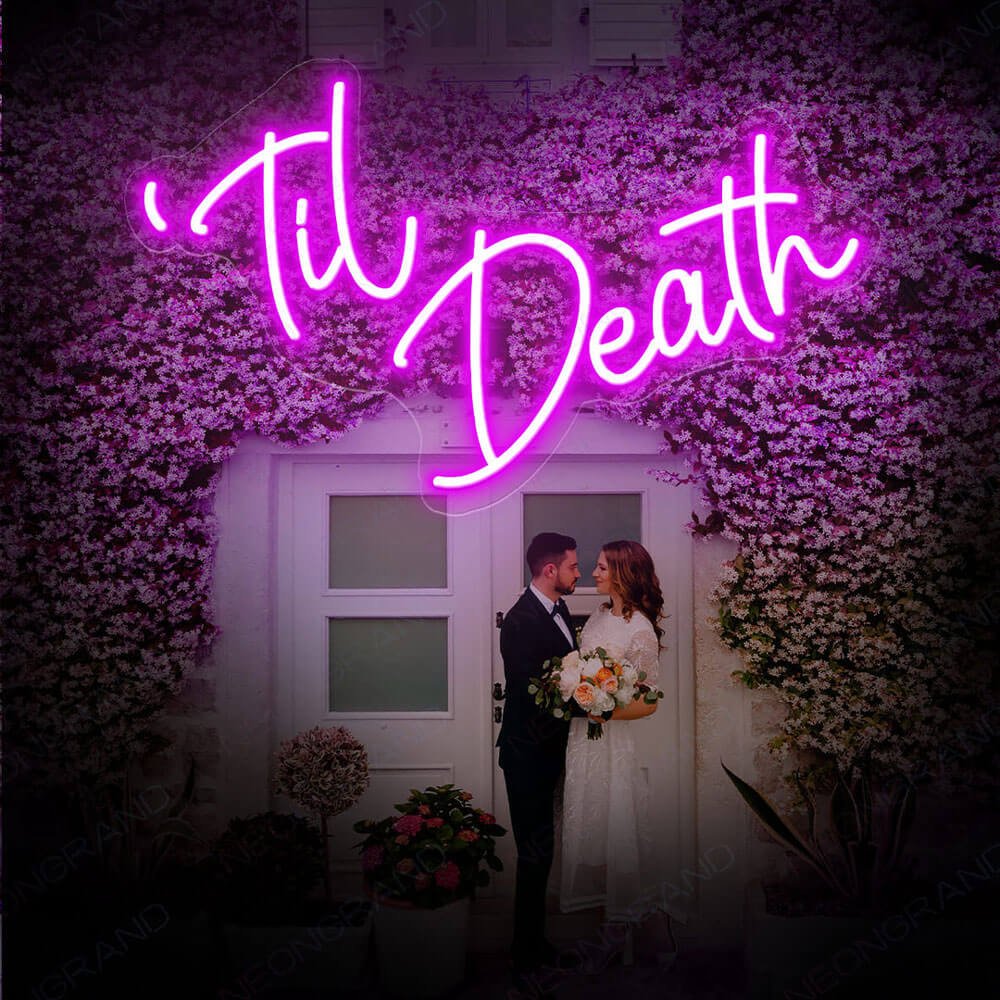
Gothic. The vow, worn in black — deep purple script over dark walls, skull-and-roses flourishes, October dates. This is the register that made the phrase famous on walls: dark-palette weddings, gothic bedrooms, and the Halloween-adjacent season. The purple sign guide covers the canonical colorway.
Wry. The vow, toasted — the party variant’s register, or the two-word classic over a home bar. The humor is in the juxtaposition: permanent language, party context.
Where the Sign Belongs
Moody weddings: the sign replaces the generic love-piece at receptions where the playlist runs minor keys — dark-floral backdrops, candlelit head tables, the dance floor after dusk. The wedding guide covers the full venue playbook including what coordinators approve.
The shared-bedroom headboard wall: the line’s residence after the wedding — furniture for a shared bed, relit every anniversary. The home post is where the phrase does its real work: proof of duration, glowing.
Gothic-inclined rooms: black walls, dark florals, skulls-and-roses decor — the year-round register. The sign anchors the aesthetic without costume.
Halloween-adjacent everything: October weddings and autumn homes claim the phrase seasonally. It’s the one wedding sign that peaks in fall.
Styling Details: The Skull Question
The design decision everyone faces: skull accent or no skull accent? A small skull (or a roses-and-thorns underline) is the gothic build’s signature flourish — add it when the whole register leans dark, skip it when the sign is romantic-with-edge. The words alone carry plenty of weight; flourishes are optional spice. Preview both free in the custom neon sign builder.
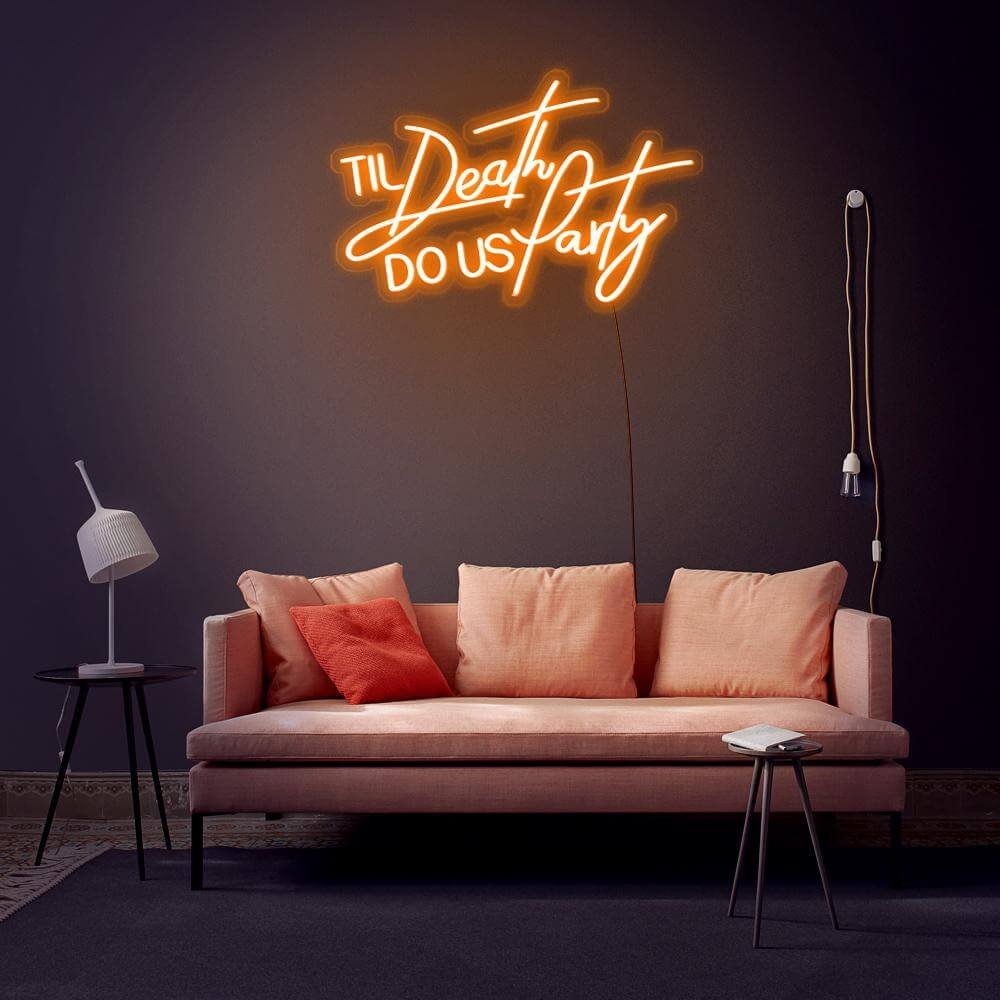
Script fonts are the default — cursive carries romance even when the words carry an edge. Block capitals exist for the poster-look and suit gyms and garages (“til death” reads as commitment-to-the-program in the iron register). The stock script design ($238, deep purple) covers the canonical build at 24–36 inches — the two-word phrase reads compact, so resist oversizing.
The Sibling Vows
The phrase’s family covers every register of commitment:
- Happily ever after — the genre vow; til death is its honest cousin.
- Drunk in love — the modern register; til death is its serious one.
- Better together — the thesis vow; til death is its duration clause.
The two-sign vow wall that works: til death plus one register-mate. Sacred-plus-gothic is a contradiction; sacred-plus-wry (the party variant) is a great wedding.
Dark-Palette Logistics: Size, Power and the Candle Question
The gothic register has specific practical needs. Size: the two-word phrase reads compact — 24–36 inches above the headboard or on the ceremony wall, 36–48 for dance-floor and party-variant duty; resist oversizing, because til death at 48 inches is shouting a line that works best at a murmur. Candles: moody weddings run open flame by the dozen, and LED neon-style builds run cool against them — but keep the sign out of direct flame-heat paths and away from drifting tulle; venue fire codes apply to anything above the candles regardless of material. Power: candlelit rooms are exactly where battery packs earn their keep — unpowered backdrop walls, dark corners, dramatic reveals; a pack runs the full evening. Dimming: the register’s whole look depends on the dimmer — full output reads as a warning (correct for the dance floor), and the low setting reads as devotion (correct for the headboard wall). The skull detail: render it small or skip it — the accent should be discoverable, not announced. The full venue playbook, including coordinator-proof mounts, is in the wedding guide.
Darker corners of the phrase shelf: the Drunk in Love neon sign meaning piece covers the other Beyonce-adjacent vow, and our custom til death sign build handles the skull-and-script variations.
FAQ About Til Death Signs
What does a til death sign mean?
The wedding vow’s final clause, compressed — the part about duration rather than beginnings. It’s the one wedding phrase that mentions the end, which is exactly its power: romance with the stakes included. Register (sacred, gothic, wry) is set by styling.
Til death or til death do us party?
The two-word classic for the ceremony wall and the home after; the party variant for the dance floor and bar cart. Weddings frequently run both — one for each end of the night. Both are in stock as separate designs.
What color works best?
Deep purple is canonical — gothic without costume. Red reads as the vow’s pulse; white on charcoal is the modern-gothic minimal build. The purple guide covers the range.
Should I add the skull?
When the whole register leans dark — yes, it’s the signature flourish. When the sign is romantic-with-edge — skip it; the words alone do that job. Preview both free in the customizer.
Is it appropriate for a wedding?
For the right wedding — moody, candlelit, October-adjacent — it’s the most honest line available. For traditional registers, gift happily ever after instead. The couple’s playlist is the tell.
Is til death appropriate for a traditional wedding?
For the right traditional wedding — candlelit, autumn, dark-floral — it’s the most honest line available. For light-filled spring registers with pastel palettes, gift happily ever after instead. The couple’s playlist is the tell: if the first dance ran minor keys, the vow’s edge is correct.
What happens to the sign after the wedding?
The anniversary relight: the sign takes its second post above the bed, and every year on the date it comes back on — proof of duration, which is the phrase’s entire argument. Care is a microfiber pass before each relight; the cleaning guide covers it.
How much does a til death sign cost?
Two words keep the vow tier friendly: the stock deep-purple build sits in the high $230s, with the skull flourish and date-stamp customs adding modest steps. The value play is the two-sign night — the classic for the ceremony wall plus the party variant ($258) for the dance floor — which together price under one long fairytale phrase. Full price bands including battery builds are in the cost guide.
Does the purple glow work in a non-gothic bedroom?
Better than expected — deep purple at the low dimmer reads as a warm plum rather than a costume, and against charcoal, navy or even warm wood it behaves like an accent lamp with opinions. If the room runs pastels or bright whites, blush or warm white carries the register without the commitment; save the full gothic purple for rooms that already own their darkness.
The Bottom Line
“Til death” is the vow that mentions the ending — and that’s why it outlasts the phrases that don’t. Hang the classic deep-purple script over the dark florals or the shared headboard wall, run the party variant at the reception, and relight the proof every anniversary.
Sources & Further Reading
- Mercury (U.S. EPA) — federal guidance on mercury exposure and safe handling.
- Neon sign (Wikipedia) — the consolidated public record of neon-sign history and technology.
Pricing based on CustomNeon’s current catalog (2026); custom quotes come live from the sign builder.