24 Neon Signs for Girls Rooms, From Nursery to Teen
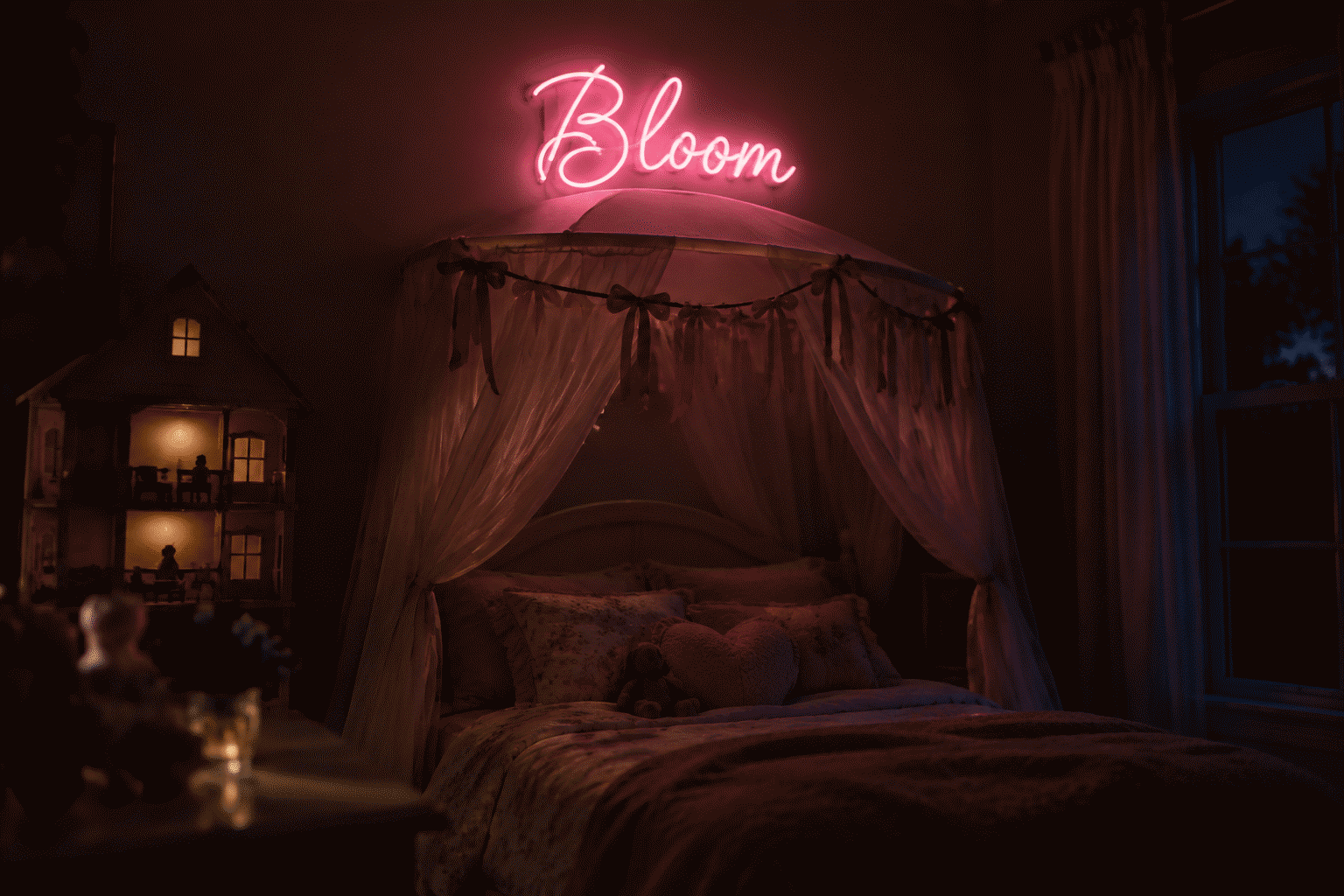
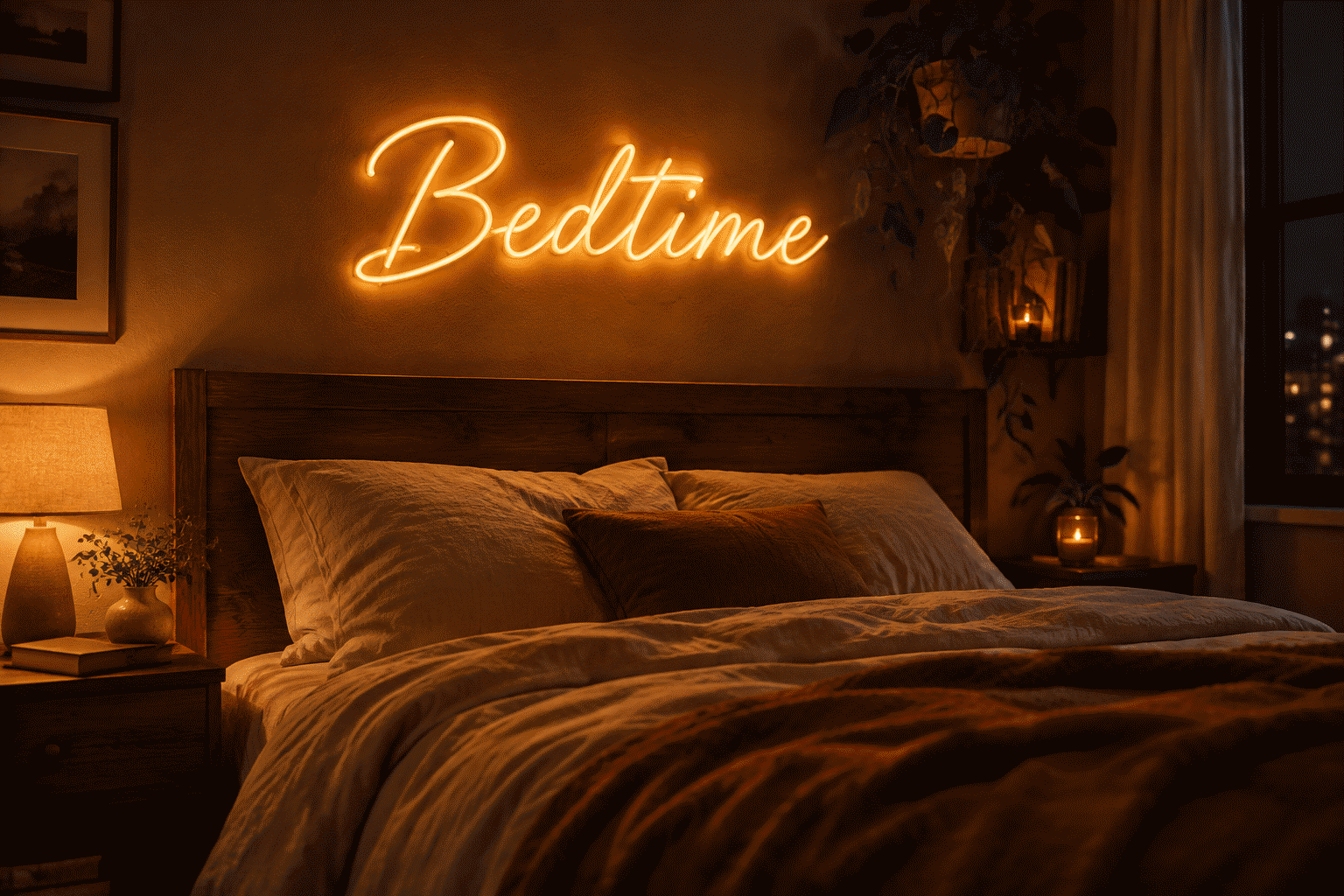
A girls’ room is where neon stops being signage and becomes personality. The piece on the wall says who lives here — dreamer, dancer, gamer, scientist, future boss — and because it glows, it does the saying at night too, which is when rooms matter most to the people sleeping in them.
Here are 24 ideas by age band and by register, from the nursery’s first script to the teen’s aesthetic statement, with the color systems that carry a room from age 4 to 14 without a full rebuild. The full kids collection lives at kids room neon signs.
The Nursery Years: Ideas 1–5
- Her name in soft script — the nursery’s centerpiece: blush, warm white, or soft lavender script above the crib wall (facing the crib, not over it — placement notes below). Every name previews free in the customizer.
- “Oh Baby” — the shower-gift classic that transitions from party wall to nursery; the most-gifted piece in the category’s history.
- A cloud + star set — the sleep-theme tier; warm white, dimmable to a night-feed glow.
- A butterfly shape — the nursery-to-preschool piece that outlives the theme years (the full butterfly tier is a category of its own).
- “Dream Big Little One” — the blessing register; the piece parents buy for themselves as much as for her.
Ages 4–10: The Magic Years: Ideas 6–12
- A unicorn — the decade-defining piece of the age band; pink or rainbow, over the bed.
- The pink room system — name + heart + cloud in layered pinks; the linked treatment shows how three coordinated pieces beat ten random ones.
- A rainbow arc — the universal build; works from preschool through third grade and never clashes with anything.
- Her initial, oversized — the monogram tier: one big letter in her chosen color; the piece that survives every phase because it’s just hers.
- A mermaid or starfish — the ocean-theme years; pairs with teal and shell-pink bedding.
- “Stay Wild” or “Be Brave” — the affirmation tier for the elementary years; reads as decoration now, motto later.
- A flower or butterfly shape cluster — three small shapes in a constellation arrangement; the tier for walls that already have the name piece.
Ages 10–14: The Identity Years: Ideas 13–17
- Good Vibes Only — the middle-school register’s signature; the phrase that launched a thousand room makeovers.
- A dance or sport piece — ballet shoes, a volleyball, a gymnast silhouette: the thing she does, in her color.
- A music piece — headphones shape, her artist’s lyric, or a treble clef; the identity tier that carries to high school.
- “Create” / “Boss Babe” / “Fearless” — the motto wall for the study years; see the quote archive for the full canon.
- A galaxy or Saturn piece — the space register for the science-minded; purple and ice blue, strongest over a desk.

The Teen Years: Ideas 18–24
- You’re Like Really Pretty — the Clueless-register classic; the teen wall’s most-hung phrase for five straight years.
- Hello Gorgeous — the greeting that starts every morning; the mirror-side placement standard.
- Sweet 16 — the birthday that earns its own piece; the milestone tier’s flagship.
- The aesthetic statement — sunset gradients, y2k shapes, or the layered look from the room aesthetic guide; the teen room that photographs is the teen room that gets built.
- A purple room system — purple is the teen girl palette’s center of gravity: it reads creative at full brightness and moody at 30%, and it carries both the galaxy theme and the aesthetic era.
- Her name, restyled — the teen upgrade from nursery script: block, outline, or edgy font in her chosen color; her call, her font, her wall.
- A vanity piece — “Get Ready With Me” or a lighted-mirror surround; the content-generation station’s official signage.
Color Systems and the Long Game
The rooms that work run color systems, not color accidents. The pink system carries nursery through age ten; the purple system carries ten through sixteen; warm white carries everything, any age, forever. The one-rebuild strategy: anchor with the name piece in a neutral (warm white), add the phase pieces in the current palette, and swap phases without touching the anchor. The bedroom color guide covers the full age-proofing logic.

Placement runs by height: nursery pieces mount out of reach (bottom edge 24+ inches above the crib rail), elementary pieces at seated-on-bed eye level (42–54 inches), teen pieces wherever the wall and the mirror agree — with cords secured behind furniture per the hanging guide, and the dimmer placed on the parent’s side until the teen earns it.
The Palette Systems, Decoded
Girls’ room palettes run in systems, not singles – and the system is what makes the room read designed across the childhood.
The pink system (birth to ~10): layered pinks rather than one pink – the blush base, the hot-pink accent, the warm-white bridge. The three-tone system survives bedding changes and phase rotations because it’s a family, not a color; the single-pink room dies with the first strawberry duvet cover. The pink register’s physics cover why the layered version photographs better too.
The purple system (~8 to ~16): the teen transition palette – purple base, gray support, one warm accent. Purple carries the galaxy phase, the aesthetic era, and the moody teen years without a full re-commission; it’s the longest-serving system in the category (the purple logic).
The warm-white system (all ages): the neutral spine – the namepiece in warm white rides every system change, because warm white agrees with everything. The room that anchors warm-white and rotates the accent pieces spends its palette budget on phases, not repaints.
The crossover discipline: the systems hand off at the transitions (pink-to-purple around age eight, purple-to-owner’s-choice at the teen restyle) – the handoff pieces (the monogram, the namepiece) carry across in the neutral, and the phase pieces retire with their phases. The room that runs systems changes its look every three years for the price of two accent pieces; the room that buys singles repaints.
The Budget by Age Band
Nursery ($80-250): the name in soft script (the keeper), the moon-and-stars set (the sleep tier), the phase shapes (cloud, butterfly) at entry price. The nursery budget concentrates on the namepiece – it’s the eighteen-year piece (the name logic).
The magic years ($60-200): the rainbow arc, the unicorn, the theme pieces – all entry-tier, all honestly disposable. The budget here is deliberately light: the phase runs 12-24 months, and the pieces that outlive their phase become clutter.
The identity years ($80-250): the sport or hobby piece, the first phrase (“Good Vibes Only”), the monogram upgrade – the tier where the child’s input starts (and where the budget starts respecting it).
The teen years ($150-450): the name restyle, the aesthetic system, the vanity tier – the room’s big re-commission, funded once, at the quality the next eight years (dorm, first apartment) will use. The teen budget buys keepers: the namepiece moves to college, the mirror surround moves to the first apartment, the dimmer habit moves everywhere.
Variations and Pairings
The girls-room canon’s variants. The word-face variants: “neon signs for girls room,” “girls room neon sign,” and “teen girl neon sign” serve the tier; the age faces split the registers – the nursery face (the soft tier), the magic-years face (the icon tier), the teen face (the teen guide, the aesthetic tier). The style faces: the pink system (the treatment), the purple system (the palette), and the neutral system each carry their pairings.
The pairing logic: the girls room pairs the name (the keeper) with the phase (the rotating) – the anchor-and-layer architecture that survives childhood. The phases pair by age-band (the unicorn never pairs with the aesthetic sunset – different childhoods); the keeper pairs with everything (the warm-white name agrees with every phase).
The shared-room pairing: the sisters’ room pairs the matched keepers (two names, one palette) with the phase layers kept separate – the fairness architecture that prevents the daily treaty violation (the sibling-set logic).
FAQ About Neon Signs for Girls Rooms
What’s the best first sign for a girl’s room? Her name in warm white. It survives every phase, belongs to nobody else, and moves to college. The phase pieces (unicorn, mermaid, aesthetic) are the fun layer; the name is the foundation.
Pink, purple, or white — how do I choose? If the room has a palette, match it. If you’re starting fresh: pink for the young room, purple for the teen, warm white for the piece that has to last. The pink system and purple palette guides have the full breakdowns.
What about a shared room? Two name pieces in one coordinated palette, or one shared phrase (“Good Vibes Only”) plus separate initials; the monogram tier exists exactly for this.
When is she too old for theme pieces? She’ll tell you — usually around fifth grade. The name, the monogram, and the phrase tier never age out; the unicorn has a window, and that window is precious.
What age is best to switch to a teen room neon sign? The teen restyle runs somewhere between twelve and fourteen – the room tells you (the unicorn’s retirement, the aesthetic saves-folder’s arrival, the opinions about everything). The switch promotes the keepers: the namepiece restyled from the nursery script to the block or outline font (the teen restyle logic), the palette transitioning from the pink system to the purple or the chosen register. The teen restyle is the room’s big re-commission – the one budget (~$150-450) that carries the room through the high school years and into the dorm (the teen guide runs the collaboration protocol that makes it land).
Can boys’ and girls’ rooms use the same neon signs? The keeper tier is fully shared – the namepiece, the monogram, the moon, the “Dream Big” blessing work identically (the kids canon covers the shared core). The phase tiers skew by interest rather than by rule: the rainbow and the unicorn for the color years, the dinosaur and the sports piece for the obsession years, regardless of who is having them. The marketing splits the canons (the girls’ guide here, the general guide carrying the rest) because the searches split – the rooms themselves take the pieces the child actually loves, which is the only canon that matters (the teen protocol‘s rule at every age).
The Pink System vs the Neutral System
The girls room’s two palette architectures, compared:
| Decision axis | The pink system | The neutral (warm-white) system |
|---|---|---|
| The statement | The classic register (the era’s signature) | The timeless register (the decade-proof) |
| The pieces | The layered pinks (the treatment) | The namepiece and the single accents |
| The phase-friendliness | High (the pink years run long) | Total (the neutral survives everything) |
| The bedding agreement | The pinks lead (the room follows) | The neutrals agree (the room leads) |
| The transition cost | The palette change at the style shift | None – the anchor rides every shift |
| The photography | The soft-aesthetic’s signature | The minimalist’s calm |
The comparison’s decision input: the room’s phase-rotation pace. The household that redecorates every phase runs the neutral anchor with the pink accents (the phases swap, the anchor stays – the transition logic); the household that commits to the register runs the full system (the pinks’ layered look at its decade of service).
The two systems’ combination – the neutral namepiece anchoring the pink system’s layers – is the girls room’s standard architecture: the keeper at the center, the register around it, and the next phase’s swap costing two accents rather than a re-commission (the palette decoder maps the full system logic).
Sources & Further Reading
- Neon sign (Wikipedia) — the consolidated public record of neon-sign history and technology.
- Neon, element 10 (Wikipedia) — element properties: density, boiling point, abundance.
Pricing based on CustomNeon’s current catalog (2026); custom quotes come live from the sign builder.