16 Nightclub Neon Sign Ideas That Own the Night
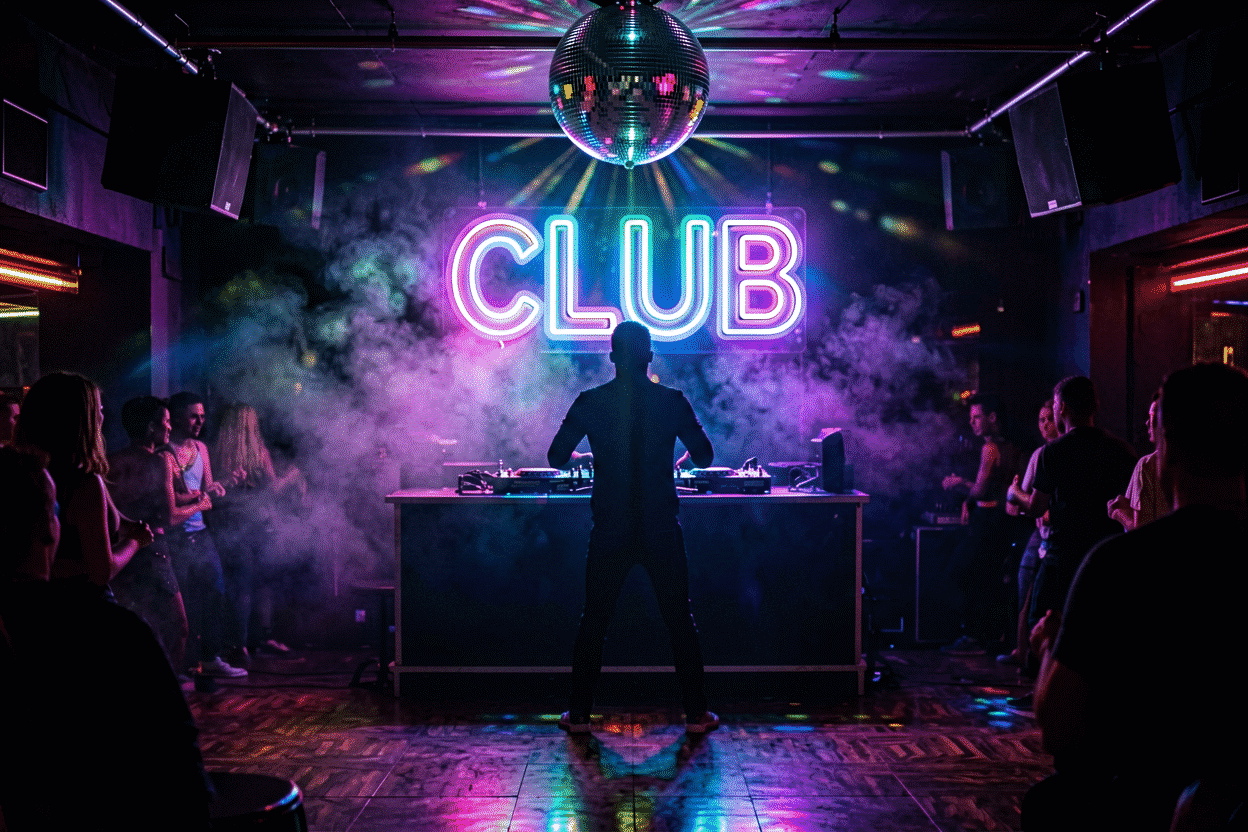
The nightclub is the one venue where neon isn’t decoration — it’s the product. The club sells an atmosphere, the atmosphere runs on light, and the sign program IS the lighting design’s identity layer. The clubs that hit (the ones the city photographs at 1 a.m.) run sign programs with the same intention their sound systems carry: every piece placed for the room’s physics and the night’s arc.
Here are 16 ideas by the venue’s zones — the street, the door, the floor, the rooms — with the night’s brightness arc built in. The bar-side canon lives at bar signs for businesses; the general playbook at open signs.
The Street & Door Tier: Ideas 1–4
- The club’s name over the entrance — the marquee piece (the customizer at venue scale): the street’s 1 a.m. landmark — the single most valuable sign the venue owns.
- The door-status tier — “OPEN” and the queue-side messaging: the door program’s functional pair (the B-end logic).
- The genre marker — “TECHNO / HIP HOP / LATIN”: the format that pre-qualifies the line — the sign that fills the room with the right crowd.
- The tonight-tier — the DJ’s name or the event’s title in glow: the calendar’s street face, changed per weekend (the programmable tier earns its keep here).
The Floor Tier: Ideas 5–8
- The DJ-booth piece — the booth’s backdrop glow (the music canon adjacent): the room’s focal architecture — the piece every crowd shot includes.
- The dance-floor phrase — “DANCE LIKE NOBODY’S WATCHING” at floor edge: the license tier — the sign that gives the room permission.
- The color-changing system — the RGB program on the night’s arc: build-up warm, drop cool, close at glow — the lighting design’s narrative layer.
- The ceiling-and-perimeter wash — the strips that define the room’s geometry: the spatial tier that makes a warehouse read as a venue.
The VIP & Room Tier: Ideas 9–12
- The VIP marker — “VIP” and the section’s glow: the tier that sells the table — the signage that pays for itself by Friday.
- The booth-name pieces — the tables’ own glows (the sponsor tier, the regulars’ names): the room’s personalization revenue layer.
- The bathroom-journey piece — the hallway glow (“You Look Great, Honestly”): the venue’s most-shared post — the tier every top club runs (the case).
- The smoking-terrace marker — the outdoor room’s glow: the venue’s second social room, signed.

The Content & Brand Tier: Ideas 13–16
- The photo moment — the one piece built for the crowd’s cameras (the logo wall, the phrase, the sculpture-glow): the venue’s content engine — every post a promotion (the case).
- The brand piece — the club’s logo in its identity colors (the register logic): the merch-preview tier — the piece that appears on the tee the crowd buys.
- The era-and-heritage piece — the venue’s founding year or the scene’s iconography (the vintage logic adjacent): the authenticity tier for the clubs whose history IS the draw.
- The after-hours signal — the “AFTER PARTY” or “TILL LATE” glow: the night’s extension tier — the sign that routes the crowd to the next room (yours).
The Night’s Arc
The club program runs brightness as narrative: full at prime (the room’s peak energy), the color shifts at the drops (the RGB logic), glow at close (the comedown register). The palette runs the venue’s identity — bold and saturated by genre (the trade logic) — with one rule from every great room: the DJ booth’s piece and the photo wall are the two non-negotiables, the focal and the engine (the music canon).

The budget: the street and DJ tier first (identity and focal — the room’s reason), the photo moment second (the content engine), the VIP and room markers as the venue’s revenue layers justify (the playbook).
The Venue Program: Street, Focal, Content
The nightclub’s program runs three systems that the venues layer in order. The street system (the marquee tier): the name over the entrance – the 1 a.m. landmark, the street’s brightest statement the code allows (the size guide for the arterial math); the door’s status tier; the tonight-board (the programmable piece that carries the calendar – the venue’s most-changed sign, worth the RGB tier’s flexibility (the color logic)).
The focal system (the room’s architecture): the DJ-booth piece (the room’s visual center – the backdrop every crowd shot includes), the floor’s color-changing program (the night’s narrative layer – the build-drop-close brightness arc), and the perimeter washes that define the room’s geometry. The focal system IS the venue’s product: the room the crowd pays to be in, lit (the night’s arc above).
The content system (the crowd’s posts): the photo moment (the one piece built for the cameras – the logo wall, the sculpture-glow, the bathroom-journey piece that every top venue runs), the VIP markers (the revenue tier that sells the tables), and the brand piece (the merch-preview – the logo the crowd buys on the tee). The content system markets the venue nightly to exactly the audience that decides to come (the case).
The Venue Budget and the ROI Lines
The venue-grade budget: the opening venue ($800-2,000) – the marquee, the DJ-booth piece, the first content wall; the room that opens with its identity. The established venue ($2,000-5,000) – the full focal system, the RGB program, the VIP tier; the room that competes on its experience. The destination venue ($5,000-12,000) – the commissioned installations, the internationally-photographed pieces; the room that IS the city’s night out.
The ROI lines that fund it: the table sales (the VIP tier’s direct revenue), the door count (the street system’s conversion), and the content reach (the photographed venue’s nightly marketing) – the three lines the venue can count, and the program’s budget defends itself on (the discipline).
FAQ About Nightclub Neon Signs
What’s the best neon sign for a nightclub? The name over the entrance and the DJ-booth piece — the street’s landmark and the room’s focal, the two non-negotiables (the canon). The photo-wall piece third: the content engine.
How do clubs use color-changing neon? On the night’s arc: warm builds, cool drops, glow closes (the RGB logic) — the lighting design’s narrative layer, synchronized where the budget runs to it.
What’s the nightclub sign budget? The street-and-focal core lands $800–1,500 at venue grade; the content and room tiers add by ambition (the brackets). The VIP tier repays itself weekly.
Do club signs need special compliance? Venue-scale exterior neon runs the municipal sign-code tier (the B-end logic) — plus venue-specific rules in some districts (brightness curfews, animation restrictions). The city call precedes the marquee.
What neon signs do nightclubs need? The two non-negotiables and the engine: the name over the entrance (the street’s 1 a.m. landmark) and the DJ-booth piece (the room’s focal – every crowd shot’s background), plus the photo moment (the one piece built for the cameras) (the venue program above). The three pieces run $800-2,000 at venue grade and cover the street, the floor, and the feed – the venue’s three audiences. The color-changing system runs the night’s arc (the build-drop-close brightness narrative) and the VIP tier sells the tables that repay the program weekly.
How much does a nightclub neon program cost? The street-and-focal core – the name over the entrance and the DJ-booth piece – lands $800-1,500 at venue grade; the full program (the color-changing system, the photo moment, the VIP tier) runs $2,000-5,000; the destination venue’s commissioned installations run $5,000-12,000 (the venue budget above). The ROI lines that fund it: the table sales (the VIP tier’s direct revenue), the door count (the street’s conversion), and the content reach (the photographed venue’s nightly marketing) – the three countable returns.
How much electricity does a nightclub neon program use? More than the household tiers but less than the venue’s fears: the full program (the marquee, the focal system, the RGB tier, the room’s pieces) draws the commercial-scale load that the venue’s electrical service handles routinely (the math scales to the program) – a fraction of the sound system’s appetite, a rounding error against the HVAC. The LED era’s gift to the venues: the color-changing tier that replaced the glass runs its whole RGB range on the LED’s few watts per meter – the nightly light show at the utility bill’s margin. The venue’s real electrical conversation belongs to the audio and the air; the glow’s line item is the production’s cheapest.
What’s the LED wattage reality for a club’s full glow program? A full club installation — facade script, main-room signage, VIP booth pieces, hallway directionals — typically lands in the 400-800 watt band for LED flex, which is less than the DJ booth’s monitor stack and disappears inside a venue’s lighting budget. The days of neon being a line item worth a second look on the electric bill ended with the LED transition; the planning conversation now is circuits and control, not consumption.
How do club neon installations handle cleaning and smoke residue? Venue haze and cigarette-adjacent residue coat tubing in weeks, so the program’s maintenance is scheduled like everything else in the club: a monthly soft-brush and microfiber pass during day cleanings, with isopropyl on the acrylic only when the film builds. Pieces near fog machines need their adapters and connectors checked quarterly — that’s where residue does real damage, not on the wipeable tubing face.
The Opening Venue vs the Established Venue
The nightclub program’s two stages, compared:
| Decision axis | The opening venue | The established venue |
|---|---|---|
| The budget | $800-2,000 (the identity’s arrival) | $2,000-5,000+ (the experience’s arms race) |
| The anchor pieces | The marquee, the DJ booth, the first content wall | The commissioned installations, the RGB system, the VIP tier |
| The risk | The room that opens without its identity | The room that out-glows its bookings |
| The measurement | The door count, the street’s read | The table sales, the content reach |
| The refresh cycle | Never (the opening’s pieces are permanent) | The season’s (the venue’s rotations) |
| The keeper weight | Total (the founding pieces) | The brand tier’s permanence |
The two stages’ sequencing (the venue program above): the opening venue buys its identity (the name, the focal, the engine – the three pieces the room cannot open without), and the established venue buys its experience (the installations and the systems that compete with the city’s other rooms).
The opening stage’s one warning: the venue that skips the identity pieces to afford the spectacle tier (the RGB before the name) opens as the room nobody can name – the street’s landmark is the marquee, not the color schedule. The name over the door outglows everything the budget could have bought instead (the street system’s logic above).
Sources & Further Reading
- Solid-State Lighting (U.S. Department of Energy) — DOE reference on LED efficacy and lifetime.
- Neon sign (Wikipedia) — the consolidated public record of neon-sign history and technology.
Pricing based on CustomNeon’s current catalog (2026); custom quotes come live from the sign builder.