17 Trade Show Neon Sign Ideas for Booths That Pull
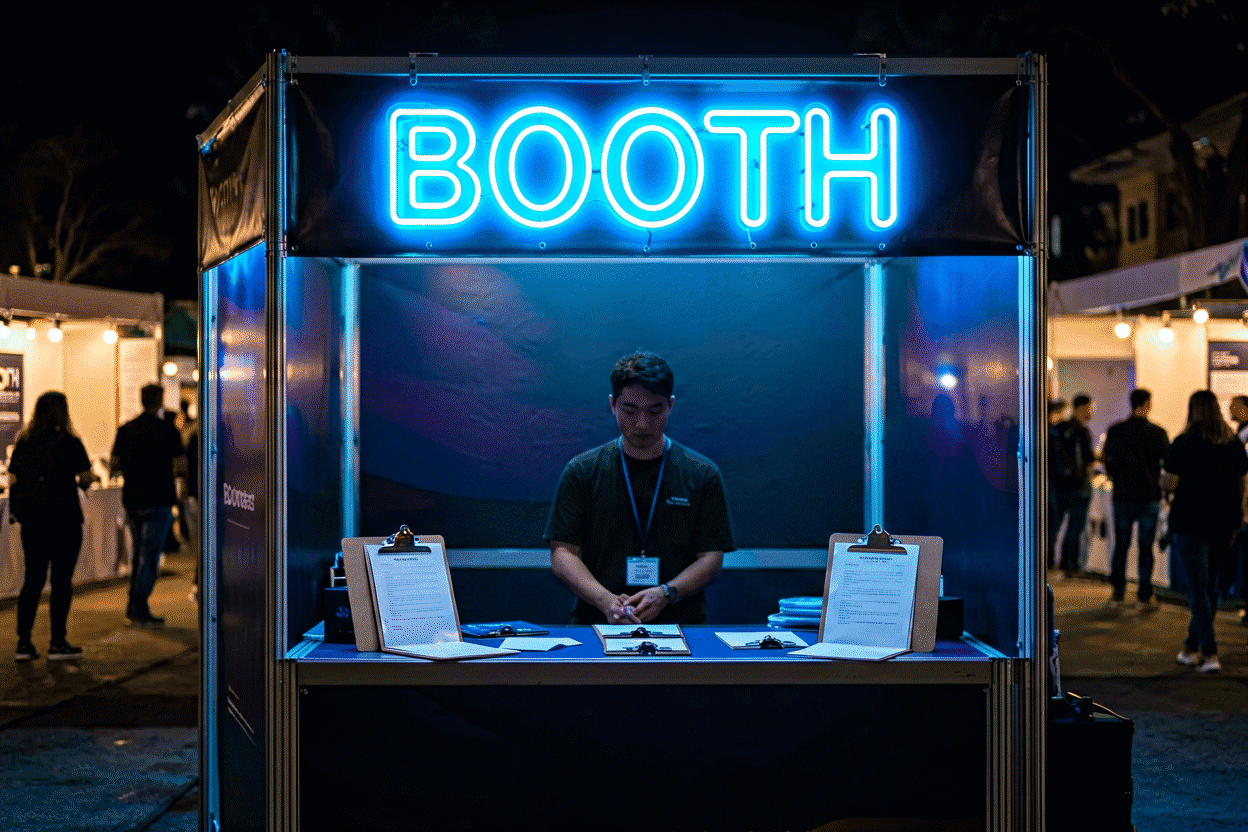
The trade show floor is the most contested three seconds in B2B marketing: an aisle of competitors, a badge-wearing prospect walking at convention speed, and your booth’s eight feet of frontage to stop them. The booths that pull traffic figured out what the best storefronts knew all along — the glow stops the walker that the banner can’t. On a floor of pop-ups and retractable vinyl, a neon piece is unfair advantage.
Here are 17 ideas by the booth’s zones and jobs, with the logistics tier that makes expo neon actually work (power, transport, setup). The general B-end playbook lives at small business neon signs.
The Aisle-Stopping Tier: Ideas 1–5
- The logo glow — the company’s mark in brand colors at booth height (preview): the aisle piece that reads from twenty feet of convention floor — the single highest-value square feet the booth owns.
- The product-name piece — the flagship’s name in light: the tier that pre-qualifies the stop — the walker who knows the product self-selects in.
- The category marker — the two-word what-you-do (“FLEET TECH,” “CLEAN ENERGY”): the format that stops the right aisle-traffic and lets the wrong pass.
- The tagline glow — the one-line value prop in script or block: the pitch before the pitch — the sign that starts the conversation the staff finishes.
- The demo-beacon — the glowing “LIVE DEMO” marker over the product station: the queue-forming tier — the sign that schedules the crowd.
The In-Booth Tier: Ideas 6–10
- The back-wall anchor — the big piece on the booth’s rear wall: the photo backdrop for every prospect’s shot and the visual the aisle sees through the booth (the case).
- The meeting-corner glow — the soft piece over the consultation table: the tier that makes the booth’s interior worth entering — the retail fitting-room logic, B2B edition.
- The swag-station marker — the glowing giveaway tier: the traffic route that ends at the badge-scan (the B-end logic).
- The stat-wall piece — the metric in light (“40% FASTER”): the proof tier — the number that stops the analyst walker better than any phrase.
- The era-or-award glow — the “WINNER” or anniversary piece: the credibility tier, glowing modestly.
The Engagement Tier: Ideas 11–14
- The photo-moment build — the booth’s Instagram piece (the logo wall, the industry’s inside joke): the content engine — every post a booth-adjacent promotion (the case).
- The interactive glow — the color-changing or motion-triggered piece (the RGB logic): the demo-adjacent tier that gathers the aisle’s attention by motion.
- The industry-humor piece — the trade’s joke in light: the register that breaks the convention-formality ice — the sign that starts the conversation laughing.
- The “ASK ME” tier — the glowing prompt above the staff’s heads: the engagement cue — the piece that gives the prospect the opening.

The Logistics Tier: Ideas 15–17
The part that decides whether expo neon works at all.
- The battery-first build — the 12V/battery tier for the booths without floor power (the power logic context): the engineering choice made at purchase, not at the convention center.
- The travel-case discipline — the pieces that pack in the custom cases and set up in minutes (the mounting methods portable versions): the booth crew’s tired-afternoon metric.
- The modular wall system — the pieces that mount to the booth’s existing frame, not the convention’s: the setup tier that survives three shows a quarter (the brackets‘ amortization logic — the sign that works one show is expensive; the sign that works twelve is infrastructure).
The Expo Economics
The booth neon’s return runs the capture case at convention density: the aisle’s traffic is the show’s whole point, the glow’s stopping power is the physics, and the photo-wall tier compounds (every prospect’s post is show-adjacent marketing). The working program: logo-and-category first (the stopping tier), the back-wall anchor and demo beacon second (the conversion tier), the content and engagement pieces as the show calendar justifies — and every piece specced portable (the logistics tier) or it never leaves the office.

The Booth Physics: Aisle-Speed Reading
The trade show floor runs its own physics: the aisle’s walking speed (convention pace – faster than a mall, slower than a street), the badge-level sightline (the attendee’s eye runs 48-60 inches – the booth piece’s band), and the aisle’s glow competition (the floor’s lighting rig flattens everything – the neon’s contrast is the unfair advantage, the case).
The physics’ applications: the logo piece at booth height (the aisle’s twenty-foot read – the stopping tier), the category marker in the badge band (the pre-qualification – the right aisle-traffic stopping), and the back-wall anchor at the booth’s depth (the photo tier – the prospect’s shot and the aisle’s view through). The booth that runs all three converts at convention rates; the booth that runs one wonders why the glow didn’t fix the traffic (the expo economics above).
The demo-beacon’s queue physics: the “LIVE DEMO” piece over the product station schedules the crowd – the queue forms, the aisle watches the queue (the social proof), and the booth’s traffic compounds on itself. The beacon’s $150 is the highest-ROI piece on the floor (the stopping tier).
The Logistics Kit: The Complete List
The expo neon’s logistics, as the complete packing list: the pieces (in their travel cases – the battery-tier builds and the booth-power builds, labeled), the mounts (the frame-clamp systems for the booth’s existing structure, the stand-off kit for the back-wall), the power (the battery bricks charged, the extension runs, the power strips – the show’s kit verified), and the tools (the zip ties, the velcro, the spare adapters – the fifteen-dollar insurance that saves the booth).
The kit’s discipline: packed the week before (the checklist run against the show’s kit requirements – the electrical rules, the booth-fire regulations), and the setup rehearsed once (the hotel-room dry run that turns the convention-center’s first thirty minutes from assembly into placement). The booth crew that rehearses glows at opening; the crew that doesn’t glows by eleven (the logistics tier).
FAQ About Trade Show Neon Signs
Can you use neon signs at trade shows? Yes — with the logistics spec’d: battery-or-booth-power builds, travel cases, and frame-mounted setup (the logistics tier portable logic). Some venues’ electrical rules want the UL-tier adapters (the safety logic context) — check the show’s kit.
What’s the best neon sign for a booth? The logo glow at aisle height plus the category marker: the stopping pair that pre-qualifies the walk-by (the case). The back-wall anchor for every photo.
How much does expo booth neon cost? The stopping pair lands $300–600; the full program $800–1,500 (the brackets) — amortized across the show calendar into infrastructure pricing (the modular logic).
LED or battery — what powers booth neon? Booth-power where the show provides it; the battery tier where it doesn’t (the tier above). The choice is made at purchase — the convention center is the wrong place to discover the power plan.
Do trade show booths allow neon signs? Yes, with the logistics spec’d: the battery-or-booth-power builds, the travel cases, and the frame-mounted setup (the logistics tier above). The show’s kit requirements (the electrical rules, the fire regulations) get verified before the pieces ship – the UL-tier adapters the venues want, and the ten-minute handbook read that prevents the booth-day surprise. The expo neon that spec’d right stops the aisle the banners can’t (the case) – the three-second advantage the trade show floor sells.
How much does trade show booth neon cost? The stopping pair – the logo glow and the category marker – runs $300-600; the full program (the back-wall anchor, the demo beacon, the engagement pieces) runs $800-1,500 (the expo budget above). The logistics tier adds its line (the travel cases, the battery builds, the modular mounts) – the $100-300 that makes the pieces survive the circuit. The amortization math: the sign that works one show is expensive; the sign that works twelve (the modular, the packed, the rehearsed) is infrastructure (the brackets).
Are battery-powered neon signs good for trade shows? The expo’s quiet standard: the battery tier’s twelve-volt and USB-C builds serve the booths without floor power (the small venues’ reality) and the aisle positions (the freestanding stops the power drops can’t reach) (the logistics tier above). The battery discipline: the runtime math before the show (the pieces’ draw against the bricks’ capacity – the eight-hour day with the margin), the spare bricks charged, and the swap plan for the lunch-hour lull. The battery tier’s honest limitation: the brightness ceiling (the bricks’ output against the wall’s draw) – the stopping pieces at the aisle sizes run fine; the venue-scale marquee pieces want the booth power.
Do battery neon pieces last a full trade show day? Current packs yes — quality battery tiers run 8-12 hours at working brightness against a show day’s 6-8 active hours, with the swap-or-charge overnight cycle matching hotel routines. The two planning notes: carry the spare pack (the piece that dies at 2 p.m. on day two is the story the team tells for a year), and dim to 70 percent — the battery math extends dramatically and the booth glow reads identical under hall lighting.
How does a neon booth piece survive the shipping reality of expos? Custom foam inserts and the original case, treated as checked freight, not luggage — the piece that survives ten expos is the one packed like the gear it is. The booth-design integration matters just as much: design the sign’s mounting to the booth wall system (hook-and-loop panels, tool-free brackets) so setup is a two-minute hang, and budget the case’s round-trip shipping into the show math from the start.
The Stopping Tier vs the Demo Tier
The booth program’s two jobs, compared:
| Decision axis | The stopping tier | The demo tier |
|---|---|---|
| The audience | The aisle (the walker at convention speed) | The stopped (the prospect at conversation distance) |
| The pieces | The logo glow, the category marker | The demo beacon, the back-wall anchor, the stat wall |
| The physics | The twenty-foot read (the aisle’s logic)) | The arm’s-length read |
| The budget | $300-600 | $500-900 |
| The conversion | The stop (the badge-scan’s start) | The conversation (the lead’s depth) |
| The queue effect | None (the stopping is individual) | The demo’s queue (the social proof’s compounding) |
The two tiers’ sequence (the booth physics above): the stopping tier first (the aisle’s traffic never reaching the demo without it), the demo tier second (the stopped traffic never deepening without it) – the booth that runs both converts at convention rates; the booth that runs one runs half the funnel.
The demo beacon’s quiet power: the “LIVE DEMO” piece schedules the crowd (the queue forms), the queue gathers the aisle (the social proof), and the booth’s traffic compounds on itself – the $150 piece that outperforms every other square foot of the booth’s real estate. The stopping tier buys the chance; the demo tier compounds it.
Sources & Further Reading
- Solid-State Lighting (U.S. Department of Energy) — DOE reference on LED efficacy and lifetime.
- Mercury (U.S. EPA) — federal guidance on mercury exposure and safe handling.
Pricing based on CustomNeon’s current catalog (2026); custom quotes come live from the sign builder.