
Neon the Element: Properties and Periodic Table Facts

Neon is element 10 on the periodic table: symbol Ne, ten protons, ten electrons, a noble gas that’s colorless, odorless, chemically inert — and, under electrical excitation, the source of the most recognizable glow in the material world. It’s the fourth most abundant element in the universe and among the rarest in Earth’s atmosphere, a paradox that tells a story about planets and gravity. And its spectral lines, studied properly, are among the most precisely known in physics.
This is the element’s data sheet and its story — for the sign-industry angle on the same substance, the companion pieces are what is neon, what gas is used in neon signs, and how do neon signs work.
The Data Sheet
| Property | Value |
|---|---|
| Symbol | Ne |
| Atomic number | 10 |
| Atomic mass | 20.180 |
| Protons / electrons | 10 / 10 |
| Common neutrons | 10 (in Ne-20, 90.5% of natural neon) |
| Group | 18 — the noble gases |
| Period | 2 (helium’s row-mate, two below it) |
| State at room conditions | Gas |
| Color / smell / taste | None, none, none |
| Melting point | −415.5°F (−248.6°C) |
| Boiling point | −411.0°F (−246.1°C) |
| Density (gas, STP) | 0.900 g/L — lighter than air |
| Electron configuration | 1s² 2s² 2p⁶ — the complete shell |
| Discovered | June 1898, William Ramsay & Morris Travers, London |
The structure in one sentence: ten electrons filling two shells exactly — two in the inner, eight in the outer — and that completeness is everything: it’s why neon bonds with nothing, why it exists as lone atoms, why the atmosphere’s neon just floats around doing nothing for eons.
The Family: Noble, Indeed
Neon sits in Group 18 with helium, argon, krypton, xenon, and radon. The family trait — full outer shells, zero appetite for chemical reactions — made them “inert gases” until the 1960s, when xenon fluorides (under extreme conditions) broke the rule and softened the name to “noble.” Neon itself remains stubbornly unbondable under anything resembling normal conditions: there are no confirmed stable neon compounds. Of all the elements, neon’s chemical career is the closest to “none.”
Within the family, neon is the second-lightest (after helium) and the most aloof — even among nobles, neon’s electronegativity and bond energy sit at the don’t-bother end of the spectrum.
The Signature Glow (Spectroscopy in One Paragraph)
Heat or electrify any element and it emits light at fixed wavelengths — atomic fingerprints. Neon’s fingerprint is dominated by the famous red-orange band (~640 nm and company), so distinctive that “neon red” is a defensible color name, and so bright-per-watt that neon discharge made signage economics work a century ago. The full visible spectrum of a neon discharge actually spans lines into orange and faint yellow-green — under a spectroscope, the “red” glow resolves into a comb of wavelengths; the eye integrates it into the warm red-orange we know.
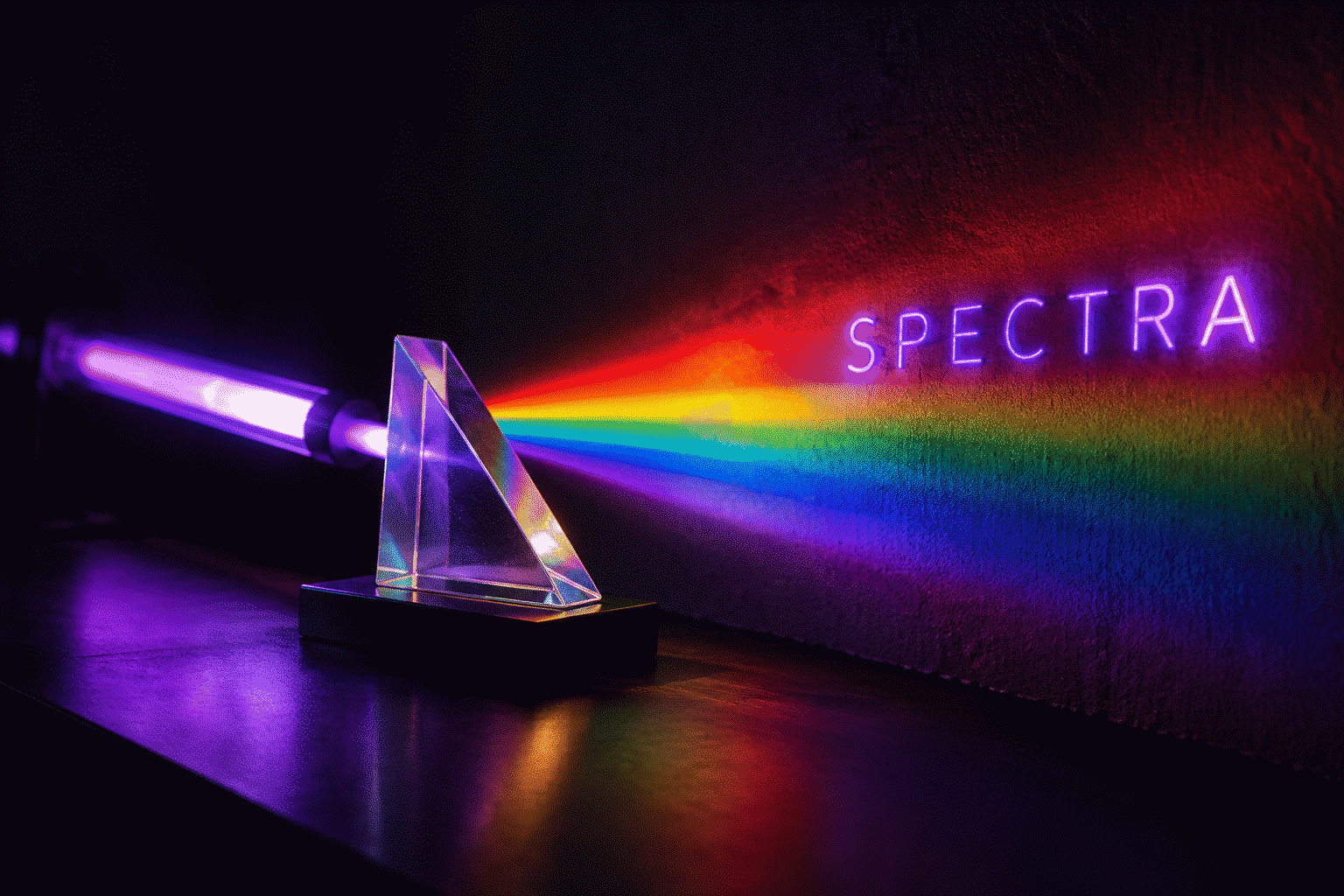
That spectral specificity also did real science: neon discharge tubes became laboratory standards, and helium-neon lasers (the red lasers of late-20th-century labs and classrooms) turned the element’s tidy transitions into coherent light.
Abundance: The Universe vs. Earth Paradox
In the universe: neon ranks around fourth by elemental mass — forged in stars (it’s a primary alpha-process product of stellar nucleosynthesis), abundant in nebulae and stellar spectra.
On Earth: about 18 parts per million of the atmosphere — 0.0018% — roughly 1/80,000th as common as argon, its heavier noble sibling. The explanation is a planetary sorting story: primordial neon is light enough that atmospheric escape stripped it over deep time, and inert enough that — unlike carbon or oxygen — it never got locked into compounds and minerals. Earth kept almost none; the universe is full of it.
Where our neon comes from: air separation. Cryogenic distillation of liquefied air separates its components (nitrogen, oxygen, argon… and the trace noble gases); neon condenses in its own fraction and is further purified. Neon supply is, literally, a byproduct economy of air liquefaction — which is why neon availability tracks industrial-gas markets, and why, during supply disruptions, sign makers and laser builders feel it (the sourcing story: where does neon come from).
Isotopes and the Odd Fact
Natural neon is three stable isotopes: Ne-20 (90.5%), Ne-21 (trace), Ne-22 (9.3%). Beyond those, a dozen-plus radioactive isotopes exist in accelerator physics — Ne-24’s minutes-long half-life is nobody’s household concern. The isotope ratios in rock samples serve as real geologic tracers (cosmogenic Ne-21 builds in surface rocks under cosmic-ray bombardment, giving geologists exposure-dating clocks — neon as a stopwatch for erosion histories).
And the trivia that travels: neon’s name (from Greek neos, “new”) was suggested by Ramsay’s twelve-year-old son at the discovery’s dinner table — one of chemistry’s better naming stories (more where that came from: fun facts about neon).
The Element in the Economy of Glow
For all the data sheet’s richness, neon’s commercial footprint is narrow: signage and discharge lamps, HeNe lasers, cryogenic refrigeration, and research. No compounds, no biology, no corrosion concerns — an element whose entire human relationship is “look at it working.” The signage relationship remains the culturally defining one: an inert, invisible, almost-nonexistent-on-Earth substance whose one trick — glowing when excited — became the visual language of the twentieth century’s nights and the twenty-first’s bedrooms.
That language is now mostly spoken by LEDs wearing neon’s silhouette (the technology story) — but the element keeps the naming rights. Design something worth the name in the custom builder.
Neon Among the Elements: Comparison Notes
The element’s data sheet gains meaning in comparison with its neighbors:
Versus helium (the noble sibling above). Helium is lighter, escapes Earth faster, fills balloons and cools MRI magnets; neon is heavier, stays (barely), and glows. Both are chemically inert — helium holds the record for refusal to bond even under lab duress, while neon matches it in practice. Their abundance inverts by venue: helium rare in the universe at large relative to neon, yet more common on Earth (natural-gas deposits trap it), which is why neon is the rarer purchase per liter despite being the commoner element cosmically.
Versus argon (the working partner below). Argon is neon’s commercial opposite number: a hundred times cheaper (0.93% of the atmosphere vs. neon’s 18 ppm — the sourcing economics), which is why argon fills the workhorse roles (inert gas shielding, insulated windows, the blue side of sign tubes) while neon stays specialty. The sign industry’s palette literally splits along the price line: red in premium neon, blues in commodity argon.
Versus sodium (the lighting competitor). The streetlight element: sodium’s yellow-orange emission beat neon’s red-orange for municipal lighting economics decades ago (efficiency and lamp life), which is why cities glow sodium and storefronts glow neon — a century-old market segmentation by wavelength. LED has since eaten both segments’ growth (the modern outcome), but the sodium-vs-neon split explains the mid-century nightscape’s two-tone palette.
Versus oxygen and nitrogen (the atmosphere’s majority). The reactive majority versus the inert minority: oxygen bonds (rusting, burning, breathing) and nitrogen feeds the biosphere’s chemistry, while neon floats through all of it untouched — one atom in 55,000 of the air you’re breathing, doing precisely nothing, forever (the abundance story). The majority elements run the planet; the noble minority watches.
The periodic placement dividend. Group 18’s column reads as an escalation: helium’s two electrons, neon’s complete shell of eight, argon’s eighteen — the family that solved chemistry’s stability puzzle and stopped reacting. Neon’s position (second lightest noble gas) makes it the family’s sweet spot for discharge work: heavy enough to stay in tubes and give rich emission lines, light enough to glow brightly at modest voltages. The physics that made Claude’s 1910 debut possible was arranged 13.8 billion years earlier in the column’s structure.
FAQ: Neon the Element
What is neon’s atomic number and symbol? Neon is element 10, symbol Ne — ten protons and ten electrons, sitting in period 2, group 18 (the noble gases), right beside helium’s column-mates argon and krypton below.
How many protons, neutrons, and electrons does neon have? Ten protons and ten electrons always; most natural neon atoms (Ne-20, about 90%) carry ten neutrons. The stable isotope set is Ne-20, Ne-21 (trace), and Ne-22 (about 9%).
Why is neon chemically inert? Its electron shells fill completely (2 + 8) — a configuration so stable that neon neither needs to gain, lose, nor share electrons. No confirmed stable neon compounds exist under normal conditions; even “noble gas chemistry” barely dents it.
What color is neon the element? Invisible — colorless, odorless gas in ordinary conditions. Under electrical discharge it glows its famous red-orange (~640 nm dominant emission), which is where the color association comes from.
Is neon abundant on Earth? Almost none: about 0.0018% of the atmosphere. Neon is cosmically common (fourth by mass in the universe) but too light and too inert for Earth to have retained or bound it — extracted commercially as a fraction of liquefied air.
What is neon used for? Signage and discharge lamps, helium-neon lasers, specialized cryogenic refrigeration (liquid neon’s −411°F boiling range), and research instrumentation — an element whose working life is entirely about light and cold. The element’s story completes with a practical footnote: everything on this page — the data sheet, the family comparisons, the spectral signature — is knowledge the sign industry runs on without stating it. When a maker specifies a neon fill for a red piece or an argon-phosphor build for a blue one, they are applying the atomic physics described above; when a collector dates a tube by its glow, they are reading an emission spectrum with their eyes. The element’s biography is also the industry’s operating manual — one of the quiet ways fundamental science keeps a century of commerce glowing (the industry side).
Sources & Further Reading
- Neon: Strong Lines (NIST Physical Reference Data) — the standard reference for neon’s emission wavelengths.
- Argon: Strong Lines (NIST Physical Reference Data) — the standard reference for argon’s emission wavelengths.
- Neon sign (Wikipedia) — the consolidated public record of neon-sign history and technology.
- Mercury (U.S. EPA) — federal guidance on mercury exposure and safe handling.