How Do Neon Signs Work? The Physics, Simply
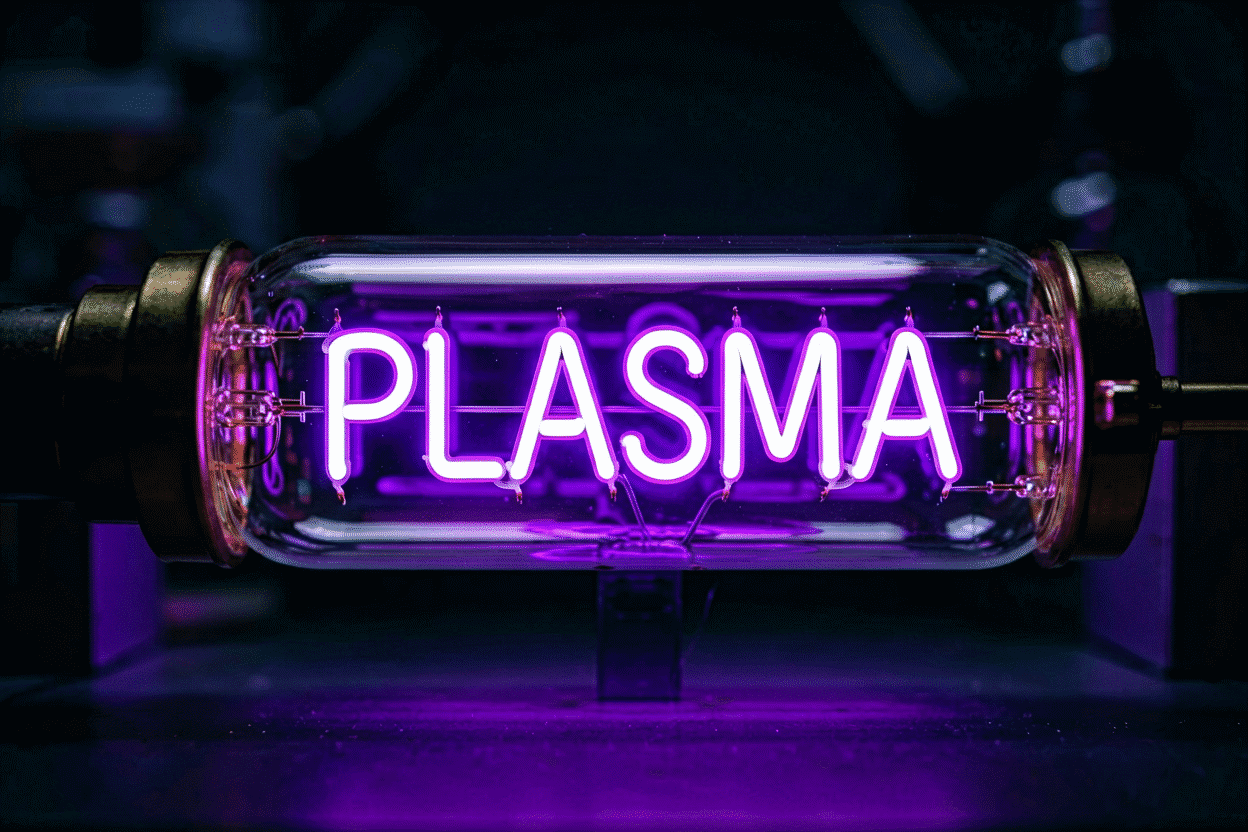
A neon sign works by pushing electricity through a sealed glass tube filled with gas at low pressure: the voltage strips electrons off gas atoms, and every time an excited electron falls back to its normal state, it releases a photon — a packet of light. Billions of those photon-releases per second, from a tube shaped into letters, is the glowing sign. That’s the whole trick, and everything else (colors, dimming, why glass neon hums and LED neon doesn’t) is a variation on it.
Here’s the explanation twice — once the way you’d explain it to a curious kid, once with the physics wearing its lab coat — plus the four components every sign needs, how colors happen, and how the LED “neon” on most signs today runs the same playbook with different hardware.
The ELI5 Version (Sixty Seconds)
Some gases, when you pump electricity through them, glow — each gas with its own favorite color. Neon gas glows red-orange. So: take a glass tube, bend it into a word, suck the air out, put a little neon gas in, and wire electricity to both ends. The gas lights up along the whole tube, and your word glows. Different gases and coatings glow different colors, which is how one technology makes the whole rainbow.
The Physics Version (Still Friendly)
Step 1: The voltage. A transformer steps ordinary power up to thousands of volts and applies it across the tube’s two electrodes. In glass neon, that’s 2,000–15,000 volts; the voltage is high because the gas resists conducting — it’s an insulator until the electric field is strong enough to matter.
Step 2: The ionization. The field accelerates the tube’s few free electrons until they collide with gas atoms hard enough to knock electrons loose. Now there are ions (atoms missing electrons) and free electrons everywhere — a conductive plasma, the fourth state of matter, filling the tube.
Step 3: The excitation and the fall. Free electrons slam into more atoms, knocking their electrons into higher energy orbits — and here is the actual light-making moment: an excited electron falling back to its ground state releases the difference as a photon. The photon’s wavelength — its color — is fixed by the atom’s energy levels, which is why each gas has a signature glow: neon’s red-orange, argon’s lavender-blue, helium’s peach, krypton’s whitish (the gas roster and what each emits lives in what gas is used in neon signs).
Step 4: The steady state. The discharge sustains itself at running voltage — a current flows, collisions continue, photons pour out. A neon tube in steady operation consumes about as much power as a strong light bulb per meter of tube, runs warm rather than hot, and hums faintly (the transformer’s vibration — 50/60 Hz mains music, not the gas).
The Four Components Every Glass Sign Needs
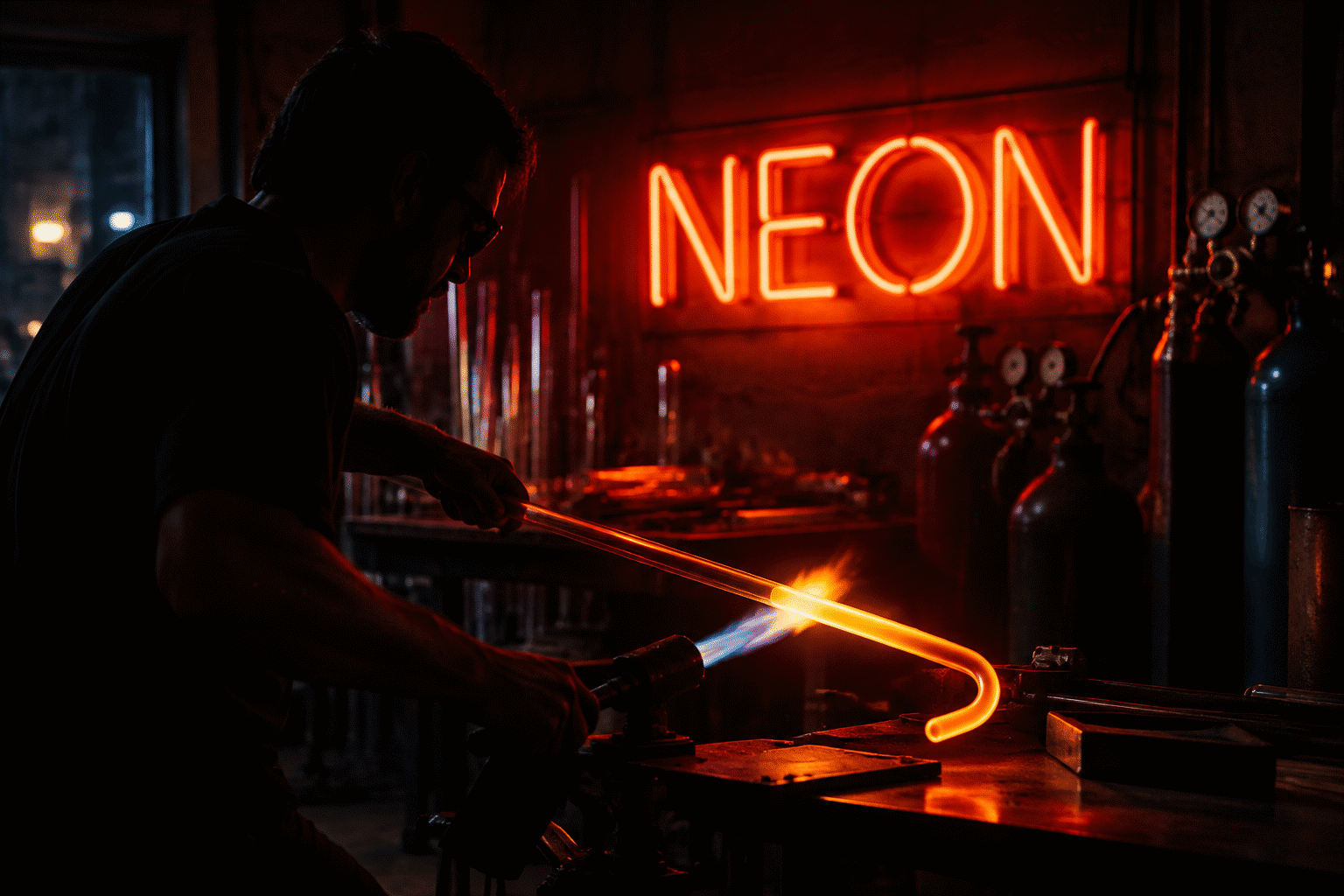
- The glass tube — lead or soda-lime glass, bent over a flame ribbon by a craftsperson following a printed pattern (the craft documented in how are neon signs made). Length limits exist: one transformer drives a maximum tube run, which is why very long signs use multiple circuits.
- The gas fill — the tube is evacuated to a hard vacuum, then backfilled to just above atmospheric pressure with its pure or mixed gas. The gas never gets “used up” — a healthy tube glows for decades on the same fill (the longevity numbers: how long do neon signs last).
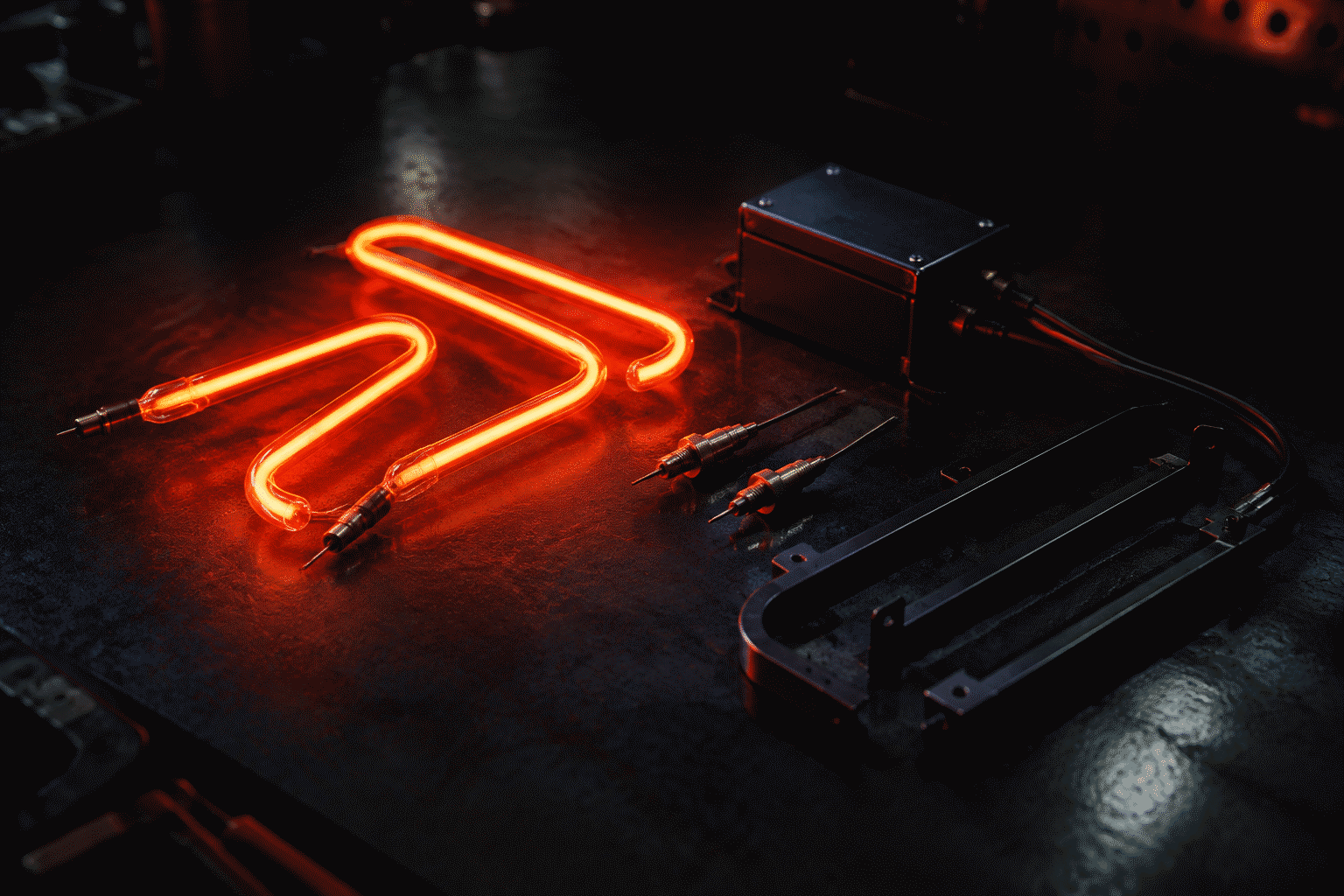
- The electrodes — metal terminals sealed into each tube end, coated to emit electrons into the discharge.
- The transformer — the voltage source, sized to the tube load, and the component that makes glass neon genuinely high-voltage hardware (why installs are professional work: safety).
Where the Colors Come From
Two mechanisms make the full palette:
- Gas choice: neon → red-orange; argon (usually with a drop of mercury) → blues and violets; helium → pinkish-white; krypton and xenon → whites and cool tones.
- Phosphor coatings and tinted glass: the tube’s inner coating converts the gas’s ultraviolet emission into visible colors — the same trick fluorescent lamps use — and tinted glass shifts the output further. That’s how the ~40-color commercial palette exists on a handful of gases.
The complete color story — design-side and physics-side — lives at what are neon colors.
How LED “Neon” Works (The Modern Answer)
Most signs sold today are LED neon, and the mechanism is cousin rather than copy:
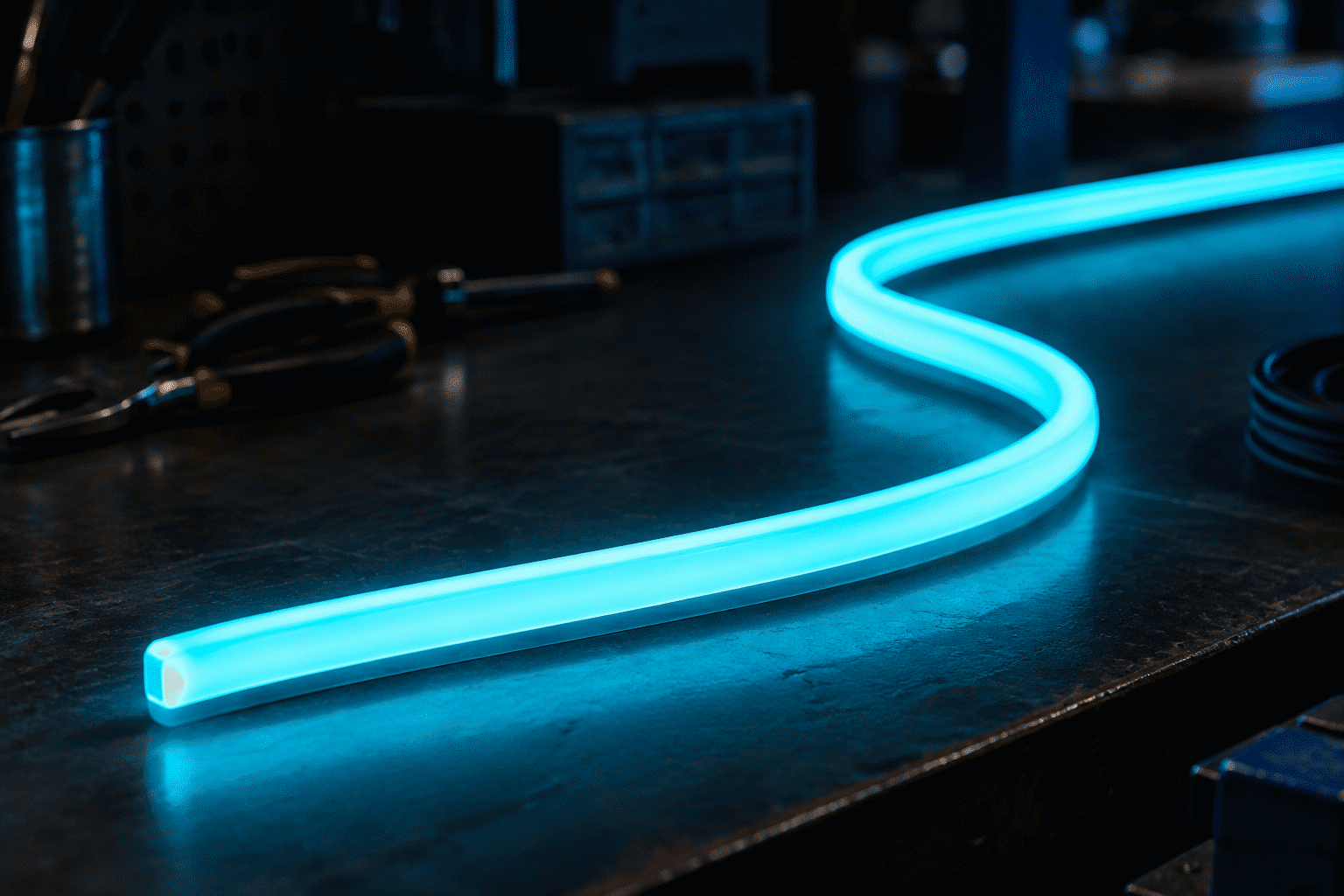
- Light source: light-emitting diodes — semiconductor devices that emit photons directly when current flows across their junction. No gas, no vacuum, no high voltage: 12 volts, the class of power your phone charger manages.
- The “tube”: the LED strip is embedded in a solid silicone extrusion, often with an internal diffuser profile, that shapes a line of point-lights into what reads as a continuous glowing tube — the aesthetic achievement that let LED inherit neon’s look (the full comparison).
- Color: determined at the diode — different LED chemistries emit different colors, and RGB builds mix three channels on the fly (color-changing signs).
- Control: dimming is pulse-width modulation — the electronics switch faster than eyes see — which is why LED signs dim smoothly at 12 volts while glass dimming is transformer engineering.
The LED deep-dive is its own article at how do LED neon signs work.
Same Physics, Different Eras
It’s worth savoring that both technologies are “electricity excites something into emitting light” — glass neon does it with gas atoms and kilovolts, LED with semiconductors and 12 volts. One is a century-old craft (1910, Georges Claude — the history); the other is solid-state engineering that made the aesthetic safe, cheap, and dimmable enough for bedrooms. The physics didn’t change; the hardware grew up.
Six Common Misconceptions, Corrected by the Physics
The mechanism above corrects the six beliefs that circulate most widely:
“Neon signs contain plasma like the sun.” Technically true at the loosest definition — ionized gas is plasma — but the resemblance ends there: a sign’s discharge is a low-pressure, low-temperature glow carrying milliamps, closer to a fluorescent lamp’s interior than to stellar fusion. The vocabulary is right; the scale is off by about twenty orders of magnitude.
“The gas burns.” Nothing burns. Combustion is chemical reaction; the gas is inert and unchanged by the process (the chemistry). The light comes from electron transitions, not oxidation — which is why the same gas glows for decades: there is nothing to consume.
“High voltage means high danger in the room.” The voltage lives inside the transformer-to-tube circuit; the room gets light, not voltage (the safety picture). The genuine hazards of glass neon are maintenance-time (handling, servicing), not spectator-time. This is why bars have hosted glass neon over seating areas for ninety years.
“LED neon works by heating something.” Semiconductors emit photons at junction transitions — a cold process at the physics level, which is why LED flex runs cool enough to touch continuously (the temperature facts) and why its efficiency is structural rather than incremental.
“Colors come from colored glass or filters.” The palette comes from atomic emission lines and phosphor conversion — light born at specific wavelengths, not white light filtered to them (the color physics). Filters subtract; neon generates. This is also why neon colors photograph with their particular saturation character.
“Dimming a sign saves it for later, like banking hours.” LED lifespan is running-hours at temperature; dimming genuinely extends both (cooler operation, PWM duty cycling — the dimming mechanics), so the belief lands half-true for LED. For glass neon, dimming is transformer engineering with no lifespan banking at all. Score the myth: accidentally right for one technology, wrong for the other.
Why the corrections matter beyond trivia: every one of these misconceptions shapes buying behavior — fear of gas, overestimation of danger, misreading of LED durability claims. The physics on this page is the antidote: the technology is simpler, safer, and more durable than folklore grants, which is precisely why it went from Parisian novelty to bedroom staple in a century.
FAQ: How Neon Signs Work
How do neon signs work? Electricity flows through a sealed glass tube of low-pressure gas, ionizing it into plasma; excited electrons falling back to lower energy states release photons of light. The tube is bent into letters, so the glow takes the shape of your words.
Do neon signs get hot? Glass neon runs warm (roughly 140–200°F at the tube) — noticeable but not dangerous in normal use. LED neon runs barely above room temperature. The full temperature story lives in our heat guide.
Why does neon glow red? Pure neon gas emits its photons almost entirely in the red-orange range — it’s the atom’s fixed energy-level signature. Other colors come from other gases, phosphor coatings, and tinted glass.
What gas is inside a neon sign? Neon, argon, or mixes with helium, krypton, or xenon — each with a signature glow color. Modern blues and whites historically used mercury vapor as well; the gas-by-color roster is in our gas guide.
Do neon signs use a lot of electricity? Less than assumed: glass neon draws like an incandescent bulb per meter of tube; LED neon like a phone charger per sign. The cost math is in our electricity guide.
How do LED neon signs work compared to glass? LED signs run 12 volts through semiconductor diodes that emit light directly, embedded in silicone diffuser tubing — same glowing look, no gas or glass, cool-running, dimmable, and safer by design. The mechanism comparison continues in the LED deep-dive.
Sources & Further Reading
- Cleaning Up a Broken CFL (U.S. EPA) — the federal mercury-spill cleanup procedure; we mirror it for broken glass-neon tubes.
- Neon: Strong Lines (NIST Physical Reference Data) — the standard reference for neon’s emission wavelengths.
- Argon: Strong Lines (NIST Physical Reference Data) — the standard reference for argon’s emission wavelengths.
- Solid-State Lighting (U.S. Department of Energy) — DOE reference on LED efficacy and lifetime.