19 Wedding Backdrop Neon Sign Ideas That Photograph
The backdrop is the wedding’s most valuable wall. Every other decoration works for the room; the backdrop works for the camera. It appears in the couple’s portrait, the family formals, the guest photos, the vendor’s portfolio, and the anniversary posts for the next fifty years — which is why the backdrop sign is the one piece of wedding neon worth over-thinking.
Here are 19 ideas for the photo wall specifically (the full ceremony-to-after-party canon lives in the wedding ideas guide), organized by the backdrop’s three jobs: name the couple, mark the moment, and light the photo. The shopping tier lives at wedding neon signs.
Name the Couple: Ideas 1–6
- The names in script, oversized — the default build and still the best: two first names or the new surname in flowing script, 36–48 inches, warm white or blush. Every name previews free in the customizer.
- Mr & Mrs — the two-word announcement of the whole day; reads instantly at any size and any guest age.
- Names + wedding date — the legal-document register; the format that pairs with the framed invitation in the home after.
- The shared initial or monogram — one big letter in a ring or crest; the most rentable format and the one that moves most gracefully to the home entryway.
- Two names joined by an ampersand — the clean modern composition; strongest when the wall is minimal and the florals do the rest.
- The new last name, alone — “THE MARTINEZES” or just “MARTINEZ”: the declaration register, for the couple whose day is about the merge.
Mark the Moment: Ideas 7–13
- Marry Me — the proposal backdrop’s signature; from the surprise setup to the engagement shoot, the two words that change everything.
- It Was Always You — the vow register; the phrase that photographs like a title card.
- Happily Ever After — the storybook close; strongest over the sweetheart table and the send-off wall.
- “The Wedding Of” + names + year — the full ceremonial format; the formal register that frames the whole event.
- “Better Together” — the agreement register; the phrase tier’s most versatile piece (the build).
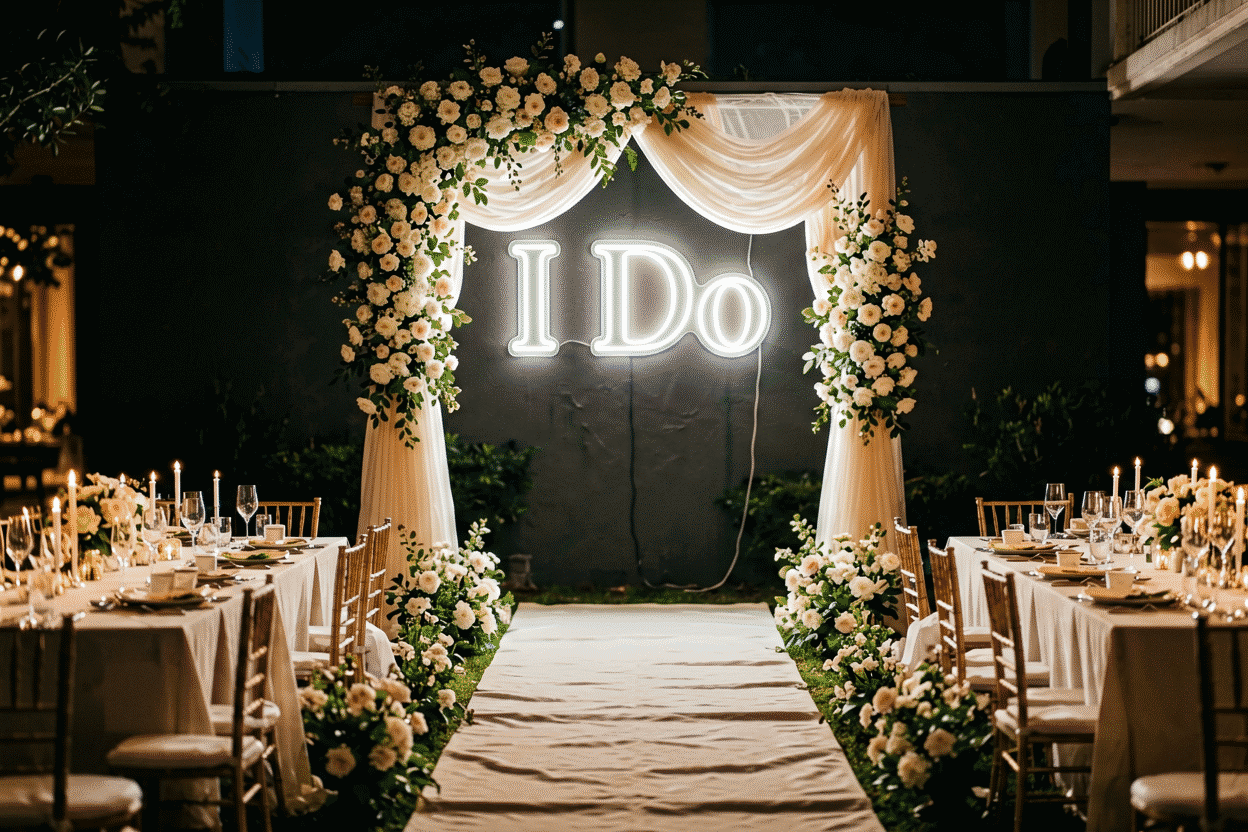
- “I Do” or “We Did” — the two-letter pivot: “I Do” for the ceremony wall, “We Did” for the after-party — the pair that tells the day’s whole story in four letters.
- Drunk In Love — the reception-after-nine register; the phrase tier’s party face (the piece).
Light the Photo: Ideas 14–16
- The warm-white rule — backlight beats frontlight: a neon backdrop piece glows best when it is the light, with the photographer shooting into its glow. Warm white and blush flatter skin; ice blue and green do not — the white wedding treatment covers the case.
- The double-duty dimmer — full brightness for the golden-hour portrait hour, 40% for the dance-floor hours when the DJ owns the light plot; one dial, two moods.
- The layer composition — neon mounted over florals, greenery, or draping: the sign floats in texture instead of hanging on flat drywall. The single highest-impact backdrop upgrade; every pro setup does it.
The Practical Backdrops: Ideas 17–19
- The stand-mounted piece — no wall, no problem: freestanding backdrop frames carry the sign plus draping; the wedding hanging guide covers the no-sag mounting math (the mistake every DIY rig makes once).
- The double-sided wall — names facing the reception, “Let’s Dance” facing the floor: one rental fee, two backdrops; the value play for open-floor venues.
- The send-off piece — “Just Married” or “See You Later” at the exit: the last photo of the night and the first piece of the marriage’s wall. The backdrop that leaves with you.
Sizing and the Physics of Photogenic
Backdrop sizing is ruthless physics: the sign must out-scale the people, not compete with them. A two-person portrait needs 36–48 inches of sign width; a group-formal backdrop wants 48–72. The centerline sits at 66–72 inches — faces in the top third of every frame, sign readable behind heads, never beheaded by the couples’ heights. Small signs at big-signal moments read as an afterthought; the backdrop is the one place to overspend, and the cost guide brackets what size buys what.
Color runs by skin: warm white, blush, warm pink, and gold flatter every guest and every photographer’s file. The bold registers (red, blue, purple) photograph dramatically but steal the frame — reserve them for the after-party wall where drama is the point. Rig safety matters more here than anywhere: the backdrop hanging guide covers frame-loading, cord-hiding, and the sag prevention that separates the pro rig from the cautionary tale.
The Backdrop Blueprint: Rig, Power, Photography
The wedding backdrop runs on three systems, and the couple that plans them runs the smoothest wall of the day.
The rig. Venue walls prohibit penetration almost universally, so the backdrop runs freestanding: the pipe-and-drape frame (the rental standard, carries the sign plus draping), the easel tier (the phrase pieces), and the command-hook tier for the lightweight pieces on venue-friendly surfaces. The rig’s engineering is the sag math – the sign mounted to a rigid backing, the backing mounted to the frame, the draping attached around – because the sign hung from fabric itself sags by the second hour of dancing (the rigging guide covers the full method and the mistakes every DIY rig makes once).
The power. The backdrop’s pieces need the venue’s outlets, and the venue’s outlets are never where the backdrop wants them: the working kit is the extension runs taped down, the power strip hidden in the drape’s base, and the battery-tier pieces for the positions that can’t reach. The pro’s habit: the power plan drawn before the decor plan, because the backdrop that dims at first dance (the circuit the DJ also found) is the wedding’s quiet technical tragedy.
The photography. The backdrop exists for the camera, and the camera’s rules govern: the piece sized to out-scale the people (36-48 for couples, 48-72 for groups – the sizing logic), the centerline at 60-72 inches (faces top-third, sign readable behind heads), the warm registers that flatter skin (warm white, blush, gold – the wedding palette), and the dusk test the pros run (the piece photographed at the hour it will work, at the brightness it will run, before the day commits).
The Wedding Budget: Buy, Rent, and the Keepsake Math
The buy tier ($150-500): the pieces that transition home – the names, the monogram, the date, the vows excerpt. The buy math is the keepsake math: the $300 names piece that hangs in the marriage’s homes for decades costs less per year than the bouquet did per hour (the cost brackets). The rent tier: the spectacle pieces (the eight-foot geometric install, the single-night themes) – the pieces whose job dies with the day, rented at the fraction their build would cost. The split: most weddings run one bought hero (the photo-wall names) plus the rented support – the hybrid that puts the budget where the decades are.
The sequencing note that saves the day: the backdrop rig goes up before the florals (it needs the ladder’s best hour and the florals build around it), the power test runs before the guests arrive (the dusk test), and the strike plan (which pieces go home, which return to the rental) is written before the champagne – the backdrop that ends well started with a list.
Variations and Pairings
The backdrop canon’s variants. The word-face variants: “wedding backdrop neon sign ideas,” “wedding photo backdrop neon,” and “wedding photo op sign” serve the tier – the full wedding canon (the produced guide) carrying the day’s other walls, this guide carrying the photographed one. The event faces: the engagement party and the bridal shower (the shower guide) run the same pieces in their softer registers; the anniversary (the anniversary canon) runs the same names piece in its archive mode.
The pairing logic: the backdrop pairs the names with the moment – the identity piece (who) with the vow or phrase (what) – and the florals around both. The pairings that work run the oversized script with one support phrase; the pairings that fail run the three-phrase backdrop (the wall that reads the reception’s script rather than its photo).
The vendor pairing: the professional’s program pairs the backdrop pieces with the rental inventory – the photographer’s and planner’s sign collections amortized across the season’s weddings, the buy-versus-rent math running at the fleet level (the rental logic).
FAQ About Wedding Backdrop Neon Signs
What’s the best backdrop sign for a wedding? The names in script, oversized, warm white. It is simultaneously the couple’s portrait background, the family-formal set, and the home’s future wall piece — no other format does three jobs at once. Preview yours free at the customizer.
How big should a wedding backdrop sign be? 36–48 inches for couples’ portraits, 48–72 for group backdrops. The failure mode is undersizing: a backdrop sign that fits the wall reads small in every photo. The cost guide shows what each size band costs.
Rent or buy? Buy if the piece transitions home — names, monograms, and dates belong on the marriage’s walls for decades. Rent only for pure-spectacle pieces (the 8-foot geometric install) — the buying logic has the full math.
How do we hang a neon sign on a fabric backdrop without sag? Rigid backing on a frame, sign mounted to the backing, draping attached around — never sign-to-fabric. The backdrop hanging guide covers the full method and the sag math.
How big should a wedding backdrop sign be? Bigger than instinct says: thirty-six to forty-eight inches for the couples’ portraits, forty-eight to seventy-two for the group formals (the sizing physics above) – the backdrop’s job is out-scaling the people, and the undersized backdrop is the wedding’s most common sign regret. The centerline runs sixty-six to seventy-two inches (faces in the top third of every frame), and the width stays within the floral frame’s footprint. The budget logic: the backdrop is the one place to overspend (the cost guide brackets what size buys what), because this wall appears in every photograph for the next fifty years.
The Script vs the Shape: The Backdrop’s Two Formats
The wedding backdrop’s two composition routes, compared:
| Decision axis | The script (the names, the phrases) | The shape (the ring, the heart, the monogram) |
|---|---|---|
| The statement | The couple (the named announcement) | The symbol (the zero-word meaning) |
| The sizing | The oversized read (36-72 inches) | The accent read (18-36) |
| The photography | The title-card frame (the words behind the couple) | The icon-adjacent frame (the symbol beside) |
| The florals pairing | The script floating in the texture | The shape nested in the greenery |
| The keepsake rate | The names and dates survive (the archive) | The monogram survives (the entry’s piece) |
| The budget | $200-500 (the commission’s letters) | $150-350 (the shape’s strokes) |
The two formats’ working combination – the script at center with the shapes flanking (the names in the florals, the ring and heart at the edges) – runs the backdrop’s full composition: the announcement and the symbolism in one wall (the composition logic above).
The format-only routes: the script-only backdrop (the minimalist wedding’s statement – the names, nothing else, the florals’ texture doing the rest) and the shape-only backdrop (the modern wedding’s icon – the monogram or the ring carrying the wall the names would have). Both work; both photograph; and the couple that picks one deliberately runs the backdrop that means their wedding rather than the catalog’s (the wedding canon for the day’s other walls).
Sources & Further Reading
- Mercury (U.S. EPA) — federal guidance on mercury exposure and safe handling.
- Neon sign (Wikipedia) — the consolidated public record of neon-sign history and technology.
Pricing based on CustomNeon’s current catalog (2026); custom quotes come live from the sign builder.