80s Neon Sign Ideas: Totally Radical Glow
The eighties did not use neon — the eighties were neon. The decade’s entire visual identity, from arcade marquees to mall storefronts to music videos, ran on saturated tube light, chrome, and geometric confidence. Decorating “eighties” today is not borrowing from the era; it is reassembling the era’s native language.
This guide is the assembler’s manual: the decade’s three visual dialects, the palette that carries all of them, the rooms they own, and the choice between original vintage pieces and modern recreations — plus the two companion guides (synthwave and retro-gaming) that go deep on the decade’s two most-loved sub-worlds.
The Three Faces of the Eighties
The decade was not one look. It was three, and they make different rooms:
Synthwave — the sunset memory. The eighties as remembered by the nineties: pink-orange gradients, chrome text, palm silhouettes, the grid horizon. This is the nostalgic-cinematic register (and honestly, half its canon is 2000s retrofuturism wearing an eighties badge — the look is what matters, not the birth certificate). The full treatment lives in our synthwave guide.
Arcade — the coin-op register. The eighties as it actually happened at the mall: pixel fonts, game marquees, the glow of rows of cabinets. The retro gaming guide covers the coin-op world; the arcade aesthetic is the eighties’ most literal glow — the decade lit its own games with the same medium you will hang on the wall.
Mallpunk — the retail decade. The eighties’ third face: food-court signage, VHS rental aesthetics, airbrush lettering, the deliberately loud retail typography. The register that current design rediscovers every few years. Neon text in bubble and chrome fonts, food-and-mall phrases (“SODA,” “SNACK BAR,” “VIDEO”), the look your local arcade-pizza joint perfected.
The design decision before buying anything: which eighties does the room want? The sunset (synthwave), the game (arcade), or the food court (mallpunk)? They share a palette but not a mood — mixing all three in one room is the decade’s chaos without its confidence.
The Palette: Pink, Purple, Blue, Chrome
The eighties palette is the most codified in decor history — four registers, fixed roles:
- Hot pink. The energy register — sunset skies, Memphis patterns, the decade’s signature hue. Its full behavior in the pink sign guide.
- Purple. The mystic register — the decade’s synth-and-smoke look. The purple guide covers its wall behavior.
- Ice blue and cyan. The tech register — the computer-age cool that balanced all that pink.
- The chrome tier. Not a tube color but a pairing discipline: warm-white or silver-white pieces against metallic surfaces — the chrome-and-neon pairing that makes the whole decade read. A neon piece next to a chrome shelf or mirror IS the eighties, complete.
The pairing law: pink-with-blue or pink-with-purple (the complementary pairs the decade canonized); all three pinks-purples-blues at once only in the party tier.
The Rooms
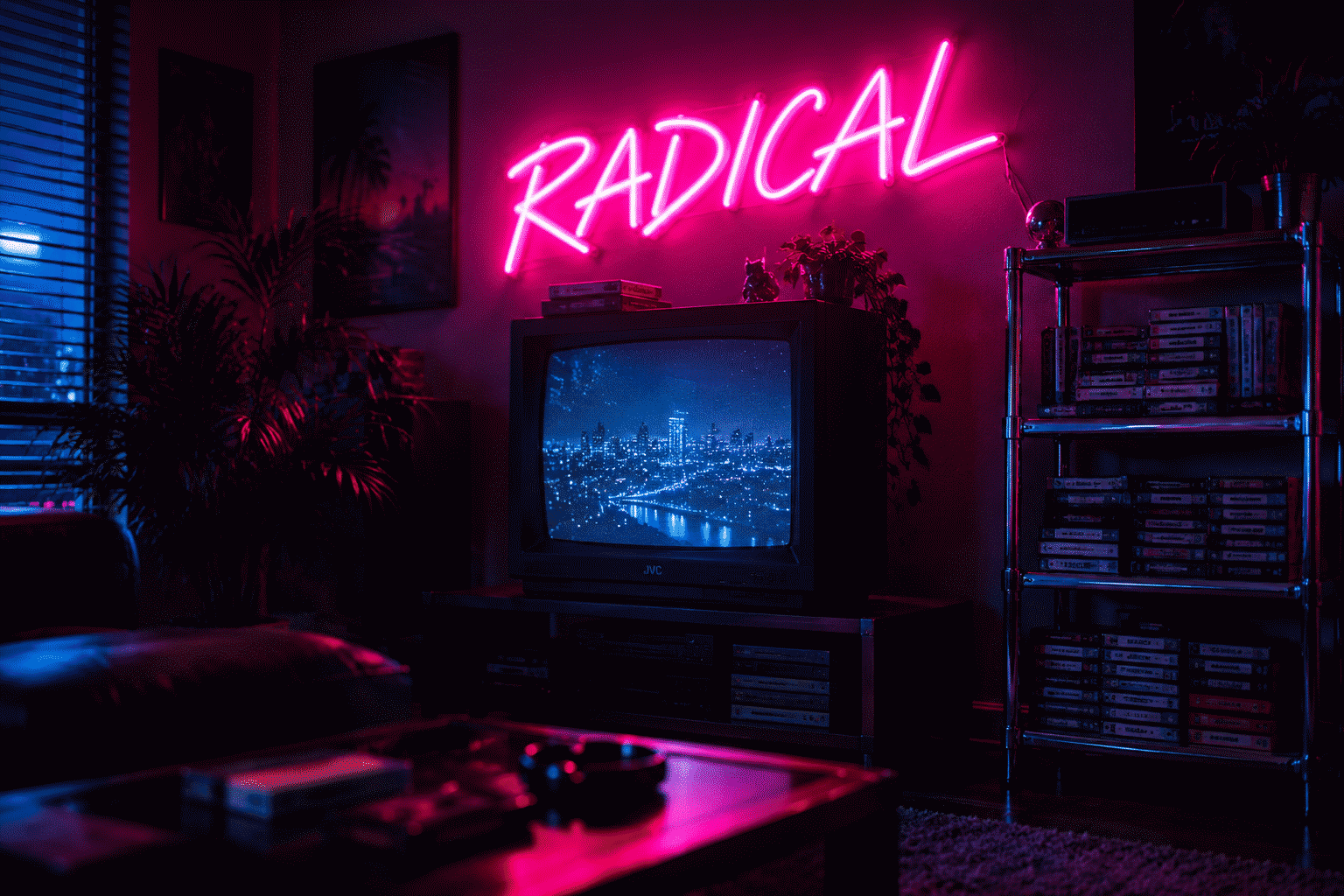
The gaming and media room. The eighties’ native indoor habitat: the arcade register around the setup — marquee-style text over the screens, pixel-font phrases beside them. The gaming room layouts cover the furniture layer; the eighties variant adds the marquee tier (light-box styling, bold horizontal text).

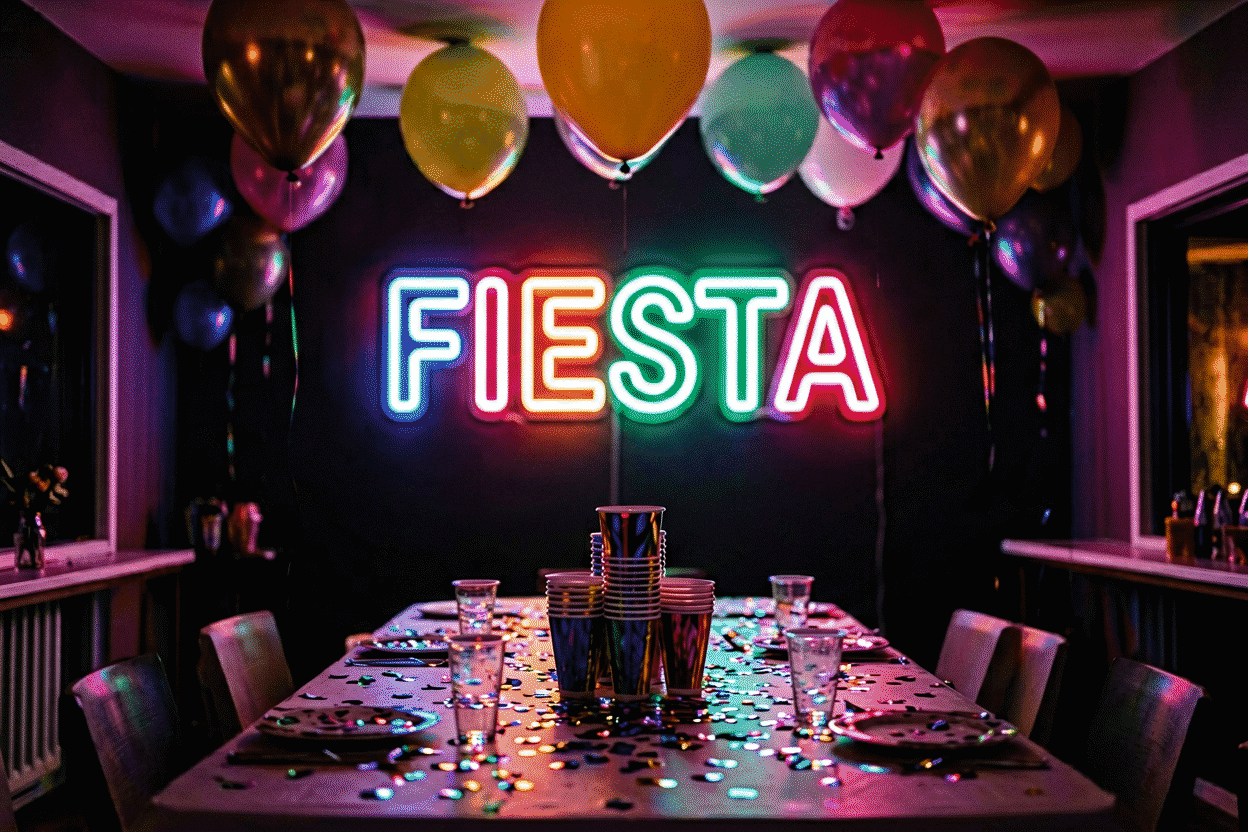
The party wall. The event tier: birthdays with decade themes, the roller-rink revival, the eighties office party. The wall kit is standard: a big phrase (“TOTALLY 80s,” “RADICAL”), the sunset or grid secondary, and the chrome accent tier. Rentals repeat; the decade’s parties never really stopped.
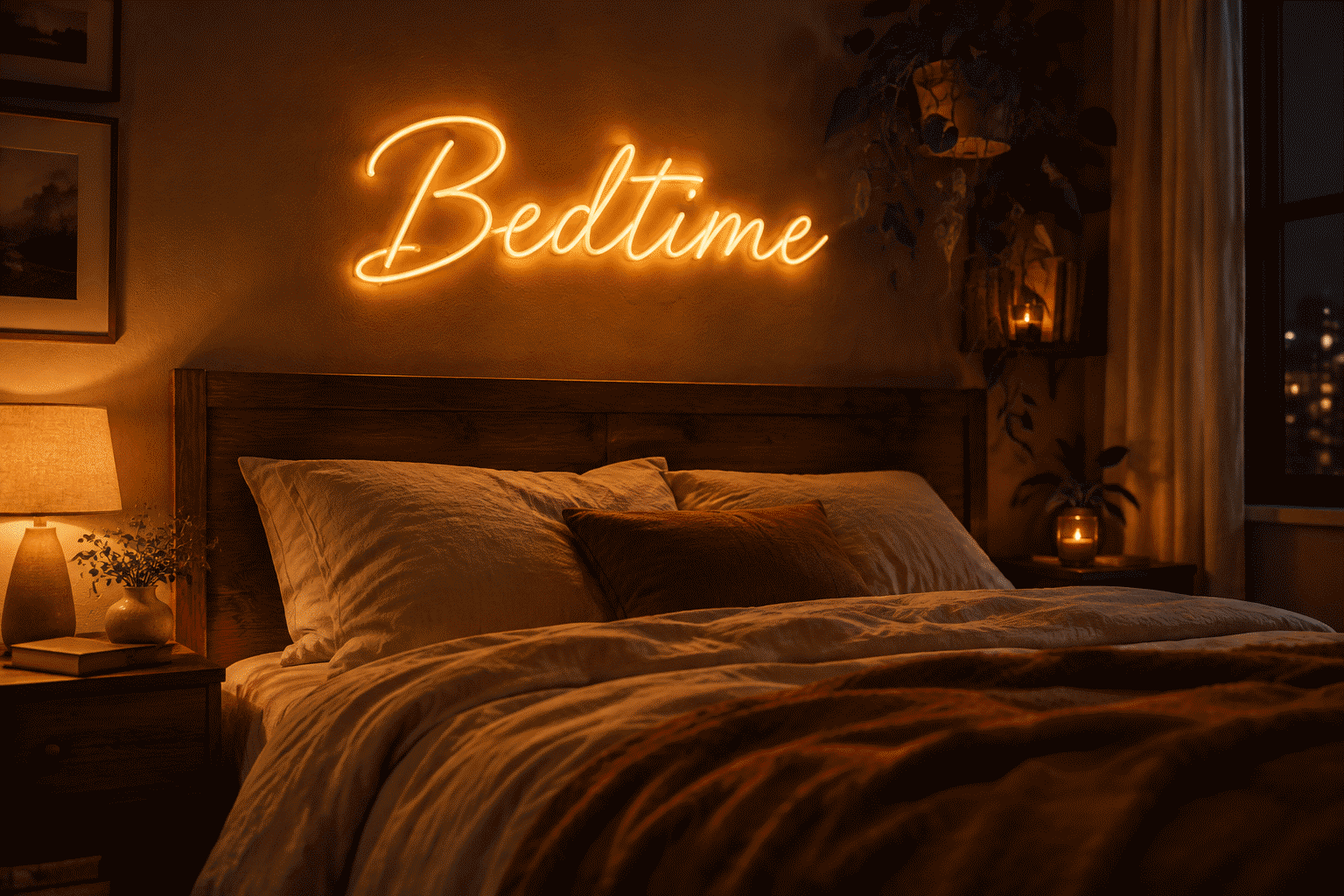
The bedroom and lounge — the synthwave corner. The sunset register scaled down: gradient piece or chrome phrase over the bed, dimmed to the evening tier. The eighties as a mood rather than a costume — the register that has outlived every trend cycle since.
The garage and den — the original mall tier. The honest middle-aged eighties room: one great vintage-style sign (“OPEN LATE,” the food-court register), the chrome shelf, the record collection. The decade at conversation volume.
The modern-crossover warning. The eighties wall and the modern minimalist wall can share a room in exactly one configuration: one large eighties piece as the room’s single statement, everything else neutral. The decade was maximal; its afterlife can be a single confident accent. Two eras competing for one wall is a temporal accident.
Originals vs. Recreations
The eighties-collecting question, honestly answered:
- The original pieces. Real eighties signs — bar and arcade stock, retail signage — surface on the secondhand market with real provenance. The honest math: glass tubes and transformers are forty years old; budget the service pass ($100–$200) into any untested original, and buy from documented sources. The payoff is the genuine artifact: glass glow, era-correct fonts, the object’s actual history.
- The modern recreations. LED builds in eighties styles — the honest route for daily-use walls. Cooler-running, dimmable, safer, and available in any text at any width. What you lose in provenance you gain in the dimmer: the original pieces ran at one volume, and it was eleven.
- The hybrid discipline. The collector’s answer: one original as the room’s artifact (run occasionally, displayed always), the modern recreations doing the daily glow. The museum-and-workshop model.
The Custom Route
The eighties text canon in custom builds — the decade’s typography is the whole game:

- The chrome-font phrase. Custom text in chrome-look styling against the room’s metallic tier — “MIAMI,” “SUNSET BLVD,” your own name in the decade’s lettering.
- The pixel tier. Game-font text — the arcade register’s signature custom; prices by width, no letterform surcharge.
- The sunset band. The gradient piece (pink-to-orange) — the synthwave register’s abstract core, in any width.
- The decade marker. “EST. 1985,” “CLASS OF 1987,” the birthday-year builds — the gift tier that never stops (every year gives the decade another birthday cohort).
All price live in the custom builder — the decade’s fonts, your text, any width.
The Decade’s Comeback Calendar
The eighties register runs on pop culture’s nostalgia cycle, and the cycle has rules worth knowing:
- The twenty-year lag, extended. The decade’s first revival hit in the 2000s (the synth-pop revival), the second ran through the 2010s (stranger things, the arcade-bar boom, the vaporwave detour), and the current wave has simply… stayed. The eighties stopped being a revival and became a permanent register — the decade the culture keeps a standing reservation with.
- The film-and-TV lever. Period shows and franchise revivals move the register’s searches in visible spikes; the wall tier follows whatever the streaming year decides the eighties looked like.
- The birthday cohort. The reliable engine: every year another cohort of sixty-somethings hits the “throwback birthday” years, and the decade party — with its wall kit — comes with them. The gift tier never stops.
- The arcade-bar economy. The physical revival: arcade bars, retro arcades, eighties-themed venues — the commercial tier that keeps the register’s vintage stock circulating and the reproduction market honest.
The practical timing: the register’s searches peak in the fall (party season) and again in the spring (the birthday cohort’s party window). Customs ordered three weeks out cover either spike.
FAQ: 80s Neon Signs
What is an 80s-style neon sign? A piece in the decade’s three dialects: synthwave (sunset gradients, chrome), arcade (pixel fonts, marquee text), or mallpunk (bubble type, retail phrases). Same palette across all three — pink, purple, ice blue, and the chrome pairing.
Where do I buy an 80s neon sign? Modern recreations from custom builders (any text in decade styling, live pricing in the builder) and original eighties bar-and-arcade stock on the secondhand market — with the forty-year service math budgeted in.
What colors make a room look like the 80s? Hot pink with ice blue, or pink with purple — the decade’s two canonical pairs — plus one chrome or metallic surface for the pairing to land. The four-register palette is above; the discipline is two hues per room, not four.
How do I decorate an 80s gaming room? The arcade register: marquee-style horizontal text over the screens, pixel-font phrases beside them, the coin-op canon covered in our retro gaming guide. The eighties variant of the standard gaming layouts — same furniture logic, marquee tier added.
Are vintage 80s neon signs worth buying? As artifacts, yes — with honest expectations: forty-year-old glass needs a service pass, and provenance matters. For daily glow, modern LED recreations run cooler, dim properly, and take any text. The hybrid — one original, modern daily pieces — is the collector’s answer.
What’s the difference between synthwave and 80s decor? Synthwave is the eighties’ cinematic memory — the sunset-and-chrome subset, and half of it is 2000s retrofuturism. The eighties at large include the arcade and mall registers. Our synthwave guide goes deep on the subset; this page is the decade.
Get Radical
The decade that glow built, rebuilt one tube at a time. Pick the dialect, hold the palette to two hues, find the chrome — and build the piece that turns the wall into 1985’s best night.
More retro glow: synthwave, retro gaming, gaming room layouts.
Sources & Further Reading
- Neon sign (Wikipedia) — the consolidated public record of neon-sign history and technology.