23 Party Neon Sign Ideas for Every Kind of Party
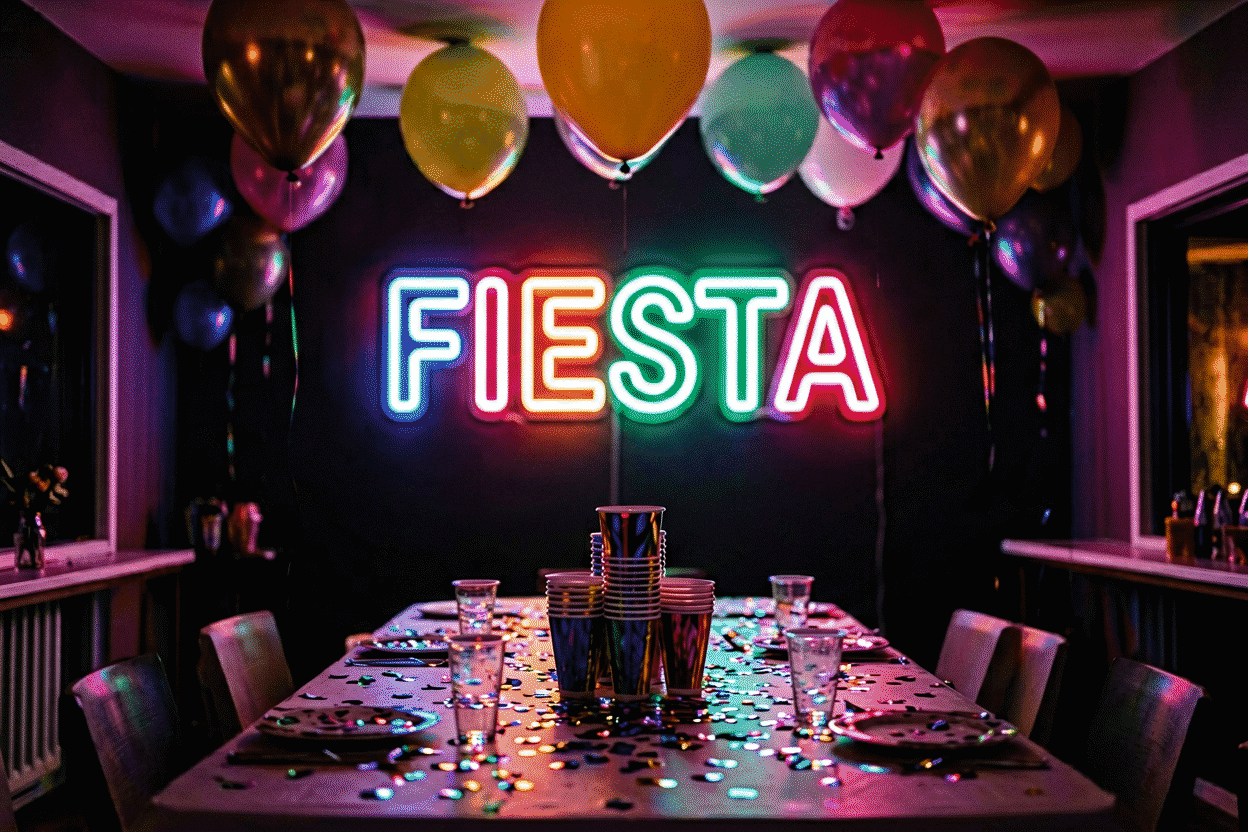
The party wall is a machine for one job: making the room look like the night already happened. Guests decide how a party feels within ninety seconds of walking in, and a glowing sign does more per dollar for that first impression than any other rental, banner, or balloon arch — it lights the room, sets the theme, and gives every phone in the place something to point at.
Here are 23 ideas organized by party type, with the rental-versus-buy logic and the setup engineering that makes the party wall work. The birthday-specific canon lives at birthday neon signs, and the night-out tier at bachelorette party signs.
The Universal Party Pieces: Ideas 1–7
The buy-once tier that works at every party you’ll ever throw.
- Let’s Party — the category’s ignition switch: two words, the room’s permission structure, works from kid birthdays to retirement parties.
- Good Vibes — the atmosphere regulator; the piece that keeps working after the party’s peak, when the lights go low and the conversation gets good.
- “Celebrate” — the all-occasion verb; the elegant register for the party that’s fancy about itself.
- A champagne or cocktail shape — the toast tier’s zero-word option; pairs with any phrase piece.
- “Dance Floor” or “Dance Like Nobody’s Watching” — the zone marker for wherever the dancing happens; the sign that licenses it.
- The balloon-and-neon arch — neon letters set into a balloon arch: the party-build combination that photographs like a professional install.
- “Cheers!” — the shortest toast in any language; over the bar table, doing its job every single time.
The Kid Parties: Ideas 8–11
- The name + age piece — “MAYA IS 7” (the full tier): the party’s headline and the bedroom’s future.
- The theme shape — dinosaur, unicorn, superhero: the phase-year marker, bought small and retired gracefully.
- “Party Animal” + the animal — the joke that works from age 5 to 15; the shape changes, the line never does.
- The game-zone piece — “Games This Way”: the traffic-direction tier that routes eight-year-olds better than any adult can.
The Adult Parties: Ideas 12–16
- Girls Girls Girls — the girls’-night register; the party that runs on one signature piece and good playlists.
- “Sip Sip Hooray” — the brunch-tier toast; the register that owns the daytime party.
- The milestone piece — “30!” or “Class of 2026” (the milestone tier): the number does the talking, the glow does the impressing.
- “Late Night Club” — the after-hours zone marker for the party with a kitchen phase and a basement phase.
- The roast tier — “Older Than The Internet” for the 40th: the birthday-joke canon is deep, and the neon version outlasts the card.

The Themed Parties: Ideas 17–20
- The Halloween party wall — “Enter If You Dare” and the ghost tier: the seasonal canon has its own guide.
- The New Year build — the year-piece and the countdown tier: the party where neon does its annual flagship work.
- The decade party — “That’s So 90s” or the era’s signature shape: the theme party’s instant-set piece (the retro system covers the eras).
- The holiday party — from Friendsgiving to the office December event: the Christmas tier covers the biggest one; the register logic transfers.
The Outdoor & Big-Room Parties: Ideas 21–23
- The backyard marquee — “Party Out Back” or the festoon-and-neon combo: the outdoor tier that makes the yard the venue.
- The photo-booth build — one phrase piece + one shape + a props table: the DIY booth that generates the party’s entire album.
- The goodbye wall — “Thanks For Coming” at the exit: the last photo of the night and the piece that ends the party on a glow.

Rent, Buy, and the Setup Engineering
The buy logic: the universal tier (party phrases, toast pieces, shapes) pays for itself by the third event — one sign, every party, zero re-decoration (the economics are trivial: a party’s worth of glow costs dimes). The single-event pieces (milestone numbers, themed shapes) run the entry tier, because their job is one night and one album.
The setup: party walls want the sign at photo height — 60–66 inches to centerline — with the room’s worst light corrected by the sign’s best glow. Venue walls take the command-hook and easel systems; home walls take the anchor method from the hanging guide; and outdoor pieces want the weather-adjacent placements (covered, powered safely, and brought in before the dew).
The brightness protocol: full power for the party’s first hour (the arrival glow), 60% for the middle hours, 30% for the endgame — the dimmer that throws a better party than the playlist.
The Party Production: The 90-Minute Setup
The party’s neon program runs as a production with a clock, and the 90-minute setup is the difference between the host who enjoys the party and the host who’s still hanging pieces when the first guest texts “here.”
The first thirty minutes: the photo wall. The hero piece mounts first (the command-hook or easel tier – the methods), the cluster pieces follow, and the glow test runs at the party’s actual light (the dusk test for the evening party, the window-walk for the daytime one). The photo wall is the party’s engine – it goes up first because everything else routes around it.
The second thirty: the zones. The bar marker, the food-station pieces, the dance-floor tier – the wayfinding that routes the crowd. The zone pieces run small and bright (their job is reading, not beauty), and the power plan executes: the strips placed, the cords taped, the battery tier distributed to the pieces that can’t reach (the party power notes cover the full system).
The last thirty: the mood pass. The brightness protocol sets (full for arrival, the dimmer staged for the party’s arc), the reflection walk catches the glare ghosts, and the host changes clothes. The party that ends its setup with the host dressed and the wall tested is the party that starts on time – the difference the guests never see and always feel.
The Party Budget and the Calendar Economics
The once-a-year host ($80-200): the universal pieces – “Let’s Party” or “Good Vibes” – the two purchases that cover every party the calendar generates. The seasonal host ($200-450): the universal tier plus the event pieces (the birthday numbers, the holiday rotations) and the zone system – the program that parties twelve times a year on the same mounts. The venue-scale host ($450-900): the full production – the photo-booth build, the outdoor marquee tier, the event system that hosts the neighborhood.
The calendar math that makes the budget make sense: the universal piece that runs four parties a year costs $25 per party in year one and nothing after (the economics – the glow itself is dimes); the themed piece that runs once costs what it costs. The host who knows which is which buys the universal tier right and the themed tier cheap – the whole party-decor discipline in one sentence (the canon above sorts every tier).
More Party Guides
- NYE party neon signs — the big countdown six weeks later
- office party neon signs — the workplace dry-run of the season
FAQ About Party Neon Signs
What’s the best neon sign for parties? “Let’s Party” or “Good Vibes” — the two pieces that work at every party you’ll ever host (the [ignition piece, the regulator). Buy those once; theme the rest per event.
Rent or buy party neon? Buy the universal tier — it out-earns any rental by the third party. The milestone and theme pieces run entry-tier pricing because they’re single-event by design.
How many signs does a party need? One hero at photo height plus one zone piece (bar, dance floor, games). More than three, and the party reads corporate; fewer than two, and the wall reads like a Tuesday.
Do party neon signs work outside? Covered outdoor placements do — the backyard marquee tier wants a roof or eave, safe power, and a dew-hour curfew. The hanging guide covers the outdoor rig basics.
Where should neon signs go at a house party? The photo wall first (the party’s album-generating surface – the phrase piece at sixty-to-sixty-six inches, the group-shot height), the bar-and-food stations second (the wayfinding glow that routes the crowd), and the entry third (the greeting that sets the night’s register). The zones run by traffic: the piece where the people stop (the photo wall), the pieces where the people route (the stations), the piece where the people arrive (the entry). The party that runs one hero and two zone pieces covers every party job at the three-piece ceiling (the composition logic above); the party that runs five pieces per room reads the venue rather than the house.
Do I need a dimmer for party neon signs? The party’s arc demands one: full for the arrival hour (the glow that greets), sixty percent for the working hours (the party’s main register), and the thirty-percent close for the last conversations (the brightness protocol above). The dimmer is the difference between the party that photographs well at every stage and the party that blows out the cameras at nine and goes dark at midnight. The ten-dollar dial (or the smart plug’s three presets) is the host’s best party equipment after the speakers – the lighting that follows the night’s energy instead of flattening it.
The Indoor Program vs the Outdoor Program
The party’s two venues, compared:
| Decision axis | The indoor program | The outdoor program |
|---|---|---|
| The pieces | The photo wall, the station markers, the dance tier | The backyard marquee, the festoon pairings |
| The power | The outlets (the wall’s luxury) | The exterior-safe runs and the battery tier |
| The weather risk | None | The forecast’s mercy (the outdoor logic) |
| The brightness | The house’s protocol (the dimmer’s arc) | The after-dark saturation (the yard’s full power) |
| The mounting | The command hooks and the easels | The covered-mount discipline (the eave’s respect) |
| The strike | The pieces in by morning | The pieces in before the dew |
The two programs’ shared core: the photo wall (the album-generating surface every party runs – the composition logic above) and the brightness arc (the arrival’s full through the close’s glow). The outdoor program adds the weather’s disciplines and the battery tier’s engineering; the indoor adds the house’s deposit-and-drywall respect – the two venue programs sharing the party’s physics.
The backyard’s specific gift: the after-dark saturation – the outdoor party’s glow runs the full power the house’s neighbors rarely see, and the marquee’s boldness (the “PARTY OUT BACK” at the yard’s scale) is the outdoor tier’s signature that the indoor program’s manners never permit (the Fourth’s outdoor canon runs the same physics). Can I use indoor neon signs for an outdoor party? Covered placements, yes – the porch, the eave, the canopy: the pieces that live indoors can serve the covered outdoor tier for the evening, with the power’s weather discipline (the exterior-rated cord runs, the outlet’s dry zone) and the strike before the dew (the outdoor logic). Open-sky exposures, no: the rain, the sprinkler’s arc, and the morning’s condensation are the indoor piece’s three enemies, and the party that tests them learns at the connections. The purpose-built outdoor tier (the weather-rated pieces, the battery builds) serves the open placements – the backyard program’s honest equipment (the outdoor program above).
Sources & Further Reading
- Neon sign (Wikipedia) — the consolidated public record of neon-sign history and technology.
- Mercury (U.S. EPA) — federal guidance on mercury exposure and safe handling.
Pricing based on CustomNeon’s current catalog (2026); custom quotes come live from the sign builder.