Blog
Open 24 Hours Neon Sign Ideas: Always On Glow
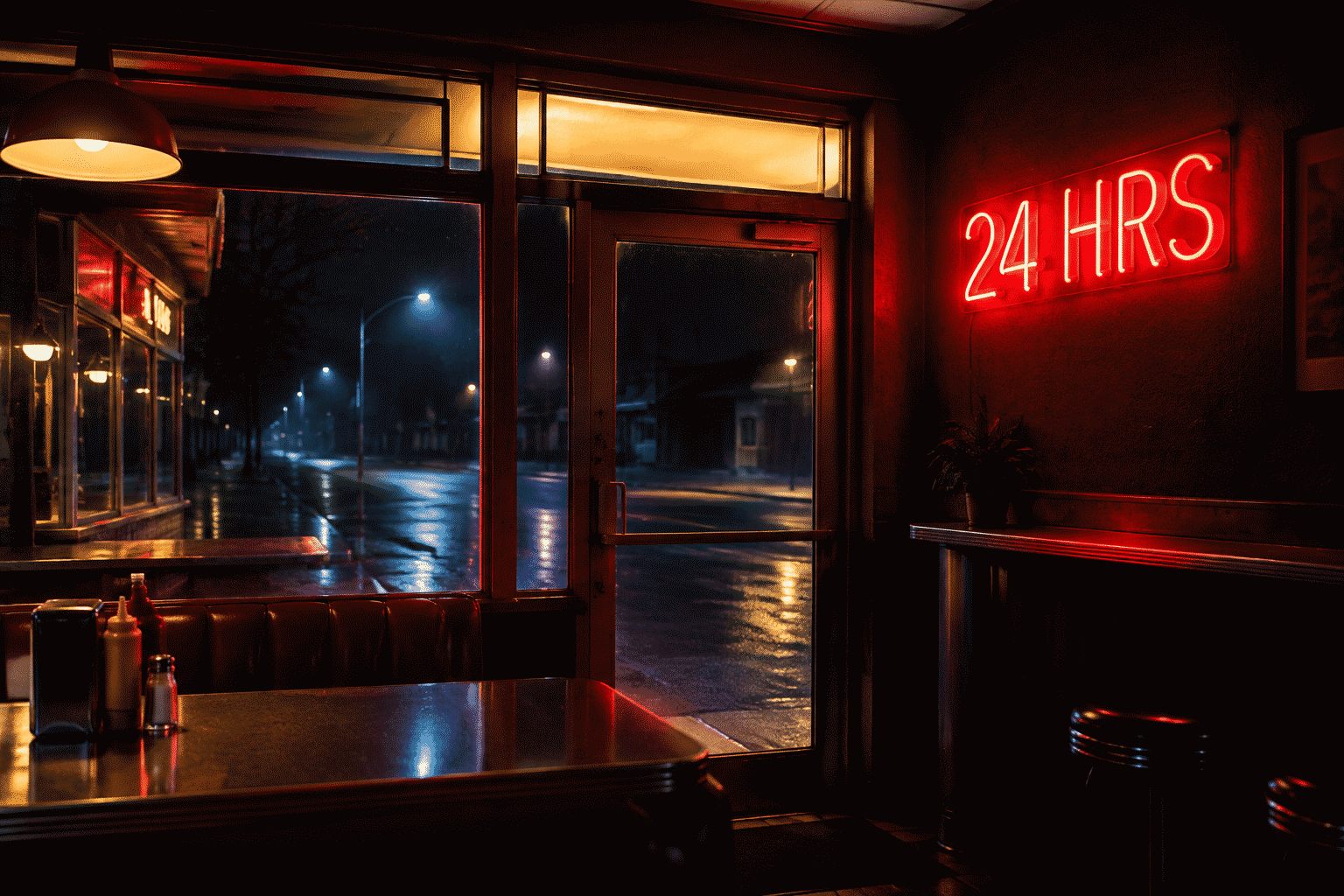
“OPEN” is the most-decorated word in commercial signage; “24 HOURS” is its stronger sibling — the promise that never sleeps, glowing through every 3 a.m. There is a reason the format has survived a century of sign technology: for the businesses that actually run around the clock, the sign is not decoration, it is the entire value proposition, visible from the darkest street at the hour of maximum need.
This guide covers the 24-hour sign: why the format works, which businesses carry it and how each one builds it, the window engineering (placement, brightness, the two-sided question), and the custom route. It sits beside our open sign guide (the general format’s deep dive), the open sign ideas page (the wordmark catalog), and the open signs landing (the ready designs).
Why “24” Works: The Grammar of the Format
The 24-hour sign is a specific piece of visual grammar, and its rules are worth knowing before designing one:
- The number does the work. “24” is the format’s engine — a two-digit numeral that reads instantly, carries arithmetic certainty, and (unlike “OPEN” alone) makes a specific, checkable promise. The numeral rendered large is the classic build; the format has run on it since the diner era.
- The variants. “OPEN 24 HRS” (the compact), “OPEN 24/7” (the arithmetic version — strictly a different promise, since it adds the week to the day), and “24 HOURS” alone (the confident minimum). Pick the true one: a business open 6 a.m. to 2 a.m. is not 24/7, and the sign that overstates becomes the review that mentions it.
- The register. The 24-hour sign is a beacon, not a brand piece — it should be the window’s brightest object, its text shorter than everything else on the glass, and legible from across the street at driving speed. Every element that isn’t the promise is subtracted from the promise.
Which Businesses Carry It (and What Each One Builds)
The 24-hour register belongs to a specific roster — the industries that genuinely never close:
The diner and the late kitchen. The format’s birthplace — the diner’s “OPEN 24 HRS” in red script is one of American signage’s permanent images. The diner build runs the red register (appetite plus urgency), the numeral large, the script warm. The modern late-kitchen variant (“KITCHEN OPEN LATE”) is the honest tier for kitchens with boundaries.
The convenience store and gas station. The roadside standard — the canopy and window pieces that mean fuel and cigarettes at any hour. The build runs high-contrast: white or red numeral against the night, sized for the road, often doubled on the canopy edge.
The pharmacy and the urgent tier. The 24-hour pharmacy’s sign is a public service announcement as much as an ad — the piece that means “someone is awake who can help.” The build runs the trust register: clean white or green, no script, the numeral dominant.
The gym (the 24-hour access era). The fitness industry’s shift to 24-hour access made the format newly common — the gym’s “24/7” in the window is the membership pitch compressed to four characters. The build runs the energy register (red or ice blue), often paired with the brand piece.
The laundry, the locksmith, the tow line. The utilitarian roster — the businesses whose 24-hour sign is literally the phone number’s bodyguard. The build is plain: “24 HR” plus the service word, high contrast, zero decoration. The format’s most honest tier.
The Window Engineering
The 24-hour sign lives in the window, and the window has rules:

- The sightline test. Stand across the street — the farthest point a customer decides. The sign must read there, at night, through whatever the glass does to glow. If it mumbles at that distance, it is too small or too busy.
- The two-sided question. A window sign reads from one direction; the all-night businesses that also catch foot traffic often run a second, smaller piece on the side glass. The roadside business needs the road-facing piece first; everything else is secondary.
- The height. Window-center or above the door — the two canonical positions. The 24-hour numeral runs high (above the door, the marquee position) when it’s the primary promise, and center-glass when it supports a larger brand piece.
- The clutter discipline. The 24-hour sign shares glass with hours, cards, decals, and health notices. The promise must win: the 24-hour piece gets the cleanest zone of glass, and anything within its reading zone moves. The window that whispers everything says nothing.
The Brightness Ladder (and the Overnight Register)
The 24-hour sign runs more hours than any other sign in commerce, which makes its brightness plan an operating decision:
- The full-output tier. Evening through midnight — the sign at its brightest, doing its primary work.
- The overnight register. The 2 a.m. to dawn tier: dimmed (quality LED builds dim; fixed-output pieces don’t), the sign shifts from advertisement to landmark — the low glow that says “still open” to the one person who needs to know. The dimmer is the 24-hour business’s cheapest operating upgrade.
- The energy math. An LED piece running all night draws single-digit watts — the year of always-on costs less than a month of the coffee it advertises. The always-on format is one of LED neon’s best economic arguments; the glass-neon original was, too (the diners ran the math decades ago).
- The ordinance check. Some municipalities regulate sign brightness overnight — the dimmer solves compliance as easily as it solves taste. Check before the install, not after the citation.
The Custom Route
The fan-styled custom tier for the always-open:

- The classic build. “OPEN 24 HRS” or the giant “24” at 24–36 inches, red or white — the $120–$200 tier, the format’s workhorse.
- The service pair. The numeral plus the service word (“24 HR TOW,” “24/7 GYM”) — the two-line build, priced by width in the custom builder.
- The dual-register build. The main sign plus a dimmable overnight accent — the window’s day-and-night pair.
- The restaurant variants. The late-kitchen honest tier (“OPEN LATE,” “KITCHEN TIL 2”) for the restaurant that flirts with but doesn’t marry the format.
A Short History of the All-Night Light
The format’s past explains its present force:
- The diner era (1930s onward). The 24-hour diner made the sign a civic institution – the glowing window that anchored the night shift, the truckers, the teenagers, and the insomnia economy. The red OPEN 24 HRS script became one of the most photographed objects in America precisely because it promised the same thing to everyone: you are not alone at this hour.
- The highway decades (1950s-1970s). The interstate system made the all-night sign a safety feature – the exit with fuel and food at 3 a.m. was chosen at 70 miles per hour, by a sign. The businesses that understood this spent on glow; the ones that did not became the exits nobody took.
- The LED transition (2010s). The always-on economics that glass neon could only barely justify, LED made trivial – single-digit watts, decade-plus lifespans, dimmers built in. The format’s current revival runs on the new economics wearing the old script.
The practical takeaway for the modern owner: the 24-hour sign you hang carries all of this history for free. The customer at 3 a.m. reads your LED piece through a century of the promise being kept.
Complete the always-open wall: the No Vacancy neon sign meaning piece covers the roadside classic that pairs with yours, and our restaurant neon signs guide extends the doorboard system to full dining rooms.
FAQ: Open 24 Hours Neon Signs
How much does a 24 hours neon sign cost? The classic build (“OPEN 24 HRS” or the giant numeral) runs $120-$200 at 24-36 inches; the two-line service builds $150-$250; the dual-register day/night pair $250-plus. The format is a workhorse – plain, bright, and priced like one.
Should my sign say 24 hours or 24/7? Say the true one. “24 HOURS” is the daily promise; “24/7” adds the week (and implies holidays). A sign that overstates becomes the review that mentions it – the format’s power is its checkability.
What color for a 24 hour sign? Red for the diner register (appetite plus urgency), clean white for the pharmacy and service tiers, green for the trust register. The 24-hour sign is a beacon, not a brand piece – contrast beats palette.
How bright should an all-night sign be? Run a brightness ladder: full output through midnight, then dim to the overnight register – the landmark glow that says “still open” at 3 a.m. The dimmer also solves the overnight-brightness ordinances some cities enforce.
Where does the 24 hour sign go in the window? High (above the door, the marquee position) when the promise is primary; window-center when it supports a larger brand piece. Stand across the street and test – if it doesn’t read at that distance, at night, it is too small.
Do 24 hour LED signs use a lot of electricity? No – LED builds draw single-digit watts; a year of always-on costs a few dollars per year of electricity. The always-on format is one of LED neon’s best economic arguments, covered with the other math in our open sign guide.
Never Close
The promise that never sleeps, in the medium built to keep it. The numeral large, the glass clean, the dimmer set for 2 a.m. — build the sign and hold the door.
More commercial glow: open sign guide, open sign ideas, the open designs, restaurant walls.
Sources & Further Reading
- Solid-State Lighting (U.S. Department of Energy) — DOE reference on LED efficacy and lifetime.
- Neon sign (Wikipedia) — the consolidated public record of neon-sign history and technology.
- Mercury (U.S. EPA) — federal guidance on mercury exposure and safe handling.
Pricing based on CustomNeon’s current catalog (2026); custom quotes come live from the sign builder.