17 Weed Neon Signs for the Smoke Corner

The cannabis leaf is one of neon’s most-drawn icons — a seven-pointed form that happens to bend beautifully in light, backed by decades of head-shop glass and a legalization era that moved the icon from back-room to living-room. Today’s weed neon runs two registers: the classic head-shop homage and the modern connoisseur’s subtle flex, and both have their place on the wall.
Here are 17 ideas across the register — the icons, the phrases, the era pieces, and the design-forward tier for the household that prefers its foliage elegant. The whole-room context lives at stoner room decor; the commercial smoke-shop playbook is separate.
The Icons: Ideas 1–6
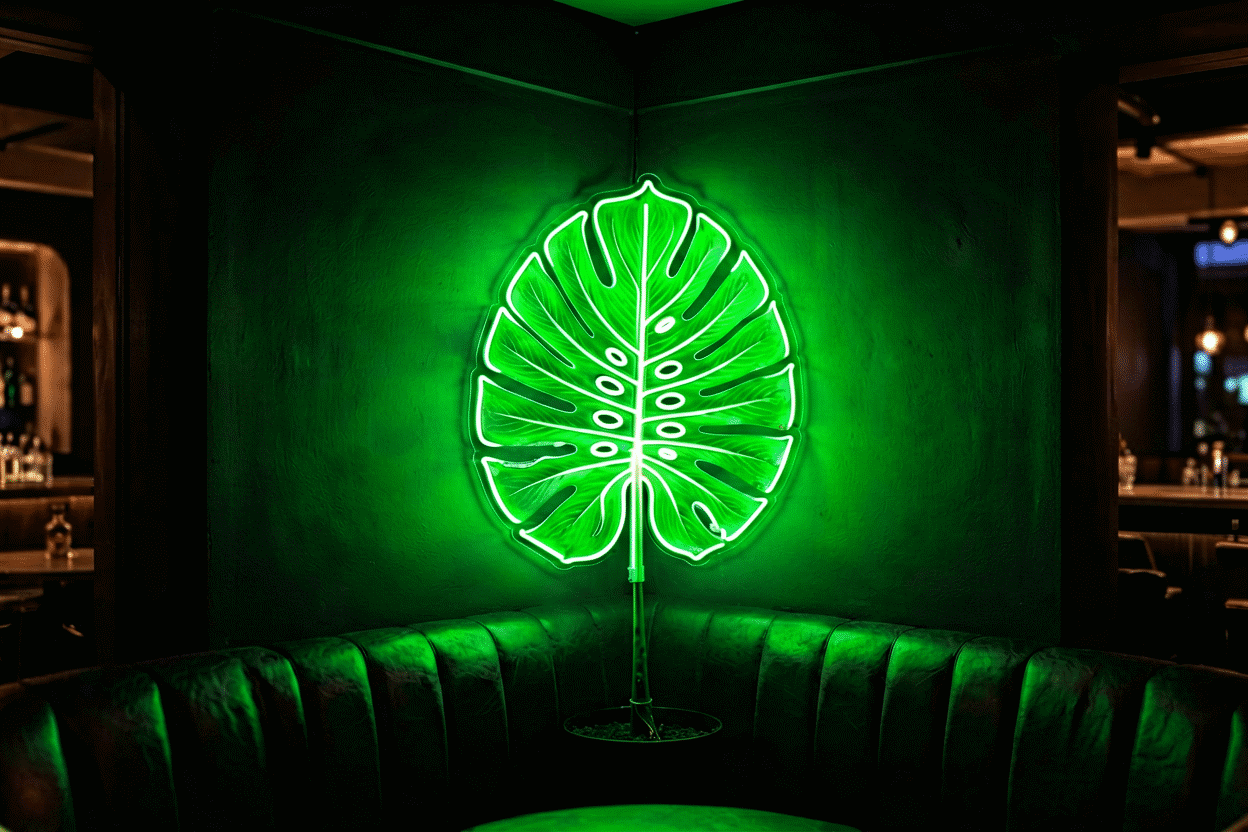
- The seven-point leaf — the canonical form, glowing green: the icon that needs no caption in any state that’s legalized and several that haven’t.
- The leaf outline, single-line — the minimalist’s version: one continuous stroke, small, the connoisseur’s subtle flex (the customizer draws it either way).
- The leaf + smoke wisps — the icon in motion: the curling-smoke companion piece that animates the form.
- The flower close-up — the bud rendered in green-and-orange: the connoisseur register — the botanical version, for households that treat it as one.
- The Rastafarian-tier piece — red-gold-green stripe compositions: the genre’s deepest heritage register.
- The Grateful-Dead-adjacent bear — the dancing-bear icon in any color (the music tier context): the crossover piece that says the era, not the activity.
The Phrases: Ideas 7–12
- “420” — the three digits that started as a police code rumor and ended as an international holiday: the number, glowing, is the genre’s shortest complete sentence.
- Chill — the activity’s actual verb: ice blue, dimmed, the word that covers all use cases (the meaning).
- Good Vibes — the genre’s blessing: the multi-color piece that reads innocent at the family gathering.
- “High Times” / “Elevated” — the elevation register: the phrases that pun on the state while staying decor-shelfable.
- “Bud Bar” / “The Smoking Room” — the fictional-establishment tier: the room’s charter, head-shop edition (the bar-charter logic).
- “In Dog Years I’m Dead” / the joke tier — the genre’s humor canon: the pieces that keep the room from taking itself seriously.
The Era & Design Tier: Ideas 13–17
- The apothecary register — “APOTHECARY” or “PHARMACY” in vintage script: the legalization-era joke that’s also genuinely elegant.
- The grow-room marker — “GARDEN OF EARTHLY DELIGHTS” over the tent: the cultivator’s pride piece.
- The disco-tier leaf — the leaf inside a rainbow arc: the 70s register, and the genre’s most joyful single object.
- The subtle-morse tier — “Let’s Stay Home” or “Botanical Society”: the coded register for households that prefer plausible deniability in their decor.
- The custom strain name — your homegrow’s name in script (preview): the connoisseur’s trophy, and the category’s most personal piece.
Placement and the Room’s Physics
The smoke corner’s neon runs the chill-room physics: warm-and-low, 20–40% brightness, with green as the native register and amber/pink as the support. The icon piece anchors (seated eye level — this genre sits), the phrase tier flanks, and the joke pieces run small. Ventilation matters more here than in any other room: keep the sign’s power supply out of the smoke column, dust the pieces monthly (the genre’s air has texture), and mount with the methods from the hanging guide.
One legal-context note for the display-minded: the icon’s legality varies by jurisdiction, and the subtle-tier pieces (the outline, the coded phrases) exist precisely for households that want the aesthetic without the announcement. The genre’s decor has always known this — it’s why the coded register is its oldest tradition.
The Sign-Buying Guide: Legibility, Subtlety, and the Coded Tier
The weed sign buyer runs a spectrum from “loud and proud” to “plausible deniability,” and the category serves both ends.
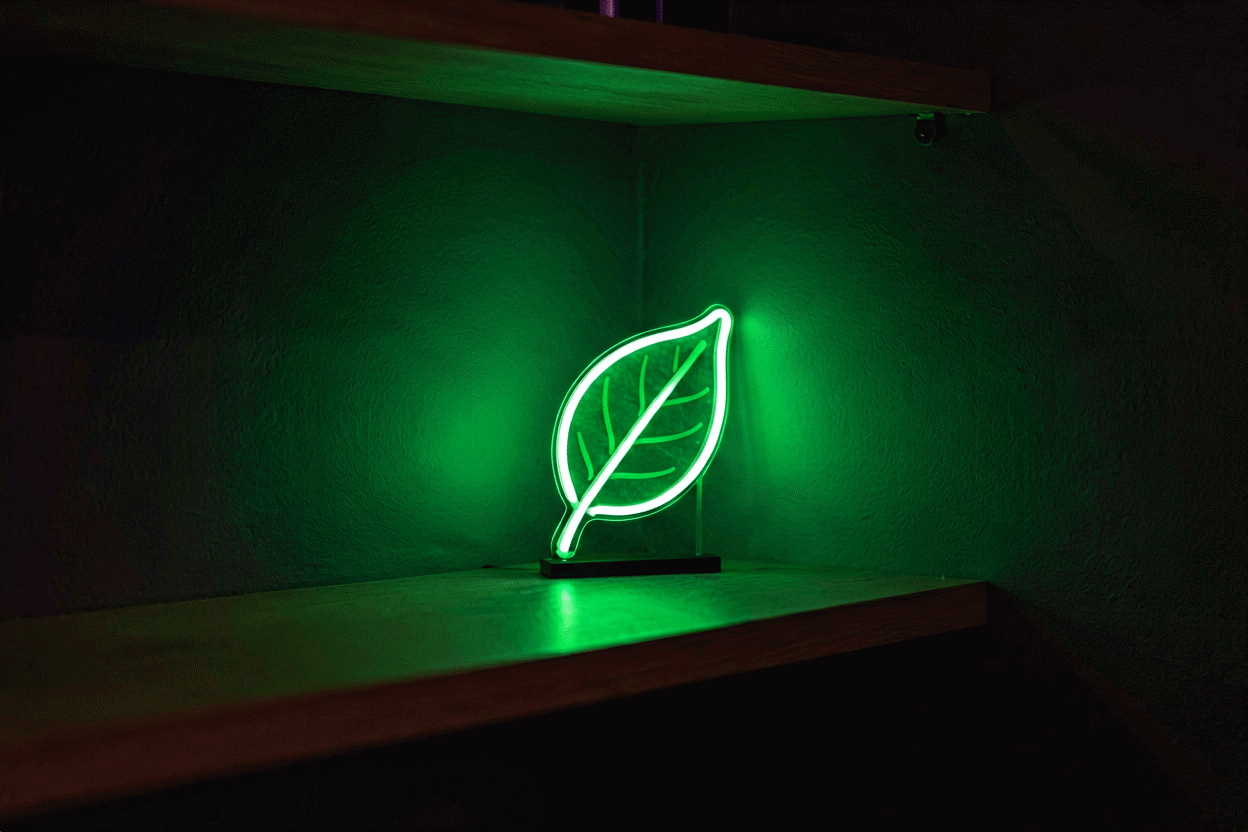
The loud end: the seven-point leaf at full size, “420” in bold, the “Bud Bar” charter – the pieces for the legalized states and the households that don’t parse. The loud tier’s palette runs green-dominant with amber support – the plant’s own colors, honoring the subject.
The middle: the flower close-up (the botanical register), “Elevated” and the pun tier, the apothecary script – the pieces that read connoisseur rather than counterculture. The middle tier works the legalization era’s mainstream rooms: the piece that says cannabis the way a wine sign says cabernet (the connoisseur logic above).
The coded end: the leaf outline at small scale, “Botanical Society,” “Let’s Stay Home” – the plausible-deniability tier for the mixed-company households and the restricted jurisdictions. The coded tier is the genre’s oldest tradition (the head shops of the prohibition era ran it as necessity) and its most sophisticated: the piece that means one thing to the initiated and nothing to everyone else.
The buying discipline: know your audience and your jurisdiction – the loud piece in the wrong room is a statement nobody asked for, and the coded piece in the safe room is a whisper nobody needed (the placement logic covers the room’s physics).
The Room Integration and Budget
The entry tier ($50-150): the icon (leaf or outline) and one phrase – the corner’s identity and its voice. The mid tier ($150-350): the connoisseur register (the botanical, the apothecary, the strain-name custom – preview) – the tier that treats the subject with the seriousness its enthusiasts do. The full room ($350-700): the chill room’s complete system – the anchor, the halo, the icons, the 70s tier – the room that’s built around the ritual rather than decorated for it.
The integration notes: the smoke column discipline (the power supply out of the direct line – the residue that lands on adapters shortens their lives silently), the ventilation-adjacent placements (the room that airs out keeps its pieces brighter), and the brightness at the chill band (20-40% – the genre’s physics) – the engineering that keeps the corner glowing for years (the maintenance logic covers the routine).
FAQ About Weed Neon Signs
What’s the best weed neon sign? The seven-point leaf in green — the canonical icon, instantly legible. The outline version for subtlety (customizer); “420” for the phrase register; “Chill” for the household that prefers verbs to nouns.
Are weed neon signs legal to display? The sign is always legal; the icon’s social (and in a few jurisdictions, practical) reception varies — hence the coded tier: outlines, “Botanical Society,” the apothecary register. Choose by audience, not by courage.
Where should the sign go? Seated eye level in the smoke corner, green-dominant palette, 20–40% brightness — the chill-room physics governs. Power supply out of the smoke column; the pieces dusted monthly.
What’s the difference between this and the smoke-shop tier? Register: the shop tier (the commercial guide context) is retail signage — bigger, bolder, customer-facing. The home tier is connoisseur decor: smaller, subtler, and legally savvier.
Where should I hang a weed neon sign? The smoke corner’s seated eye level (the genre sits – the placement respects the posture), the power supply out of the smoke column, and the ventilation-adjacent walls (the room that airs out keeps its pieces brighter) (the placement logic). The palette runs green-dominant with amber support (the plant’s own colors); the coded tier (the outline, the “Botanical Society” register) hangs where the mixed-company household needs its plausible deniability – the genre’s oldest tradition, still doing its work.
How much does a weed neon sign cost? The entry tier runs $50-150 (the leaf icon or the outline – the corner’s identity); the mid tier runs $150-350 (the connoisseur registers – the botanical, the apothecary script, the strain-name custom); the full room runs $350-700 (the budget tiers above). The coded tier runs the same brackets as its explicit counterpart – the plausible-deniability register is a vocabulary choice, not a price tier. The genre’s honest economics: the corner’s glow at the chill band costs the dollar-a-month power (the math), which the room’s residents typically find appropriately mellow.
What can a dispensary legally put on exterior neon? It varies enough to check every time: the common state rules restrict product imagery on exterior signage, mandate license numbers, cap total illuminated sign area, and some prohibit the word choices that read as promotion. The compliant exterior piece is often the shop’s name and open status only — all the creative register moves inside, where the interior signage rules run looser and the coded palette does its work.
What’s the coded register for states with strict signage rules? The botanical vocabulary: cannabis leaf outlines in abstract form, “WELLNESS,” “BOTANICALS,” apothecary script, and the green-cross pharmacy register where medical rules apply. The tier exists because outright product references trip advertising codes — the code-compliant piece signals the category to anyone looking while reading as a spa to everyone else, and that dual readability is the design brief, not a compromise.
The Home Corner vs the Smoke Shop
The weed canon’s two audiences, compared:
| Decision axis | The home corner (the C-end) | The smoke shop (the B-end) |
|---|---|---|
| The program | The chill room’s (the guide) | The trade playbook (the shop guide) |
| The pieces | The icons and the coded registers (the connoisseur tier) | The identity, the offering list, the compliance pair |
| The compliance | The household’s own judgment | The jurisdiction’s rules (the compliance map) |
| The budget | $60-350 by depth | $400-800 for the program |
| The palette | The warm-and-low (the genre’s physics) | The trade’s bold (the street’s registers) |
| The icon vocabulary | The coded and the subtle | The explicit and the commercial |
The two audiences’ shared iconography – the leaf, the botanical, the coded registers – running at different scales and disciplines: the home corner’s connoisseur tier (the subtle, the warm, the seated-eye placements) against the shop’s street tier (the bold, the legible, the conversion’s physics) (the two canons above).
The crossover buyer’s note: the dispensary-adjacent household and the smoke-shop owner buy from the same icon pool with the opposite rules – the home honors the subtlety, the shop honors the visibility, and the piece that crosses from one to the other (the shop’s icon hung at home, the home’s coded piece at the shop) reads each audience’s mistake. The canons are separate for the physics’ sake.
Sources & Further Reading
- Neon sign (Wikipedia) — the consolidated public record of neon-sign history and technology.
- Mercury (U.S. EPA) — federal guidance on mercury exposure and safe handling.
Pricing based on CustomNeon’s current catalog (2026); custom quotes come live from the sign builder.