21 Storefront Sign Ideas That Win the Street
The storefront is the business’s most contested real estate: three seconds of a stranger’s attention, at walking or driving speed, against every other sign on the block. The storefront sign that wins those three seconds follows rules a century deep — legibility at distance, honesty in status, color by trade — and the ideas that work within those rules run from the heritage formats to the modern pieces that photograph the block.
Here are 21 ideas organized by the storefront’s surfaces and jobs. The open-sign mechanics live at the open sign guide; the trade-specific registers at business sign ideas.
The Identity Tier: Ideas 1–5
The storefront’s permanent pieces — what the street learns to know you by.
- The blade sign — the perpendicular projection sign: the format that catches sidewalk traffic from the side, the street’s oldest conversion trick, reborn in neon.
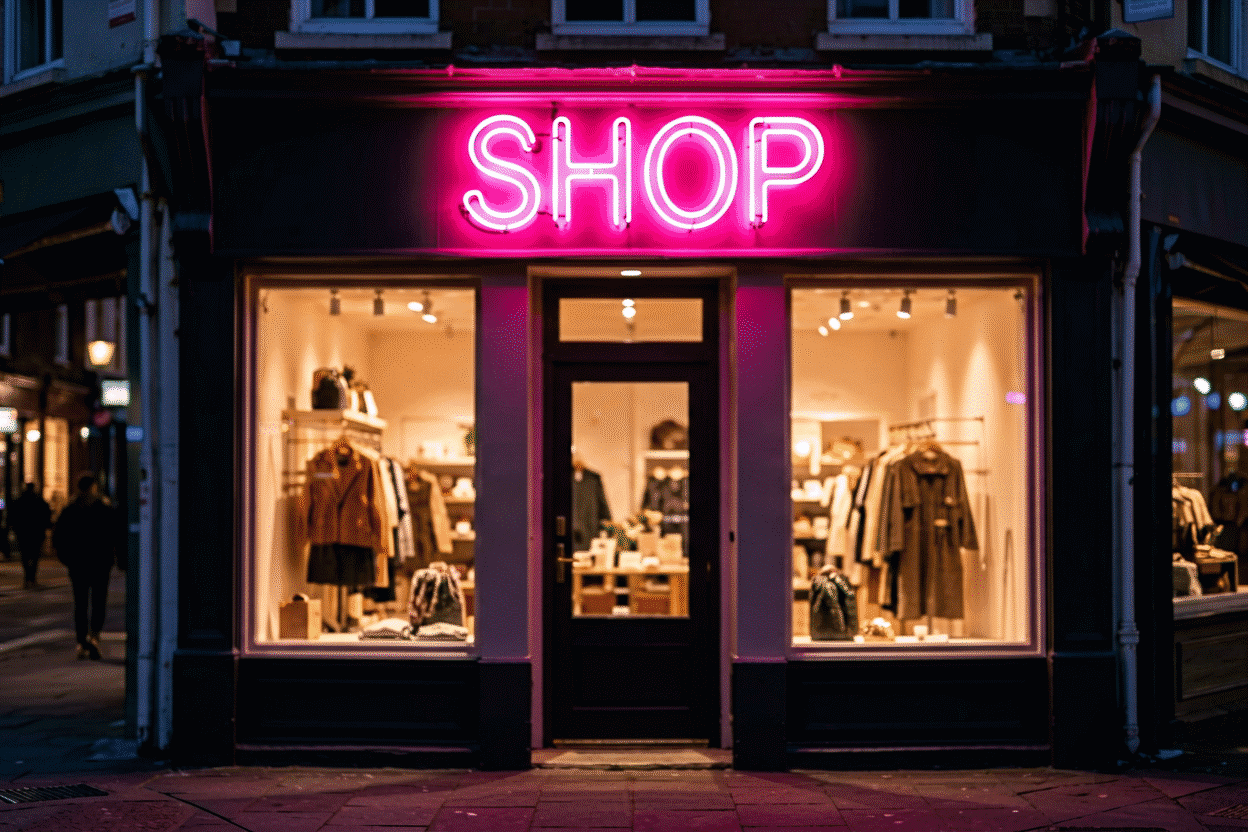
- The name-in-neon above the transom — the classic storefront identity (the retail canon): the business’s name where the block’s architecture expects it.
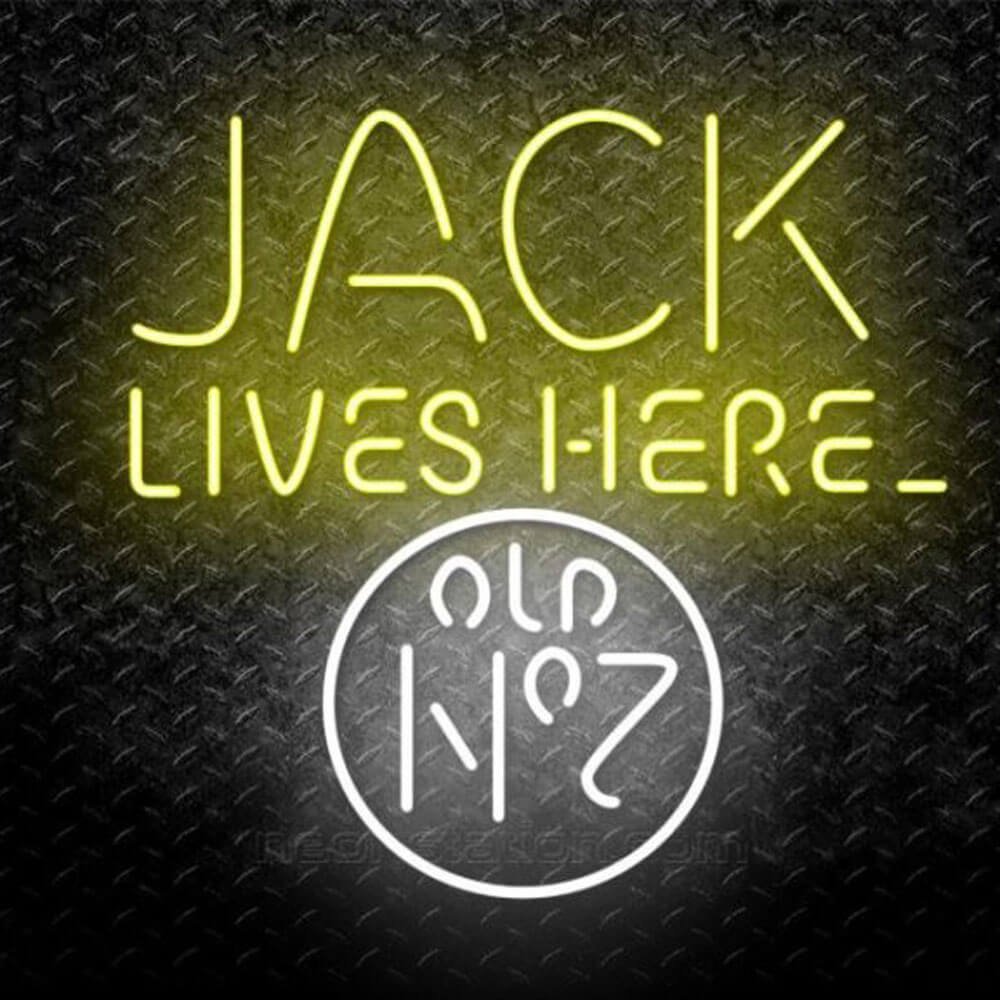
- The logo glow — the mark in brand colors (the customizer takes files): the identity piece that photographs on every customer’s walk-in post.
- The window-lettering companion — neon above, vinyl hours-and-info below: the two-layer system that keeps the glow doing the branding and the quiet text doing the logistics.
- The “EST.” piece — the founding year on the storefront: the heritage register that earns trust at a glance, strongest for the businesses old enough to have one.
The Status Tier: Ideas 6–8
- The open sign — the storefront’s working light (the guide): blue-red default, window-center, the piece whose three letters convert the street.
- The hours-beside-open format — the honest tier: the sign that answers the second question and never lies (the guide’s rules).
- The “OPEN 24 HOURS” tier — the always-on register (the ideas): for the businesses whose sign never sleeps.
The Trade Tier: Ideas 9–13
The icons and phrases that say what’s inside.

- The trade icon — the cup, the slice, the scissors, the dumbbell: the zero-word shorthand each trade owns (the industry canon maps them all).
- The specialty piece — the house’s signature item in glow: the pizzeria’s pepperoni slice, the salon’s blowout, the bar’s house pour — the sign that sells the best thing specifically.
- The phrase-of-trade — “Fresh Daily,” “Walk-Ins Welcome,” “Cold Beer”: the storefront’s three-word pitch (the retail logic).
- The menu-tier accent — the neon price-board item (“TACOS $2”): the transaction tier that glows the deal.
- The trade-humor piece — “Best Coffee on [This Side of] the Street”: the register that wins the smile and the memory (the case).
The Seasonal & Event Tier: Ideas 14–16
- The holiday rotation — the storefront’s seasonal layer (the holiday canon for December): the same mount, three seasons of content.
- The sale-event piece — the “SALE” and “CLEARANCE” glow: the promotional tier, honest and loud by design.
- The grand-opening piece — “NOW OPEN”: the storefront’s birth certificate, kept or retired with ceremony.
The Modern Tier: Ideas 17–19
- The photo-wall storefront — the interior piece visible through the window, built to be photographed (the retail case): the sign that markets through the glass.
- The hashtag-or-handle piece — the social tier: the handle in glow, for the businesses whose street runs on tags.
- The QR-companion piece — neon above the code: the analog-digital hybrid that routes the passerby to the menu, the loyalty app, the review page.
The Compliance & Craft Tier: Ideas 20–21
- The code-aware program — the permit-tier discipline (the size guide and the local rules): the storefront that wins the street within the city’s lines.
- The heritage-glass commission — real neon, bent for the storefront: the craft tier for the businesses whose register earns it (the vintage logic adjacent) — the block’s authentic anchor.
The Street’s Physics
The storefront runs four measurements: speed (the arterial storefront reads at 35 mph — size and simplicity; the pedestrian one reads at 3 — detail permitted), distance (the sign’s legibility from the block’s far corner), competition (the glow that must win its own block’s sign-noise, not just exist), and hours (what the storefront says after close — the glow that keeps the brand alive while the register sleeps) (the case).
The palette runs by trade (the business logic) with the honesty rule absolute: the storefront’s only asset is that the street believes it. The sizing runs the business chart; the budget runs the playbook‘s jobs-per-piece discipline; and the whole program previews at the customizer before the block ever sees it.
The Storefront Audit: Reading Your Own Frontage
Before the ideas, the audit – the fifteen-minute exercise that tells you which ideas your storefront needs. Stand across the street. What reads first? (The glow’s hierarchy – if the answer is “nothing,” the identity tier is the gap; if the answer is “the wrong thing,” the hierarchy needs the fix.) Drive past at street speed. What survives? (The arterial test – the sign that disappears at 30 mph is undersized for its street, the sizing chart.) Walk past at night. What does the frontage say after close? (The glow’s night work – the storefront that goes dark loses the evening’s brand impressions; the storefront that glows works the graveyard shift.)
The competitor scan: the block’s sign-noise level (the glow that must win its own block, not just exist), the trade’s conventions (the register the block expects), and the gap (the block’s missing register – the position no competitor holds, which is the creative tier’s actual opportunity).
The audit’s output: the storefront’s gaps, ranked – the identity tier’s presence or absence, the status tier’s honesty, the trade tier’s clarity, and the block-position opportunity. The ideas above fill the gaps; the audit tells you which ones to buy first.
The Lease-Compliant Program
The storefront’s legal layer, compact: the sign code (area caps per frontage, height and projection limits, brightness and animation rules – the municipal call, the permit tier); the lease’s signage clause (the landlord’s approval rights, the permitted mountings, the restoration obligations – the document nobody reads until the re-mount); the historic-district tier (the additional review layer for the heritage frontages – the slowest approval, worth starting earliest).
The compliant program’s sequence: code check, lease check, then budget – the storefront that verifies first buys once, mounts once, and glows for years; the storefront that buys first buys twice (the mistakes chart).
FAQ About Storefront Sign Ideas
What’s the best storefront sign? The working trio: name-above-the-transom, open-in-the-window, trade-icon-or-phrase at the street’s reading distance (the playbook). The blade sign is the conversion upgrade when the sidewalk’s the audience.
How much does a neon storefront sign cost? The trio lands $300–700; the identity customs run $150–500 (the brackets); glass commissions run several multiples. The street’s return compounds nightly.
Do I need a permit for storefront neon? Exterior-mounted pieces usually yes (the size guide‘s code tier); interior window signs rarely. The ten-minute city call precedes every mount.
What makes a storefront sign fail? The four from the century: unreadable at speed, unbelievable in status (the lying “open”), invisible in competition (the window pile), and silent after hours (the dark storefront the street forgets). The ideas above are the counters, in order.
What makes a good storefront sign? The four measurements: legible at the street’s speed (the sizing physics), honest in its status (the open that’s believed), distinctive against the block’s noise (the glow that wins its own street), and alive after hours (the evening’s brand work) (the street’s physics above). The good storefront sign answers all four; the great one answers them in the trade’s own register (the palette and the iconography that pre-qualify the customer before the door). The failures cluster on the first measurement – the undersized arterial sign is the storefront’s most expensive silence.
How much does a storefront neon sign cost? The window tier runs $60-300 (the open signs and the window pieces); the main storefront identity runs $300-1,000 (the name-in-neon at architecture scale); the blade signs and the exterior-mounted tier run $500-2,000 with the fabrication (the brackets). The code’s compliance (the permits, the historic-district reviews) adds its own line – the ten-minute calls that precede the budget. The street’s honest math: the storefront sign repays itself in the walk-ins it converts within months, and the glow works the evening street for years (the case).
What is the best sign for a small storefront? The working trio at the small frontage’s scale: the name-in-neon at the storefront’s beam (the identity – $300-800 at the small frontage’s sizes), the open sign in the window (the conversion – $60-200), and the trade icon or phrase at the street’s read (the voice – $100-300) (the storefront audit above). The small frontage’s advantage: the concentrated impression – the three pieces composing one statement rather than the big frontage’s spread. The trio’s code-check precedes the budget (the permit logic) – the small frontage’s area allowance runs tighter, and the concentrated pieces want the compliance’s blessing before the money.
What storefront sign style survives design trends longest? The trade-generic registers: the blade sign format (projecting perpendicular signage, a century of Main Street precedent), the gold-arc transparency script, and the lightbox with clean type. These read as architecture rather than decoration, and architecture ages slowly; the trend-locked styles — the floating neon hashtag, the oversized single word in super-condensed type — mark the storefront to a two-year window the way skinny jeans mark a photo.
How much of the storefront budget should the sign get? The working rule from storefront-redesign practice: signage takes 15-25 percent of a facade budget, because the sign performs the building’s single hardest job — converting a passing stranger into someone who knows what happens inside. Underspending produces the invisible storefront (great interior, no discovery); the overspend risk is real but rare, and almost always involves animation or custom fabrication the trade didn’t need.
Sources & Further Reading
- Neon sign (Wikipedia) — the consolidated public record of neon-sign history and technology.
Pricing based on CustomNeon’s current catalog (2026); custom quotes come live from the sign builder.