Baseball Team Neon Signs: Diamond Glow Guide
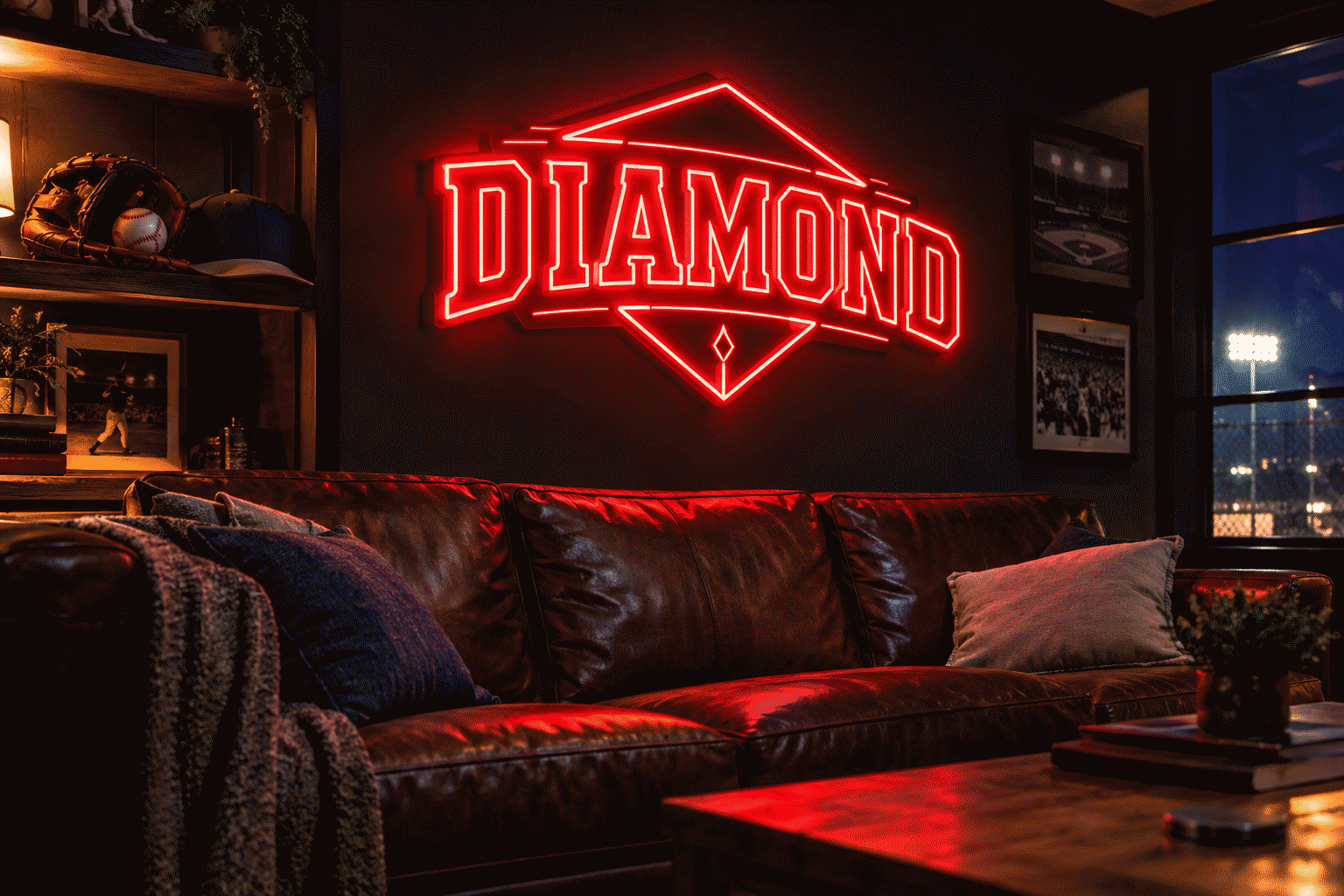
Football owns the winter wall; baseball owns the summer one. From March’s spring training through October’s World Series, the baseball fan wall works its long season — 162 games of it, plus the evenings on the porch with the radio register that no other sport has. A baseball neon sign is the summer wall’s anchor: the team mark in the evening glow, the porch light of the sports calendar.
This guide covers the franchise tiers (from the dynasty walls to the small-market faithful), the season calendar, the porch-light culture no other sport’s glow has, the year-round multi-sport architecture, and the custom tiers — including the softball tier the licensed catalogs forget entirely.
The Franchise Tiers
Baseball’s visual identities sort into four glow-friendly tiers:
The dynasty tier. The franchises whose histories carry numerals — the Yankees’ 27, the Cardinals’ 11, the Dodgers’ continuous excellence. These walls run the mark plus the title count, the record book in lights. Our Yankees, Dodgers, and Cardinals pieces carry the tier.
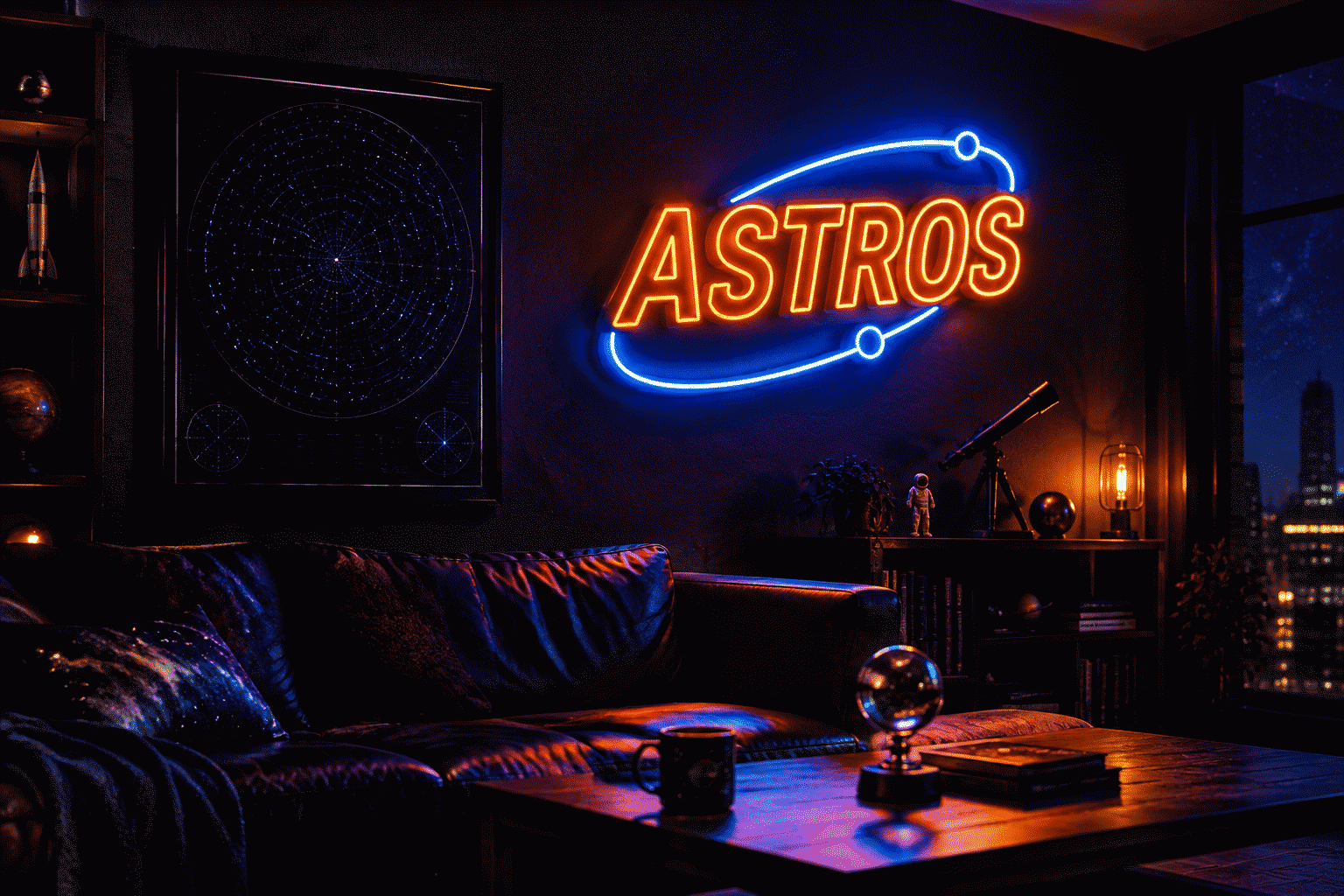
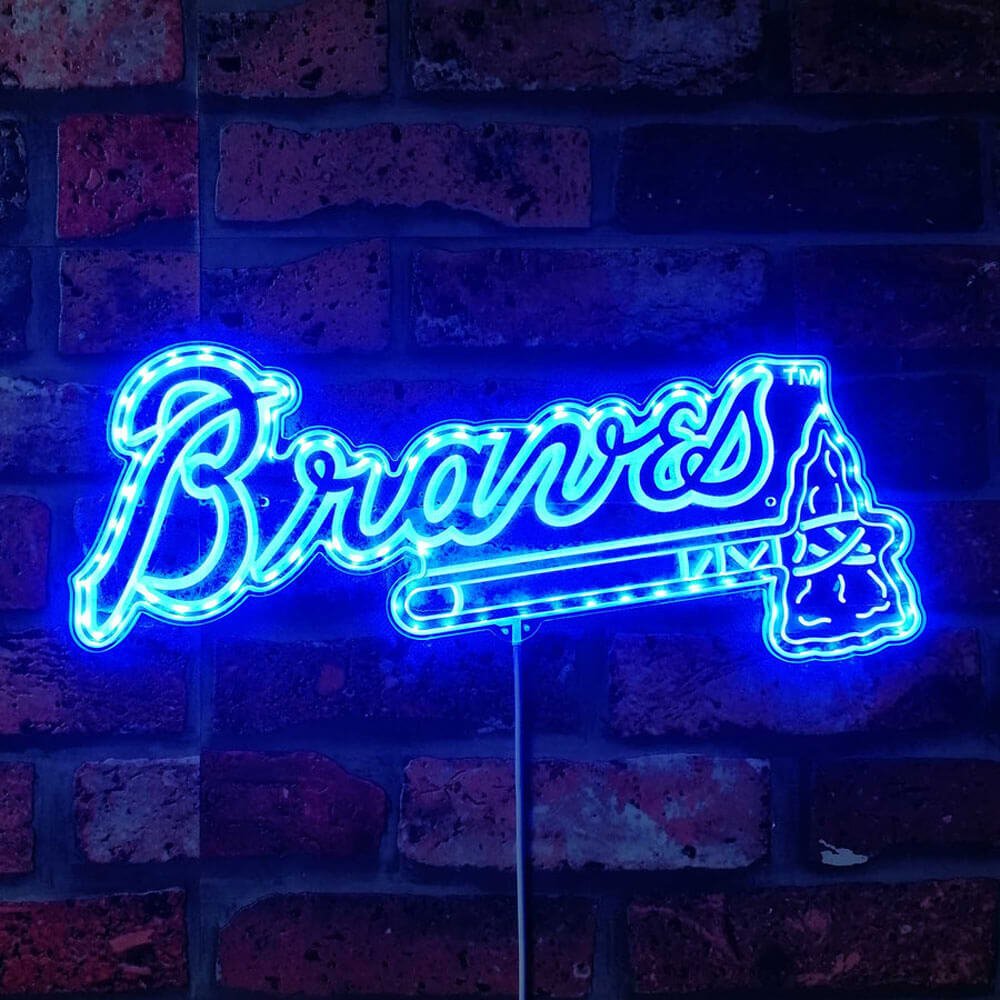
The single-mark tier. Baseball’s best logos are its simplest: the Braves’ tomahawk, the Astros’ star (our Astros guide is the archetype — the mark that survived every rebrand), the Tigers’ old-English D. Single marks render cleanest in neon — one stroke, one color, instant read.
The lettermark tier. The interlocked NY and LA, the single letters with a century of typography behind them. Lettermarks live at 16–24 inches — the flank tier around a larger piece or the anchor of a smaller wall.
The small-market faithful tier. Every city’s team, the marks that mean one specific place: the cream-and-sea, the riverboat, the northsiders’ and southsiders’s split-city registers. The fan-styled custom route serves this tier best — your team’s colors and your text, when your market’s licensed tier is thin. The Braves piece shows the format.
The Season Calendar
The baseball glow season, month by month:
- February–March: spring training — the wall wakes up; customs ordered now arrive by opening day. The smart money’s window.
- April–June: the long steady stretch — the mark at the evening register, game-night output two or three nights a week.
- July: the All-Star break and the trade deadline — the mid-season inventory moment, when the fan wall’s hopes are recalibrated.
- August–September: the stretch run — full output, the race the wall was built for.
- October: the World Series — the glow season’s championship month. Everything at 100%, one last run.
- November–March: the hot-stove register — the wall at simmer, the free-agency speculation months. Real baseball walls never go fully dark.
The gifting spike runs its standard December course, but baseball’s honest buying window is late winter — order by March 1 and the piece owns the whole season.
The Multi-Sport Wall: The Year-Round Architecture
The house that runs both glow seasons builds deliberately:

- The season exchange. The football piece and the baseball piece swap the anchor position — football on top September through February, baseball March through August. The two-sport wall’s classic layout, and the reason equal sizes matter: they trade jobs twice a year.
- The sport stack. The permanent layout: both marks on one wall, football above baseball by convention (the taller season on top), the football team guide covering the winter half.
- The baseball-plus-beer wall. The summer porch’s native architecture: the team mark among the beer pieces, the outdoor-evening register. The man cave guide covers the layout logic that transfers to the porch.
- The full fan-house stack. The four-layer house: football (fall), baseball (summer), hockey (winter), basketball (spring) — the year-round fan wall, one anchor per season, the sports-team register covered in its own guide.
The Softball Tier (The Market the Catalogs Forget)
Half the diamonds in America run softball — the youth leagues, the travel teams, the adult rec leagues — and almost no licensed catalog serves them. The fan-styled custom tier is where softball walls live:
- The player’s name and number in team colors — the travel-ball bedroom standard.
- “SOFTBALL” or the team name in the script register — the dugout and rec-league hall tier.
- The softball silhouette — the ball with its distinct seams, instantly different from the baseball’s, for the family that knows the difference.
- The senior-night piece — the name, the number, the years: the keepsake tier that gets photographed and kept. The gift register that peaks every spring.
The Porch Light Culture
Baseball’s glow has a register football never developed: the outdoor evening. The sport’s long association with summer evenings, porch radios, and the backyard grill gives the baseball piece an outdoor life most signs never get:
- The porch and patio tier. The team mark on the covered porch, run at the evening register from first pitch to last out — the sport’s native habitat. Covered mounting only (the weatherproof tier for open exposure), but the covered-porch deployment is the category’s most romantic.
- The backyard ballpark. The wiffle-ball field’s own outfield wall sign; the family’s team mark over the batting-cage netting. The summer-camp register.
- The bar and taproom tier. The tavern’s baseball wall — the team mark among the beer pieces, the sport’s century-long association with the corner bar doing its work. The man cave layouts transfer directly to the taproom.
- The radio register. The lowest-brightness tier: the mark at 10-15% output on a summer night with the game on the radio — the sport’s most traditional glow, the one your grandfather would recognize.
The honest pricing tiers for all of it: lettermarks and small marks $80-$150, the single-mark anchor $150-$250, dynasty numerals and multi-piece walls $250-$400, customs priced live by width.
The Custom Tiers
The fan-styled note, as every team piece carries: custom builds are your text and design, not licensed merchandise. Baseball’s custom canon:
- The est.-tier. “FANS SINCE 1986” in team colors — the generational fandom documented.
- The ballpark piece. Your stadium’s name or your section — the personal-tier detail no catalog carries.
- The scoreboard custom. The perfect game, the walk-off, the rivalry score that gets retold — the wall’s own record book.
- The grandfather clause. The Brooklyn-grade heritage piece — the team your family followed before the move, the mark that means where you’re from.
All price live in the custom builder.
Dynasty Numerals and the Record-Book Wall
The baseball wall’s one unique mechanic: the numbers accumulate. A football wall counts titles in single digits; a baseball wall’s dynasty tier counts them by the dozen — and the display conventions differ accordingly:
- The aggregate register. The title count as a single numeral piece — the franchise’s number in team colors, the wall’s own museum plaque. The honest version of fandom: the number is the argument.
- The year-list register. The title years in a row or grid — the collector’s version, updated (in theory) each October. Custom builders price a year list by width; the long dynasties need the wide wall.
- The retired-number tier. The franchise’s own retired numbers — the player identities a wall can wear without any logo at all. A single retired number in team colors is the fan-styled custom at its most elegant: specific, personal, legally clean.
- The personal record. The family’s own numbers — the season of the no-hitter they attended, the year of the perfect road trip. The record book nobody else keeps, which is exactly why it belongs in lights.
The numerals discipline: numbers below the mark, one scale tier smaller, same color family. The mark argues; the numbers prove.
More Diamond Guides
- Yankees neon signs — the franchise every collection gets measured against
- Dodgers neon signs — the coastal counterpart in Dodger blue
- St. Louis Cardinals neon signs — the Midwest classic in two-tone red
FAQ: Baseball Team Neon Signs
Where do I buy a baseball team neon sign? Team-styled LED pieces like our franchise designs, the secondhand market for vintage bar pieces, and fan-styled custom builds — your text in team colors, priced in the custom builder.
What size baseball sign for a fan cave? The single-mark tier anchors at 24–36 inches; lettermarks flank at 16–24. Dynasty walls add the numerals tier below the mark — the title count in lights.
When should I order for the season? Late February, before opening day — the baseball buying window is earlier than the December gift rush, and customs ordered by March 1 own the whole six-month season.
Can I mix baseball and football on one wall? Yes — the season exchange (equal sizes, swapping the anchor position twice a year) or the permanent sport stack (football above baseball by convention). The year-round architecture is covered above.
What about softball — are there softball neon signs? Almost no licensed tier serves softball; the fan-styled custom is where it lives — player name and number, team script, the softball-silhouette piece, the senior-night keepsake. All custom, all reasonable at the $90–$180 tier.
Can a baseball sign go outdoors? The covered porch yes — the sport’s own native register, run at the evening tier all summer. Open-exposure mounting needs the weatherproofed build tier; standard indoor pieces stay under cover. The porch deployment is the category’s most romantic and its most abused — check the build tier before the first rain.
What’s the best custom baseball sign? The est.-year piece and the ballpark tier — the personal documentation no catalog carries. For gift-giving, the senior-night and senior-league keepsakes are the register’s most meaningful builds.
Play the Long Season
Six months of games, one mark in lights. Pick the tier — dynasty numerals, single mark, or the softball custom nobody else sells — and build it before opening day.
More sports glow: football walls, the sports-team register, the Astros archetype, man cave layouts.
Sources & Further Reading
- Neon sign (Wikipedia) — the consolidated public record of neon-sign history and technology.
Pricing based on CustomNeon’s current catalog (2026); custom quotes come live from the sign builder.