Synthwave Neon Decor: Sunset Grids and Chrome
Synthwave is a memory of a future that never happened — the eighties as imagined by people who weren’t there yet: chrome, palm trees, a wireframe grid rolling toward a sun that never finishes setting. The aesthetic was born in music (the 2000s revival of eighties synthesizer sound), and it grew a visual grammar so complete that you can build a room in it today: pink and orange, sunset forever, chrome catching the light.
This guide is the room builder: the four visual ingredients, the palette discipline, the rooms the register owns, its border with cyberpunk (the frequently-confused cousin), and the custom route. The music matters here — the aesthetic and the sound are one package — but the room is built from light.
The Four Ingredients
Every synthwave room runs on the same four-element recipe, and the recipe is strict:
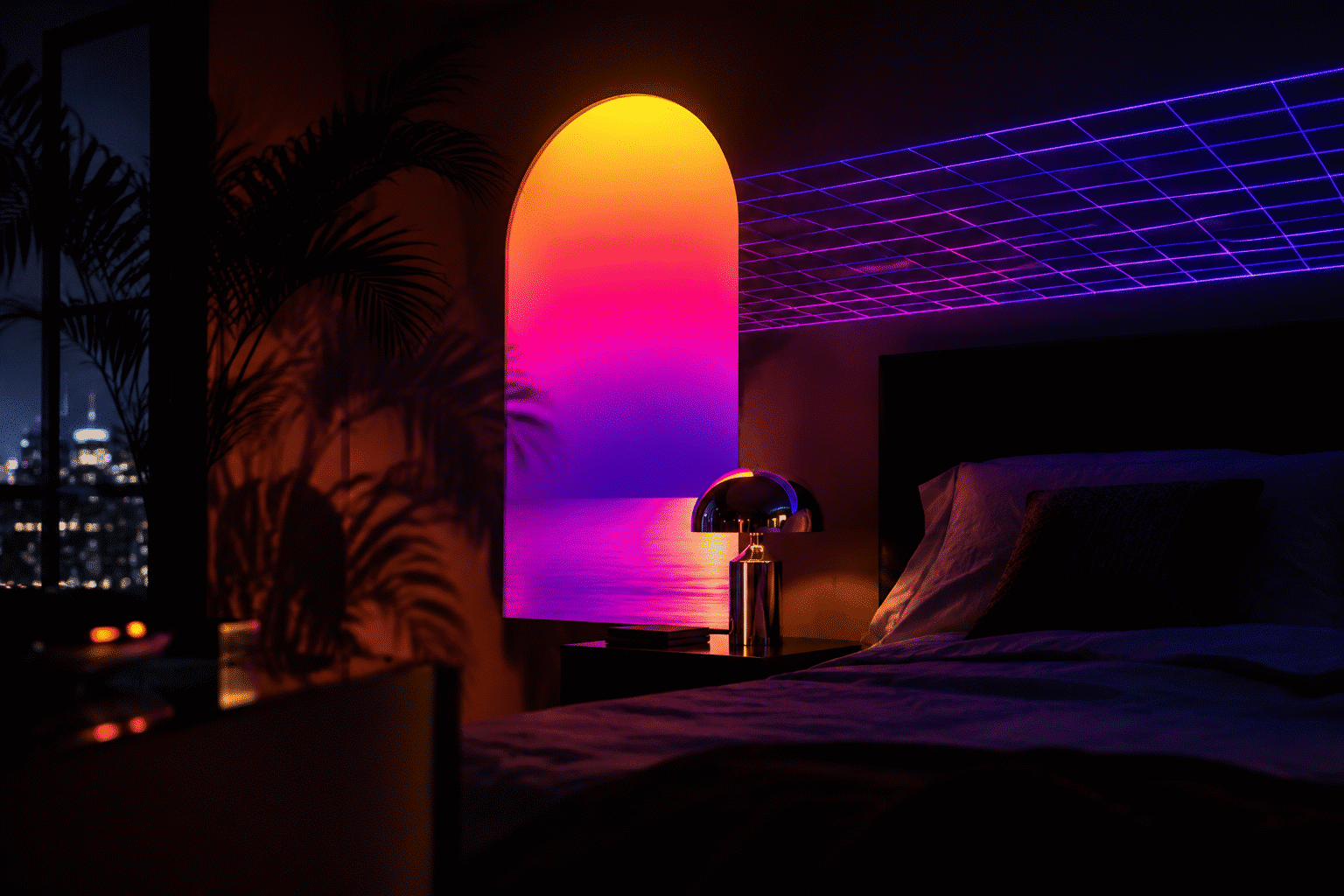
- The sunset gradient. Pink melting into orange (with purple at the horizon’s edge) — the register’s core image, rendered as a wall piece, a print, or the room’s actual color wash. The gradient piece is the anchor: a half-circle sun or a full sunset band in the pink-orange fade is the signature build.
- The grid. The perspective floor — the neon grid rolling to the horizon, the “outrun” road. The grid piece is the register’s second signature: a green or pink wireframe in any width. The two-piece sunset-plus-grid build is the complete synthwave wall in two objects.
- The palm silhouette. The coastal element — black palm shapes against the glow, the register’s organic counterweight to all that wireframe. Our palm tree guide covers the piece as its own subject; in the synthwave room it runs as silhouette against the sunset tier.
- The chrome tier. Not a tube color but a material pairing: chrome or mirror surfaces that catch the neon and double it — the lamp, the shelf, the furniture legs. Chrome plus neon is the register’s complete sentence; without the chrome tier the room is half-built.
The Palette Discipline
Synthwave runs a two-hue discipline with fixed roles — the strictest palette in decor after casino:
- Pink — the sky register. Hot pink, always: the gradient’s top, the text pieces, the room’s energy hue. The pink guide covers the family.
- Orange — the sun register. The gradient’s bottom, the warmth, the horizon.
- Purple — the edge tier. At the horizon and in the accents — the third hue in small doses only.
- The cyan exception. One cool accent is sanctioned (the grid often runs cyan against the pink sky — the complementary shock the genre canonized). One cyan piece per room, never two.
The failure mode: adding blue, green, or white beyond the sanctioned grid accent. The register lives or dies on the pink-orange discipline — the room that drifts into general “neon decor” loses the sunset and keeps only the glow.
The Rooms
The bedroom — the sunset corner. The register’s most livable deployment: the gradient piece over the bed, palms flanking, dimmed to the 15–25% evening register. The synthwave bedroom is the aesthetic at its calmest — the sunset as the room’s night light, the grid piece optional at the desk tier.

The gaming and media room. The genre’s native habitat (the aesthetic and gaming culture grew up together): the sunset-plus-grid wall behind the setup, the chrome shelf tier, the full-output evening. The retro gaming guide covers the arcade-adjacent corner that shares this room.
The music and studio room. The genre’s origin room: the synth corner with the sunset band behind the keys. The register’s most honest deployment — the aesthetic was literally built for the room where its music gets made.
The office-and-desk tier. The minimum viable sunset: one gradient piece at 20 inches, one chrome object, the wireframe at the monitor’s edge. The genre at conversation volume.
Synthwave vs. Cyberpunk vs. Vaporwave (The Border Posts)
The three siblings get confused constantly, and the rooms read completely differently:
- Synthwave is the sunset. Coastal, backward-looking (the eighties’ own future), pink-orange, warm, nostalgic. The room asks: wasn’t the future beautiful?
- Cyberpunk is the city. Urban, forward-looking (the future that actually arrived), cyan-magenta, cold, layered. The room asks: what if it never sleeps? Our cyberpunk guide builds that room; the two share a tube and not a mood.
- Vaporwave is the mall. The third sibling: pastel, ironic, the bust-and-shopping-mall register — cooler pink, teal accents, the aesthetic of commerce in quotation marks. Synthwave is sincere; vaporwave smirks. The sincere room outlives the smirk.
The color test, one line each: sunset gradient says synthwave, cyan signage says cyberpunk, pastel-with-statues says vaporwave.
The Custom Route
The register’s custom canon, all live-priced by width in the custom builder:

- The gradient sun. The half-circle or full sunset band in the pink-orange fade — the signature piece, any width.
- The grid. The perspective wireframe in pink or cyan — the second signature; sunset-plus-grid is the two-piece complete wall.
- The synth-era text. “OUTRUN,” “MIAMI,” “NIGHT DRIVE,” your own text in the chrome-styled lettering — the phrase tier.
- The palm pair. Two silhouettes at window height — the palm piece as the register uses it.
- The year plate. “EST. 1984” or the synth-look year custom — the gift tier (every year gives the register another eighties birthday).
The Setup Symphony (The Room the Sound Built)
The synthwave room deserves its music-room section, because the aesthetic and the sound are one package – the register’s most honest deployment is the room where the music that named it actually gets made or played:
- The synth corner. The keyboard station with the sunset band behind it – the genre’s iconic image, the producer’s wall that every synth-tuber runs. The gradient piece at 30-40 inches behind the keys, dimmed to the studio register (bright enough to film, low enough to mix by).
- The listening wall. The vinyl and cassette tiers with the grid piece above – the format-era media displayed under the era’s iconography. The grid at any width; the media shelf beneath; the chrome tier (the tape deck’s face) doing its reflective work between them.
- The drive-in register. The car-culture corner – the register’s “outrun” tier is literally named for driving; the wall with the sunset, the palm pair, and the model car shelf is the aesthetic’s garage variant.
- The headphone station. The desk tier for the streaming listener: one gradient piece at 20 inches, the chrome lamp, the wireframe at the monitor’s edge. The minimum viable sunset for the person who consumes the genre eight hours at a time.
The music-room rule: the glow serves the sound. The synth corner’s pieces run at the brightness that flatters the keys on camera; the listening wall runs lower – the register the room’s evening sessions actually use.
FAQ: Synthwave Decor
What is synthwave room decor? The four-ingredient recipe: the pink-orange sunset gradient, the perspective grid, palm silhouettes, and chrome surfaces that catch the glow. Two hues with fixed roles, one sanctioned cyan accent – the strictest palette in decor after the casino register.
What colors are synthwave? Pink (the sky register) and orange (the sun), with purple at the horizon’s edge and one sanctioned cyan accent – usually the grid. The discipline is the aesthetic: drift into general neon colors and the sunset dies.
What is the difference between synthwave and cyberpunk decor? Direction and temperature: synthwave is the backward-looking coastal sunset (pink-orange, warm, sincere); cyberpunk is the forward-looking night city (cyan-magenta, cold, layered). The cyberpunk guide builds the other room – same tube, opposite mood.
What do I need for a synthwave room? The two-piece core: the gradient sunset piece and the grid, plus one chrome surface to catch them both. Palms and the text tier build outward from there. The bedroom version runs it at 15-25% brightness – the sunset as the room’s night light.
How much does a synthwave neon setup cost? The gradient sun runs $120-$220 by width; the grid $100-$180; the palm pair $140-$220; the two-piece complete wall assembles for $250-$400. The chrome tier is furniture, not neon – budget it separately.
Where did the synthwave look come from? The music: the 2000s revival of eighties synthesizer sound grew a complete visual grammar – the sunset, the grid, the chrome – borrowed from the era’s album art, arcade cabinets, and sports-car posters. The room is the soundtrack’s stage set.
Chase the Sun
The future the eighties promised, glowing permanently at the horizon. Sunset, grid, palms, chrome — build the sunset and let the room drive toward it.
More retro glow: the eighties decade, retro gaming, cyberpunk rooms, palm trees.
Sources & Further Reading
- Neon sign (Wikipedia) — the consolidated public record of neon-sign history and technology.
Pricing based on CustomNeon’s current catalog (2026); custom quotes come live from the sign builder.