Star Neon Sign Ideas: The Sky’s Punctuation

Stars are the sky’s punctuation — the tiny marks that make the dark mean something. As wall pieces they play the same role: the star is the catalog’s great supporting shape, the scatter and the accent and the filler-that-isn’t-filling. And occasionally it takes the lead: the shooting star, the constellation, the single big five-point statement that carries a wall alone.
This guide covers the star in all its roles: the shape’s renderings, the constellation custom tier, the rooms it owns, the palette, the sky-family rules it lives by, and the practical case for the catalog’s most deployable shape. The short version: the scatter of three to seven units in warm white, drifted rather than gridded, beside the moon or the phrase piece. The family’s anchor — the moon — has its own guide; the stars are the sky’s everything-else.
The Renderings
- The five-point star. The classic outline — the shape every culture drew. In neon: ten straight lines, the medium’s easiest geometric build after the bolt. Reads at any size; the single big star (20–30 inches) is the statement version, the small star (8–12 inches) is the scatter unit.
- The sparkle. The four-point twinkle — the star as drawn in cartoons and holiday cards. The friendlier, softer version; the aesthetic register’s preferred star and the kids’ tier’s default.
- The shooting star. The star plus its trail — the composition that means wish. The most narrative shape in the sky family: the moment of motion rendered permanently. The shooting star runs 24–36 inches as a diagonal; the wish-tier gift build.
- The star cluster. Three to seven stars at scattered sizes and heights — the wall’s own constellation, the sky-family’s scatter tier deployed as one composition. The bedroom standard: one moon or phrase anchor plus the cluster’s drift.
The Constellation Custom (The Astronomy Tier)
The register’s most sophisticated build: your constellation, drawn correctly — the real star positions, connected by the real lines, in tube light.
- The zodiac tier. Your sign’s constellation — the birthday build, the register’s most gifted custom (every date has one; the witchy guide’s celestial stack runs the room around it).
- The named-star tier. The constellation plus a name — the memorial and dedication build, the star map that means someone.
- The night-sky map. The full constellation chart of a date and place — the anniversary’s sky, the birth-night’s sky, the custom tier’s masterpiece build (runs 30 inches and up, priced on the star count).
- The astronomy-honest tier. The real constellations at their real relative brightness — Orion, the Big Dipper, the Southern Cross — drawn for accuracy. The register’s only build where being right is the aesthetic.
The Rooms
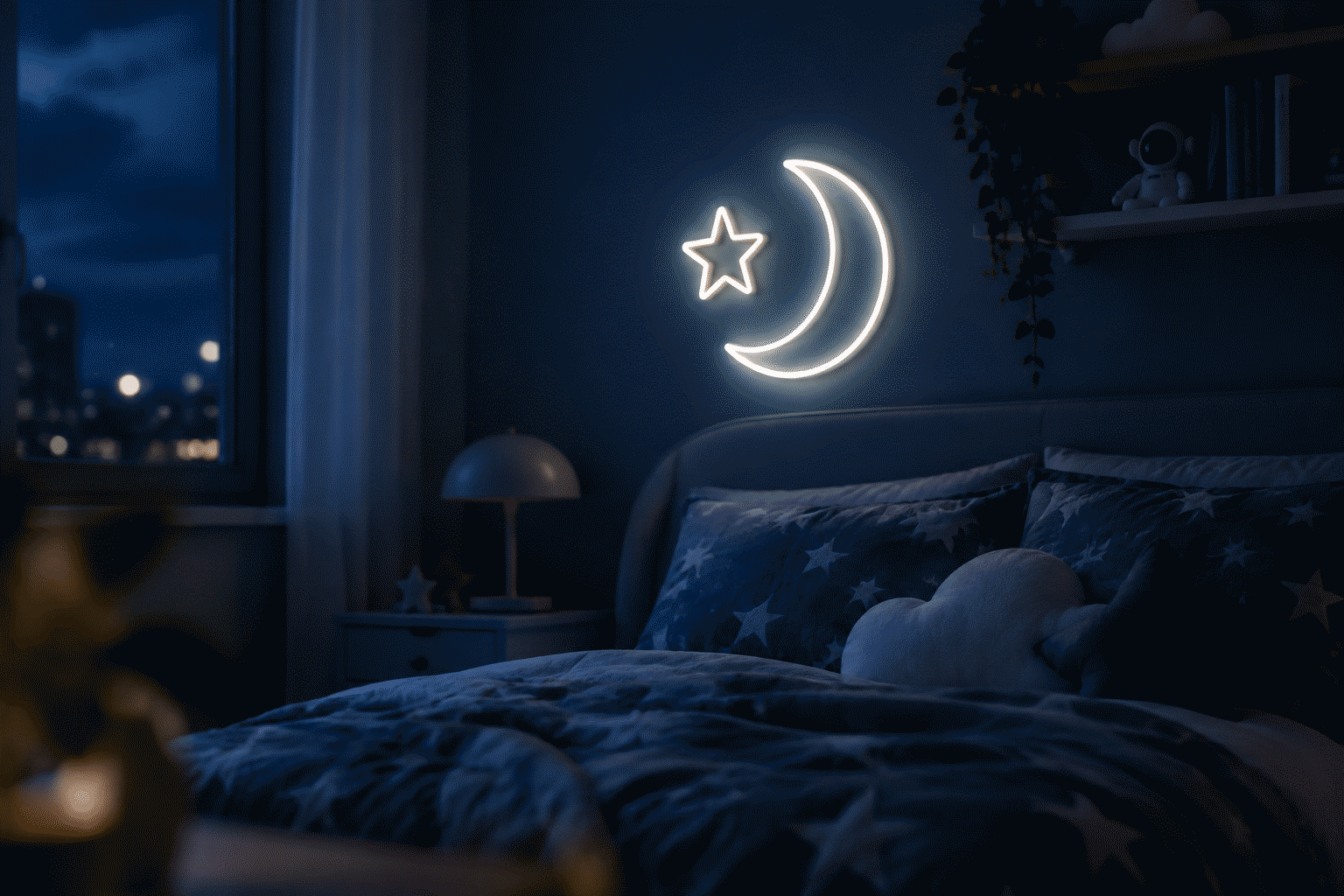
The kids’ room and nursery (the native tier). The star cluster plus the moon at the lowest dimmer register — the ceiling suggestion, the room’s night sky in two shapes. The kids’ guide covers the wider wall; the star-and-moon pair is its most-run standard.

The witchy and celestial wall. The constellation tier’s home — the zodiac pieces, the moon-and-stars stack, the purple family’s celestial register. The witchy guide builds the room; the stars are its second icon.
The aesthetic bedroom. The sparkle tier — the four-point stars in warm white or soft pink, scattered along the headboard line. The dreamy register’s most affordable build (the scatter unit runs under $60); the sky that budgets for itself.
The gallery wall (the punctuation role). The star as accent among the framed pieces — the one glow object on a mixed wall. The sparkle in white at 8–12 inches; the star doing the job it was born for: making the other objects mean more.
The Palette
- Warm white. The canon — the night sky’s own register, the piece that survives every room. The star’s default and the family’s neutral.
- Gold and amber. The celestial tier — the golden star of the witchy and sacred registers, the warm glow that reads as meaning rather than weather.
- Purple and ice blue. The night registers — the purple family’s celestial end and the ice-blue sky. The witchy and dreamy tiers’ hues.
- The multi-star custom. The cluster with each star in a different hue — the register’s one sanctioned rainbow (the real sky being polychrome at heart).
The Sky-Family Rules
The star lives in the family with standing rules — from the moon’s guide, the family’s constitution:
- One moon per wall; the stars are many (the real sky set both precedents).
- The scatter discipline: stars at three sizes maximum, one hue family, drifted rather than gridded (the sky does not align).
- The constellation exception: the astronomy tier’s connected stars are one piece, not a scatter — the build that excuses precision.
- The combo set: moon + stars (the classic), stars + clouds (the gentle sky), stars + the galaxy tier (the full cosmos). One dominant hue, one accent.
The Star’s Advantage (The Catalog’s Most Practical Shape)
The star deserves its practical case made explicitly, because it is the catalog’s most deployable object – the shape that solves more wall problems than any other:
- The price floor. The star is the catalog’s cheapest custom: ten short straight tubes, minimal bending, minimal acrylic. The scatter units run under $80, which makes the star the entry point for entire walls – the first piece most buyers commission and the filler that finishes most collections.
- The no-context read. The star means nothing specific and everything pleasant – wish, night, magic, excellence (the five-pointed award), the celestial register. The shape that can join any wall without palette or meaning conflict: the universal donor of the icon catalog.
- The seasonal double-duty. The star works in the December register without becoming Christmas-specific – the star over the manger, the star on the tree, the star that reads all year. The shape’s only true double-life in the catalog.
- The scatter mathematics. Because stars are cheap and context-free, they are the only shape that works as a scatter (five to seven small pieces across a wall section) without reading as clutter or cost. The drift composition is the star’s native deployment and the wall treatment no other icon supports.
The Custom Route
The star canon, live-priced in the custom builder:
- The scatter units — small stars at $50–$80 each; the cluster builds from $180.
- The shooting star — the wish build, $120–$200.
- The constellation tier — the zodiac and custom-chart builds, $150–$400 on the star count.
- The name-and-stars custom. A name in the cluster — the dedication build, the kids’-room standard.
FAQ: Star Neon Signs
What does a star neon sign cost? Scatter units run $50-$80 each; the big five-point statement $100-$180; the shooting star $120-$200; the constellation customs $150-$400 on the star count. The star is the catalog’s most affordable shape – ten straight lines doing the whole job.
What is a constellation neon sign? Your constellation drawn correctly – the real star positions and connecting lines in tube light. The zodiac tier (the birthday build) is the most gifted; the night-sky map (a date and place’s actual sky) is the custom masterpiece.
What color star sign is best? Warm white – the night sky’s own register and the family neutral. Gold for the celestial and sacred tiers, purple and ice blue for the witchy and dreamy registers. The multi-hue cluster is the one sanctioned rainbow.
Can a star sign carry a wall alone? The single big five-point at 20-30 inches is the statement version, and it carries – but the star’s native role is the supporting shape, and it serves the wall best in the scatter or the constellation build. The lone star statement suits the gallery wall and the entry tier.
How many stars should go on a wall? The scatter discipline: three sizes maximum, one hue family, drifted rather than gridded – the sky does not align. The cluster builds run three to seven; more reads as a ceiling, not a wall.
What pairs with a star neon sign? The sky family: the moon (the classic pair – one moon, many stars), the clouds (the gentle tier), the galaxy pieces (the full cosmos). The rules are in the moon’s guide – the family’s constitution.
Is a star sign good for a nursery? One of the native choices – the star cluster plus moon at the lowest dimmer tier is the room’s night sky in two shapes, the piece that starts as the baby’s ceiling and stays as the kid’s sky.
Make the Wish
The sky’s punctuation, deployed as the wall needs it: scatter, statement, or the constellation that means a date. Build the stars — one or many, drifted like the real thing.
More sky glow: the moon, clouds, the galaxy tier, the witchy register.
Sources & Further Reading
- Neon sign (Wikipedia) — the consolidated public record of neon-sign history and technology.
- Neon, element 10 (Wikipedia) — element properties: density, boiling point, abundance.
Pricing based on CustomNeon’s current catalog (2026); custom quotes come live from the sign builder.