How to Fix a Neon Sign: Flickering & Dead Sections
Fixing a neon sign starts with one insight: most “broken” LED neon signs have a dead power adapter, not dead lights — and adapters are a $15–$40 replaceable part. Glass neon is the opposite: its failures usually involve the transformer or the gas in the tubes, and both are professional jobs because the hardware runs on 2,000–15,000 volts. Diagnose before you touch anything, and the fix is usually smaller than the scare.
This guide walks the full decision tree: won’t turn on, partially dark, flickering, buzzing — what each symptom means, what you can safely fix yourself, what a shop charges, and when replacing beats repairing.
Safety First: The Two Rules
- Unplug before anything. Every check below starts with the sign unplugged from the wall. “Off” via remote is not off.
- Know which sign you have. LED neon (silicone tubing, lightweight, wall adapter) is owner-serviceable within limits. Glass neon (glass tubes, heavy, transformer box) contains high voltage and a drop of mercury in argon tubes — leave anything beyond dusting to a sign shop.
If your glass sign has a cracked tube, ventilate the room, and clean up following the mercury-safe steps in our gas guide before anyone handles it further.
Step 1: Match Your Symptom to the Likely Cause
| Symptom | LED neon: most likely cause | Glass neon: most likely cause |
|---|---|---|
| Completely dark | Failed adapter (~the most common failure of all) | Dead transformer or tripped GFCI |
| One section dark or discolored | Loose connector or damaged section | One tube lost gas pressure |
| Flickering (whole sign) | Aging adapter, poor outlet contact | Failing transformer |
| Flickering (one area) | Damaged section, pinched wire | Tube aging — electrode wear or a slow leak |
| Buzzing loudly | (rare — usually the adapter) | Transformer aging — normal hum gone loud |
| Dimmer than it used to be | LED age or dust film | Phosphor age or gas contamination (slow leak) |
Work down the table: whole-sign symptoms point at power, localized symptoms point at sections or tubes.
“It Won’t Turn On”: The Power Chain Check
Four checks, five minutes, in order:
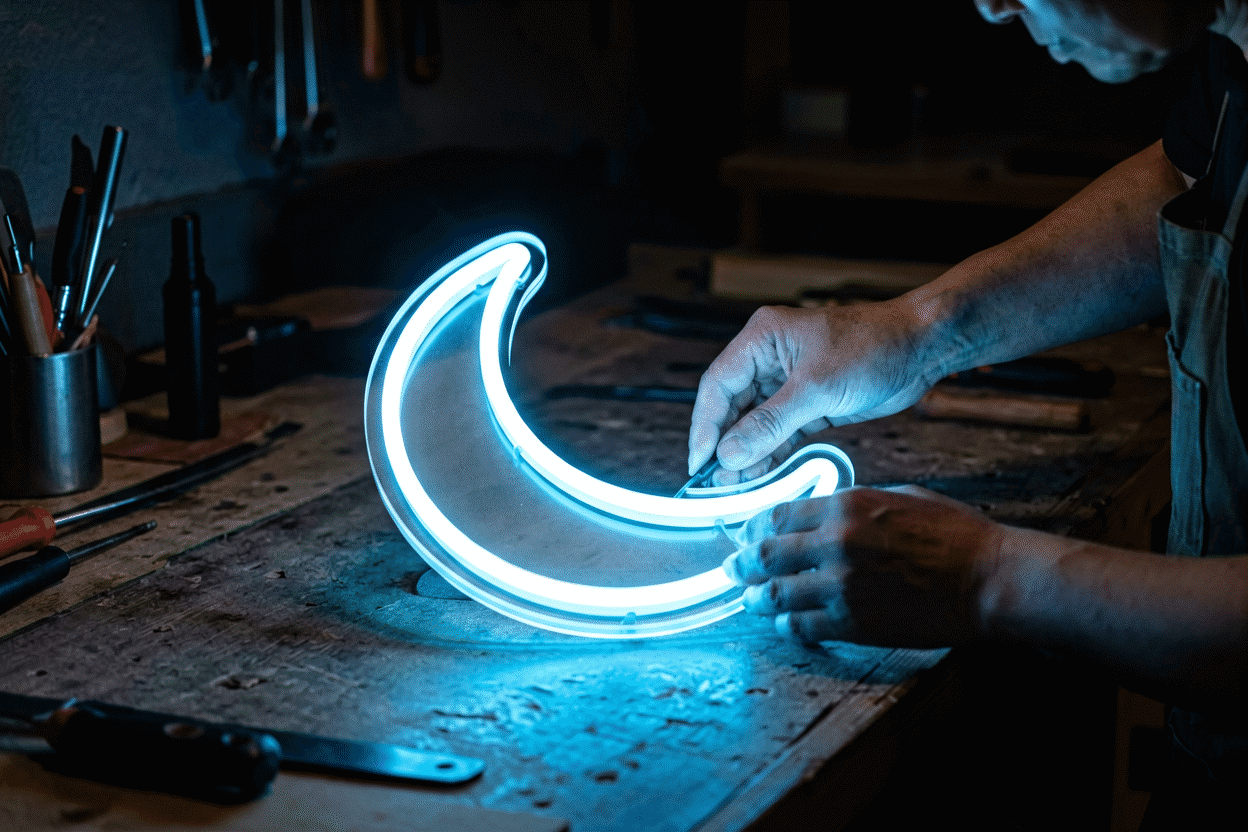
1. The outlet. Plug in something you know works — a phone charger. If the outlet is dead, the sign was never broken. Check the GFCI reset button if it’s a kitchen, bathroom, or garage circuit.
2. The adapter. The small box between the wall and the sign. Warm-and-humming means it’s trying; completely cold and silent after minutes plugged in means it’s likely dead. Adapters fail silently and often — they’re the hardest-worked, cheapest-made component in the whole product.
3. The connections. Unplug everything. Reconnect the adapter-to-sign connector firmly, and check the input jack where it meets the sign. These connectors work loose with dusting, moving, and wall flex.
4. The remote. Some signs default to “off” after a full power cut and need any remote button pressed once. It’s embarrassing how many “repairs” end at this step — press every button once before concluding anything.
If the outlet works and reconnecting everything doesn’t help, replace the adapter (next section). If a new adapter doesn’t wake the sign, the driver inside the sign has failed — that’s a warranty claim or a shop visit.
Flickering: Causes, Ranked by Likelihood
Flicker is the most-searched neon problem, and the causes rank consistently:
- Aging adapter (LED). Output voltage sags and rebounds; the LEDs stutter. The flicker is usually sign-wide. Fix: replace the adapter. This resolves the majority of LED flicker cases.
- Loose connection. Wiggle test — gently, sign unplugged — along the cord and at the connector. A flicker that changes when you nudge the line is a connection, not a component.
- Incompatible or failing dimmer. Third-party dimmer plugs and smart plugs with triac switching make LED neon flicker. Test by plugging the sign directly into the wall.
- One failing section (LED). A localized flicker that stays in the same spot means that section’s diodes or wiring are failing — see below.
- Transformer aging (glass). Whole-sign flicker on glass, often with a louder hum. Shop job; the transformer is replaced, not repaired.
- Tube end-of-life (glass). A single tube flickering, sometimes with darkened ends, means the gas pressure is dropping. A sign shop can reprocess the tube.
Buzzing deserves its own sentence: a faint hum from glass neon is normal (it’s a transformer doing transformer things). A hum you can hear across the room is the transformer asking to be replaced — usually years of service, and a routine swap for a shop.
The Five-Minute Flickering Diagnostic
Before spending a dollar, run this flow in order — it settles the majority of flicker cases with zero parts:
- Film the flicker. Twenty seconds of video reveals the pattern: a whole-sign stutter points at power, a stutter locked to one spot points at a section.
- Bypass every accessory. Unplug the dimmer, the smart plug, and any extension cord; run the sign straight into the wall outlet. Triac-switched smart plugs cause LED flicker all by themselves.
- Wiggle test. Sign unplugged, work gently along the cord and at the connector. A flicker that changes when you nudge the line is a connection, not a component.
- Swap the adapter. Borrow a matching-voltage adapter if you can — if the flicker stops, a $15–40 part was the entire problem.
- Read what’s left. A localized flicker that survived all four steps is a failing section (warranty claim or shop visit). Whole-sign flicker on glass neon is the transformer — book the bench.
LED Repairs You Can Do Yourself
Replace the adapter. The single highest-value repair in neon. Find the output rating printed on the old adapter (e.g., 12V ⎓ 3A) and buy a match with the same voltage, the same or higher amperage, and the same polarity (center-positive is typical). Wrong polarity or voltage can kill a healthy sign. Matching adapters run $15–$40 online and swap in seconds.
Reseat and clean connections. Unplug, disconnect, blow the connectors clean, reconnect firmly. Free, fixes an amazing number of intermittent faults.
Re-pair the remote. Remotes and receivers occasionally lose pairing after power cuts. Hold the receiver near the remote and cycle power per the manufacturer’s sequence (usually holding the “on” button for several seconds).
Relieve pinched wiring. A cord wedged behind furniture can fatigue a conductor over months. Re-route with slack and adhesive clips.
Repairs to Leave to the Professionals
Sealed LED sections. You cannot replace individual diodes in a sealed silicone tube — the sections are bonded assemblies. If one section is truly dead (dark while the rest glows, after the connector checks), the sign goes back to the maker under warranty or to a shop for a section replacement. Attempting to cut into the tubing typically converts a repairable sign into a dead one.
Everything on glass neon. Gas reprocessing (re-evacuating and refilling tubes), tube bending replacements, and transformer work all involve high voltage, glassworking torches, and vacuum pumps. This is a trade with benches and tools, not a kitchen-table fix. The good news: shops exist in most metro areas, turnaround is usually days, and repairs often cost less than people fear (table below).
What Does Neon Sign Repair Cost?
| Repair | Typical cost (parts + labor) | DIY? |
|---|---|---|
| LED adapter replacement | $15–40 part | Yes — match voltage & polarity |
| Connection cleanup / remote re-pair | $0 | Yes |
| LED section replacement (out of warranty) | $60–150 | No |
| Glass transformer replacement | $150–350 | No |
| Tube gas reprocessing (recharge) | $100–300 per tube | No |
| Bent tube replacement | ~$15–30 per foot fabricated + labor | No |
| Bench diagnosis fee | $50–100 (often credited toward the fix) | — |
Ranges reflect typical U.S. sign-shop pricing and vary by region and sign size. Businesses running a storefront sign should weight these numbers against downtime: if an open sign is dark for a week, the repair bill is the smaller number on the invoice.
Repair or Replace? The Decision Math
Two questions decide it:
- Is the repair more than half the cost of a new sign? A $150 section repair on a $220 sign is a bad trade; a $200 transformer swap on a $900 glass piece is a good one. Current replacement pricing is in our neon sign cost guide.
- Is there sentimental or brand value? A vintage glass sign, a wedding sign with your names, a business’s landmark piece — these repair at almost any ratio. Mass-produced LED with no custom value doesn’t.
Also check the calendar before paying: quality makers warranty custom LED signs for 12–24 months, and “failed adapter” is precisely what those warranties exist for. A photo of the order confirmation usually settles the claim in one email.
One more consideration for LED signs specifically: if the sign is 5+ years old and now failing, the adapter will be cheap to swap once — but a second component failure within months means the whole unit is at end-of-life, and each additional repair is buying time, not years. The aging mechanics are explained in how long do neon signs last?.
When a “Dead” Sign Is Still Under Warranty
Before paying anyone anything, check these five things:
- The purchase date. Quality makers warranty custom LED signs for 12–24 months. “Bought it last spring” is inside most windows.
- What the warranty covers. The good ones cover the adapter and workmanship — which is precisely where most failures live. The thin ones cover only the LED strip, which rarely fails.
- Your evidence. Order confirmation plus a photo of the adapter’s rating label plus a short video of the symptom. That trio settles most claims in one email.
- The maker’s channel. Custom sign shops generally don’t have return logistics — expect a mailed replacement adapter or a section swap rather than a full return.
- The repair-versus-wait tradeoff. If a $25 adapter from a local retailer fixes the sign tonight and the warranty claim takes two weeks, buy the adapter and keep the receipt — some makers will reimburse it.
Glass neon warranties run shorter (commonly 12 months on tubes), but the transformer discussion with a shop is worth having before you pay out of pocket, since transformers are sometimes covered separately.
FAQ: Neon Sign Repair
Why is my neon sign flickering? Most LED flicker is a failing power adapter or a loose connection — replace the adapter ($15–40, matching voltage and polarity) or reseat the connectors. On glass neon, whole-sign flicker means the transformer; one-tube flicker means the gas is ending its life.
Why did my neon sign suddenly stop working? Work the power chain in order: the outlet (test with a phone charger), the adapter (cold and silent is suspicious), the connections, and the remote. Adapter failure is the most common sudden-death cause in LED signs and the cheapest fix.
Can I fix a neon sign myself? LED signs: yes for adapter swaps, connector cleanup, and remote re-pairing. No for sealed sections. Glass neon: no — transformer and gas work involve 2,000–15,000 volts and belong to a sign shop.
How much does neon sign repair cost? Typical U.S. pricing: LED adapter $15–40 (DIY), LED section replacement $60–150, glass transformer replacement $150–350, gas reprocessing $100–300 per tube, plus a $50–100 bench fee that’s usually credited toward the repair.
Why is my neon sign dim? Three causes, in order: dust film (cleaning fixes it — see our cleaning guide), aging (LEDs fade slowly over years; phosphors and gas in glass dim too), or a failing power supply delivering low voltage. Clean first, then photograph against a “when new” shot to compare.
When should I replace instead of repair? When the repair exceeds half the new-sign price and the sign has no sentimental or brand value — or when an LED sign starts its second component failure after five-plus years. New custom signs start lower than most people expect: see the custom neon sign builder for live pricing.
If the Sign Is Beyond Saving
Repair chains end somewhere, and the replacement math has moved — a new custom LED sign often costs less than people paid years ago, with better diodes, a real warranty, and exactly your text. Try your words in every color at any size in the custom neon sign builder, priced live as you design. And if the sign that died was your storefront’s only beacon, our open signs guide covers what to hang in its place tonight.
Sources & Further Reading
- Cleaning Up a Broken CFL (U.S. EPA) — the federal mercury-spill cleanup procedure; we mirror it for broken glass-neon tubes.
- Neon: Strong Lines (NIST Physical Reference Data) — the standard reference for neon’s emission wavelengths.
- Argon: Strong Lines (NIST Physical Reference Data) — the standard reference for argon’s emission wavelengths.
- Solid-State Lighting (U.S. Department of Energy) — DOE reference on LED efficacy and lifetime.
Pricing based on CustomNeon’s current catalog (2026); custom quotes come live from the sign builder.