How Do LED Neon Signs Work? Inside the Tube
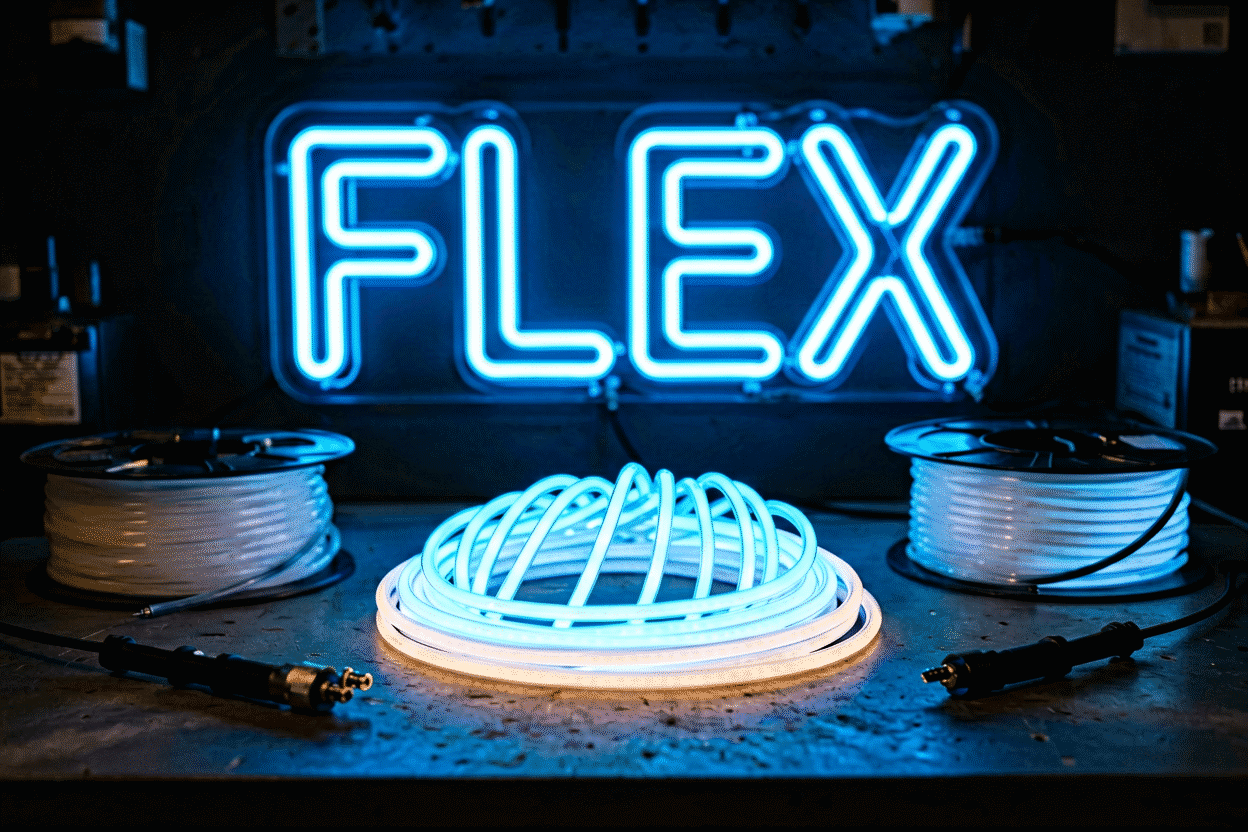
An LED neon sign works by running low-voltage electricity through a strip of light-emitting diodes embedded side-on inside a solid silicone tube: each diode emits light directly from its semiconductor junction, and the tube’s shaped profile turns that line of bright points into what reads as one continuous glowing ribbon — the look of glass neon without gas, vacuum, glassblowing, or high voltage. The entire sign runs on about 12–24 volts, roughly the domain of a laptop charger.
This is the inside story of the modern neon sign: the diode physics, the four-layer anatomy of a neon flex tube, how the glow gets its color, and how dimming and color-changing work at the electrons’ level. The glass-tube counterpart and the full head-to-head live at how do neon signs work and LED vs glass neon.
The Diode: Light With No Filament, No Gas
The light source is a light-emitting diode — a sandwich of two semiconductor materials. When current flows across their junction, electrons drop across an energy gap and release the energy as photons. Three properties of that process explain everything LED neon is:
- The color is built in. The energy gap’s size sets the photon’s wavelength — the color. Different semiconductor recipes (gallium nitride family, plus phosphor coatings for whites and warm hues) emit different colors from the factory. Nothing in operation “makes” the color; the diode is its color.
- It’s brutally efficient. Nearly all the energy leaves as light rather than heat — why an LED neon sign draws 10–30 watts where a glass equivalent draws multiples of that, and why it stays cool to the touch (energy math).
- It switches instantly, forever. Billions of on-off cycles without wear — the property that dimming and color modes abuse happily (below).
The Anatomy of a Neon Flex Tube (Four Layers)
The engineering achievement of LED neon isn’t the diode — it’s the delivery system that makes point sources read as a continuous neon tube:
Layer 1 — The LED strip. A flexible printed circuit board carrying the diodes at fixed pitch (density measured in LEDs per meter — the quality tier’s core spec, typically 60–120/m in neon flex). Better density = smoother line, fewer visible “dots” at close range.
Layer 2 — The side-emission geometry. In standard strip lights, diodes face outward. In neon flex, they’re mounted to fire sideways — up to 90–270 degrees around the strip’s axis — because the light needs to fill the tube’s profile, not shoot out of its face. This rotation is the unglamorous trick behind the entire category.
Layer 3 — The silicone extrusion. The strip lives inside a solid (or co-extruded) silicone body shaped with the classic dome-tube profile. Food-grade silicone handles heat, UV, bending, and weather (it’s what makes outdoor ratings possible — waterproofing). The material choice is also why quality flex feels dense and cheap flex feels hollow.
Layer 4 — The diffusion shell. The outer profile’s curved geometry and (in better products) an internal diffuser layer scatter each diode’s output across the tube’s width. Done well — correct diode pitch matched to tube diameter — the eye integrates the points into a line from any reasonable distance. Done cheaply, you get the dotted look that betrays budget builds (what to check).
Bend radius rules come from this stack: the circuit board inside silicone tolerates gentle curves (a few centimeters’ radius) but not hairpins — which is why sign factories pre-form letters with bends done properly rather than trusting end-users to fold flex like ribbon.
Where the Colors Come From
Two roads to a colored glow:
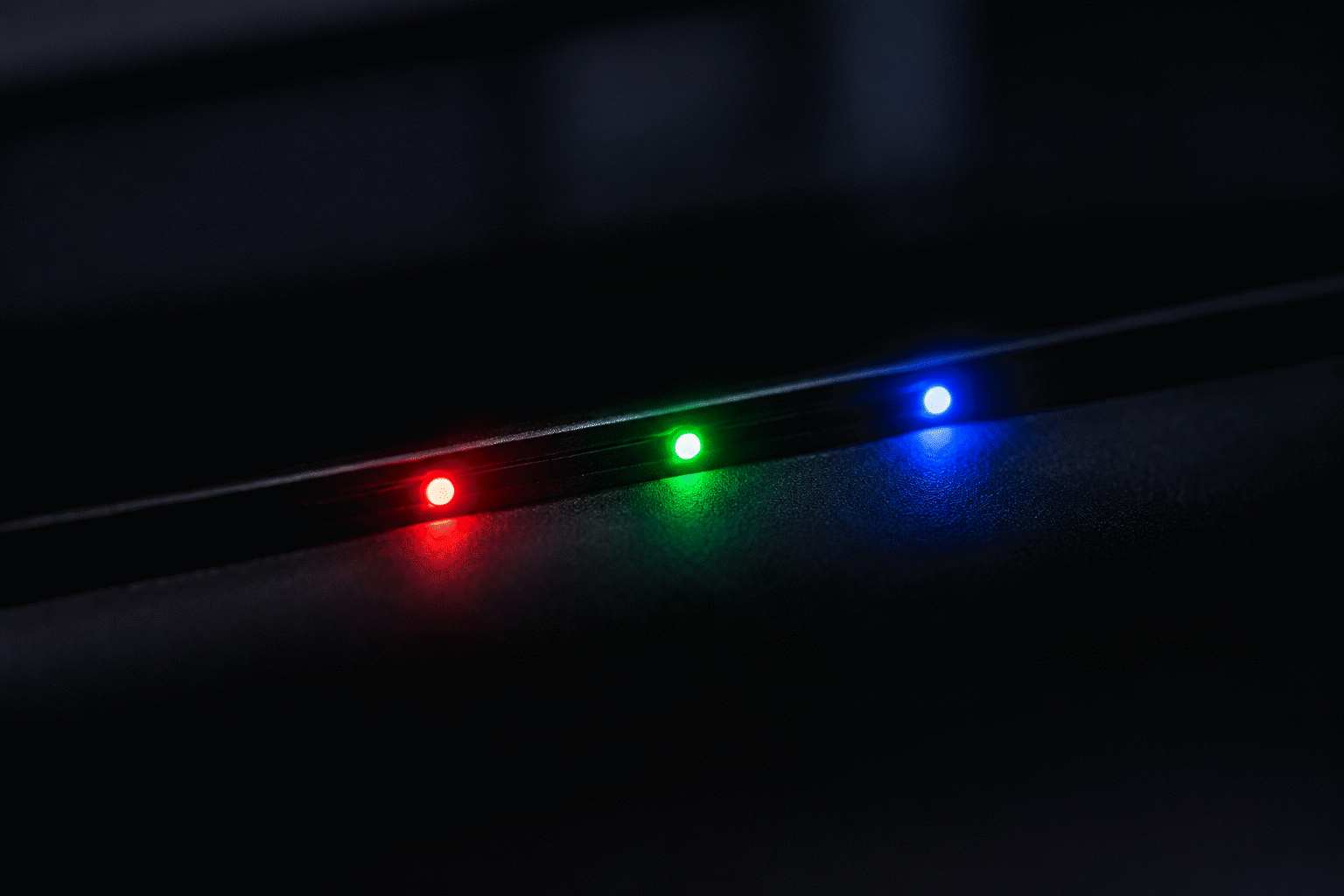
- Fixed colors — diodes manufactured for the hue: the whites and blues from GaN-family junctions; warm whites and ambers from blue diodes driving phosphor coatings (the same phosphor trick as premium lighting); pinks, purples, and teals from phosphor blends tuned per brand. Your single-color sign is photostable by physics: the diode emits its wavelength until it ages out decades later (lifespans).
- RGB mixing — color-changing signs carry red, green, and blue diode sets per segment; the controller blends channels to synthesize the visible color (16-million-color palettes on paper, a very good few dozen in practice). Mixing has a cost in perceived brightness — a mixed purple shares output across two channels where a native purple diode gives everything to one hue — which is why flagship colors on RGB signs look slightly quieter than their fixed-color equivalents (the RGB layer).
Dimming and Control: The PWM Story
LED neon dims by pulse-width modulation: the driver switches the diodes fully on and fully off — say, a thousand times a second — and varies the fraction of time spent on. 100%-on reads full brightness; 10%-on-in-time reads one-tenth bright, and because the switching outruns vision, you perceive steady light.
The consequences worth knowing: zero color shift across the dim range (a dimmed pink is the same pink), efficiency that scales (10% duty cycle draws roughly 10% power), and — occasionally — a camera artifact (shutter-speed beat frequencies that show as banding in video; the photography guide covers the fix). None of this is possible with glass neon’s gas discharge, which is why “dimmable” went from premium feature to default expectation the moment signs went LED (dimming mechanics).
The Power Chain (Twelve Volts, End to End)
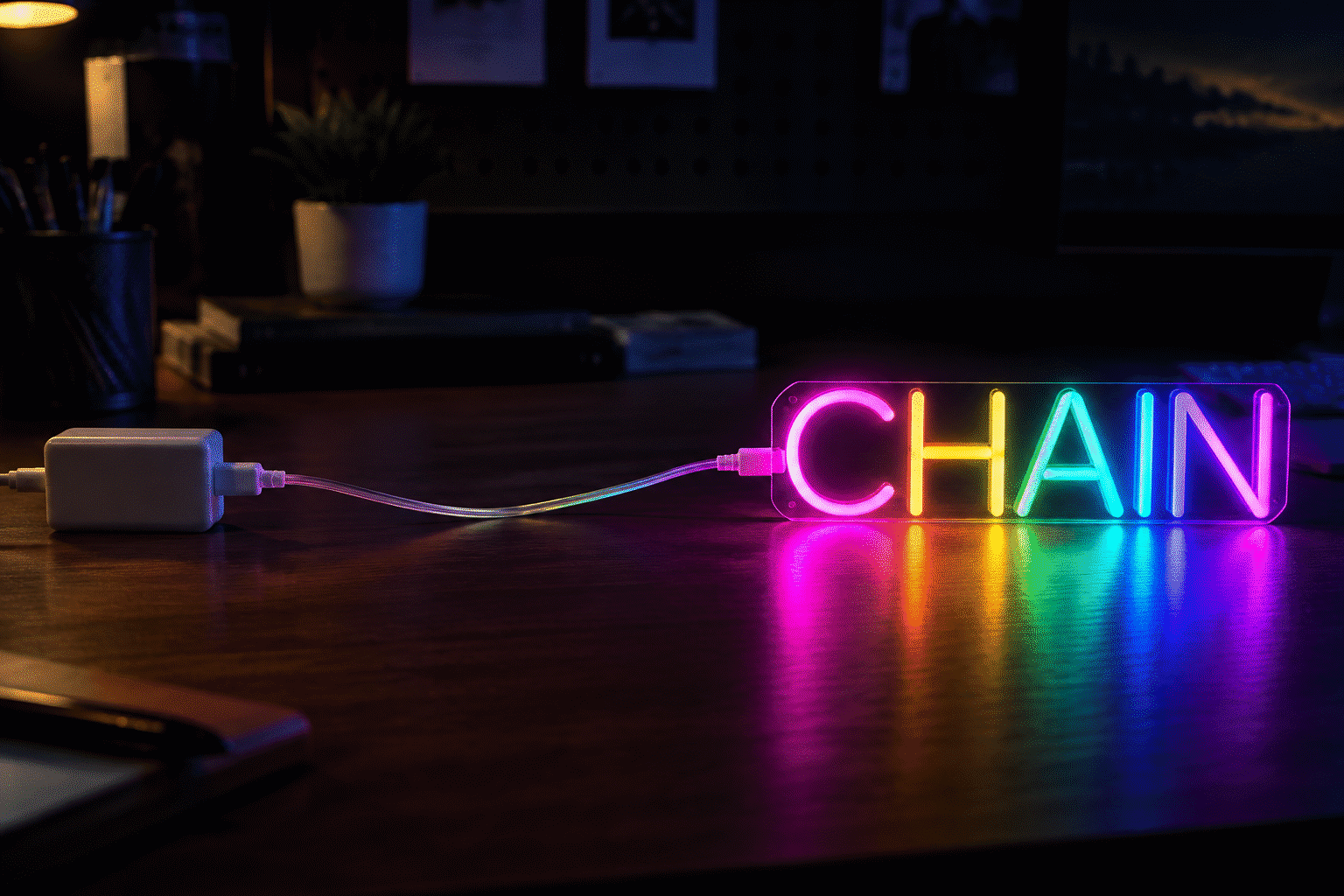
Mains power enters the adapter, which converts it to the sign’s 12V (or 24V) DC; the driver/controller module conditions it (adding PWM dimming, RGB channel commands, remote/app input); the strip’s parallel runs of diodes drink from the bus. Every failure mode in real-world LED signs lives in this chain — adapters, connectors, controllers — rather than in the diodes themselves (the diagnostic order in the power guide).
Why the Technology Won
Stack the properties: 12 volts against kilovolts; cool silicone against hot glass; 30,000+ hours against maintenance schedules; instant dimming and RGB against fixed output; factory repeatability against craft variance — and the aesthetic gap closed by layer-2/3/4 engineering. The result is the neon look at consumer safety and price, which is why bedrooms, not just bars, glow now. The full economic and visual comparison with glass lives in LED vs glass neon, and the technology in product form at custom LED neon — where you can watch this entire article render your own words, in the builder.
The LED Era’s Quiet Victories
What the mechanism above explains about the medium’s modern dominance — the capabilities that fell out of the physics:
The dimming dividend. Because LEDs switch at kilohertz speeds natively, brightness became a software feature — pulse-width modulation delivers the 5–100% range with zero color shift and proportional power draw (the control layer). Glass neon never had a native dimmer; the LED’s switching speed made mood-control free. Every bedroom sign running at 15% at midnight is using a physics trick the original medium couldn’t purchase at any price.
The safety inversion. Semiconductor emission at 12 volts moved signage from the electrical trades to the consumer aisle (the safety landscape) — no transformer cabinet, no kilovolt clearances, no professional install for the home tier. The sign became an appliance: unboxed, hung, plugged in, dimmed. The market’s center of gravity moved to bedrooms and weddings because the voltage domain did.
The color flexibility. Diode chemistry plus RGB mixing made color a setting rather than a commitment (the RGB layer): one sign, every hue, seasonal palettes, brand-matching. The gas palette was fixed at manufacture; the diode palette is negotiable at runtime — a categorical change masquerading as a feature list.
The durability physics. No glass under vacuum, no gas pressure to lose, no electrodes sputtering — silicone-jacketed solid-state construction replaced the fragility budget with connector-and-driver economics (the failure map). Signs went from handle-like-eggs to ship-like-appliances, which is what made global e-commerce in the category possible at all (the logistics).
The manufacturing scalability. File-to-router-to-flex production (the pipeline in how signs are made) turned custom work into a configure-price-ship flow — the reason a bespoke phrase costs $150 and arrives in two weeks rather than being a sign-shop negotiation (the economics).
The honest summary: the LED didn’t imitate neon — it rebuilt the medium’s entire economic and safety envelope while wearing the look. Understanding the mechanism above is understanding why the century-old aesthetic suddenly became a consumer product category: every property buyers now take for granted (dimming, safety, shipping, price) traces to a diode’s physics rather than to clever product design.
FAQ: LED Neon Signs
How do LED neon signs work? Low-voltage DC powers a strip of light-emitting diodes mounted sideways inside a silicone tube; each diode emits photons directly at its semiconductor junction, and the tube’s diffusing profile blends the points into a continuous glow that mimics glass neon.
What is LED neon made of? Four layers: a flexible circuit board carrying LEDs (60–120 per meter), side-emitting diode geometry, a solid silicone extrusion, and a diffusing outer profile. Plus the power chain — adapter, controller, connectors — documented in our power guide.
Is LED neon the same as real neon? Different technology, convergent look: glass neon is gas discharge in bent glass at thousands of volts; LED neon is semiconductors in silicone at 12. The visual trade-offs (halo, glow texture, tube character) are compared in LED vs glass neon.
Why doesn’t LED neon get hot? LEDs convert nearly all input energy to light rather than heat — a 30-watt sign radiates a trivial amount of warmth. Glass neon’s gas discharge wastes more as heat, running warm to hot at the tube.
How does LED neon change colors? RGB signs carry red, green, and blue diode sets per segment; the controller blends channel intensities to synthesize the visible color. Fixed-color signs use diodes manufactured for their hue — no mixing, full brightness to a single wavelength.
How long do LED neon signs last? Quality builds run 30,000–50,000 hours — years of nightly use — with the realistic failure points being connectors and adapters, not the diodes. The full longevity math is in our lifespan guide.
Sources & Further Reading
- Neon: Strong Lines (NIST Physical Reference Data) — the standard reference for neon’s emission wavelengths.
- Solid-State Lighting (U.S. Department of Energy) — DOE reference on LED efficacy and lifetime.
- Mercury (U.S. EPA) — federal guidance on mercury exposure and safe handling.