
Blog
How to Decorate a Bedroom With Neon, Start to Finish
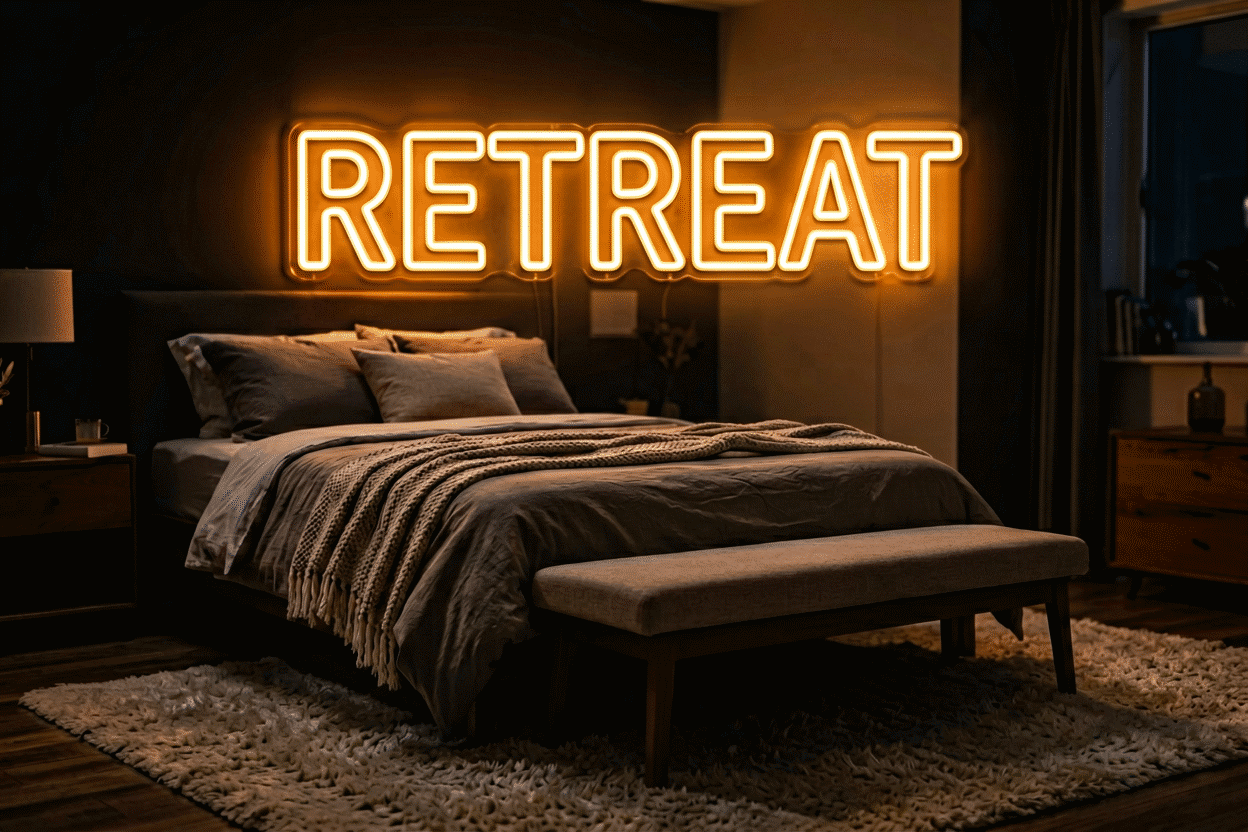
A bedroom decorated around a neon sign is built in the opposite order most people attempt: the light comes last in most plans and first in the good ones. The sign decides the room’s evening identity, the palette follows the sign, and everything else — bedding, walls, the reading corner — arranges itself around the glow. Done in that order, the room lands; done in the other order, the sign arrives and fights the room it was meant to finish.
This is the full method, from the room’s audit to the final dimmer setting. The inspiration tiers live in the bedroom ideas guide and the style-mapped guide; this is the process.
Step 1: Audit the Room’s Night Self
Bedrooms live at night, so audit at night. Three questions:
What does the room do at 10 p.m.? Sleep-only rooms want one warm piece at low brightness; the stream-from-bed, read-late, and teen rooms want layered pieces with zones. The room’s actual night habits — not the catalog’s — pick the tier.
What are the wall options? The headboard wall is the classic anchor; the corner wall (the one you face lying down) is the underrated alternative — the piece you see falling asleep beats the piece visitors see. The window wall is usually out (glow against glass reads weak and competes with blackout curtains).
What’s the palette? Bedding and wall color pick the sign’s register: neutral rooms take anything, warm rooms want warm-white or blush, cool rooms carry blue and purple. The bedroom color guide maps the full logic.
Step 2: Pick the Piece by Job, Not by Trend
The bedroom sign does one of three jobs — pick the job first.
The namepiece (names, initials, monograms): the permanent tier. It outlives trends, partners, and phases; it’s the piece you spend on. Preview any version free at the custom neon sign builder.
The phrase or shape (script words, moons, waves): the mood tier. Warm-white script for calm rooms, a shape for the style-forward ones; this is the piece that defines the room’s register.
The layer system (two or three coordinated pieces): the aesthetic tier — arc plus script plus small shape in one palette, covered in the aesthetic guide. Bedrooms cap at three; four is a display case.
Step 3: Size and Place
Bedroom sizing is stricter than other rooms because the bed is an unforgiving anchor: the headboard piece runs 60–80% of the bed’s width — a queen (60 inches) carries a 36–48 inch piece; a king carries 40–54. Wider than the bed reads hotel-lobby; smaller reads lost. The size guide covers the full ratios, including the corner-wall alternative.

Placement: the headboard wall centers the piece to the bed’s centerline, bottom edge 8–12 inches above the headboard. The corner-wall piece (the one you face lying down) runs slightly lower — reclined eye level, roughly 48–56 inches to center. Above-the-dresser and reading-nook pieces run small and low. And the glow rule: no neon opposite the bed at direct eye level, unless you enjoy waking up to a sign.
Step 4: The Palette Lock
Once the piece is chosen, the room locks to it:
- Warm-white script → warm neutrals, wood, linen; the sign is the room’s only color or its match.
- Blush/pink → layered whites and creams; the pink is the accent and the room stays quiet.
- Purple → grays and darks; the moody bedroom’s native system.
- Blue/ice → whites and silvers; the tech-adjacent and teen rooms.
- Multi-color → the room’s bedding goes neutral, because the sign is now the bedding’s boss.
The font locks too: script for romantic and soft rooms, block for modern and teen rooms, outline for the aesthetic tier — the fonts guide covers the full decision.
Step 5: Hang, Dim, and Live In It
Hanging runs the standard method — stud-find, anchor, level, cord-route — with one bedroom-specific rule: the cord never crosses the bed’s reach arc (the full mechanics). The dimmer is not optional in a bedroom: 40% for the reading hour, 15–20% for sleep-adjacent glow, full only for the post-laundry reset. The room’s evening lighting plan is the sign at low plus whatever lamp handles the book — and that’s the whole plan.

The final check runs from the pillow: at 15%, lights off, eyes adjusting — the piece should read as a warm presence, not a lamp. If it glows too hard, dim it; if it reads lost, it’s undersized or the palette mismatched. The room tells you; the audit at Step 1 taught you how to listen.
The Three Rooms That Result
The method converges on three archetypes: the calm room (one warm-white script, dimmed, linen everything — the adult master), the identity room (namepiece plus phase layer, style-locked — the teen and guest rooms), and the aesthetic room (the coordinated system, photographed and layered — the content-generation bedrooms). All three work; the failure mode is mixing them half-heartedly — the calm room with a joke piece, the identity room with three competing phrases. Pick the archetype, run it completely.
The Four Bedroom Failures and Their Cures
The hotel-lobby piece (wider than the bed): the sign that outsizes its anchor reads commercial – the bedroom’s intimacy dies at scale. The cure: 60-80% of the bed’s width, always (the size chart).
The dorm accumulation (four small pieces, no anchor, full brightness): the bedroom version of clutter – the pieces competing, the room humming, the style reading seventeen rather than whatever age the occupant is. The cure: one anchor at the headboard, the rest demoted to accents or removed – the hierarchy that makes any style work (the style map).
The glowing alarm clock (the piece opposite the bed at eye level): the bedroom’s specific sleep trap – the glow that the reclined eye reads all night. The cure: the corner-wall placement (the wall faced while falling asleep, not while lying awake), or the dimmer’s 10% setting for the pieces that must stay (the brightness physics).
The palette fight (the sign’s color arguing with the bedding): the room’s two loudest voices disagreeing nightly. The cure: the palette lock (Step 4 of the method) – the room’s existing colors pick the register, the sign agrees, the bedding follows. The bedroom that runs one palette reads calm even at full brightness; the bedroom that runs two reads unsettled even at 20% (the color decoder maps the agreement).
The Rental and the Small Room
The rental bedroom runs the damage-free toolkit: command strips rated for the piece’s weight, the over-door hooks for verticals, the leaning pieces for the shelves – the bedroom that glows without losing the deposit (the no-drill methods). The rental’s one upgrade: the dimmer’s plug-in tier (no wiring, no switches) – the bedroom’s brightness protocol on a rental-safe plug.
The small bedroom runs the mirror’s geometry: the piece placed to double in the mirror makes the room read twice its size, and the wall-hugging registers (warm white, single accent) keep the glow from crowding. The small room’s sizing drops a band (24-36 over a twin or double, the corner wall preferred over the headboard when the bed pushes against the window) – the bedroom that scales down its neon reads larger than the bedroom that doesn’t (the placement logic).
Variations and Case Studies
The bedroom method, run through its three most common cases. Case one – the starter bedroom: the apartment’s smallest room, the budget’s first piece. The method’s application: the corner-wall piece (the faced wall, the placement logic) rather than the headboard (the window sits where the headboard wall should be), the warm-white word at 24-30 inches, the dimmer on the plug-in tier – the $150 program that makes the rental read designed. Case two – the master’s refresh: the room that’s had its sign for years, the refresh that upgrades it. The application: the namepiece replacing the phrase (the keeper’s promotion), the palette lock re-run against the current bedding, the halo added behind the headboard – the $300 refresh that reads a new room without moving the furniture. Case three – the shared room: the couple’s room, the two-taste negotiation. The application: the joint piece (the two-name blend or the shared phrase) as the anchor, the individual accents on the nightstand walls – the treaty architecture that keeps both voices (the couples logic).
The cases’ common thread: the bedroom’s sign program answers to the room’s night-self – the audit at 10 p.m., the palette that flatters the dark, the brightness that means sleep – and every case found its answer through the same five-step method (the guide above).
Two stops to finish the room plan: the how to decorate a kitchen walkthrough applies the same method to the other daily room, and our how to hang a neon sign guide covers the wall step that comes last.
FAQ About Decorating a Bedroom With Neon
Where should a neon sign go in a bedroom? The headboard wall (centered, 60–80% of bed width, 8–12 inches above the headboard) or the wall you face lying down. Never opposite the bed at direct eye level. The placement mechanics cover the hardware.
What size neon sign for a bedroom? Queen bed: 36–48 inches. King: 40–54. Twin: 24–30. The size guide has the complete chart.
What color is best for a bedroom? Warm white and blush for sleep-first rooms; purple and blue for style-first ones. The palette lock (Step 4) matches the room; the color guide has the decoder.
How do I make a neon bedroom look designed, not dorm-like? One focal piece, one palette, one dimmer, sized to the bed. Dorm rooms fail at four small pieces at full brightness with no anchor — the method here is the counter-case.
Can I use a neon sign as the only bedroom light? As the only evening light: yes, and it is the bedroom’s best light – the warm register at thirty-to-forty percent with one lamp covers the reading hour and the wind-down beautifully (the brightness protocol above). As the only light at all: no – the morning’s dressing and the closet’s finding still want the overhead’s honesty. The bedroom’s honest lighting plan: the overhead for the morning, the lamp for the book, and the neon for everything between – the three-layer system the best bedrooms converge on, with the neon doing the hours the room actually loves.
Should a bedroom neon sign go over the bed or on the opposite wall? Over the bed (the headboard wall) for the bedroom’s classic composition, or on the faced wall (the one you see lying down) for the sleeper’s private view – the placement guide’s two bedroom options, each serving a different audience. The headboard placement serves the room (the visitors, the photographs, the classic composition); the faced-wall placement serves the sleeper (the pillow-view glow, the night’s own piece). The bedroom that runs both (the namepiece at the headboard, the calm shape on the faced wall) covers the two audiences – and the bedroom that must choose runs the faced wall: the room’s night-self is the self the bedroom actually serves.
Sources & Further Reading
- Mercury (U.S. EPA) — federal guidance on mercury exposure and safe handling.
- Neon sign (Wikipedia) — the consolidated public record of neon-sign history and technology.