Neon Sign Repair Cost: Fix It or Replace It?
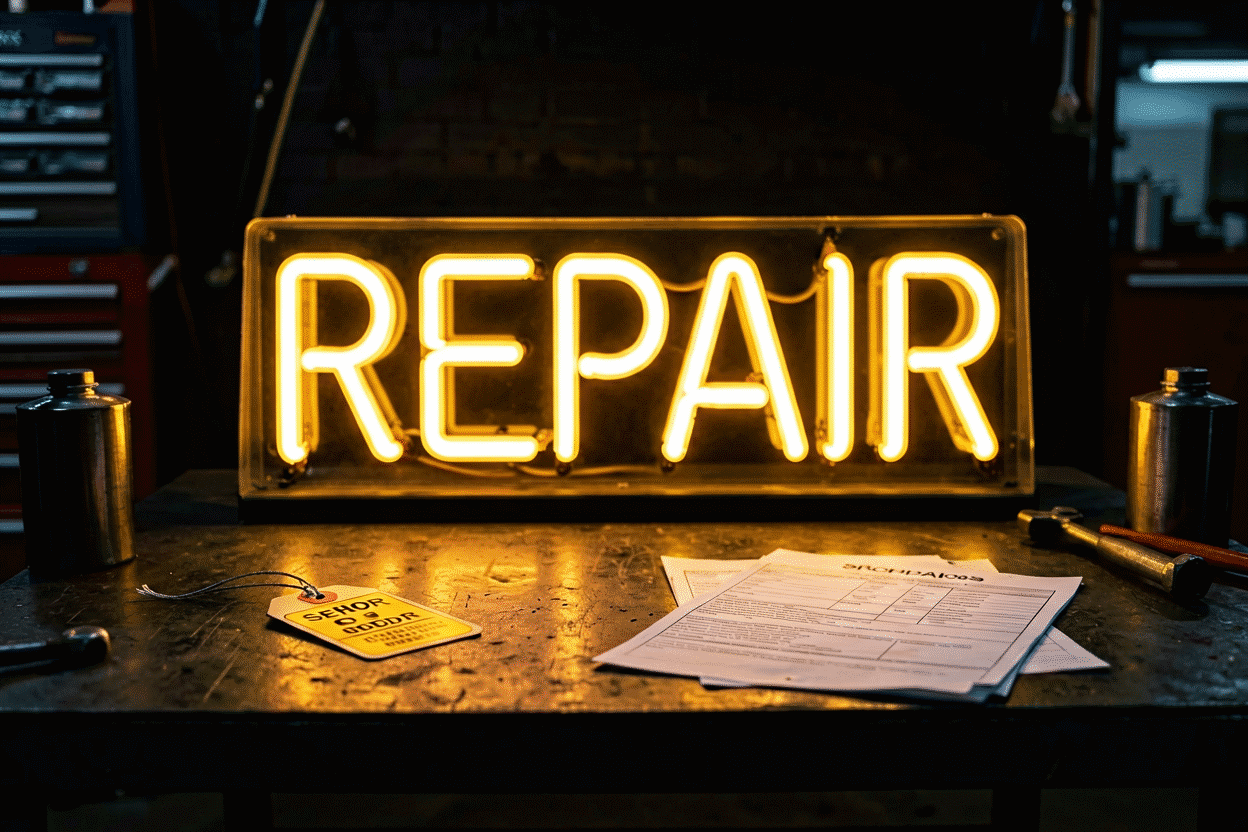
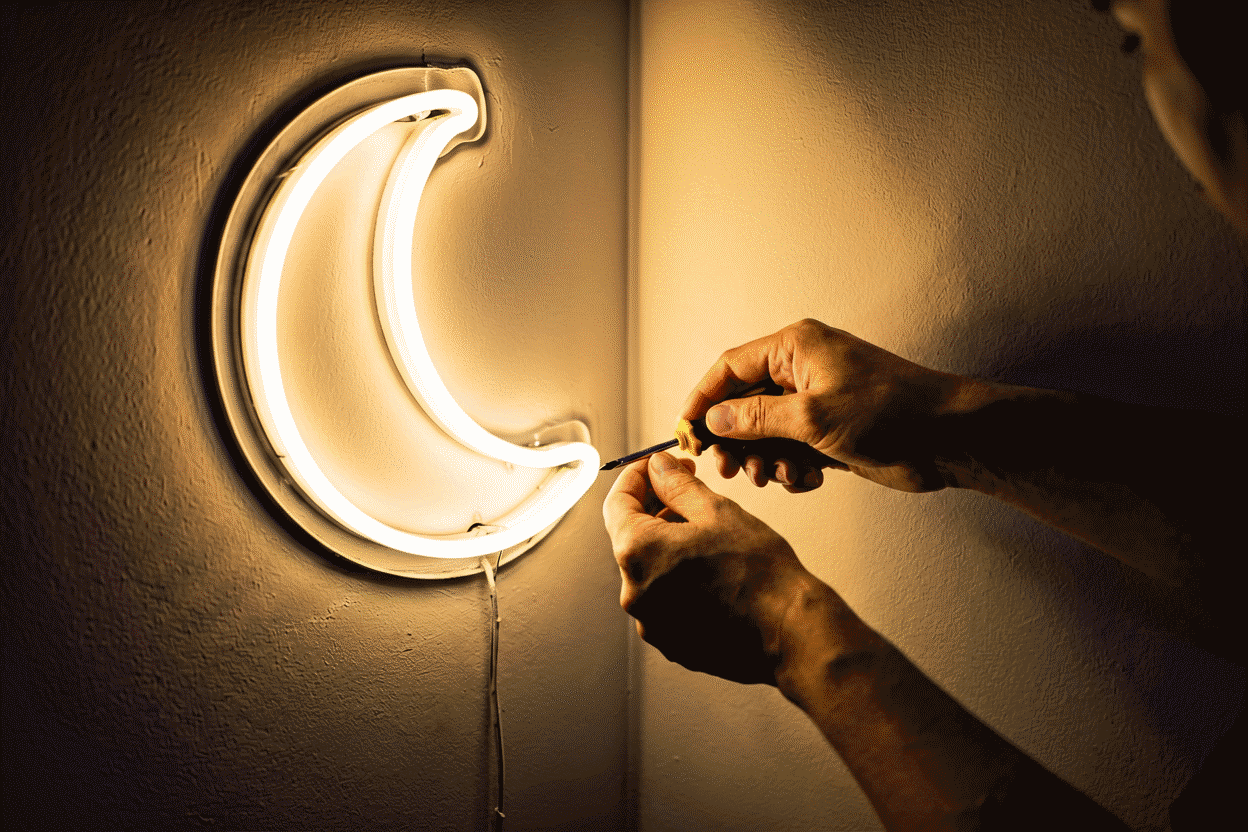
Repairing a neon sign costs $20–$60 for the common LED faults (connectors, adapters, dimmers — mostly DIY with parts), $100–$300 for professional glass neon service visits, and $50–$150 per tube section for glass re-pumping work. Whether repair beats replacement follows one rule cleanly: electrical-part repairs on sound panels are always worth it; panel-level LED failures and multiply-repaired glass usually aren’t — a new custom LED sign at $100–$300 beats sinking $200 into a dying one.
This is the economics decision guide; the hands-on fault diagnosis and fix instructions live at how to fix a neon sign, and what signs should cost new is covered in neon sign cost.
First: Diagnose Before You Spend
The repair-vs-replace math only works on a real diagnosis, and LED neon faults cluster into four buckets by cost gravity:
- Cord/connector faults (sign dead or flickering intermittently, jiggling the connector changes things) — $0–20, minutes, DIY.
- Adapter/driver failure (sign completely dead, adapter silent or cold, another 12V supply proves the sign’s fine) — $15–40 for a matched replacement adapter, DIY.
- Dimmer/controller failure (sign works on direct power, controls do nothing) — $10–25 for an in-line dimmer, DIY.
- Section/panel faults (dead or discolored sections that follow no connector logic) — replacement territory, almost always.
Buckets 1–3 cover the strong majority of real failures, and none of them cost a professional visit. The diagnosis walkthrough turns symptoms into buckets in about ten minutes.
LED Neon: The Repair Price Table
| Fault | DIY fix | Pro fix | Verdict |
|---|---|---|---|
| Loose/failed connector | $5–15 (parts) | $50–100 | DIY, always |
| Failed adapter/driver | $15–40 | $75–150 | DIY with matched spec |
| Dead dimmer/controller | $10–25 | $75–125 | DIY in-line replacement |
| Broken acrylic backing | $20–40 (panel + standoffs) | $80–150 | DIY if clean cracks |
| Dead LED sections | — | $100–200+ | Replace the sign |
| Water ingress damage | — | varies | Replace; upgrade rating |
The DIY column assumes the fault is diagnosed (bucket-level, not guess-level) and parts are spec-matched — voltage, polarity, wattage. The matching rules are in the power supply guide; an unmatched adapter is how a $20 repair becomes a $150 replacement.
The math that ends most debates: a typical quality home sign costs $150–250 new. Two DIY-repair cycles ($30–60 total) keep it alive for years and are trivially worth it. One dead-section event ($150+ against a fresh sign with new warranty and better LEDs) is not. The line really is that simple.
Glass Neon: The Professional Price Table
Glass neon repair is skilled trade work — prices from sign shops across the US, 2026 band:
| Service | Typical cost | Notes |
|---|---|---|
| Service call/diagnosis | $75–150 | Often credited toward work |
| Transformer replacement | $150–400 | The most common glass repair |
| Tube section re-pump | $50–150 per section | Gas refresh on dim sections |
| Broken tube re-bend/replace | $100–300 per section | Craft labor dominates |
| Full sign refurbishment | $300–800+ | Multi-tube vintage pieces |
The glass repair-vs-replace rule: transformer-only repairs on sound tubes are usually worth it; repairs approaching half the sign’s replacement value on aging multi-tube pieces usually aren’t. Vintage and collectible signs are the exception in both directions — a 1960s porcelain-and-neon piece justifies repair economics that a 2010 mall sign doesn’t. (Authenticity and valuation context: our vintage neon guide.)
The Decision Tree
Walk it in order:
- Is it just a connector, adapter, or dimmer? (Buckets 1–3) → DIY repair, $20–60, done. Stop here; 60–70% of “dead” signs end at this step.
- Is the sign under warranty? → Stop spending. Open the claim — quality makers cover driver and section faults typically 12–24 months (terms decoded in the warranty guide). The maintenance routine keeps claims clean.
- Dead LED sections on a sign under 3 years old? → Replacement beats repair at $150+ against a new $150–300 sign with fresh warranty and current-generation LEDs.
- Dead sections on an expensive large/custom piece ($500+)? → Get a pro quote before deciding — large panels sometimes justify section work that small ones don’t.
- Glass neon, anything beyond a known transformer? → Professional diagnosis first ($75–150, usually credited) — glass faults hide each other.
- Sentimental value high? → Repair economics bend. A hand-me-down sign is allowed to cost more than its replacement price; that’s not irrational, it’s the actual value structure.
Finding Repair Service (When You Need Hands)
- Local sign shops are the glass-neon network — search “neon sign repair” plus your city, and the local_pack results (which dominate this SERP) are genuinely the right results. Call two for quotes; service-call and transformer pricing varies meaningfully by shop.
- LED custom-sign makers increasingly offer mail-in service for their own brands — check your sign’s maker before anyone local.
- Generic electronics repair shops handle adapter/driver work fine when you don’t want to DIY — bench fees of $40–80 apply.

Prevent the Next One
The repair-cost rabbit hole has a floor: the maintenance routine — connector checks, surge protection, dust control — prevents buckets 1 and 2, which are most of the repair market. And when replacement does win the decision, the replacement worth buying is the one with certified electricals and a real warranty: build yours here.
Repair Stories: Five Cases With Numbers
The repair-vs-replace math in five real scenarios:
The flickering wedding sign (month three). Symptom: intermittent flicker on a $240 custom names piece. Diagnosis: connector at the sign’s entry (the jiggle test localized it in one minute). Fix: reseat, then replace the connector — a $9 part and ten minutes DIY. Warranty note: it was inside the coverage window, but the DIY fix took less time than the support email would have. Verdict: repair, trivially.
The dead storefront sign (year two). A $380 business piece went completely dark on a Monday morning. Diagnosis chain: outlet live, adapter cold and silent (the power-layer sequence), sign confirmed good with a matched spare. Fix: replacement driver, $34, next-day delivered, swapped by the owner in fifteen minutes. Business downtime: one evening (the sign’s dimming schedule ran the shop’s evening ambiance; the daytime OPEN piece was separate). Verdict: repair — thirty-four dollars against a four-hundred-dollar replacement.
The vintage bar inheritances (the glass case). A 1962 porcelain-and-neon bar sign, inherited dark, appraisal at $1,400 as-displayed. The service path: diagnosis visit $125 (credited toward work), transformer replacement $310, two tube sections re-pumped $220 — $655 total to bring a four-figure antique back to working glow, all documented for provenance (the restoration logic). Verdict: repair, emphatically — the piece’s value doubled as working heritage, and the paperwork proves it.
The fading bedroom sign (year six). A budget-marketplace sign (original price: $65) developed a permanently dim section plus color drift in its third color band. Diagnosis: section-level panel failure — the DIY boundary (the bucket logic). The math: repair quotes started at $110 (exceeding the sign’s class replacement), quality replacement at $150–180 lasts 5× longer (the tiers). Verdict: replace — and the replacement conversation included, for the first time, reading spec sheets.
The storm casualty (the insurance case). A $290 outdoor sign, surge-killed through an unprotected outlet (the previous owner’s install — the surge strip was on the shopping list, unfilled). The sign: dead across all sections. The adapter: also dead. The claim: warranty denied (electrical surge, excluded — the terms decoded); renter’s insurance covered it as personal property past the deductible only because other items shared the event. The replacement order included the $15 surge strip and the GFCI outlet tester — the cheapest possible tuition for the lesson.
The pattern across all five: electrical-part repairs (connectors, drivers) at $10–40 always beat replacement; panel failures on cheap signs never justify repair; glass antiques justify almost any reasonable service; and the cheapest repair is always the one prevented by the surge strip and the annual inspection (the maintenance economics).
FAQ: Neon Sign Repair Costs
How much does it cost to repair a neon sign? Common LED faults run $20–60 DIY (connectors, adapters, dimmers) or $75–150 professionally. Glass neon service runs $75–150 for diagnosis, $150–400 for transformer replacement, and $50–150 per tube section for re-pumping.
Is it worth repairing a neon sign or should I replace it? Repair connector, adapter, and dimmer faults — always worth it. Replace signs with dead LED sections when a new sign ($100–300) costs less than the repair; the exception is expensive large panels and sentimental pieces.
Can you repair an LED neon sign yourself? Yes, for the common faults: reseat or replace connectors, swap a spec-matched adapter, add an in-line dimmer. Section-level LED failures are the DIY boundary — those are panel replacements.
Why did my neon sign stop working suddenly? Usually the adapter (test with a matched spare or multimeter) or a connector fault (jiggle test at each joint) — the two cheapest possible failures, both DIY fixes. The full diagnosis sequence is in the fix guide.
How much does glass neon transformer replacement cost? $150–400 including labor from a sign shop — typically worth it on sound tubes, since transformers are the most common glass-neon failure and the tubes themselves last decades.
Does neon sign repair come with a warranty? Reputable shops warranty their repair work (30–90 days on labor, longer on parts); replacement adapters and dimmers carry their own manufacturer warranties. Keep receipts — component warranties are how $30 parts stay $30.
The Economics Summary
Compress the whole page into the owner’s pocket math: budget nothing for repairs in year one (the warranty window — claims, not cash (the coverage)); hold $30 mentally for the adapter that eventually dies (the near-certain, near-cheap event (the failure map)); and decline any repair quote that crosses half the replacement price for signs under $300 — the line where new beats mended (the decision tree). For glass owners, the same math runs at commercial scale: transformers yes, tube-sections case-by-case, full refurbishments only for pieces whose value outruns the invoice. The repair market exists to serve the power chain; the light itself almost never needs anyone.
When should I stop repairing and accept a sign’s end of life? The line arrives when cumulative repairs pass the replacement price, when the fault is the panel itself rather than the power chain (the bucket logic), or when a repair quote takes a week and a replacement takes two. Signs earning their retirement gracefully: strip the working parts (adapter, dimmer, hardware — spares for the next one), photograph the design for a better-informed re-order, and recycle the panel through e-waste (the disposal notes).
For the complete fault-diagnosis walkthrough behind every bucket in this economics guide, see how to fix a neon sign — the hands-on companion to every repair decision above.
The guide’s pocket summary holds: budget nothing in year one, hold thirty dollars for the adapter year, and let the decision tree arbitrate everything past that.
Sources & Further Reading
- Solid-State Lighting (U.S. Department of Energy) — DOE reference on LED efficacy and lifetime.
- Neon sign (Wikipedia) — the consolidated public record of neon-sign history and technology.
Pricing based on CustomNeon’s current catalog (2026); custom quotes come live from the sign builder.