How to Hang a Neon Sign on Drywall Without Damage
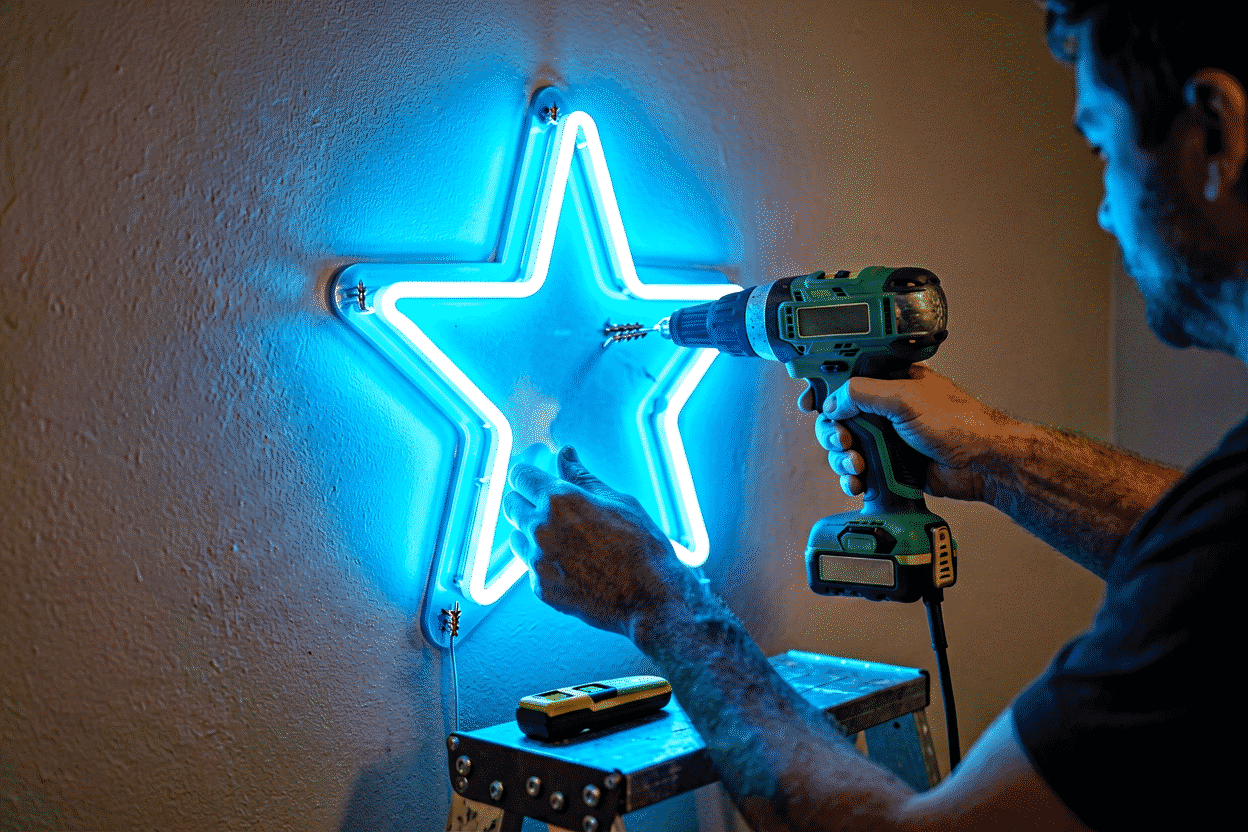
Hanging a neon sign on drywall is the easiest case in mounting: a typical LED sign weighs 2–6 lb, drywall anchors alone are rated 20–30 lb, and any hole that lands on a wood stud needs no anchor at all. The job takes 30 minutes with a drill, a stud finder, and the anchor kit that came in the box — the only real skill is knowing which of the three wall situations you’re looking at, because each one gets different hardware.
This guide covers all three: stud hits, hollow drywall, and the problem walls (old thin drywall, double-layer, and the spot behind your TV where someone has already drilled twelve abandoned holes).
The universal basics — backing types, templates, and leveling — live in the main hanging guide. This page is the drywall deep-dive.
Why Drywall Is Easy (The Weight Math)
Drywall gets a reputation for being fragile that it doesn’t deserve at neon weights. The numbers:
| Mount | Pull-out rating | Neon sign weight |
|---|---|---|
| Screw into wood stud | 80–100+ lb | 2–6 lb typical |
| Plastic expansion anchor | 20–30 lb | Same |
| Self-drilling thread anchor | 30–45 lb | Same |
| Toggle bolt | 40–60 lb | For 15 lb+ signs only |
Every column over-delivers by 3–10x. A neon sign is roughly the wall load of a medium picture frame. The failures people blame on drywall are almost always installation errors — oversized pilot holes, anchors spun past their grip, or signs hung from one point when the backing has six.
The one load direction drywall genuinely hates is pull-out force on a bare anchor near the panel edge. Mount away from corners and seams by a few inches and that risk disappears.
Step 1: Find Out What’s Behind the Wall (5 Minutes)
Run a stud finder across the marked area in two horizontal passes at different heights. Studs read as consistent vertical lines 16 or 24 inches apart. Mark each edge with painter’s tape so you know the center — screws want dead center of the stud, not its edge.
No stud finder? Two field methods:
- The magnet trick: a strong magnet (neodymium, not a fridge magnet) slides along the wall and snags on the drywall nails or screws that pin the panel to each stud. Where the magnet sticks in a vertical line, there’s a stud.
- The knock test: hollow sounds between studs, dull thuds on them. Crude but real — combine with the outlet trick: electrical boxes mount on studs, so the wall side of an outlet faceplate is usually a stud edge.
While you’re scanning, note two hazards:
- Wires and pipes. Better stud finders have a metal/AC-voltage mode — use it. Never drill directly above or below an outlet or switch without scanning; that’s exactly where vertical wire runs live.
- Existing repair patches. A section that reads uniformly dense across a wide area can be a patch panel with no stud behind your specific spot.
Step 2: Match the Anchor to What You Found
Hole lands on a stud (best case). Skip the anchor entirely. Drill a shallow pilot hole (1/8″ is plenty — just deep enough to break the paint) and drive the wood screw directly, leaving a quarter-inch proud for the backing’s keyhole slots. This is the strongest mount on the page.
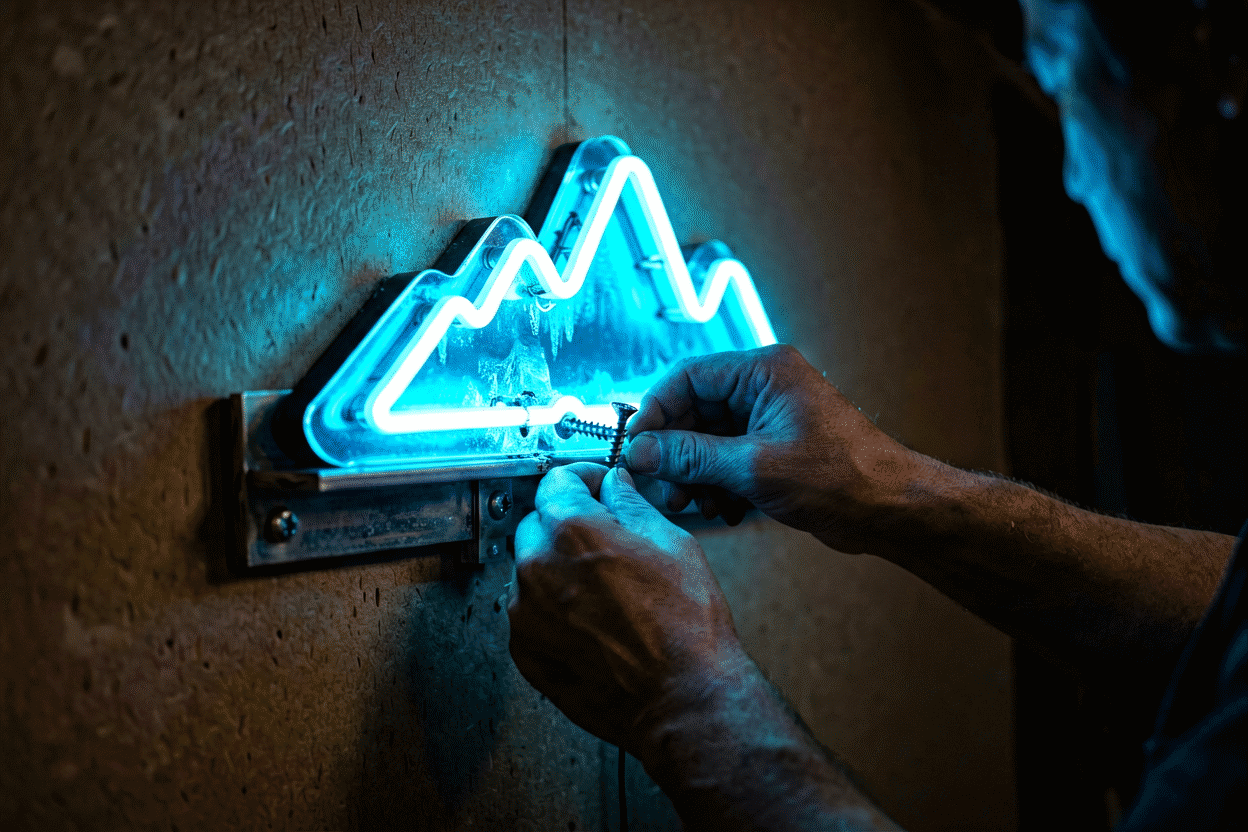
Hole lands in hollow drywall (the normal case). Use the included plastic expansion anchors correctly:
- Drill the pilot hole the same diameter as the anchor body — this is printed on the anchor package and universally ignored. An oversized hole is why anchors spin.
- Press the anchor in by hand until it grips, then tap flush with a light hammer. If the hole is right, this takes gentle taps.
- Drive the screw in, leaving a quarter-inch proud.
If your sign is on the larger side (8 lb+) or the wall is old half-inch drywall, upgrade from the kit’s basic plugs to self-drilling thread anchors — the coarse threaded ones that screw in like a corkscrew with no pilot hole. They hold 30–45 lb and never spin out, because the thread cuts its own grip.
The don’t-bother tier: toggle bolts exist for drywall, and at neon weights they’re unnecessary. Save them for the TV mounting conversation.
Step 3: Hang the Sign (Same as Every Wall)
Line up the backing’s holes with your proud screws, drop the sign on, check level, and route the cord with adhesive clips down the shadow line. The full seven-step sequence with the pre-mount checks (test the sign on the floor first — always) is in the hanging guide.
One drywall-specific habit: when you drop the sign onto the screws, support its weight with one hand until every hole is engaged. Racking a heavy sign onto two of six screws is how backing corners crack and how anchor holes wallow out.
The Three Problem Walls
Old 1950s–70s half-inch drywall. Thinner panels grip anchors less. Fine at 2–6 lb sign weights with thread anchors; if the sign is large, hunt studs aggressively — even one stud hit plus two thread anchors makes a bulletproof triangle.

Double-layer or plaster-over-board walls. The drill suddenly needs to go through 1.5 inches before hitting hollow. Anchors must be long enough to expand fully inside the cavity, not half-buried in the second layer — use long-body anchors and check the depth.
Swiss-cheese walls. The spot you want already has abandoned holes that won’t grip a new anchor. Fill them: squeeze a knot of spackling or better, a matchstick-and-glue plug, into each dead hole, let it cure, re-drill clean. Or simply shift the sign two inches — nobody will ever know where the old TV used to hang.
Removing Anchors Without a Trace
The checkout-ready routine:
- Unscrew the screw; the plastic anchor stays.
- Pull the anchor out with needle-nose pliers, straight out, wiggling gently.
- Fill each hole with a fingertip of spackling, wipe flush with a damp cloth, touch up paint if the color shows.
- Peel cord clips carefully (dental floss sawed behind the adhesive).
Eight holes, ten minutes, one tube of spackling — the wall reads untouched. For the full damage-free playbook (strips, leaning, and lease-safe methods), see hanging without drilling.
Where Drywall Signs Actually Go
Drywall is the default wall of bedrooms — the single biggest neon destination — and of offices and dorms. Placement conventions worth stealing: 8–12 inches of clearance above a headboard or sofa, centered at seated eye height behind a desk, and at least one full sign-width away from door swings (impact, not weight, is what ends drywall-mounted signs). Our neon signs for bedroom guide maps positions, colors, and sizes room by room.
Design for the Wall You Have
Because drywall is forgiving, it’s also the wall where you can go bigger: longer phrases, larger letters, multi-line layouts. In the custom neon builder the preview shows your design at real dimensions — hold a tape measure to the wall first, then size the sign to the space, not the other way around. Every sign ships with the mounting hardware and pre-drilled backing holes this guide assumes.
Special Cases: Older Homes, Thick Walls, and Crowded Walls
The standard drywall install gets interesting in older homes and over-decorated walls. The recurring special cases:
Plaster-and-lath (pre-1950 homes). Not technically drywall, but the closest relative and the one that surprises people: plaster over wooden lath reads solid, accepts screws poorly without pre-drilling, and cracks radiating from overtightened anchors. The drill-with-care method: pilot drill, hand-tighten only, and prefer mounting into the lath’s framing where a stud finder finds it. Weight capacity is fine — neon loads are trivial; the care requirement is about not cracking a century-old finish.
Double drywall and soundproofed walls. Modern condos and media rooms run doubled 5/8-inch panels: drill bits that just reach, anchors long enough to expand fully in the cavity (standard-length anchors open inside the second layer and hold almost nothing). The tell during drilling: the sudden change of resistance twice. Count your layers and buy anchors to match.
The wall behind the previous TV. The most common real-world drywall situation: a field of abandoned holes and hollow anchors where a mount used to live. The repair-then-hang sequence: pull dead anchors, fill holes with spackle (two applications for deep holes — spackle shrinks), let cure overnight, re-drill clean. Or shift the sign one sign-width sideways onto virgin wall and hang a plant over the history.
The wall with unknown pipes. Bathrooms and kitchen-adjacent walls hide supply and drain lines that no one wants to meet. The scan-first rule applies twice over here: stud finders with AC/metal modes, and the fallback geometry — never drill directly in line with a sink or toilet’s vertical stack, and treat the 16 inches on either side of an outlet column as scan-carefully territory.
The thin modern interior wall. New-build partition walls can run half-inch drywall on 24-inch centers — the lightest drywall situation. Signs under 8 lb anchor fine; anything larger wants at least one stud hit or thread anchors, and the layout discipline of using every backing hole matters more here than anywhere.
The wallpapered wall. If drilling is unavoidable, wallpaper cuts cleanly: a fresh blade in a small X over each hole position, drill through, mount, then (for the fastidious) wallpaper paste re-seals the flaps after the anchor sets. For no-drill situations, wallpaper strips off with adhesive strips more often than paint does — the fishing-line-to-rail method is the wallpaper-preserving answer.
Every one of these cases still ends in the same place: template, scan, pilot hole, anchor, quarter-inch-proud screws, drop the sign on. The special case only changes the preparation, never the finale.
FAQ: Neon Signs on Drywall
Can drywall hold a neon sign? Yes, easily. LED neon signs weigh 2–6 lb; a single plastic drywall anchor is rated 20–30 lb, and screws into studs hold far more. Use every backing hole and the load spreads across four to eight anchors.
What anchors should I use for a neon sign on drywall? The included plastic expansion anchors in a correctly-sized pilot hole for signs up to about 8 lb; self-drilling threaded anchors for heavier signs or old thin drywall. Stud hits need no anchor at all.
Do I need to find a stud to hang a neon sign? Not strictly — anchors alone exceed the requirement — but take any stud you can get. One screw into wood plus anchors elsewhere is the most over-engineered (and therefore most relaxing) mount.
How do I stop drywall anchors from spinning? The pilot hole was too wide. Drill at the anchor’s stated body diameter, clean, and press-tap the anchor in. If a hole is already wallowed, fill it with spackle or a glued matchstick, cure, and re-drill.
How much weight can a drywall anchor hold for neon signs? Plastic expansion anchors: 20–30 lb. Self-drilling thread anchors: 30–45 lb. Both are several times a typical sign’s weight — failure comes from bad installs, not load limits.
How do I fix drywall holes after removing a neon sign? Pull anchors with pliers, fill each hole with spackling, wipe flush with a damp cloth, and touch up paint. Ten minutes for a typical sign’s six to eight holes.
Sources & Further Reading
- Neon sign (Wikipedia) — the consolidated public record of neon-sign history and technology.
- Mercury (U.S. EPA) — federal guidance on mercury exposure and safe handling.