Neon Sign Wall Placement: The Complete Guide

Placement is the difference between neon that looks installed and neon that looks stuck. The same piece, hung sixty inches on the focal wall with its cord channeled, reads as design; hung seventy-four inches on the wrong wall with a dangling wire, reads as an afterthought. This is the decision layer above the hanging itself — which wall, what height, near what, and why — and it’s the layer most buyers skip.
Here’s the complete placement system: the wall-selection logic, the height mathematics, the room-by-room calls, and the glow physics that most guides never mention. The hardware-and-anchors how-to lives at how to hang a neon sign; the piece-size math at the size guide.
Wall Selection: The Three Candidates
Every room offers three walls; only one should win.
The anchor wall — the one the primary furniture faces (behind the sofa, behind the headboard, behind the desk). This is the default winner: the sign joins the composition the room already has, and the furniture anchors the sign’s scale (the sizing logic).
The focal wall — the one the eye hits first from the doorway. In open floor plans and odd rooms, this beats the anchor wall: the sign does the room’s announcing before the furniture gets a vote.
The sightline wall — the one visible from the position the room is actually used in (the bed’s reclined view, the desk chair’s turn, the sofa’s lean). The underrated pick for private rooms: the piece you see while living beats the piece visitors see while visiting.
The rule: pick one per room. The room that runs signs on two competing walls reads as a sign shop’s showroom; the room that picks its one wall reads designed.
The Height Mathematics
Four numbers cover every room:
- 57 inches to centerline — the gallery standard, works for standing rooms (hallways, entries, kitchens): the average eye hits the sign’s middle dead-on.
- 48–54 inches — seated rooms (living rooms, offices): the conversation-height register.
- 42–54 inches — reclined rooms (bedrooms, home theaters): the lying-down sightline; the piece lands in the pillow-view frame.
- 60–72 inches — photo walls and event rooms: faces and sign share the frame; every group shot works (the backdrop logic).
The one universal: measure to the centerline, not the top or bottom — the same habit that makes galleries look right does it for glow. And when in doubt between two heights, take the lower: signs drift high on walls because people measure standing and live seated.
The Room-by-Room Calls
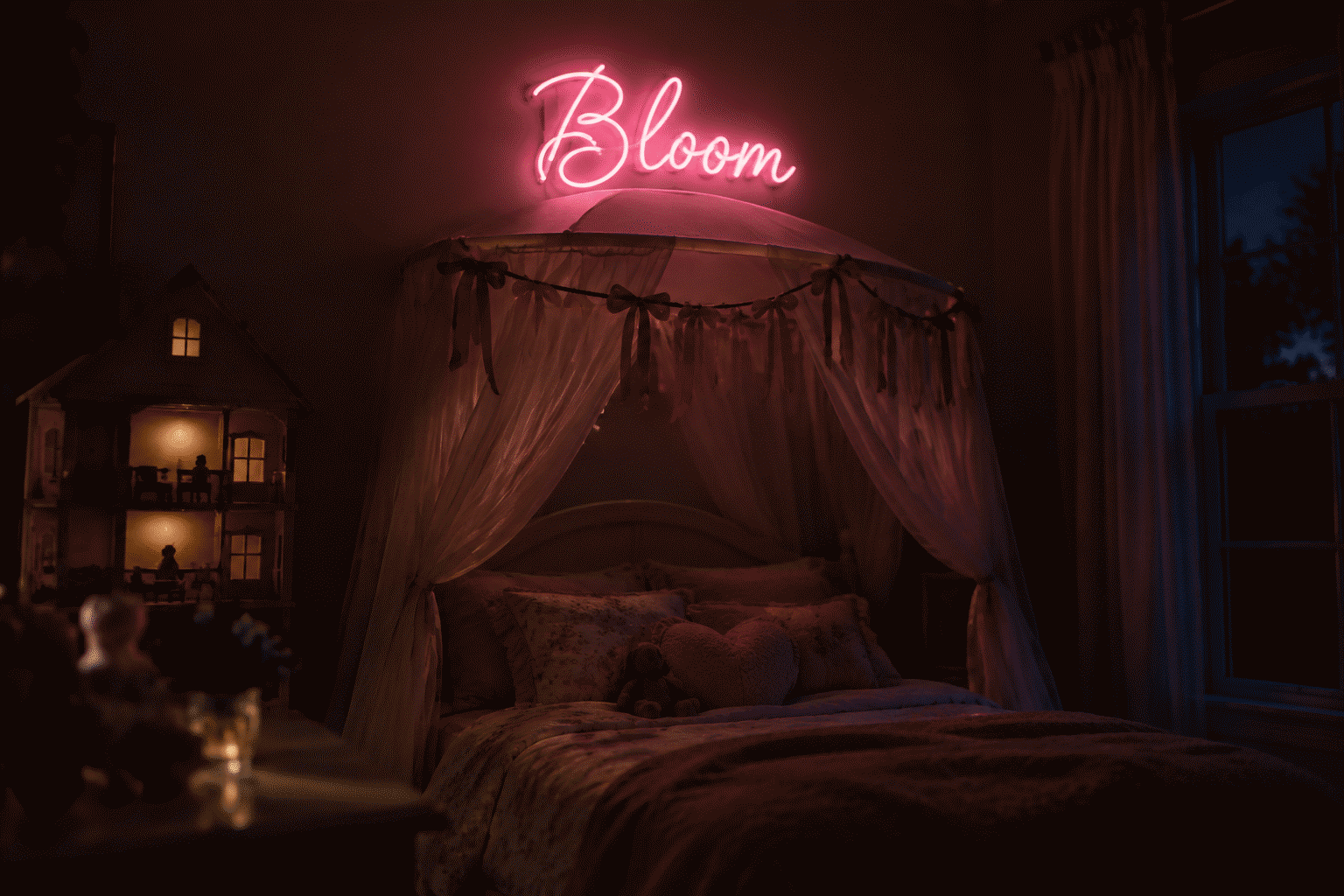
The bedroom (full guide): headboard wall, centered to the bed’s centerline (not the wall’s — walls are rarely symmetric about beds), bottom edge 8–12 inches above the headboard, width 60–80% of the bed’s. The alternate: the wall you face lying down, slightly lower.

The living room (full guide): behind the sofa, centered to the sofa (not the wall — same rule), width within the sofa’s footprint. The alternate: the gallery-fusion wall, where the neon joins framed pieces as one element.
The gaming and office rooms (full guide): the two-wall system — camera wall (behind the shoulder) for identity pieces, monitor wall (behind, offset 30 degrees) for glow. Never opposite the screen: the reflection band kills both the game and the sign.
The kids’ rooms (full guide): out of the crib’s reach arc (24+ inches above the rail), descending to seated-eye as the child grows; cords behind furniture, always.
The kitchen and bathroom (full guide): splash-zone discipline — over the counter run, not the range; above mirror height, never in the shower’s column. Humidity wants placement, not luck.
The Glow Physics
Four effects the placement decides:
The reflection audit — glass, mirrors, glossy paint, and monitor faces all bounce neon. Walk the room’s positions before mounting: if the sign ghosts in the TV at seated eye level, shift six inches left and the problem dies.
The wall-color gain — dark walls make neon read twice as vivid (the glow has no competition); white walls make colors read softer and rooms read cleaner. Same piece, different walls, different sign — choose the wall with the room’s darkness in mind (the color logic).
The sightline gradient — signs nearest the eye read brightest; the same piece across the room reads half as strong. Place the room’s boldest register farthest (distance softens it) and the subtle pieces nearest.
The cord topology — the outlet location picks the winning wall more often than aesthetics do: the sign whose cord drops invisibly behind furniture to a live outlet beats the sign whose cord crosses a doorway. Walk the cord’s path before committing the wall (the routing methods).
The Placement Mistakes, Ranked
- Too high — the #1 error (measured standing, lived seated): drop it a hand-width and the room changes.
- Wrong center — centered to the wall instead of the furniture: the bed/sofa/desk is the true centerline.
- Two competing walls — two focal signs in one sightline: neither reads; pick one and demote the other to accent.
- The reflection blindside — un-audited glass and screens: six inches of shift fixes what a whole re-mount wouldn’t.
- The dangling cord — the placement that ignored the outlet: the piece that reads 90% because of the last 10% (fixes here).

The Placement Workbook: Room by Room
The placement system compressed into the working table – the room, the wall, the height, the one rule.
| Room | Wall | Height to centerline | The one rule |
|---|---|---|---|
| Bedroom | Headboard wall (or the faced wall) | 48-60 in | 60-80% of bed width, never wider |
| Living room | Anchor wall (behind sofa) | 57 in | Sized to the sofa, not the wall |
| Kitchen | Counter run or nook | 60-66 in | Never in the range’s splash arc |
| Bathroom | Above mirror or door wall | 66+ in | Dry zones only (the logic) |
| Gaming/office | Camera wall + monitor wall | 57-66 in | Two-wall system, reflection-audited |
| Kids | Faced wall, out of reach | 42-54 in (by age) | Cords behind furniture, always |
| Party/event | Photo wall | 60-66 in | Out-scale the people (the math) |
| Bar | Pour wall | 66-72 in | Sized to the bar, never wider |
The workbook’s meta-rules: measure to the furniture’s centerline (never the wall’s), verify from the primary seat and the doorway (both sightlines), and route the cord before committing the wall (the outlet’s location is a placement input, not an afterthought) (the hanging methods cover every wall type’s hardware).
The Six Placement Mistakes, Ranked by Cost
One: the too-high piece (the #1 error – measured standing, lived seated): the fix is a hand-width down, and the room changes. Two: the wrong center (wall-centered, furniture-offset): the fix is re-measuring to the anchor. Three: the two-focal sightline (two competing pieces): the fix is demotion – the hierarchy or nothing. Four: the reflection blindside (the ghost in the TV or the glasses): the fix is the six-inch shift. Five: the splash-zone piece (kitchen or bath): the fix is the dry-zone move – maintenance by placement (the physics). Six: the cord-dangle (the 90% piece): the fix is the channel or the re-route (the guide).
The honest ranking note: the first two mistakes account for most of the bad placements in the world – both are measurement errors, both are free to fix, and both are caught by the method’s first step (the honest measurement the guide opens with). The placement that measures twice hangs once.
FAQ About Neon Sign Wall Placement
Where is the best place to hang a neon sign? The anchor wall (behind the primary furniture) or the focal wall (first from the doorway) — one per room, centered to the furniture, at the height the room actually uses. The room guides above carry the specifics (living room, bedroom).
How high should a neon sign be? 57 inches to centerline for standing rooms; 48–54 seated; 42–54 reclined; 60–72 for photo walls. Measure centerline, and when torn, go lower (the math).
Can you hang a neon sign on any wall? Any wall that passes three checks: it’s the room’s one chosen wall, its cord reaches an outlet invisibly, and it survives the reflection audit. Drywall, plaster, brick, and paneling all take the methods in the hanging guide.
Where should a neon sign NOT go? Opposite screens (reflection band), inside splash arcs (kitchen/bath), above the crib’s reach, on two competing walls in one room, and anywhere the cord crosses a walkway — the five placements that fail. Everything else is style (pick yours).
Where should you never hang a neon sign? The five forbidden placements: opposite the screen (the reflection band kills both), inside the kitchen splash arc and the shower column (the maintenance and safety failure), above the crib’s reach (the toddler physics), on two competing focal walls in one sightline (the hierarchy collapse), and anywhere the cord crosses a walkway (the trip hazard and the visual failure). The rest of the wall universe is open – the placement system above covers the working placements room by room, and the forbidden list exists because each of its five entries was learned the hard way, repeatedly, by the buyers who came before.
How high is too high for a neon sign? The ceiling is 72 inches to centerline for the standing rooms, 60 for the seated, 54 for the reclined – and above those numbers the piece enters the too-high zone where the room stops reading it (the height mathematics above). The too-high test: sit in the room’s primary seat and look at the wall – the piece above your natural sightline (the standing-measured hang that the seated life never corrects) is the room’s most common placement error, fixed by the hand-width drop that changes everything. The exceptions: the photo walls (the 60-72 band where the faces share the frame) and the tall-wall installations (the deliberate heights the big shapes command) – the placements that measure their success by the camera rather than the chair.
How far should a sign sit from the viewer’s main sightline? For seating areas, aim the sign’s center at 56-60 inches from the floor — seated eye level for most adults — which puts the glow inside the natural gaze without neck-craning. Standing zones (entryways, hallways) raise the band to 64-68 inches; the rule’s purpose is that the piece should be encountered, not hunted, and every foot above that band costs a portion of the people who’ll ever actually look at it.
What wall properties kill a placement? Four disqualifiers: direct sun paths (washes the glow out for hours daily and ages the acrylic), wallpaper texture fights (the sign needs a smooth field or it looks appliquéd), heating vents blowing across the mount (thermal cycling works mounts loose years early), and the swinging-door arc that will eventually connect with the sign’s corner. Every one of these is checkable in two minutes with a tape measure and a day of watching the light.
Sources & Further Reading
- Mercury (U.S. EPA) — federal guidance on mercury exposure and safe handling.
- Neon sign (Wikipedia) — the consolidated public record of neon-sign history and technology.