History of Neon Signs: 1910 to the LED Era
Neon sign history runs six acts over 116 years: a laboratory glow (1898), a French engineer’s debut (1910–12), the American conquest and golden age (1923–1941), the wartime blackout and long decline (1941–1970s), the preservation and art turn (1970s–1990s), and the LED-driven revival that put the glow in everyone’s bedroom (2010s–now). The throughline is strange and good: a technology invented for advertising, abandoned by advertising, and rescued by art, nostalgia, and finally by a semiconductor that borrowed its silhouette.
The people-and-dates version of Act One lives at who invented the neon sign; the scannable year-by-year table at neon sign history timeline. This is the narrative.
Act I: The Glow in a Jar (1898–1910)
William Ramsay and Morris Travers discover neon among liquefied air’s fractions in London, 1898 — a gas that announces itself by glowing red-orange under electrical discharge. Twelve years pass with neon as a beautiful lab curiosity: glowing, but too fragile, too short-lived, too unmotored for commerce. The gap between discovery and industry is the story’s first lesson, and Georges Claude closes it (the full invention story).
Act II: The French Debut (1910–1923)
Claude — founder of Air Liquide, owner of the gas supply and the engineering temperament — solves electrode sealing, gas purity, and transformer matching. December 1910: two enormous red neon tubes light the Grand Palais at the Paris Motor Show. 1912: the first commercial sign, a Montmartre barbershop, in the medium’s signature hue.
Claude patents everything, everywhere. Claude Neon Lights franchises city by city (licensees included the future sign dynasties of America), litigates infringers, and through the 1920s effectively owns the format. Paris goes neon-first: cinemas, the Opera, cafés — the city provides the aesthetic template nightlife still uses.
Act III: America and the Golden Age (1923–1941)
Earle C. Anthony’s $24,000 “Packard” signs hit Los Angeles in 1923 and the medium finds its superpower market. The sequence that follows is advertising history: sign shops proliferate in every American city; Broadway’s “Great White Way” converts from lightbulb spectaculars to neon density; Las Vegas incorporates in 1931 with neon as its native architectural language; Route 66’s motel row adopts the arrow-and-script vocabulary overnight.
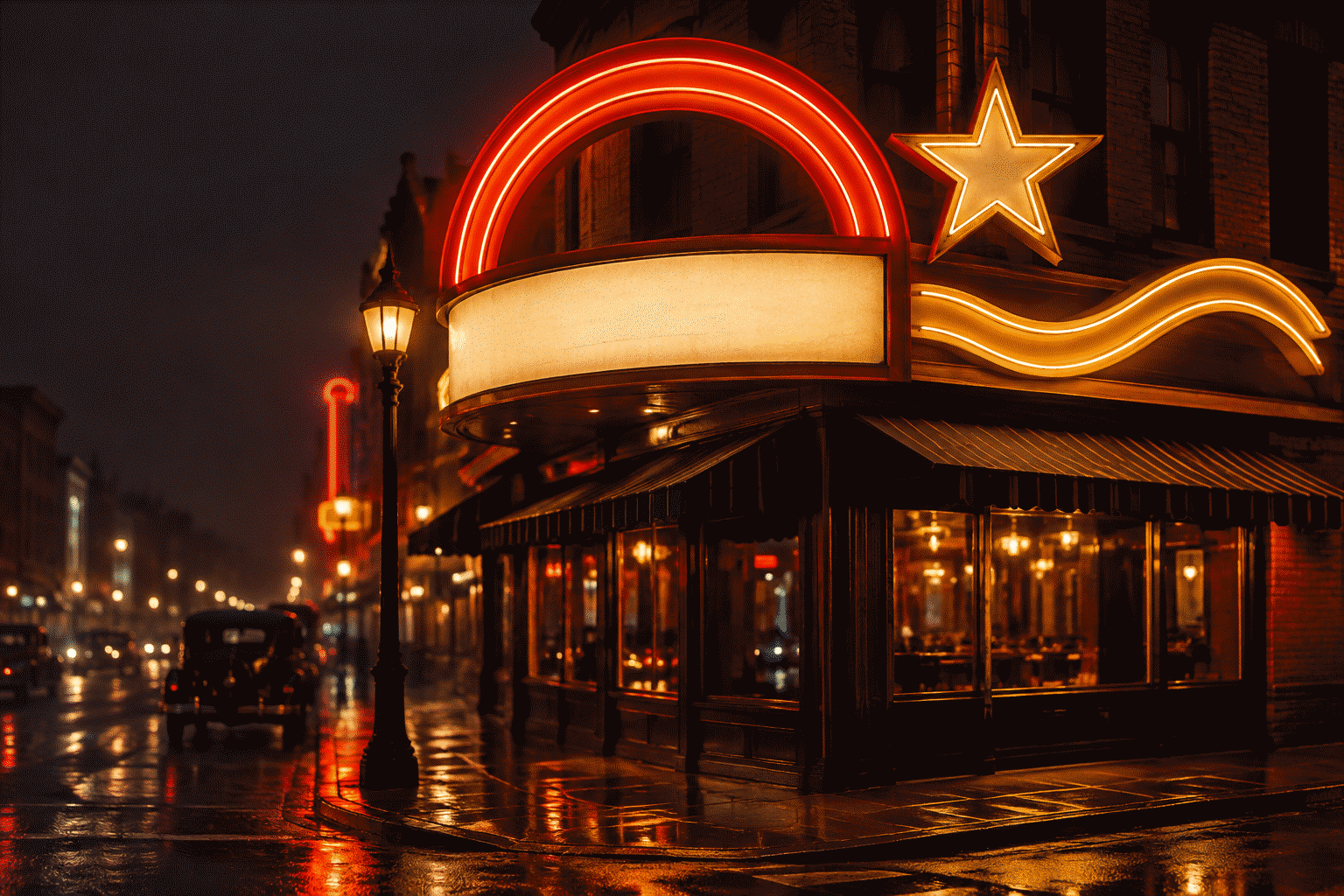
Technically, the golden age expands the palette: argon-mercury fills deliver blues and whites, phosphor coatings push past a dozen colors, and animated units (chasing borders, flashers) turn facades into motion pictures. By 1941, neon is the American commercial vernacular — the visual voice of main streets from Miami to Seattle. The craft infrastructure peaks with it: thousands of trained glass benders, sign painters, and installers — a genuine trade economy.
Act IV: Blackout and Decline (1941–1970s)
WWII ends it abruptly: materials rationing, blackout regulations, signshops converted to war production. What returns after 1945 is a different world: backlit plastic channel letters (cheaper, mass-produced, daylight-friendly), fluorescent interiors, and a modernist architectural taste that read neon as Depression-era clutter. Municipal “sign codes” — many written in the 1960s urban-renewal era — actively restrict the medium.
Neon contracts into its fortresses: Las Vegas (which never quits), Times Square (diminished but alive), the bars and diners that never repainted. The trade ages; the apprenticeships thin. By the 1970s, glass neon is a specialist’s trade in a medium that advertising has moved past — the setup for its second life.
Act V: Preservation and the Art Turn (1970s–1990s)
Two rescues arrive simultaneously.
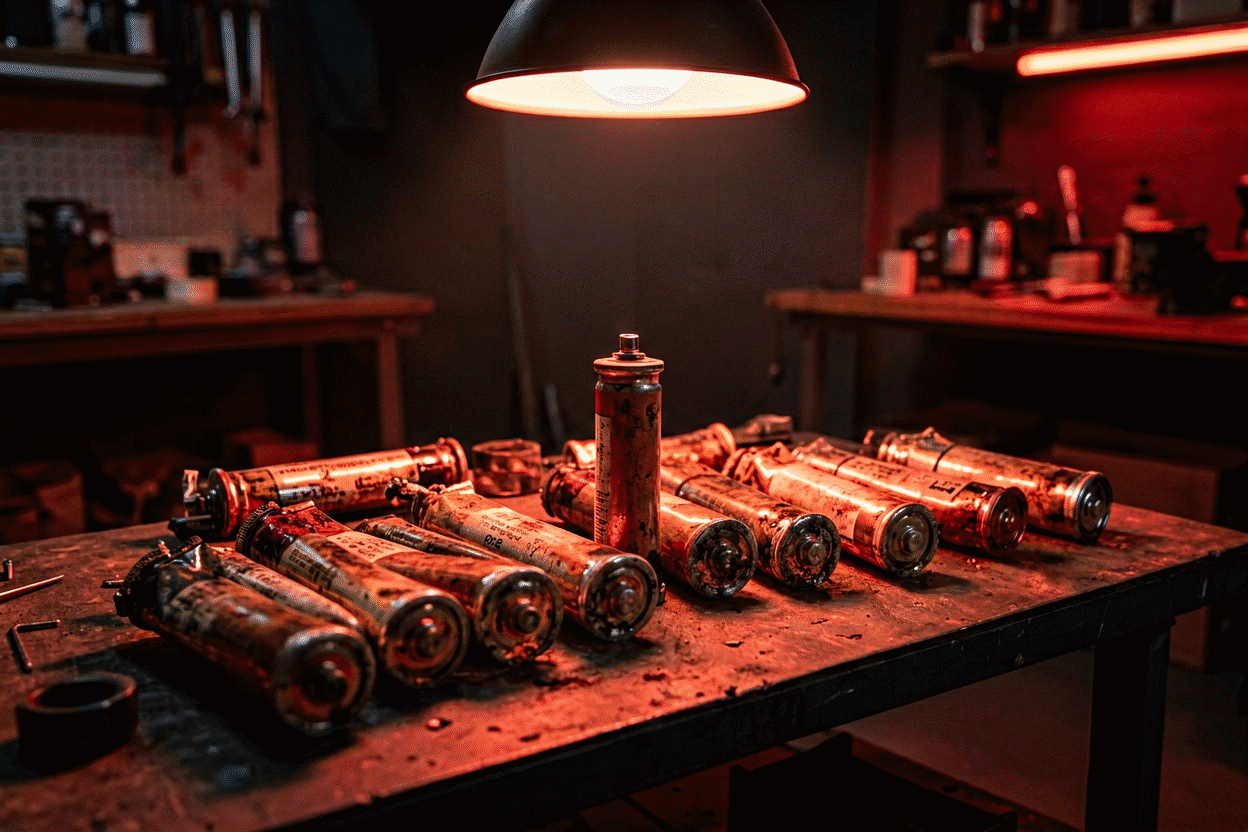
Preservation: the first generation of great signs starts coming down (Vegas’s implosions and remodels scrap decades of work), and activists organize. The Neon Museum in Las Vegas grows from a boneyard rescue operation into a chartered institution; Los Angeles’s Museum of Neon Art (MONA, founded 1981) makes the case for neon as art outright; cities begin landmarking individual signs. The collecting culture that now moves serious money at auction is this movement’s economic echo.
Art: artists discover that advertising’s discarded medium speaks fluent critique — commerce’s own light, repurposed. The lineage runs through light artists using the tube as brushstroke; by the 1990s, neon-adjacent light art is gallery-established worldwide, and the full story deserves its own page at neon art history.
Meanwhile, cinema keeps the myth alive — noir retrospectives, then Blade Runner (1982) fusing neon with permanent future — exactly while the physical medium declines. The look outlived the industry that made it. That inversion, in retrospect, was arguably the revival’s precondition — the chronology reads that way.
Act VI: The LED Revival (2010s–Now)
The comeback arrives via substitution: LED flex — diode strips in silicone tubing shaped to read as neon — reaches consumer price and quality in the 2010s. The economics invert Claude’s era entirely: a custom glowing sign for $100–300 instead of a house, 12 volts instead of kilovolts, dimmable, safe, bedroom-legal (the technology comparison).
The social layer lights the fuse: wedding names-and-dates signs become the 2010s’ most-photographed decor moment; Instagram-wall culture builds businesses around photo-op glow; the “aesthetic room” era adopts the warm phrase above the headboard as a standard furnishing (the bedroom chapter). Glass neon doesn’t die — it settles into craft, heritage signage, and the high-end commercial installs where its depth still outglows silicone — but the market is LED now, overwhelmingly.
And so the technology that Claude built to advertise Packards glows over nurseries, gaming rigs, and marriage altars — purchased by people who have never heard his name. That’s the medium’s sixth act: no longer advertising’s servant, no longer art’s critique, just… available. A vernacular of light.
The Six Acts, Compressed
| Era | The story | Where its relics live |
|---|---|---|
| 1898–1910 | Discovery; glow without application | Museums and archives |
| 1910–1923 | Claude’s engineering and Paris debut | Paris facades, private collections |
| 1923–1941 | American golden age | Neon Museum (Vegas), MONA (LA), Route 66 restorations |
| 1941–1970s | War, plastic, decline | Surviving diners and dive bars; the Boneyard |
| 1970s–1990s | Preservation + art rescue | MONA, galleries, landmarked signs (art history) |
| 2010s–now | LED democratization | Your wall, potentially — start here |
The full year-by-year version — every date, launch, and landmark in scannable form — is the history timeline.
The Global Dialects of the Neon Century
The six-act history played differently across the world’s cities — the medium’s regional accents:
Paris (the originator). Claude’s home market ran neon as elegant identity: cinema facades, the Opera, café script. The Parisian dialect favored refinement — smaller letterforms, warm fills, architectural integration — and the city’s surviving pieces still carry the debut era’s reserve (the invention scenes).
Times Square (the spectacular dialect). New York’s contribution was scale and motion: block-wide animated units, density as spectacle, the “Great White Way” converting from bulbs to neon in the twenties. The dialect’s grammar — bigger, brighter, moving — became the global default for “big city” imagery, then outlived the physical medium in cinema (the golden age).
Las Vegas (the vernacular dialect). Vegas built neon into its native architecture: not decoration on buildings but buildings as signs — the facade-as-signature genre the Neon Museum now curates (the museum story). The dialect’s vocabulary (arrows, stars, script, cowboys) is the medium’s most complete folk tradition.
Hong Kong (the vertical dialect). The city’s stacked signs — whole-facade towers of Chinese characters — made neon’s most architecturally integrated dialect: signage as skyline, the street-level canopy of glowing commerce. Cinema adopted it as the future’s visual shorthand; preservationists now fight for the survivors as heritage (the cultural chapter).
Tokyo (the electric dialect). From Ginza’s postwar rebuilding through Akihabara’s electric town: kanji density, tight typographic integration, the alley-scale intimacy neon reached in Japan. The dialect’s photography genre (wet streets, vertical signs, glow-on-glow) built the aesthetic vocabulary the synthwave era sampled (the aesthetic lineage).
The American roadside (the vernacular spread). Route 66 and the motel row: neon as wayfinding-plus-promise, the arrow-and-script grammar that turned highway strips into linear galleries. The dialect’s decline produced the collecting culture that now trades its survivors (the vintage market).
Six dialects, one grammar — gas or diode in a tube, shaped into a message, hung where people look. The regional stories are the medium’s richest layer precisely because they show the same physics becoming different cultures: what Paris whispered, Times Square shouted; what Vegas framed, Hong Kong stacked. The LED era writes its own dialect now — bedroom-scale, personal, global — the first one without a geography (the current act).
FAQ: Neon Sign History
When were neon signs invented? The engineering debut was December 1910 (Georges Claude, Paris Motor Show); the first commercial sign followed in 1912. The underlying element was discovered in 1898 by Ramsay and Travers.
Who invented the neon sign? Georges Claude — who solved electrode sealing, gas processing, and transformer matching between 1902 and 1910, turning a lab glow into durable commercial signage. The full people-and-dates story is in our inventor guide.
When was neon popular in America? The golden age ran 1923–1941: from Earle Anthony’s Packard signs in Los Angeles through the prewar peak, when neon was the default American commercial vernacular — Broadway, Las Vegas, Route 66.
Why did neon signs decline? WWII rationing and blackouts stopped production; postwar backlit plastic was cheaper and matched modernist taste; and 1960s-era sign codes restricted the medium. Neon survived in Las Vegas, Times Square, and the bar culture that never repainted.
When did neon signs come back? Two waves: the 1970s–90s preservation-and-art rescue (museums, landmarking, light art) that saved the heritage, and the 2010s LED revival that made custom glowing signs consumer-priced — powering today’s bedroom-and-wedding ubiquity.
Are old neon signs valuable? Surviving golden-age porcelain-and-neon pieces are genuine collectibles, with the best examples trading at auction for thousands — the collecting culture is covered in our vintage guide.
Sources & Further Reading
- Cleaning Up a Broken CFL (U.S. EPA) — the federal mercury-spill cleanup procedure; we mirror it for broken glass-neon tubes.
- Neon: Strong Lines (NIST Physical Reference Data) — the standard reference for neon’s emission wavelengths.
- Argon: Strong Lines (NIST Physical Reference Data) — the standard reference for argon’s emission wavelengths.
- Solid-State Lighting (U.S. Department of Energy) — DOE reference on LED efficacy and lifetime.