14 Neon Night Light Ideas Kids Will Sleep Under
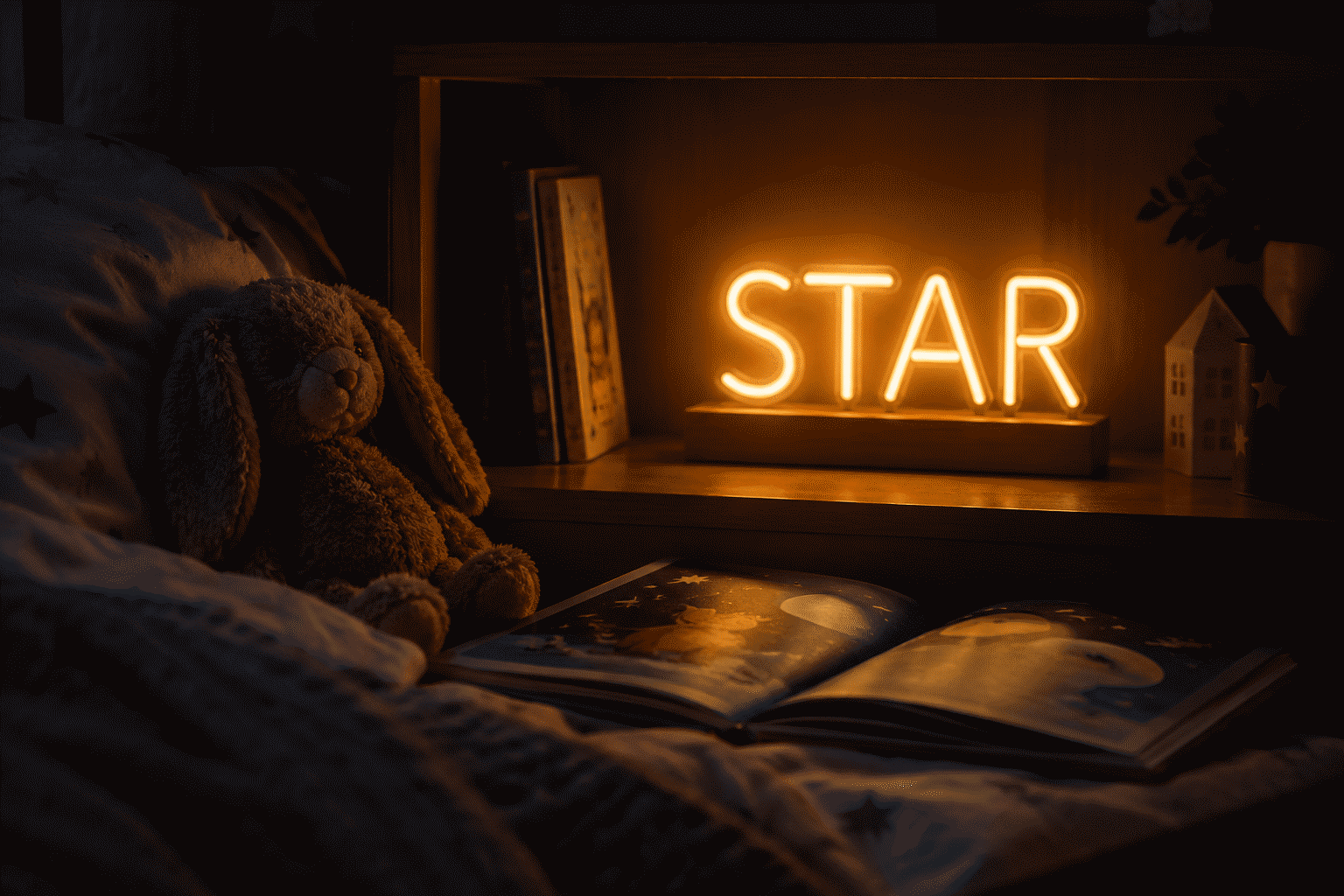
The night light is the kids room’s quiet workhorse: it gets more hours of use than any other object in the house, and it carries a job description no lamp wants — bright enough to navigate by, dim enough to sleep under, interesting enough that the child claims it as theirs. A small neon piece does all three, plus one thing no duck-shaped plug-in has ever done: it looks good in the daytime too.
Here are 14 ideas organized by the night-light’s actual jobs — falling asleep, staying asleep, navigating, and being loved — with the safety and engineering notes parents ask about. The full kids canon lives at kids room neon signs.
The Sleep Tier: Ideas 1–5
Pieces whose whole job is the 8 p.m. wind-down.
- The moon — the original night light: a crescent in warm white at 15% brightness, mounted over the bed’s wall. No piece in the category has ever failed at this job.
- The star trio — three small stars scattered at different heights; the constellation register, dimmable to a sky.
- “Sweet Dreams” — the blessing script in warm white; the phrase tier’s sleep-adjacent classic.
- A cloud — the softest shape in the catalog; pairs with the moon tier or glows alone at 10–15%.
- “Goodnight” in the child’s language of choice — the bilingual household’s sleeper piece; “Buenas Noches” and “Bonne Nuit” both glow beautifully.
The Navigation Tier: Ideas 6–9
Pieces that light the 2 a.m. walk to the parents’ room or the bathroom.
- The hallway rocket — an astronaut or rocket at 10%: the mission-control register for the overnight corridor run. Bright enough to walk by, dim enough to keep everyone half-asleep.
- The baseboard strip — a small neon strip run low along the wall or behind the headboard: the hotel-bathroom logic, kid-scaled. The professional version of “don’t turn on the big light.”
- The bathroom-path piece — a tiny sign or shape at the door: the waypoint that keeps the whole house dark except the ten square feet that matter.
- The closet-cloak glow — behind-the-door glow for the monster-check routine: the light that proves the closet is empty, every night, on demand.
The Identity Tier: Ideas 10–12
The night light that doubles as the room’s decor — because a piece that runs 12 hours a day should earn its wall space.
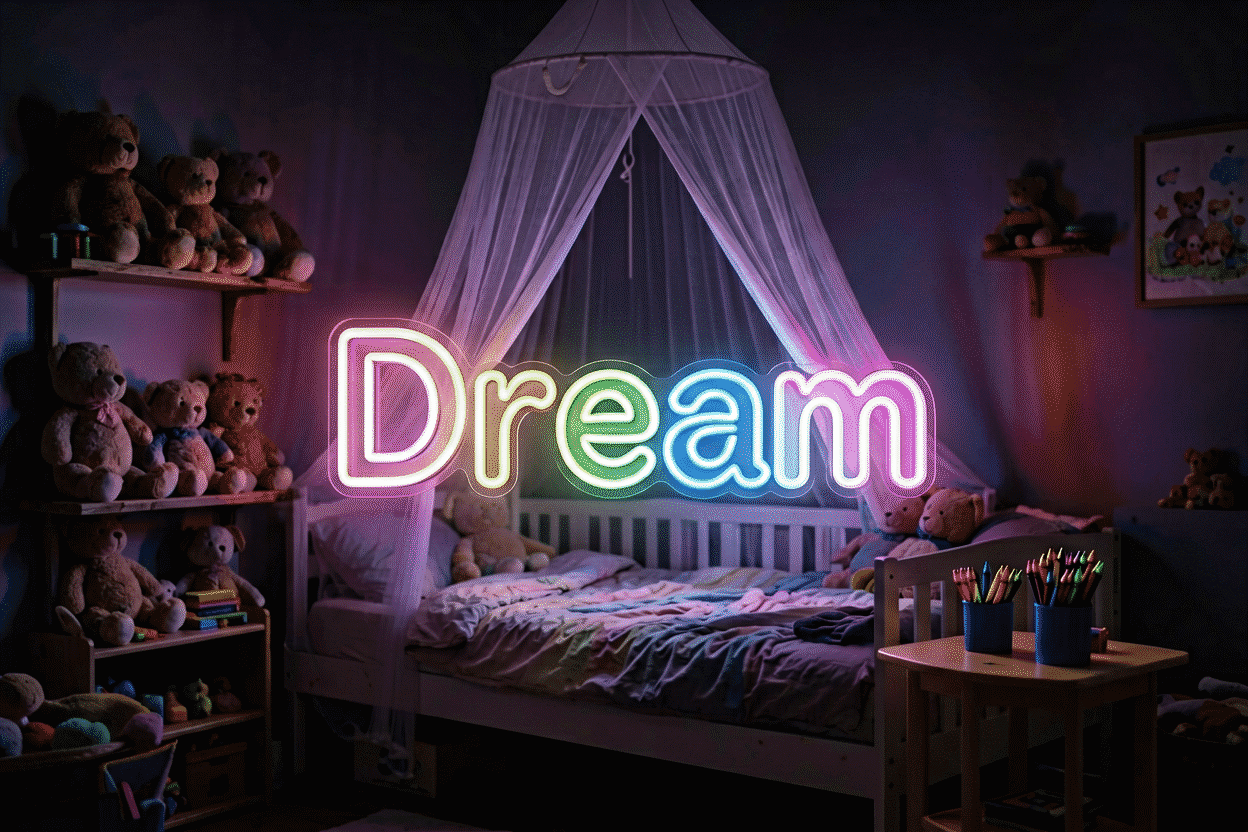
- The name piece, dimmed — the child’s name in warm white, running at 15% all night: nameplate by day, night light by dark. The dual-role build that justifies the good piece.
- The pink room system, low mode — the layered-pink pieces (name, heart, cloud) on a dimmer: play-room at 4 p.m., sleep-room at 8.
- Their favorite shape — dinosaur, unicorn, shark: the phase piece running at 20%. When the phase ends, the piece moves to the playroom and the moon returns.
The Engineering Tier: Ideas 13–14
- The dimmer-or-nothing rule — a night light without a dimmer is a bedroom light; the 10–20% band is the entire product category. Every piece in this guide assumes one; add it to any existing piece for the cost of a pizza.
- The timer tier — the piece that fades out at sleep-plus-forty: the training-wheel setting for kids who need glow to fall asleep and dark to stay asleep. Smart plugs do it; the power math says an all-night 15% piece costs about a dollar a month.
The Parent Questions, Answered Straight
Is it safe to leave on all night? Yes — LED neon runs cool (the temperature facts: warm, not hot; nothing to burn curious fingers), draws a few watts (the math), and contains no glass. The engineering risks are household ones: secure the cord out of toddler reach (the hanging guide covers the clip systems), keep the power supply in open air, and mount the piece out of the crib’s reach arc.
Will it keep them awake? At 10–20% brightness, warm-white and soft-pink registers read as “sky at dusk,” not “bedroom lights on.” The failure mode is brightness and color: full-power blue light at 9 p.m. is a bad bedtime in any form. The sleep-tier rule: warm colors, low digits, dimmer required.
What about the “still scared” phase? That’s the identity tier’s real job: the piece the child chose is the piece that protects them. A dimmed rocket they picked themselves outperforms the objectively-brighter lamp they didn’t — the psychology does the lighting.
The Sleep Science, Honestly Stated
The night-light category runs on sleep science’s actual findings, stated carefully: warm-spectrum light (amber, warm white, soft pink) suppresses melatonin far less than blue-spectrum light at equivalent brightness – the reason every sleep-adjacent recommendation runs warm registers after sundown. The neon night light that follows the science runs warm, dim (the 10-20% band), and warm-white-or-amber by color; the one that fights it runs blue or green at full power, which is a bedtime problem wearing a night light’s costume.
The brightness bands by job: the fall-asleep tier at 10-15% (the presence, not the light), the navigation tier at 15-25% (the walk-to-bathroom band), and the fear-management tier at 20-30% (the monster-check brightness – the psychology does most of the work, the light confirms). The dimmer covers all three; the fixed-brightness piece covers one (the color logic maps the full temperature science).
The timing tier: the smart plug’s fade schedule (the piece that dims to off at sleep-plus-forty) serves the kid who needs glow to fall asleep and dark to stay asleep – the training-wheel protocol that weans itself. The all-night tier (the piece that glows till morning at 10%) costs about a dollar a month (the math) and serves the household that has decided, after the third 2 a.m. visit, that the dollar is the cheapest sleep either party will ever buy.
The Night-Light Decision Guide
By age: nursery (0-2) the moon-and-stars tier, warm white at 10%, mounted on the wall the crib faces (the nursery logic); toddler (2-4) the shape-with-meaning tier (the rocket, the cloud) at 15-20%, the piece the child chose and therefore trusts; school-age (5-9) the identity tier (the name piece dimmed, the hobby shape) – the night light that doubles as decor and stops being called a night light; tween-plus the aesthetic tier (the teen guide) – the glow that’s ambient rather than protective, the room’s mood rather than its guard.
By problem: the afraid-of-the-dark kid gets the chosen piece (the psychology outranks the lumens); the 2 a.m. wanderer gets the navigation strips (the hallway tier); the early waker gets the blackout-plus-dim combo (the room that reads “still night” at 5:30 a.m. buys the household its morning); the sleeper who needs nothing gets the decor tier that happens to glow (the honest answer – not every room needs a night light, and the piece that’s just beautiful is allowed).
By budget: the entry tier ($30-80) runs the small shapes and the strip tiers; the keeper tier ($100-250) runs the namepiece-dimmed (the dual-job piece that justifies the custom budget – nameplate by day, night light by night, for eighteen years).
Variations and Pairings
The night-light canon’s variants. The word-face variants: “neon night light for kids,” “kids night light neon,” and “dimmable kids neon sign” serve the function tier – the decor faces (the kids canon, the landing) carrying the daytime pieces this guide doubles at night. The function faces: the navigation tier, the sleep tier, and the fear-management tier each carry their brightness bands – the same piece serving different functions at different settings.
The pairing logic: the night-light program pairs the keeper with the function – the namepiece (the dual-job piece: nameplate by day, night light by dimmed night) with the dedicated tiers (the moon for the sleep job, the rocket for the navigation job). The pairings that work run one function per piece; the pairings that fail run the bright phase piece as the night light (the dinosaur at full power is a bedtime problem, not a solution).
The household pairing: the siblings’ rooms pair the matched dimmers with the individual pieces – the shared brightness discipline, the separate identities – the two-room program that keeps both children asleep and both rooms theirs (the sibling logic).
FAQ About Neon Night Lights for Kids
What’s the best neon night light? A warm-white moon or the child’s name at 15% on a dimmer. The moon is the universal answer; the name is the keepsake answer. Both run all night for about a dollar a month (the math).
What color night light is best for sleep? Warm white, soft pink, and amber — the dusk-spectrum registers. Blue and green at full power are the stay-awake colors; at 10% they’re tolerable but the warm registers win every sleep study adjacent to this question.
Can a neon sign replace a toddler’s night light? Yes, with placement: the piece mounts on the wall the bed faces (out of reach, cord secured), runs at 10–15%, and does the plug-in’s job while looking like the room’s decor instead of its apology. The kids canon has the full placement logic.
What color night light helps kids sleep best? The warm registers – amber, warm white, and soft pink – because the sleep science is consistent: warm-spectrum light suppresses melatonin far less than blue-spectrum light at equivalent brightness (the color logic covers the full temperature science). The neon night light that follows the science runs warm, dim (the ten-to-twenty-percent band), and steady (no color-cycling at bedtime). The blue and green pieces – beautiful as day decor – become the bedroom’s problem at night: the full-power blue light at nine p.m. is a bad bedtime in any form, and the dimmer cannot fully fix the spectrum. The moon in warm white at fifteen percent is the category’s sleep-science gold standard; the rocket in ice blue is the negotiation the child usually wins.
What age can kids start using a neon night light? From the nursery onward, with the placement doing the age’s work: the newborn’s piece mounted on the faced wall at the dimmest band (the 10% presence that serves the night feeds), the toddler’s pieces above the reach arc with the cords channeled (the safety layer), and the school-age child’s pieces descending to their world (the seated-eye heights where the glow becomes theirs). The night-light function itself never ages out the way the plug-in ducks do – the dimmed namepiece serving the eight-year-old and the sixteen-year-old with the same ten dollars of electricity a year. The piece the child chose (the rocket, the moon) outperforms the brighter piece they didn’t – the psychology doing the lighting from the first night.
What brightness setting works for overnight use? The lowest tier of the remote, full stop — around 10-15 percent of full output puts the piece into true night-light territory: enough to orient by, dim enough that it doesn’t suppress melatonin the way a phone screen does. The habit that works is setting the level together at bedtime for the first week, then letting the kid own the remote; the dim setting they choose themselves is the one they stop arguing about.
Do glow night lights affect a toddler’s sleep quality? Warm-hue dim glow has no documented downside for toddler sleep — the sleep-science concern centers on bright, blue-shifted light before bedtime, which a warm dimmed sign is the opposite of. The practical risk isn’t the light; it’s the interaction: a remote in the crib becomes a toy and a bedtime-stalling device, so the parent keeps the remote until the child is old enough to trade it for the responsibility.
Sources & Further Reading
- Solid-State Lighting (U.S. Department of Energy) — DOE reference on LED efficacy and lifetime.
- Mercury (U.S. EPA) — federal guidance on mercury exposure and safe handling.