22 Bar Neon Signs for Guys: The Full Playbook
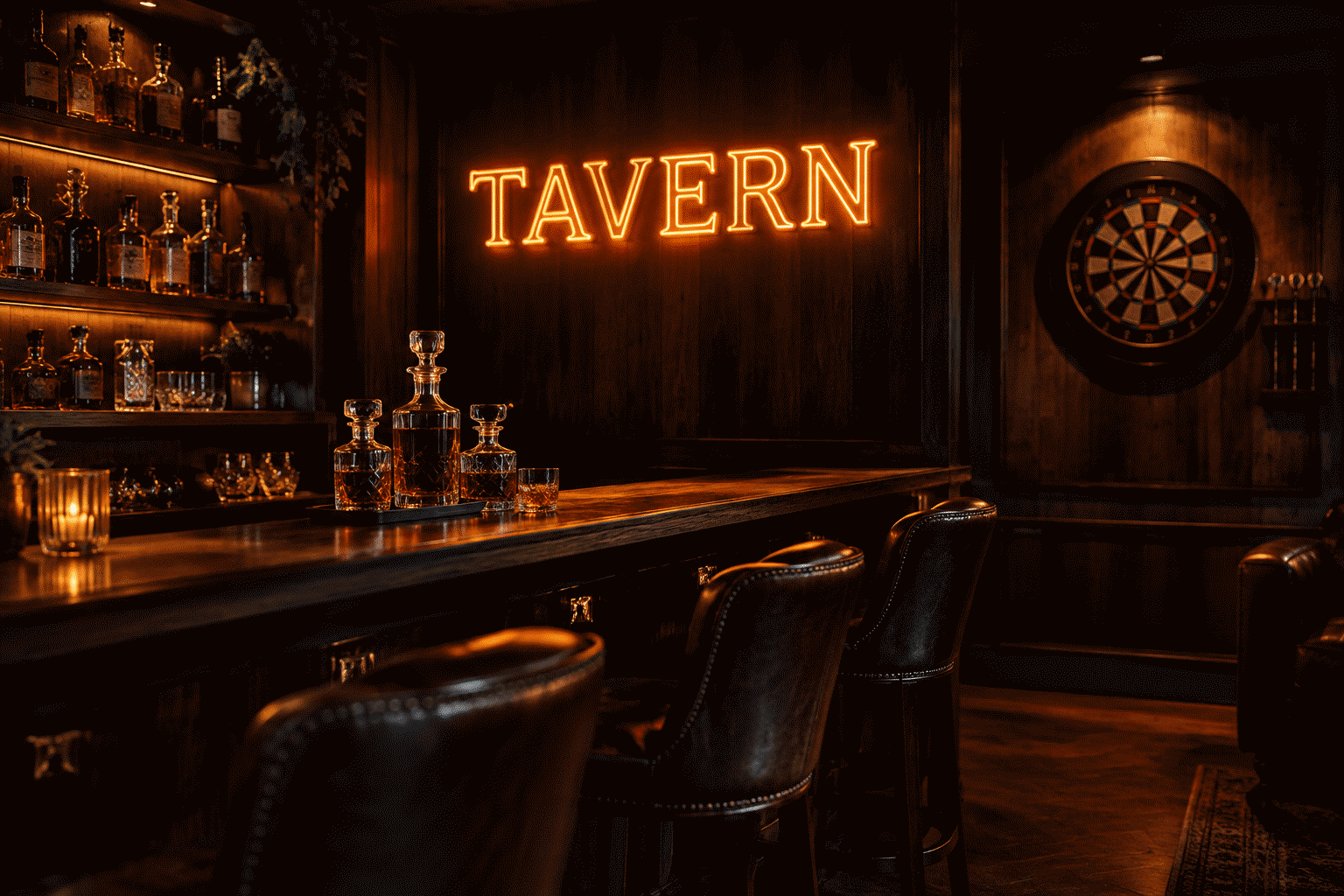
“For guys” is doing honest work in that search bar. It means: no script hearts, no pastel anything, and nothing that requires an explanation. It means whiskey registers, sports shrines, garage bars, and the specific humor of a room where the fellas watch the game. The good news is that neon’s first century was basically built for this brief — the entire archive of bar-wall glass was designed by and for guys who took their pour and their team seriously.
Here are 22 ideas organized the way a guys’ bar actually comes together — the pour wall, the game-day tier, the garage hybrid, and the jokes that carry the room. The full shopping tier lives at neon bar signs.
The Pour Wall: Ideas 1–7
- The last-name bar charter — “SMITH’S BAR, EST. 2015” in block or era script; the room’s founding document. Preview any name free in the customizer.
- The red statement — red is the guys-bar default: appetite, punch, and the visual temperature of whiskey and late nights; the linked treatment makes the full color case.
- “Cold Beer” — two words, zero ambiguity; the pour wall’s constitution (beer tier here).
- A whiskey register piece — “BOURBON” in amber, or “Whiskey Business” for the pun-tolerant; the brown-spirit wall’s anchor.
- A brand script — the classic American lineup leads the era register; one strong script beats five weak ones.
- A pint or shot shape — the zero-word tier; two silhouettes flanking the namepiece is the classic composition.
- “ON TAP” — the utilitarian piece; pairs with the actual taps and updates with the keg calendar.
The Game-Day Tier: Ideas 8–13
- The team piece — franchise colors, era-correct script (NFL ranks here); the game-day wall’s permanent resident.
- “Game Day” — the two-word calendar that runs September to February; switch it on when the grill does.
- The jersey number — your number, the legend’s, or the kid’s; one oversized numeral in team color.
- “Man Cave Sports Bar” — the hybrid charter for the room that’s equal parts both (crossover tier).
- A sports-shape cluster — football, basketball, baseball shapes in a row; the tier for walls already carrying text.
- “No Excuses” over the screen — the fantasy-league wall’s attitude register (the motivational canon).
The Garage & Bachelor Tier: Ideas 14–19
- No Vacancy — the full-house announcement; the roadside register that reads perfect over folding chairs.
- Hustle — for the bar that shares the garage with the side business; the grind register in red or ice blue.
- “Members Only” — the private-club joke; strongest on the door side, where entry feels earned.
- “The Dog House” — the self-deprecating charter; the name that has rescued a thousand basement bars from decoration committees.
- A car or motorcycle piece — the garage-bar crossover; the automotive tier covers the badge builds.
- A gaming piece — for the bar with a screen and a console in it (the full canon): “GAME ON” or a controller shape in the corner where the controllers actually live.

The Jokes That Carry the Room: Ideas 20–22
- “It’s 5 O’Clock Somewhere” — the all-hours permission slip; afternoon-project energy in sign form.
- “In Dog Beers I’ve Only Had One” — the pet-household crossover; the most-quoted piece on any guys’ wall.
- “Free Beer Tomorrow” — the eternal promise; the joke that has never once gotten old, hung where the fridge meets the wall.
The Rules That Make It Look Right
The guys-bar wall runs on three disciplines. One hero per sightline — the namepiece or the biggest brand script owns the pour wall; everything else clusters in support. Past three pieces per wall, the room reads storage, not shrine. Color temperature discipline — warm registers (red, amber, warm white) with one cool accent (ice blue, bottle green) is the ratio that made every classic bar wall work; all-cool reads convenience store, all-warm reads burger joint, and either may be exactly the joke you’re building. Brightness hierarchy — the hero runs full, the jokes run at 60–70%, the shape tier at half; the layered glow is what makes the room feel run-in rather than installed.

Sizing follows the bar: the namepiece matches the bar’s width minus about 20% (a 6-foot bar carries a 48–54 inch piece), the game-day tier runs 24–36, the jokes run small — 18 to 24 inches — because the humor shouldn’t shout. The hanging guide covers the drywall anchoring most basements need and the stud-direct method garage walls allow.
The Three-Build System: Starter, Serious, Shrine
The starter build ($80-200): the charter-small (“SMITH’S BAR” at 24-30 inches), one pour piece (“Cold Beer”), and one joke (“It’s 5 O’Clock Somewhere”) – the room’s identity, menu, and voice for the price of a decent whiskey bottle. The starter build tests the room’s register: if the charter lands (the household quotes it, the guests photograph it), the room has earned the serious tier.
The serious build ($200-500): the charter at real size (36-48), the team piece in franchise colors, and the brand script – the three anchors of the guys-bar canon. This is the tier where the room stops being a basement corner with a fridge and becomes a destination: the anchors carry the wall, the starters become the accents, and the composition rules (one hero per sightline, warm-dominant with one cool accent) start doing their work.
The shrine build ($500-1,200): the full wall (four to six pieces, era-consistent), the game-day calendar tier, the custom commissions (the charter with the family crest, the retirement piece) – the room that hosts the neighborhood’s Sundays and gets named in group chats (“the sign bar”). The shrine earns itself only after the room’s identity is settled – the collection built before the register is known reads as spending, not devotion.
The sequencing rule that saves the budget: charter first, always. The room that buys its name before its jokes builds around a center; the room that buys the jokes first hangs them around a hole. The charter is the guys-bar’s one non-deferrable purchase (preview yours).
The Room’s Physics: Brightness, Reflection, Beer Light
The guys-bar glow runs the room’s hours: full for the arrival (the glow that greets), 60% for the game (the screens need the contrast), 30% for the conversation hours (the register where the good bars live), and the 15-20% closing glow for the last two guests who won’t leave – the tier where the room’s best conversations happen and the dimmer earns its ten dollars.
The reflection audit matters in the bar room more than most: the bottles, the mirror, and the TV all bounce glow. The working placements: the charter above the mirror’s center line (glow doubles, no glare), the brand tier off-axis from the TV (the screen’s reflection band kills both), and the jokes at seated eye level where the stools’ occupants live. The hanging guide covers the drywall anchoring most basements need – and the stud-direct method the garage-adjacent bar walls allow.
The power math for the full shrine: six pieces at conversation brightness cost less per month than the bar fridge’s defrost cycle (the numbers) – the room’s whole glow is a rounding error on the electric bill, which is the guys-bar’s favorite kind of math.
Variations and Pairings
The guys-bar canon’s variants. The word-face variants: “bar neon signs for guys,” “guy cave neon signs,” and “mens bar neon” serve the demographic tier; the general faces (the bar canon, the home-bar guide) carry the room tier – the demographic skew running the register selection rather than the piece range. The crossover faces: the sports-and-bar hybrid runs the man-cave canon; the garage-bar runs the workshop registers.
The pairing logic: the guys-bar pairs the charter with the loyalty – the name (the room’s own identity) with the brand or team (the owner’s) – and the jokes small beneath. The pairings that work run the masculine-palette discipline (the warm-dominant, one-cool-accent ratio); the pairings that fail run the novelty pile, the five-joke wall that reads the bachelor-party souvenir.
The roommate pairing: the shared space (the roommates’ bar, the brothers’ cave) pairs the joint charter with the individual loyalties on opposite walls – the treaty architecture that keeps the peace and the glow (the couples logic adapted for the non-romantic treaty).
FAQ About Bar Neon Signs for Guys
What’s the best first sign for a guys’ bar? The charter: last name + Bar + Est. year. It sets the register (institution, not decoration), survives every phase, and makes every later addition an amenity rather than a decision. Free preview at the customizer.
How do I keep it from looking like a dorm room? Scale and hierarchy: one big hero piece, two supports, dimmers on everything. Dorm rooms fail at eight small pieces at full brightness with no anchor — the charter-plus-tier system is the counter-programming.
Beer signs, whiskey signs, or jokes — which tier first? Charter first, then the pour menu (“Cold Beer” or the whiskey register), then the jokes last and smallest. The tiers install in that order because the room’s identity has to exist before it can be funny about it.
What about the sports wall — same rules? Same rules, different calendar: the team piece is permanent, “Game Day” is seasonal (on when the season is), and the rest of the wall stays pour-tier. The room shouldn’t need a jersey to explain itself in July.
What is the difference between a man cave sign and a bar sign? The room’s center of gravity: the man-cave sign marks the territory (the identity, the sports, the hobbies – the man-cave canon), the bar sign marks the pour (the establishment, the brands, the toasts – the bar canon). The rooms overlap (the cave with the bar corner, the bar in the cave) and the pieces travel between them – the “Cold Beer” works on both walls, the team piece leads the cave and supports the bar. The distinction that matters for buying: the cave leads with identity (the charter or the team), the bar leads with the establishment (the name or the brand) – the room’s primary piece announcing what the room primarily does.
How do I make a neon bar sign look expensive? Scale and hierarchy: one oversized hero (the charter at 36-48 inches – the sizing chart) reads more expensive than five small pieces at the same total spend; the warm-dominant palette with one cool accent reads tavern rather than novelty; and the dimmer’s twenty-percent closing glow reads the room that has hosted a thousand conversations. The details complete it: the cord channeled (the dangling wire is the cheap read – the hanging guide), the mirror-backed placement (the doubled glow), and the era-consistent composition (the matched-register pieces rather than the mixed novelty pile – the collection logic).
Sources & Further Reading
- Neon sign (Wikipedia) — the consolidated public record of neon-sign history and technology.
- Neon, element 10 (Wikipedia) — element properties: density, boiling point, abundance.
Pricing based on CustomNeon’s current catalog (2026); custom quotes come live from the sign builder.