Outdoor Neon Signs: Ratings, Mounting, and Care
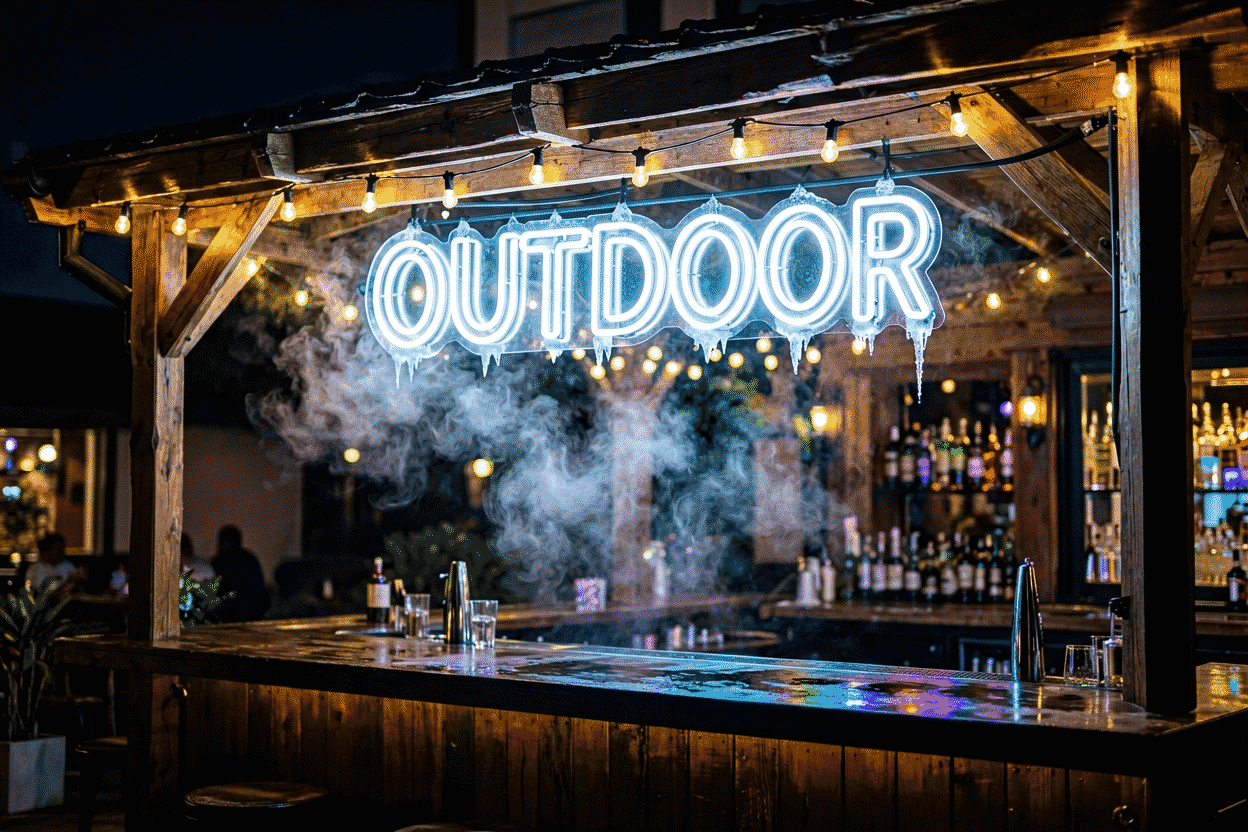
An outdoor neon sign works when three things are true: the sign is actually rated for it (IP65 or better for covered spots, IP67 for full weather), the power side is GFCI-protected and weatherproofed, and the mount treats wind load as the real enemy rather than rain. LED neon makes all three achievable at consumer prices — a weather-safe patio or storefront sign runs $150–$500 and installs in an afternoon, where outdoor glass neon meant a sign company, a permit, and a transformer in a weatherproof cabinet.
This is the complete outdoor guide: what the ratings mean, what to buy for which exposure, how to mount for wind, and the seasonal care that keeps an outdoor sign glowing for years. For the deep dive on water specifically — IP numbers, testing standards, what “waterproof” legally means — see are neon signs waterproof.
First: Indoor Signs Die Outdoors (Know the Difference)
Most neon signs sold online are indoor signs, and they fail outdoors in one to two seasons — not dramatically, but through connector corrosion, driver moisture damage, and UV-yellowed jackets. The spec that separates the categories:
- IP65: weather-resistant. Handles rain spray, dust, and humidity under cover — a porch, an awning, a deep eave.
- IP67: waterproof. Survives direct rain and even temporary immersion — exposed fences, open patios, garden walls.
- No IP rating or “indoor use only”: will corrode, flicker, and die. Every time.
One more spec hides in the details page: UV-resistant jacket material. Sun beats water for killing outdoor flex neon — unrated jackets yellow and crack in direct sun within two summers. Signs sold explicitly for outdoor use specify UV-stable silicone; signs that don’t mention it, don’t have it.
What to Buy for Which Spot
| Location | Minimum rating | Notes |
|---|---|---|
| Covered porch, deep eave | IP65 | Any angle rain can’t reach directly |
| Under an awning, coastal air | IP65 + UV | Salt air wants stainless hardware |
| Open patio wall | IP67 | Full weather exposure |
| Fence, pergola, garden | IP67 + UV | Consider winter teardown |
| Storefront, sign band | IP67 + commercial | See our open signs line |
Two purchasing details that matter outdoors and nowhere else: buy one size bigger in brightness (daylight washes neon out — a sign that glows richly indoors can look pastel at noon) and shorter is stronger — every word on a sign is sail area in wind; concise phrases survive storms better than poetry.
The temperature angle is friendlier than people expect: quality LED flex handles roughly −4°F to 140°F operating range, which covers most of North America’s four seasons. What kills cold-climate signs isn’t the cold — it’s condensation cycling inside non-sealed connectors. The rating, again, is everything.
Mounting for Wind (The Actual Engineering)
Rain is a solved problem (the IP rating handles it). Wind is where outdoor installs actually fail. Three rules:
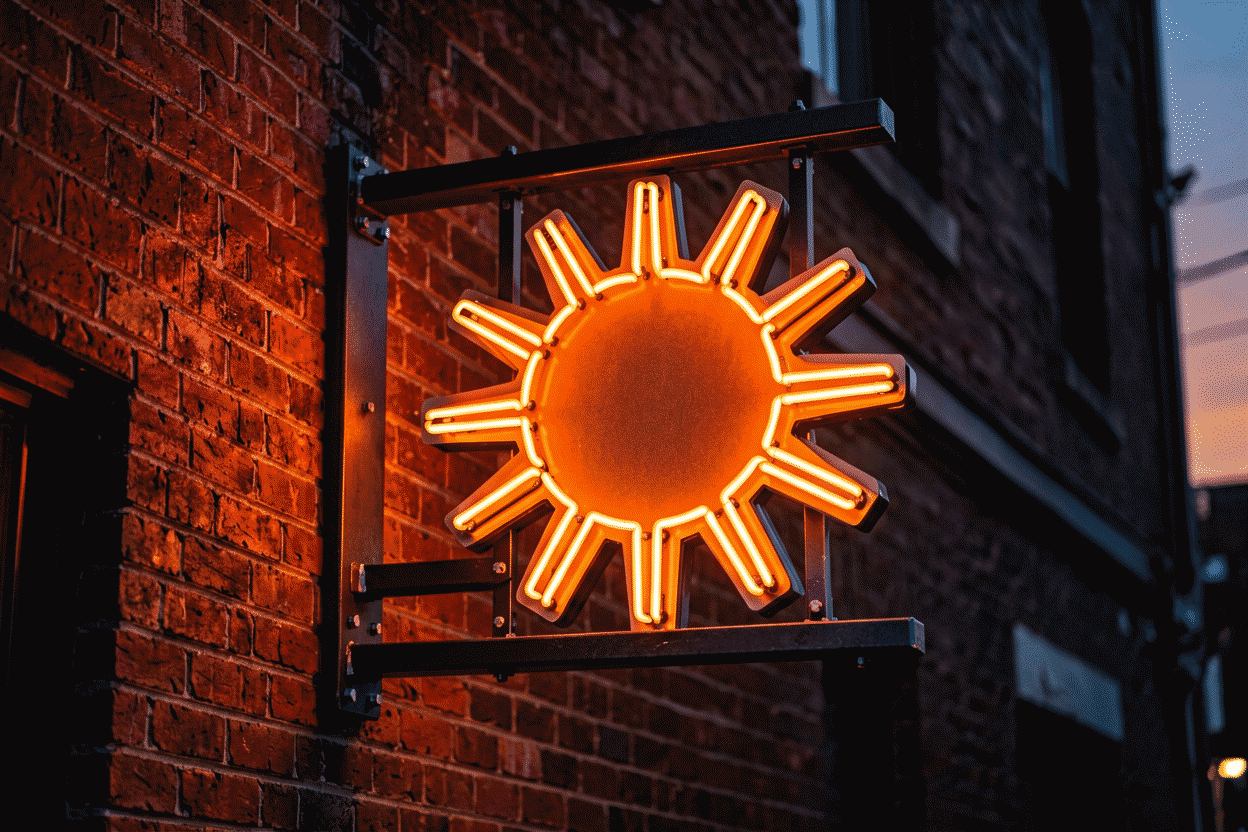
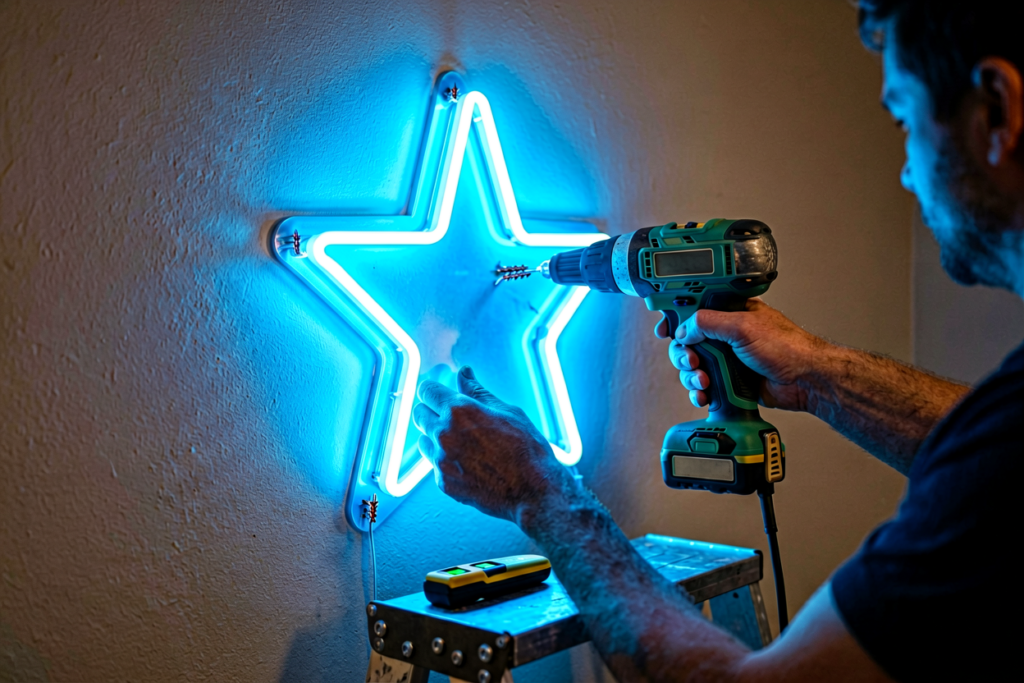
Rule 1: Every mounting point, and then two more. Indoor hanging tolerates four of six screws engaged; outdoor wants all of them plus extras. A sign that rattles in wind works its fasteners loose with remarkable speed — the vibration cycle unscrews things by itself. Use locking hardware (nylon-insert nuts, lock washers) on anything that flexes.
Rule 2: Rigid surface, not springy fence rails. Mount to the solid thing: the wall, a fence post, a structural frame. Long unsupported fence panels and thin pergola slats amplify vibration; the post takes the same load without the guitar string.
Rule 3: Standoffs beat flat mounts in wet climates. Small spacer posts behind the backing let air flow and water drain behind the sign — no freeze-thaw, no algae line, no trapped moisture against the electronics. On covered spots it’s optional; on open exposure it’s cheap insurance.
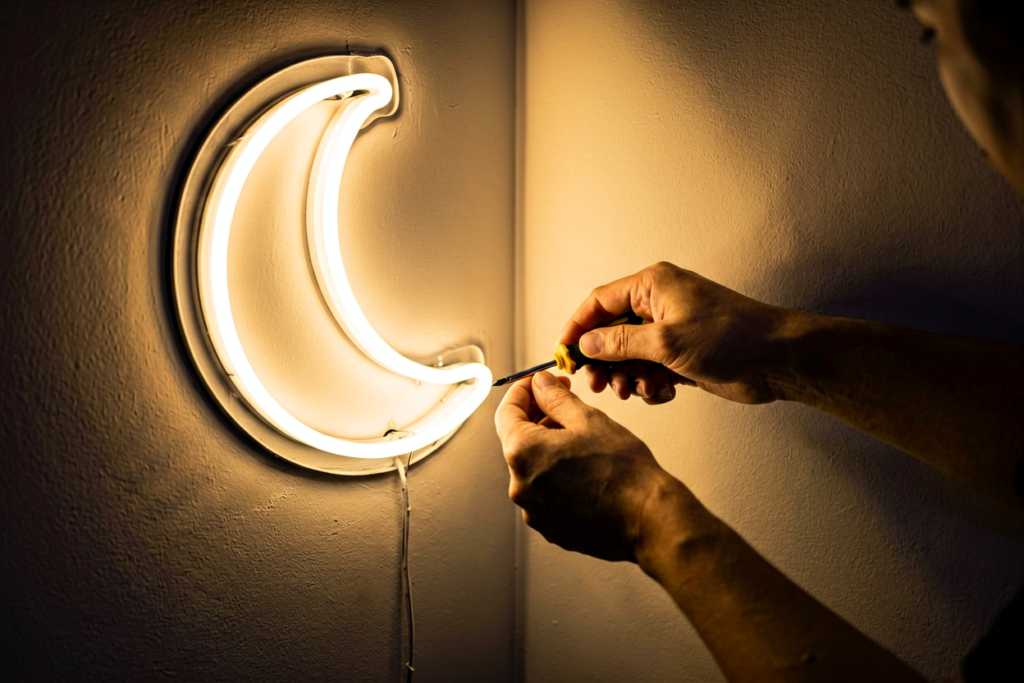
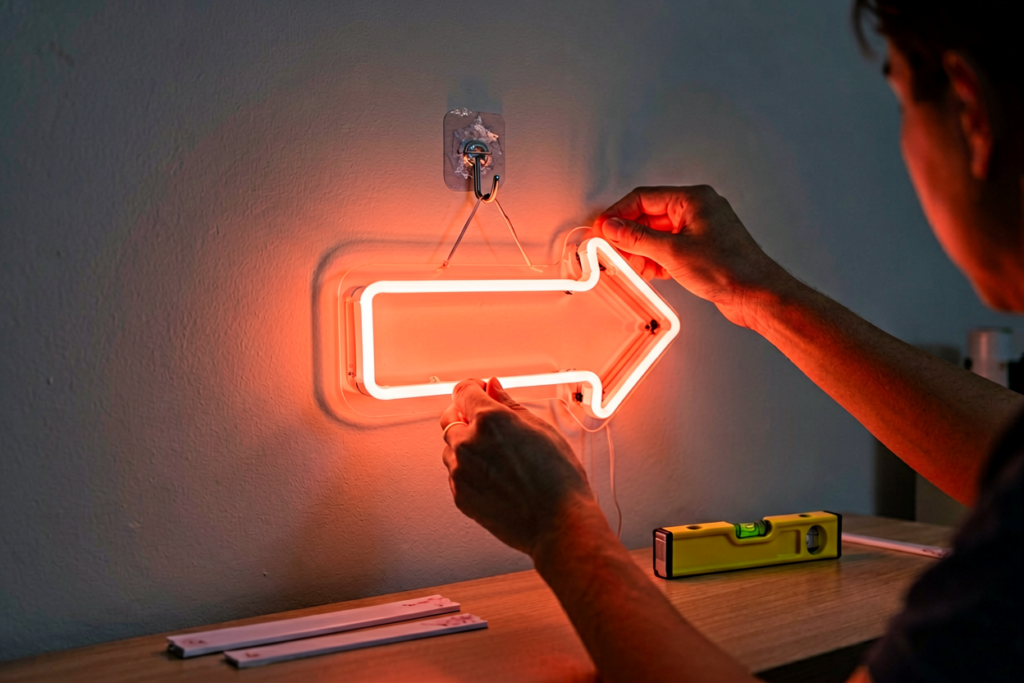
The mechanics of the mount itself (anchors for brick and drywall, keyhole slots, leveling) are identical to indoor work — the full hanging guide covers all of it.
The Power Side: GFCI or Go Home
Outdoor electricity has one non-negotiable and two best practices:
- GFCI protection, always. The outlet (or circuit) feeding an outdoor sign must be ground-fault protected — it’s code in most jurisdictions and the difference between a rainy-night nuisance and an actual hazard. GFCI outlets are identifiable by their test/reset buttons; GFCI breakers do the same job at the panel. Outdoor-rated power strips with built-in GFCI exist for spots without protected outlets.
- Weatherproof covers on everything — the outlet gets an in-use bubble cover (the kind that closes over a plugged cord), and cord connections get IP-rated junction boxes or self-fusing weatherproof tape wrapped properly (stretched, overlapped half-lap, from the bottom up so water sheds off the laps).
- Shortest run possible, and never on the ground. Route cords along structures with UV-rated clips; every foot of cord is a maintenance point and a trip point. Elevated runs age slower than ground runs.
Extension cords get a special note because everyone reaches for one: use only outdoor-rated (orange jacket, “W” rating) cords, sized one gauge heavier than you think, and treat them as temporary. A permanent outdoor install deserves a permanent power solution — for storefronts, that’s an electrician running a dedicated circuit, usually $200–$500.
Seasonal Care (Fifteen Minutes, Twice a Year)
The outdoor maintenance rhythm is two sessions annually:
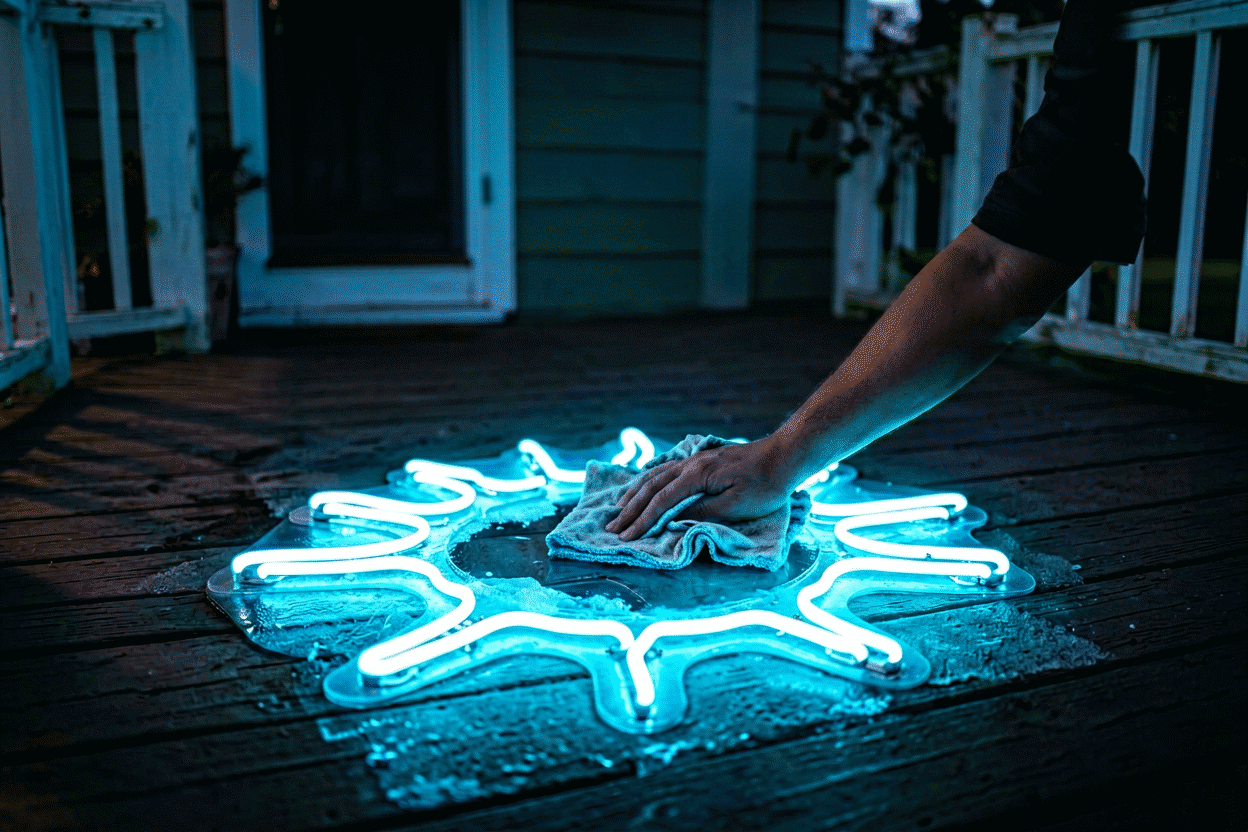
Spring wake-up:
- Inspect connectors for corrosion (green crust, dark discoloration) — clean contact surfaces with electrical contact cleaner and replace anything pitted.
- Check mounting hardware tightness (the vibration tax comes due yearly).
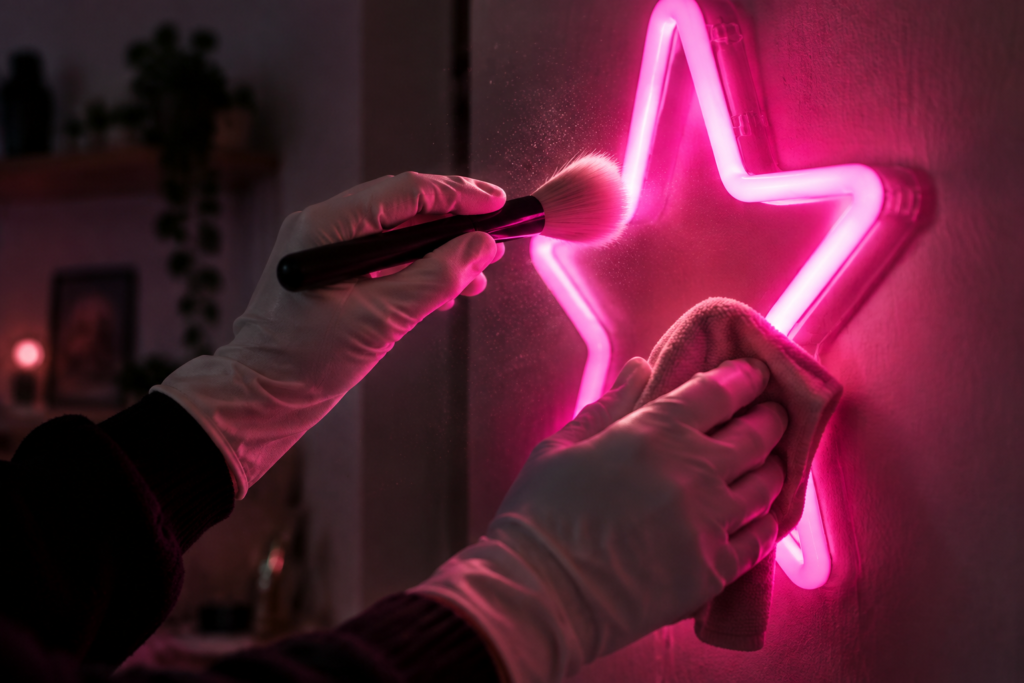
- Wipe the sign’s face with a soft damp cloth — pollen film cuts light output measurably and cleans off in five minutes. Powered off, per our cleaning guide.
Fall prep, for four-season climates:
- Re-tape or re-box any cord junctions before freeze season; water that got in this summer freezes and cracks this winter.
- For signs on fences and pergolas in heavy-snow regions: honestly consider teardown — a five-minute unmount in November beats a March of wind-loaded ice. Wall-mounted IP67 signs under eaves ride out winter fine.
- Photograph the install while it’s perfect — the comparison baseline for next spring’s inspection.
Brightness, Visibility, and the Sun Problem
Outdoor neon competes with the biggest light source in the solar system. Practical consequences:
- Position beats wattage: signs aimed away from the western setting sun read at their best; signs facing it wash out every evening precisely when outdoor entertaining happens.
- Dark backdrops carry better: a sign on a dark fence or shaded wall reads like a night installation even at dusk. Against pale stucco in full sun, even IP67 signs look anemic until golden hour.
- Dimmers still work outdoors (rated ones) — porch signs at full glow at 9 pm annoy the neighbors and attract every moth in the county; the evening dim setting is the civilized default.
Designing for Weather
Everything above bends back toward design: the outdoor-sign sweet spot is a short bold phrase in a high-saturation color (warm whites, ambers, and pinks carry best against night skies; blues and greens own pool and patio zones), on a cut-to-shape backing with standoffs, sized to the wall with a tape measure first. The custom sign builder previews your exact phrase in every color at true dimensions — and flags outdoor-rated options for the configurations that support them, before you fall in love with an indoor-only build.
Four Outdoor Installs and What They Taught
The outdoor guide’s principles, verified against four real installation types:
The patio statement wall (open exposure). A 30-inch warm-white phrase on a stucco patio wall facing full weather. The build: IP67 sign, stainless standoffs, sleeve anchors into the wall, adhesive-lined heat-shrink on every connector junction, and the driver relocated inside a weatherproof box on the protected side of the wall. Two years in: zero failures. The lesson — the rated sign is the entry ticket; the connector treatment and driver placement are what actually survive years.
The balcony rail sign (apartment outdoor). The no-drill outdoor case: a rented balcony forbidding holes, solved with two adjustable rail-mounted bracket clamps (plant-hook hardware) carrying a small 16-inch sign on a crossbar. Cord ran inside a UV-rated cable sleeve down the rail to the outlet strip. The lesson — outdoor no-drill exists, and balcony railings are underrated mounting structures; the failure mode to respect is wind, addressed by the sign’s small sail area and quick-release brackets for storm nights.
The storefront fascia (commercial exposure). A business’s 48-inch logo sign on the fascia board above the entrance: the full commercial treatment — IP67 build, four through-bolt mounts with sealing washers, dedicated GFCI circuit, conduit run to the sign’s junction box, and the dimmer schedule (full by day, 50% evenings, off overnight per local sign code). The lesson for anyone commercial: the permit conversation (the regulations) went smoothly because the build was specified rated and compliant before the application — code offices like paperwork that matches reality.
The garden and fence line (the winter test). A decorative garden sign on a cedar fence post: rated sign, post-mounted through the structural member, cord in buried conduit for its eight-foot run to the garage’s GFCI. The winter decision made itself in year one: the sign comes down at first freeze (five-minute unmount, original packaging storage) after an ice storm taught the lesson that fences flex and ice is heavy. The seasonal rhythm (fall prep) is now automatic.
The common threads: rated signage at entry, connectors and drivers treated as the real weather frontier, structure-mounted rather than surface-guessing, power that’s GFCI and tidy — and the honest seasonal awareness that four-season climates ask for one autumn afternoon of prep per year in exchange for a decade of outdoor glow.
FAQ: Outdoor Neon Signs
Can neon signs be used outside? Only signs rated for it — IP65 for covered spots, IP67 for full weather exposure, with UV-resistant jackets. Indoor-rated signs corrode and die outdoors within a season or two regardless of how they’re sheltered.
What IP rating should an outdoor neon sign have? IP65 under cover (porches, awnings, deep eaves); IP67 anywhere rain lands directly (open patios, fences, storefronts). For sun-baked walls, also require UV-stable silicone jackets — sun kills jackets faster than rain kills electronics.
How do you mount a neon sign outside? Into the rigid structure (wall, fence post, frame) with every mounting point engaged plus locking hardware, standoffs for airflow in wet climates, and attention to wind load — wind, not rain, is what tears signs off walls.
Do outdoor neon signs need a GFCI outlet? Yes — ground-fault protection on any outdoor circuit is code in most areas and the core safety measure. Add an in-use weatherproof cover over the outlet and IP-rated junction boxes on cord connections.
How long do outdoor LED neon signs last? A quality IP67 sign on a maintained install runs 30,000–50,000 hours — years of evening use. The realistic failure points are connectors and cords, which is what the twice-yearly fifteen-minute inspections catch early.
Can I leave my outdoor neon sign out in winter? Wall-mounted IP67 signs under eaves handle winter fine; signs on fences and pergolas in heavy-snow regions are worth unmounting seasonally — ice load and wind work fasteners loose. Re-tape cord junctions before the first freeze either way.
Sources & Further Reading
- Solid-State Lighting (U.S. Department of Energy) — DOE reference on LED efficacy and lifetime.
- Mercury (U.S. EPA) — federal guidance on mercury exposure and safe handling.
Pricing based on CustomNeon’s current catalog (2026); custom quotes come live from the sign builder.