Are Neon Signs Safe? Bedroom and Home Facts
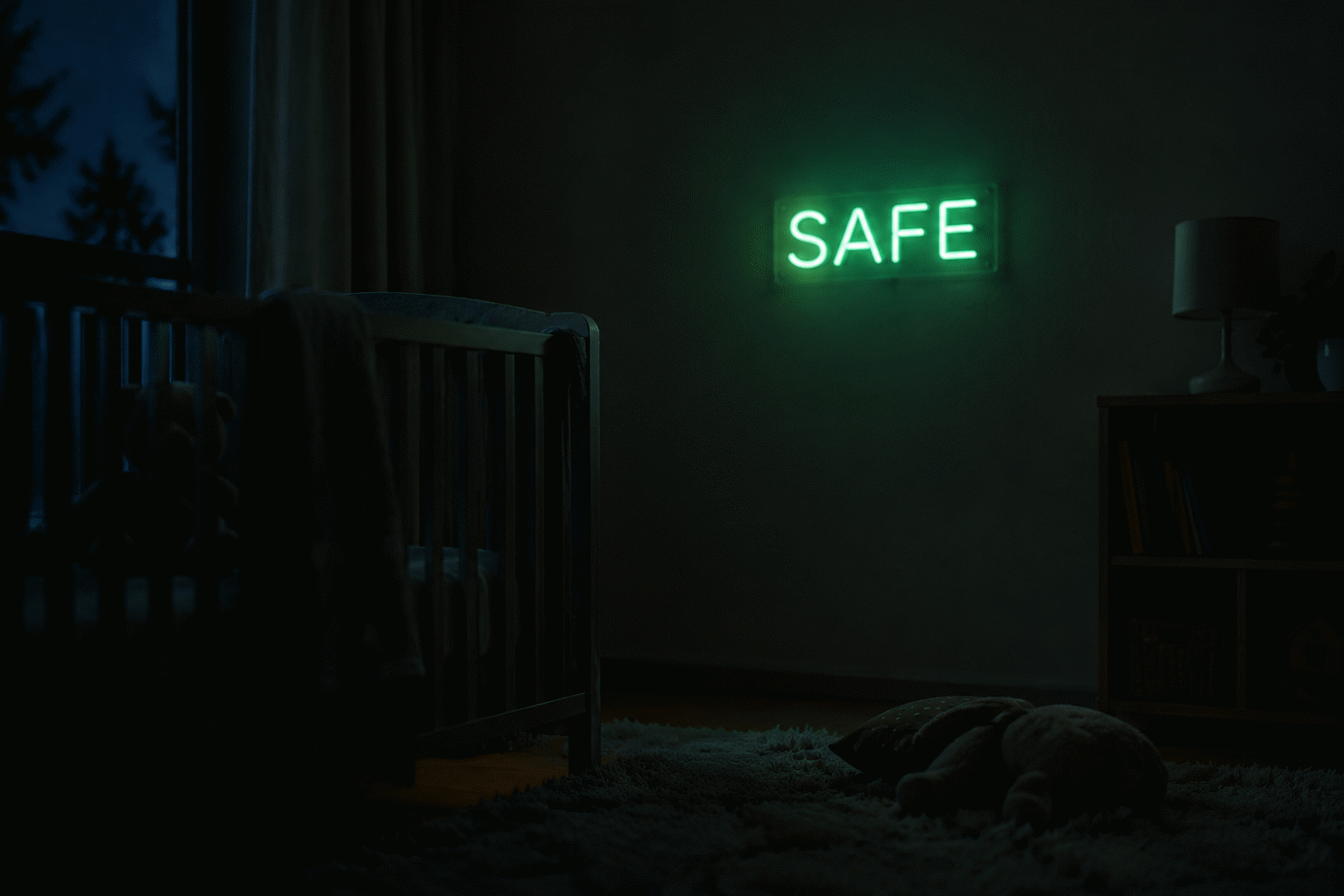
Yes — LED neon signs are safe for bedrooms, nurseries, and daily home use. They run at 12 volts (less than a phone charger’s circuit), stay cool enough to touch, draw less power than a lamp, and contain no gases at all. The honest safety conversation has exactly four real topics — electrical quality, night-time light exposure, mount security, and the glass-versus-LED distinction — plus a landfill of myths worth clearing on the way through.
Here’s the complete picture, myth by myth and room by room, with the deep dives (fire risk, gas chemistry, operating temperature) linked where they each live.
The One-Paragraph Mechanism
A modern LED neon sign is a strip of light-emitting diodes embedded in flexible silicone, powered by a low-voltage adapter — the same class of hardware as string lights, desk lamps, and every USB device you own. There is no gas, no glass under vacuum, no high voltage, no UV output worth naming. Nearly every safety question about “neon” signs is actually a question about 1950s glass neon technology, and the answers changed when the LED replaced the tube. The chemistry and history of what’s actually inside each type is its own story at what gas is used in neon signs.
Myth-Clearing: The Five Recurring Fears
“Neon signs contain toxic gas.” Glass neon signs contain noble gases — neon, argon, sometimes helium or krypton — which are chemically inert: they don’t react with anything, including you. Even a broken glass tube releases harmless quantities. The one historical caveat is mercury: some glass colors (blues and whites especially) were historically made with a mercury-argon mix, which is a real hazardous-materials issue for disposal and breakage cleanup. LED neon contains none of it. (Full toxics breakdown in our gas guide.)
“Neon signs get hot enough to burn or ignite things.” Glass neon tubes run warm — 140–200°F at the glass in spots. LED neon runs barely above room temperature: warm to the back of the hand, never hot. Neither one starts fires by existing; the actual fire discussion is about wiring quality and installation, and it lives at are neon signs a fire hazard.
“Neon emits UV radiation.” Real UV output from glass neon is trace — negligible against ordinary daylight. LED neon emits essentially none. The blue-light conversation (below) is about visible light and sleep, not radiation.
“The electricity is dangerous.” LED neon’s 12-volt DC supply can’t deliver a dangerous shock — the voltage is too low to drive current through skin resistance. Glass neon’s transformer (2,000–15,000 volts) is genuinely hazardous hardware, which is why glass installs belong to professionals and home use overwhelmingly chooses LED.
“They’re bad for kids and pets.” The realistic child/pet risks are physical, not electrical: cords to pull, signs to knock off shelves, small remote batteries. Addressed below with placement rules.
The Real Topic 1: Night-Time Light and Sleep
The one genuinely personal safety question is blue light at night — and it’s a light-hygiene issue, not a hazard, with easy engineering fixes:
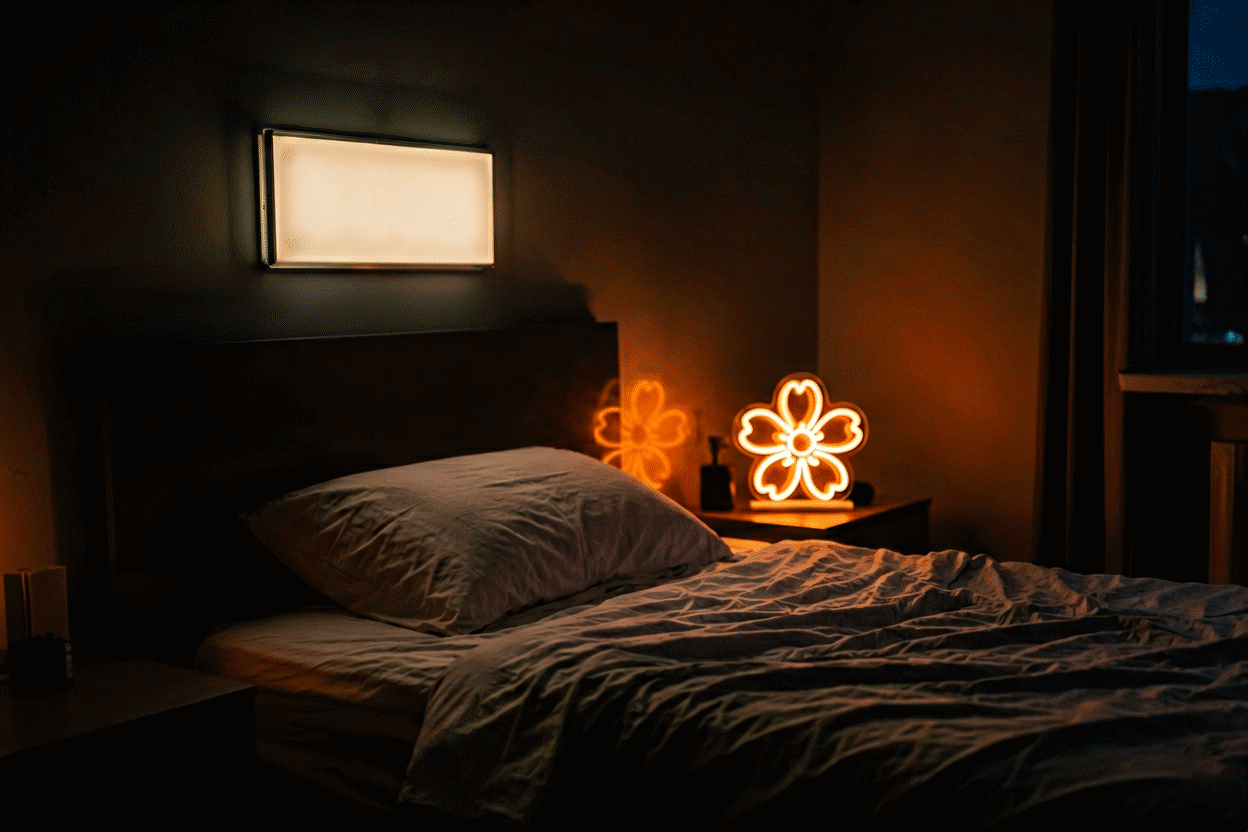
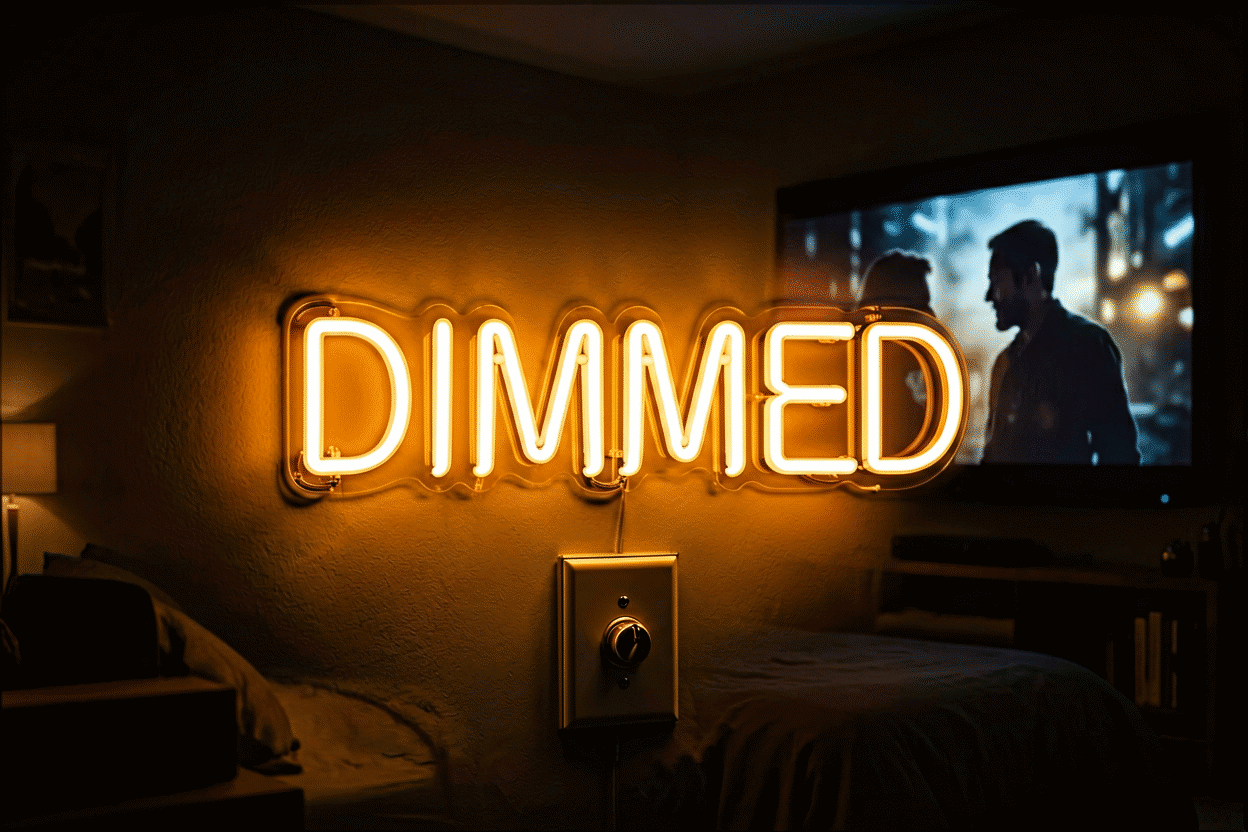
- Warm colors at night: red, orange, amber, and warm white LED output sits at wavelengths that minimally suppress melatonin. A red “relax” sign on a dimmer in a bedroom is light-hygiene equivalent to candlelight.
- Cool colors read as daytime: blue and ice-white signs running bright at midnight tell your circadian rhythm it’s afternoon. In bedrooms, they belong on dimmers, timers, or the off switch.
- Dimming solves 90% of it: every quality sign supports dimming — the dimming guide covers the control options. Bedroom-level glow (10–30% brightness) preserves the aesthetic and the sleep architecture.
For the bedroom-specific setup — placement, night-level brightness, bedside distance — the neon signs for bedroom guide maps it room by room.
The Real Topic 2: Buy-Quality Electricals
When LED neon signs make news, it’s the same story every time: counterfeit chargers, fraying cords, no-name adapters. The checklist:
- Certified power adapter — UL/ETL mark (US) or CE/UKCA (elsewhere) on the brick itself, not just the box.
- Strain-relieved cord connections — where the cord meets the sign and the adapter, molded collars instead of bare wire disappearing into housing.
- A real brand warranty — the warranty guide covers what the honest terms look like; manufacturers who test their electricals guarantee them.
- No DIY driver swaps — matching voltage and polarity matters; random adapters from the drawer are how low-voltage gear dies young.
The Real Topic 3: Physical Installation Safety
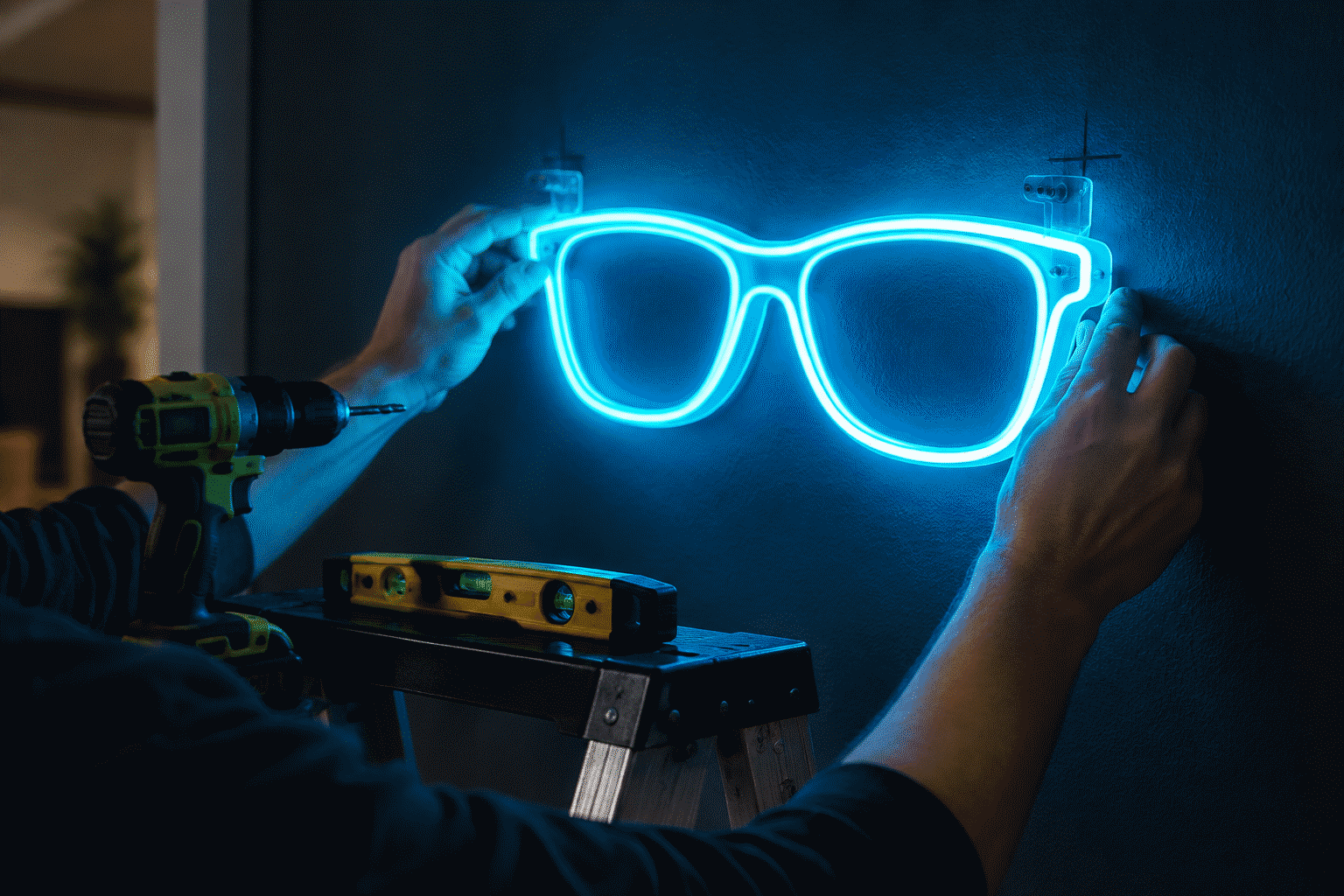
- Mount into structure (studs, anchors rated for the weight, every backing hole engaged) — the hanging guide covers all wall types.
- Nothing heavy above beds without over-engineering — the same rule picture frames follow. Over-the-bed signs mount securely (screws, not strips) or lean on the headboard instead.
- Cord discipline around kids and pets: clips keep runs tight to walls, no cords across floors, and the remote lives in a drawer once the dim level is set (its coin cell is the one swallowable part in the box).
Glass Neon at Home: A Different Risk Class
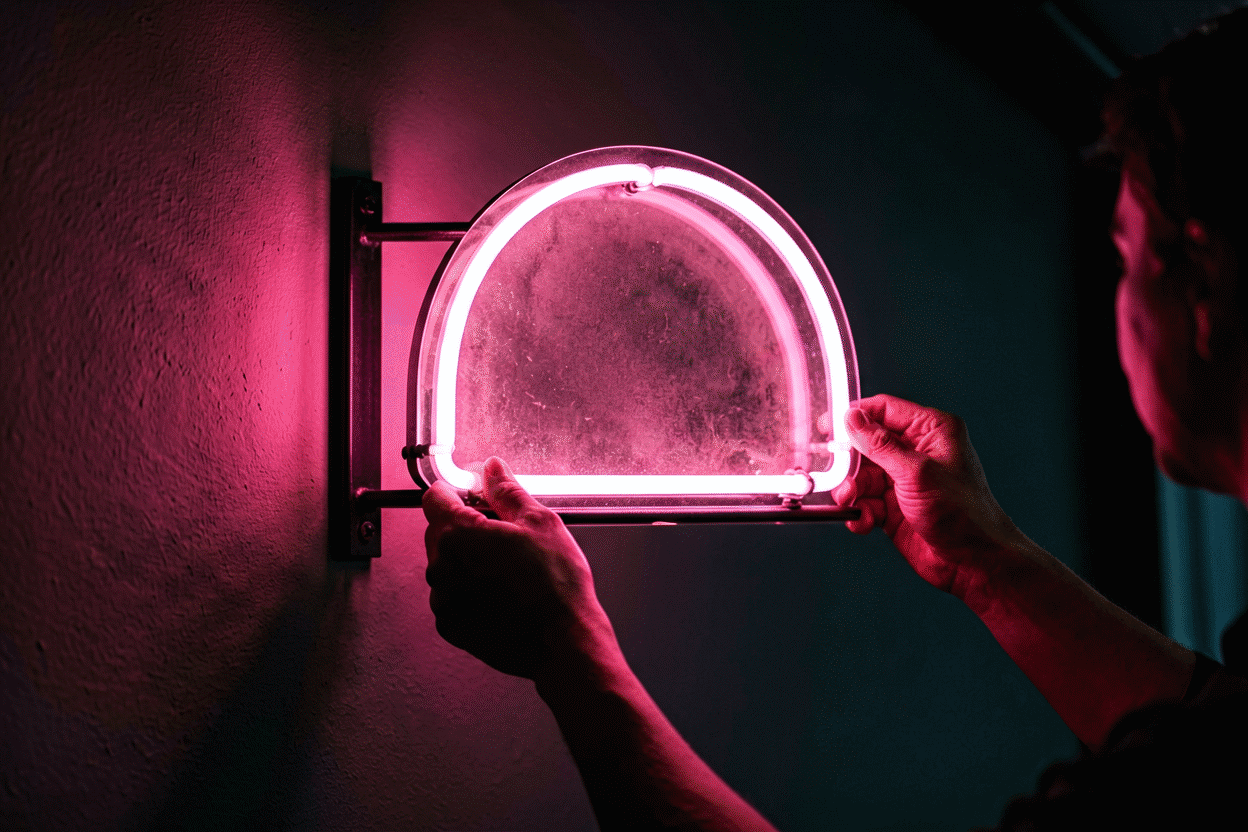
Glass neon isn’t unsafe — shops and bars have run it for a century — but its risk profile is professional-grade: high-voltage transformers, fragile pressurized tubes, break-glass cleanup protocols, and occasional mercury in vintage blues and whites. It’s a beautiful commercial medium and a poor bedside lamp. The full comparison of what you give and get between the two technologies lives in our LED versus glass guide.
Safe by Room
| Room | Verdict | The one rule |
|---|---|---|
| Bedroom | Safe | Warm color or dimmer for sleep; secure mount over bed |
| Nursery / kids room | Safe | Mount out of reach, cord clipped, remote stowed |
| Bathroom | Safe with spec | IP54+ for steam, away from direct splash |
| Kitchen | Safe | Keep distance from stove heat, wipe grease regularly |
| Garage / covered patio | Safe with spec | IP65+ rated for humidity and swing, GFCI outlet |
The Bottom Line
LED neon signs are among the safest decorative lighting made — lower voltage than your laptop charger, cooler than your reading lamp, and chemically inert. Safety in practice reduces to buying certified hardware, mounting it to structure, managing cords, and dimming warm colors at night. Start with the design itself in the custom sign builder — every configuration there runs on certified adapters with sealed low-voltage wiring, which is the safety decision made once, at order time.
Safety by Household: The Specific Setups
Safety questions get specific fast once a sign enters a real home. The household-by-household answers:
The nursery. The question behind the question is always overnight exposure. The layered answer: an LED sign at warm-white 10% is gentler than any plug-in nightlight (the dimming math), mounted out of the crib’s reach on secure anchors (the mounting standard), cord clipped and remote stowed — and on a smart schedule so it manages itself (automation). The certified-adapter requirement is doubly non-negotiable here: it runs all night, every night, in the room you care most about (buying certified).
The pet household. Cats treat cords as toys and signs as perches; dogs treat everything as tails. The pet-proofing kit: cord channel or sleeve on every exposed run (the routing methods), signs mounted at heights cats can’t launch from the bookshelf onto, and the stand-and-base rule — freestanding signs get sandbagged bases in pet homes (the stability physics). The signs are safe around pets; the physics of leaping animals is what’s being managed.
The dorm and shared room. Two risks rule: outlet quality (old dorm wiring) and traffic (signs in walk paths). The answers: one quality surge strip as the room’s sign station (the power rules), leaning or furniture-mounted placement rather than wall drilling the room isn’t yours to drill (the renter methods), and battery operation as the option that ends the outlet conversation entirely (power options).
The vintage-glass household. Owning real glass neon changes the safety file: professional installation and servicing (the voltage reality), placement out of daily traffic, mercury-era awareness for the older blues and whites (the toxicology), and the family rule that everyone knows where the sign’s circuit breaker lives. Glass neon rewards preparation the way any beautiful high-energy system does.
The home with young kids beyond the nursery. The school-age years add curiosity: signs get touched, dimmed, investigated. The adjust-and-educate approach: mounting height above touch range for the main piece, a designated kid-level piece they’re allowed to operate (their own name sign, dimmer and all — control converts mischief into pride), and the remote living at parent height. LED neon’s cool touch and low voltage make the stakes low; the management is about longevity, not danger.
The through-line: LED neon’s baseline safety means household safety is placement, mounting, and power discipline — logistics, not fear. Every setup above ends with the same equipment list doing the work: anchors, clips, a surge strip, and a schedule.
FAQ: Neon Sign Safety
Are LED neon signs safe in bedrooms? Yes — 12-volt operation, cool-running silicone tubes, and dimmable warm colors make them bedroom-safe. For sleep hygiene, use warm hues or dim cool colors to 10–30% at night.
Do neon signs emit toxic gases? No. LED neon contains no gas. Glass neon contains inert noble gases that are harmless in the quantities in a sign; the only historical caveat is mercury in some vintage glass colors — a disposal and breakage issue, not an operating hazard.
Can neon signs cause fires? Not through the light itself — LED neon runs too cool and too low-voltage. Fire risk follows electrical quality: certified adapters, intact cords, no daisy-chained power strips. Full breakdown in our fire hazard guide.
Is neon light bad for your eyes? Normal exposure is harmless — LED neon’s output is ordinary visible light, dimmable to comfort. The only real consideration is blue-heavy colors at full brightness at night, which affects sleep timing more than eyes.
Are neon signs safe for kids’ rooms? Yes with placement discipline: mounted out of reach, cords clipped to the wall, the remote (with its coin cell) stowed away, and dimmable warm colors for nightlights — see the kids’ room guide for setups.
Do neon signs get hot? Glass neon tubes run warm to hot (140–200°F); LED neon runs barely above room temperature — warm to the touch, never burning. The details and measurements live in do neon signs get hot.
Do neon signs interfere with wifi or electronics? LED neon: no — its 12-volt electronics emit negligible interference, and millions coexist with routers on the same shelves. Glass neon’s transformer can produce mild broadband hash in unlucky proximity to antennas; the fix is distance (a few feet) or orientation. Neither technology is a meaningful source of household electromagnetic complaints, and neither requires special separation from your equipment in practice.
Every consideration in this section compresses into the order form: certified adapter, sealed wiring, integrated dimming, and the quality tier checks that verify them at delivery.
Sources & Further Reading
- Cleaning Up a Broken CFL (U.S. EPA) — the federal mercury-spill cleanup procedure; we mirror it for broken glass-neon tubes.
- Neon: Strong Lines (NIST Physical Reference Data) — the standard reference for neon’s emission wavelengths.
- Argon: Strong Lines (NIST Physical Reference Data) — the standard reference for argon’s emission wavelengths.
- Solid-State Lighting (U.S. Department of Energy) — DOE reference on LED efficacy and lifetime.