Neon Color Temperature: Warm vs Cool White

White neon is three different lights, and the difference is measured in Kelvin: warm white (2700–3000K — candlelight-adjacent, golden, cozy), natural white (~4000K — neutral, clean, balanced), and cool white (5500–6500K — crisp, icy, alert). Choosing between them is the single most consequential “white” decision in a neon sign — more than backing or font — because temperature determines whether the glow feels like evening or morning, intimacy or precision, bedroom or clinic. Here’s the scale, the room-matching logic, and the one error (mixed temperatures) that quietly ruins white-sign installs.
The aesthetic context lives at white neon sign aesthetic; the physics of how neon makes white at all at what makes neon white. This page is the temperature engineering.
The Kelvin Scale, Practically
Kelvin (K) describes light’s color temperature — counterintuitively, higher numbers are cooler looking:
| Range | Name | Reads as | The reference |
|---|---|---|---|
| 2700–3000K | Warm white / soft white | Golden, cozy, intimate | Incandescent bulbs, candlelight’s cousin |
| 3500–4000K | Natural / neutral white | Balanced, clean | Office-neutral, gallery |
| 5000K | Daylight white | Crisp, energizing | Noon daylight |
| 5500–6500K+ | Cool white / ice white | Icy, clinical, alert | Overcast sky, surgical |
The home rule: match your room’s existing bulbs. A 2700K lamp bedroom with a 6000K sign is a temperature clash your eye reads instantly even if you can’t name it — the sign looks “wrong” without seeming to be any particular color. ([The same principle, inverted: pure-white in warm rooms, warm-white in cool rooms — mixing is the error, not either choice.)
Choosing by Room (The Matching Table)
| Room | Temperature | Why |
|---|---|---|
| Bedrooms | Warm white 2700–3000K | Sleep-compatible coziness; the candlelight register (bedroom guide) |
| Living rooms | Warm white | Continuity with lamp culture; evening-first rooms |
| Nurseries | Warm white | The gentlest option at low dim |
| Bathrooms / spa | Cool or natural white | The crisp-clean register (damp ratings) |
| Kitchens | Natural 4000K | Task-balanced: clean without clinical |
| Home offices | Natural to cool | Alertness-supporting (the psychology) |
| Studios / galleries | Natural 4000K | The neutral that flatters artwork |
| Retail / clinical-adjacent | Cool white | Precision and hygiene signaling |
| Photography corners | Warm (flattering) or by design | Warm light flatters skin (the method) |
Warm vs Cool: The Decision Logic
Choose warm white when the room’s job is evening — relaxation, romance, intimacy, hospitality. Warm glow flatters skin continuously (the candlelight inheritance), leaves sleep architecture undisturbed at low dim (the wavelength science), and integrates with the warm-lamp culture most homes already run. If the sign is a wordmark over a bed or a piece in a lounge-y corner: warm, almost always.
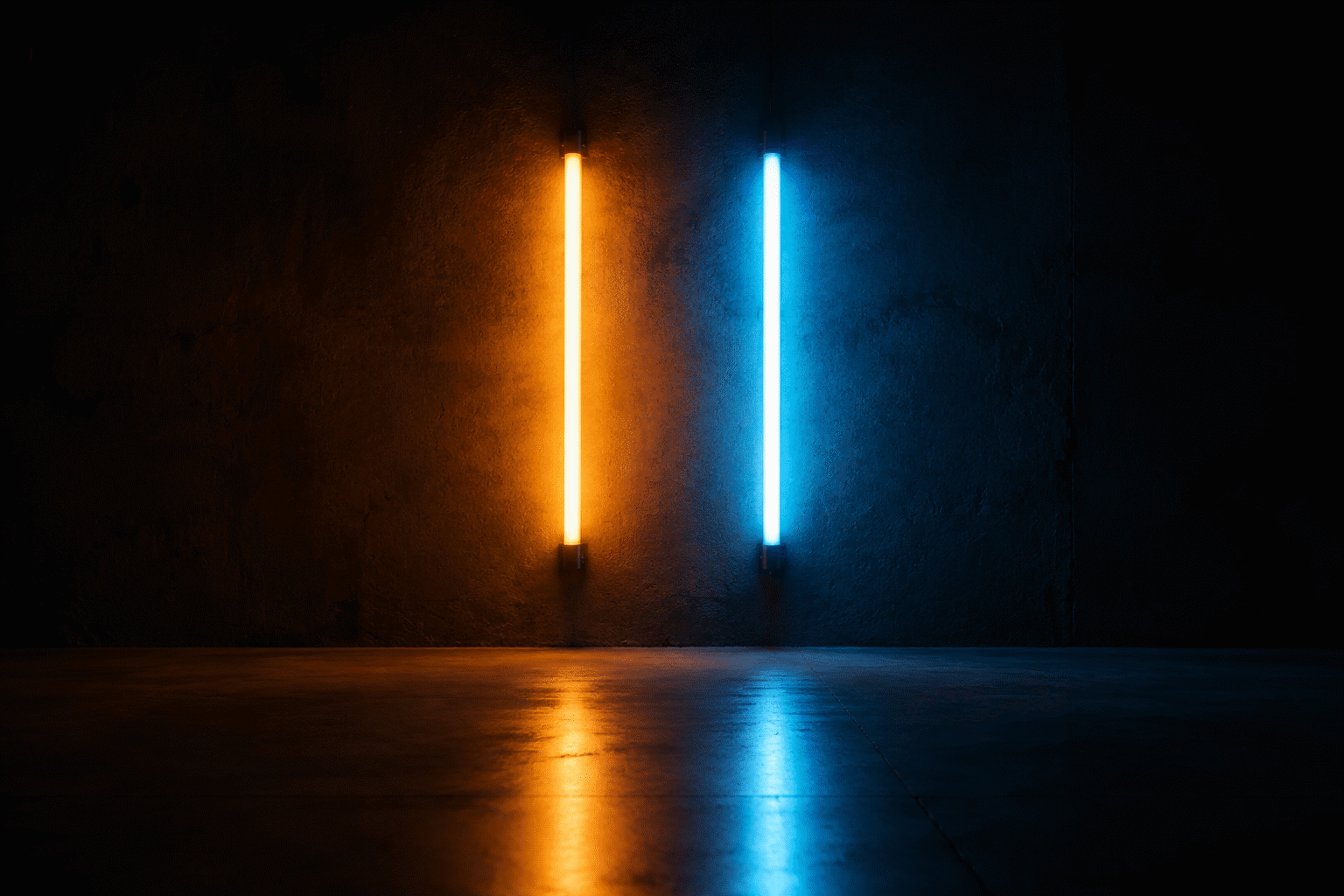
Choose cool white when the room’s job is precision — grooming, tasks, tech aesthetics, the spa-clean register. Cool white reads hygienic and sharp (ice-adjacent aesthetics), suits black-and-white schemes, and supports alertness in work zones. Bathrooms, studios, minimalist tech rooms: cool or natural.
Choose natural white when the room does both — the increasingly common open-plan answer: 4000K balances day function and evening mood without committing either way.
The Mixed-Temperature Error (And Its Fixes)
The most common white-sign mistake: new sign at one temperature, room’s existing lighting at another. The fix is always alignment —
- Inventory the room’s bulbs first (phone cameras exaggerate; the eye at dusk is the honest instrument — do the bulbs read golden or white?)
- Match the sign to the room’s dominant temperature, or commit to changing the bulbs to match the sign (often the better project: the sign becomes the room’s lighting standard)
- Multi-sign walls must share temperature — two white signs at different Kelvins fight each other more obviously than any hue mismatch (multi-sign method)
Kelvin and the Rest of the Palette
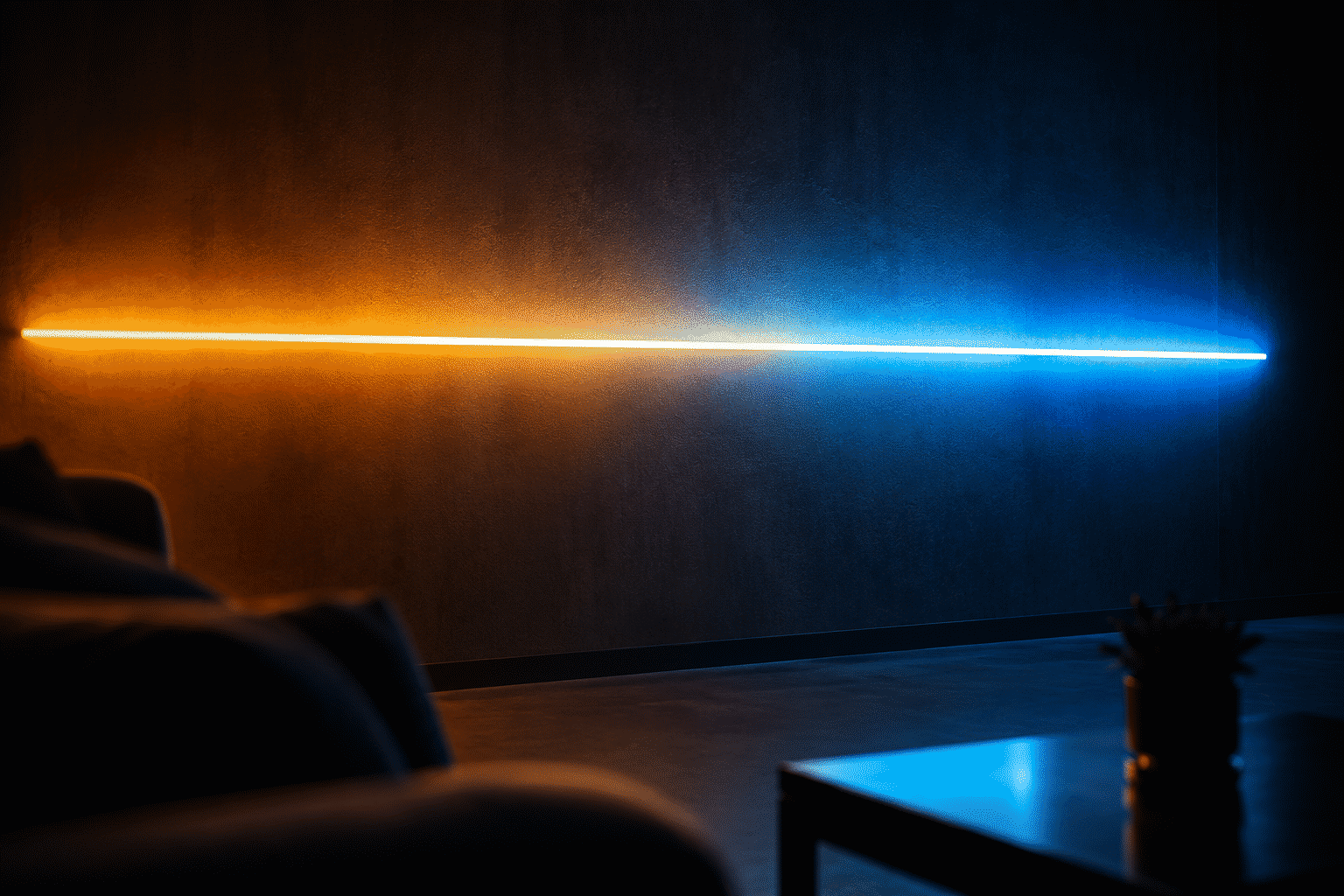
Temperature thinking extends past white: every glow has a temperature character — pinks and ambers are warm-family, blues and greens cool-family — and the mixing rules apply palette-wide: warm-glow signs live easiest in warm-light rooms (the combinations logic). White’s internal scale is just where temperature is most visible and most controllable.
Designing with Temperature (Order of Operations)
- Decide the room’s register: evening (warm) / task (cool) / both (natural)
- Check the existing bulbs and align
- Pick the white on the table above — when torn between two, choose toward the room’s evening use
- Plan the dim story: warm white at 15–20% is the premium low glow; cool white dimmed reads moonlight
- Preview the exact temperature on your words — the custom builder renders the white families distinctly — then verify against the wall at your home’s evening hour
Galleries across the whites: white neon sign; the full aesthetic: white neon aesthetic.
The Temperature Matching Workbook
Temperature fluency in practice — the workbook’s five steps for any white-sign order:
Step one: inventory the room at dusk. Every lamp on, evening hour, phone away — the eye’s honest read: golden or white? Mixed rooms (some lamps warm, some cool) note the dominant; the sign matches the majority or the room changes for it.
Step two: name the room’s register. Evening rooms (bedrooms, living rooms, hospitality) default warm; task rooms (bathrooms, studios, offices) lean natural-to-cool; dual-purpose rooms take the natural middle (the matching table). The register names the temperature band; step one’s inventory confirms it.
Step three: choose within the band. The warm band’s internal choice (2700K softer-cozier versus 3000K slightly crisper — the linen-lamp versus gallery-lamp distinction); the cool band’s (5500K daylight-crisp versus 6500K+ clinical-icy — the studio versus spa distinction). Preview both within-band options on your words — the differences are real and the builder shows them (the preview).
Step four: plan the multi-sign discipline. Two-plus white signs share one temperature, always (the mixed-temperature error); the multi-sign wall orders its whites together, and the smart move is one order one day for matched batches. Older and newer signs on one wall: the newer order matches the older’s spec (families grow by adoption).
Step five: set the dim expectation per temperature. Warm white’s low register is candlelight (live at 15–20%); cool white’s is moonlight (reads brighter at the same dial — go lower); natural white’s evening behavior splits the difference. The temperature choice and the dim habit together create the room’s final register — two dials, one atmosphere (the dimming layer).
Five steps, ten minutes, and the “which white” question — the most consequential decision in white-sign ordering — resolves by method rather than guesswork (render your white here).
FAQ: Neon Color Temperature
What color temperature are white neon signs? White neon spans three practical bands: warm white (2700–3000K, candlelight-cozy), natural white (~4000K, neutral-clean), and cool white (5500–6500K, crisp-icy) — with makers offering the range, and temperature being the decisive “which white” choice.
Warm white or cool white for a bedroom sign? Warm white, almost always: it’s the sleep-compatible, skin-flattering, lamp-culture-matching register. Cool white belongs in bathrooms, task zones, and tech-minimal schemes (the bedroom map).
What does 3000K or 4000K mean on a neon sign? Kelvin ratings — light’s color-temperature scale (counterintuitively, higher = cooler-looking). 3000K is warm-golden; 4000K is neutral; 6000K+ is icy. The scale, references, and room matches are the table above.
Can you mix warm and cool white neon signs in one room? Avoid it — mixed temperatures fight more visibly than any color mismatch. Align all white signs to one temperature (and ideally to the room’s bulbs); change the bulbs if the sign’s temperature is the better standard.
Which white neon is closest to natural daylight? The 5000K “daylight white” band — noon-neutral, crisp and energizing: studios and task spaces; for living rooms, natural 4000K is the more livable daylight cousin.
Does neon color temperature affect sleep? Yes, as all light does: cool whites carry the alerting short wavelengths and want dimming discipline at night; warm whites at low dim are the sleep-compatible glow (the science).
The temperature summary: white’s three lights (warm, natural, cool) naming evening, balance, and precision; the room-matching table; the mixed-temperature error and its alignment fixes; and the five-step workbook that resolves which-white by method (render your Kelvin). Temperature is the most consequential invisible choice in sign ordering — nothing about the sign changes except its entire feeling, and the room’s lamps always hold the deciding vote. Do all neon sign makers offer all three white temperatures? Quality makers carry warm, natural, and cool whites across their lines; budget listings often ship one unmarked white (typically cool) — which is how mismatched rooms happen by default (the mixed-temperature error). The order-time discipline: the temperature stated in the spec, not assumed from the listing photo — the three whites are as different as three colors, and the builder’s preview shows each honestly (preview yours).
Can I get a neon sign that shifts between warm and cool white? Yes — tunable-white builds exist (dual-channel white LEDs mixing across the Kelvin range on a dimmer or app (the smart layer)), delivering the morning-energetic to evening-cozy transition in one sign. The honest trade: tunable whites run at a premium over single-temperature signs and sacrifice a little peak brightness per mode — for most rooms, choosing the right single temperature and dimming it well outperforms the tunable feature in practice.
Match the room, commit to one temperature, dim with intention — the three habits that make the invisible choice visible only in how right the room feels.
Sources & Further Reading
- Neon: Strong Lines (NIST Physical Reference Data) — the standard reference for neon’s emission wavelengths.
- Neon sign (Wikipedia) — the consolidated public record of neon-sign history and technology.