
Blog
22 Garage Neon Sign Ideas for the Home Workshop
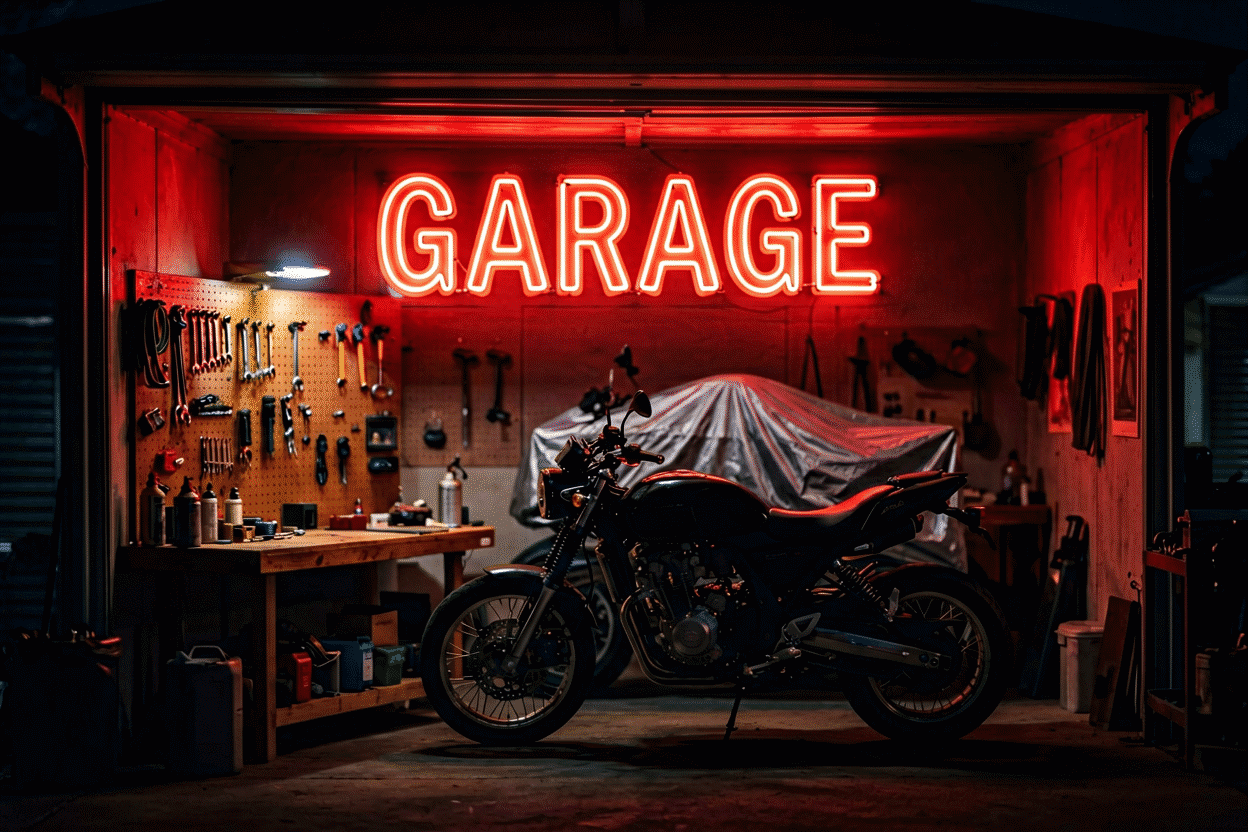
The garage is the last room in the house where the decoration still has to tell the truth. Inside those walls, a sign earns its place by matching what actually happens there: the project on the lift, the Sunday wrench session, the beer fridge that’s technically for “emergencies.” Garage neon is workshop signage first and decor second — which is exactly why it looks better than anything the living room gets.
Here are 22 ideas organized by garage type, from the working shop to the finished man-cave-garage hybrid, with the placement and power notes that matter in a room full of tools. The broader basement-and-garage collection lives at man cave neon signs.
The Working Garage: Ideas 1–7
Signs that survive sawdust, sparks, and a man who measures twice.
- “Garage” in vintage gas-station script — the single most-built garage piece: warm white or amber script, the 1950s service-station register. It works because the garage is the last building type that still looks right under vintage signage.
- “Open” on the roll-up door’s inside face — the joke that greets you every time the door goes up: the garage as private business. Small, red or warm white, mounted at head height.
- “Est.” + the year you got the house — the ownership marker; pairs with a last-name piece for the full deed treatment.
- A wrench or piston shape — the zero-word workshop piece; hang it over the tool chest and let the wall explain itself.
- “Measure Twice” — the woodworker’s creed in light; the joke every visitor who’s ever cut a board short will quote back at you.
- “Do Not Touch” — over the good tools, the project car, or the reloading bench. A rule posted in neon is a rule that gets followed.
- “Hustle” (the build) — for the garage that moonlights as the side-business HQ: the grind-culture classic, usually in red or ice blue.
The Garage Bar: Ideas 8–13
The garage fridge grew up and brought friends.
- A beer script in amber — the classic American builds lead this tier; the bowtie format fits the narrow wall beside the fridge.
- Howdy in burnt orange — the friendly register for the garage that hosts the neighbors; matches oil-stained concrete better than any pastel ever could.
- No Vacancy — when the folding chairs are full, the sign handles the announcements.
- “Cold Beer” in ice blue — the two-word menu; the most efficient piece of signage ever hung in any room of any house.
- “The [Name] Garage Co.” — the fictional-establishment custom: your surname + Garage Co., in workwear-inspired block. Free preview in the customizer.
- A racing-flag or checkered piece — for the garage that serves a car; pairs with the number piece below.
The Motorsport Garage: Ideas 14–17
- The project car’s number — one oversized numeral in racing red; the Le Mans register for a Miata, a Mustang, or a kart.
- A car-logo piece — the automotive guide covers the full lineup; the garage wall is where a logo piece reads as devotion rather than decoration.
- “Pit Crew” or “Pit Stop” — the maintenance-bay humor for the household where the owner does all the wrenching.
- A piston-and-flag combo — two small shapes flanking a workbench window; the tier for walls that already have too many words.

The Finished Man-Cave Garage: Ideas 18–22
Epoxy floor, insulated walls, and a sign budget to match.
- An orange statement piece — warm orange is the garage’s native neon color: it reads like late-afternoon light through the door, flatters tool chests and pegboard, and never fights the cars.
- A yellow initial — the oversized family initial in marquee yellow; the single-letter build is the strongest flex on a big finished wall.
- The sports piece — team name in franchise colors (the NFL ranks); the finished garage is the room where fandom gets permanent housing.
- A game-day double — “GAME DAY” over the TV wall plus the garage bar piece on the fridge wall: the two-piece system that runs the whole fall calendar.
- The retirement piece — “Gone Fishin’” or the boat name, hung where the daily-driver used to park; the sign that announces the garage’s next era.
Placement and Power in a Room Full of Tools
Garage walls are less forgiving than basement walls, so the placement rules earn their keep. Over the workbench, keep the sign at least 18 inches above the highest tool on the pegboard — you want it lighting the work, not blocking it. On the wall between the overhead doors, center the piece between the door tracks where the eye lands on entry. And anywhere near the compressor or the welding corner, mount high: heat rises, and while LED neon runs cool (the numbers), the power supply wants clean air.

For hanging: drywalled garages take the standard anchor method from the hanging guide; exposed-stud walls are easier (screw straight into the stud, no anchor needed); and finished garages with metal-lined walls use the stand-off bracket trick the same guide covers. Dust management is the one garage-specific chore — a monthly pass with the dry method from the cleaning guide keeps sawdust from baking onto the tubes.
The Garage-Specific Engineering
The garage is harder on neon than any other room in the house, and the pieces that survive it are the ones bought with the room’s physics in mind.
Temperature swings. Attached garages ride the seasons and detached ones ride them harder; quality LED neon handles the typical insulated range without complaint, but the power supply is the sensitive component. The working rule: mount the adapter off the floor (cold air pools), away from the door’s weather zone, and in open air rather than a cabinet. The unheated garage in deep-freeze climates wants the piece brought in for the season – the LED tubes forgive, the electronics remember.
Dust and grit. Garage air has texture – sawdust, brake dust, the lawn equipment’s exhaust – and it lands on everything at head height. The maintenance discipline is the dry method monthly rather than quarterly: a soft brush pass and a microfiber wipe before the dust bakes in. The piece over the workbench collects fastest; the piece over the bar zone collects slowest – the placement decision is also a maintenance decision.
Vibration. The compressor, the door’s opener, the hammering – the garage vibrates, and wall-mounted pieces feel it. The mounting wants the anchor method rather than adhesives alone (the guide covers both): the screw-anchored backing board rides the vibration; the adhesive-mounted one eventually doesn’t.
The Garage Budget Map
Three tiers, garage-adjusted: the working phase ($60-150) runs the vintage script or the tool shape – the honest pieces that match the room’s current function, bought cheap because the working phase is hard on everything. The finishing phase ($150-400) adds the bar tier and the namepiece – the pieces that arrive with the epoxy floor and the insulated walls. the finished room ($400-900) runs the full hybrid: the man-cave crossover wall, the sports corner, the custom charter.
The phase discipline saves real money: the pieces bought for the room’s current phase get used hard and retired without guilt; the pieces bought ahead of the phase (the expensive custom in the dusty workshop) age before their room does. Buy the honest piece now, the anchor when the floor goes down, the collection when the room earns it.
Variations and Pairings
The garage canon’s variant faces and pairings. The word-face variants: “garage neon signs,” “neon signs for garage,” and “workshop neon sign” reach the same ideas through different doors – the working-shop face leaning the tool tier, the finished-garage face leaning the bar and sports tiers (the landing tier for the commercial split). The crossover faces: the garage-bar runs the home-bar canon; the garage-gym runs the gym canon; the motorsport garage runs the automotive tier – the garage being the house’s most multi-purpose room, its sign canon inherits from every specialty it hosts.
The pairing logic: the garage’s pieces pair by work-zone – the workshop tier over the bench, the bar tier over the fridge, the car tier over the bay – each zone’s pieces staying within the zone’s sightline. The garage that mixes zones (the joke over the workbench, the wrench over the fridge) reads disorganized in a way the living room never quite manages to.
The upgrade pairing: the garage’s upgrade path pairs the room’s finishing – the epoxy floor’s arrival earning the charter commission, the insulation’s completion earning the sports wall – the sign program tracking the room’s build-out phase by phase (the budget map above).
FAQ About Garage Neon Signs
Will temperature swings in a garage hurt an LED neon sign? No — quality LED neon handles the typical insulated-garage range without complaint. The real enemy is condensation on the power supply: mount the adapter off the floor, away from the door’s weather zone, and an unheated garage stays fine in all but deep-freeze climates.
What’s the best sign for a garage that’s still a working shop? A vintage “Garage” script or a tool shape — pieces that match the room’s honest function. Save the expensive customs for after the epoxy floor goes down; the working phase is hard on everything, including glass-adjacent decor.
How do I light the workbench without killing the mood? Two layers: keep the shop lights for the work, and let the neon handle the mood. A small piece over the bench on a separate switch gives you the 9 p.m. project glow without the fluorescents.
One sign or several? Working garage: one. Garage bar: two (the beer piece plus one joke). Finished hybrid: three is the comfortable ceiling per sightline — after that, the room starts reading like a dealership.
How long do LED garage signs last? Quality LED neon runs 30,000-50,000 hours of service (the lifespan facts) – at the garage’s realistic schedule of a few evening hours per week, that is a decade-plus of glow, and the pieces that fail early almost always fail at the power supply rather than the tubing. The garage-specific longevity factors: the temperature swings (the adapter’s placement matters more than the tube’s), the vibration (the anchored mount rides it out), and the dust (the monthly dry pass – the cleaning method – prevents the baking that shortens everything). The sign that outlives its garage’s remodel was bought mid-tier and maintained monthly.
Can I run a neon sign in an unheated garage through the winter? Insulated attached garages: yes, without qualification – the LED tubing handles the range, and the adapter placed off the floor and out of the door’s weather zone stays within its comfort band. Unheated detached garages in hard-freeze climates: seasonally – bring the pieces in for the deep-winter months rather than testing the electronics’ low end, and re-hang in spring (the temperature logic covers the heat side; the cold side is the adapter’s, and the adapter remembers). The garage that runs its signs April through November never notices the limitation.
Sources & Further Reading
- Neon sign (Wikipedia) — the consolidated public record of neon-sign history and technology.
- Mercury (U.S. EPA) — federal guidance on mercury exposure and safe handling.
Pricing based on CustomNeon’s current catalog (2026); custom quotes come live from the sign builder.