Blog
20 Home Office Neon Signs for Focus and Flex
The home office is a room built on a promise: that you’ll do your best work here. The neon on its wall is either a part of that promise or a violation of it — the difference between “Hustle” glowing over the desk (the room’s engine) and a random lamp glowing in a corner (the room’s apology). The home office earns the most functional neon in the house.
Here are 20 ideas by the office’s jobs — the work sign, the meeting-call wall, the focus system, and the closing-time ritual — with the on-camera and engineering notes that make them work. The commercial-office canon lives separately at office neon sign ideas.
The Work Signs: Ideas 1–6
- Hustle — the grind register’s flagship: the word works because it reads as both instruction and identity. Red for intensity, ice blue for the tech room.
- Do What You Love — the gentle-contract version; the freelancer’s sign, and the one that re-signs you daily.
- The business namepiece — your company or practice’s name in the brand font (free preview): the room stops being a spare bedroom the day it goes up. The commercial tier of this lives at the open signs hub.
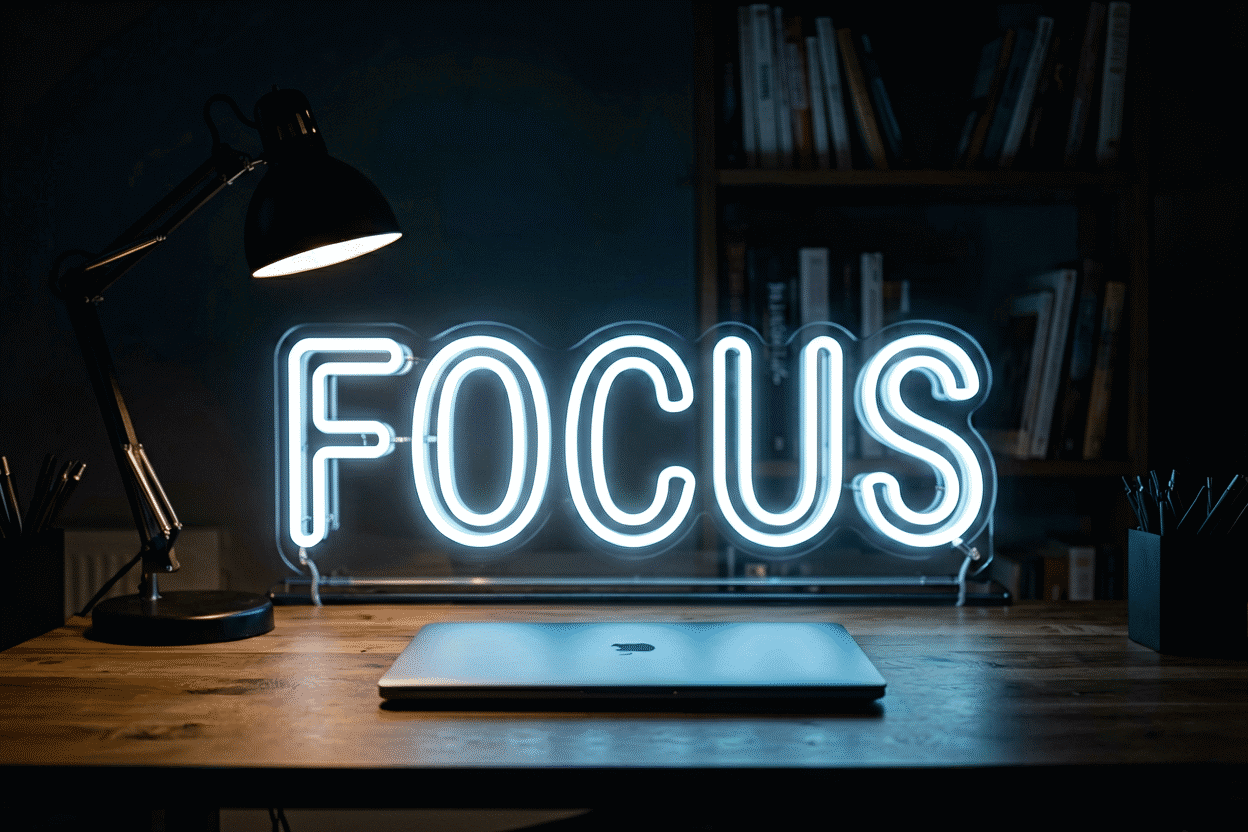
- “Focus” — the one-word instruction; strongest in warm white at 40%, the brightness that means it.
- “Deadlines Are Closer Than They Appear” — the joke that carries the deadline-driven household; humor as pressure management.
- The motivational canon — “No Days Off,” “Work Hard in Silence” (the full archive): the tier that runs from sincere to ironic depending on the career stage.
The Meeting-Call Wall: Ideas 7–11
The wall behind you on every video call — the most-viewed wall of the remote era.
- The namepiece, shoulder-mounted — your name or the business’s, off-center behind the camera-facing shoulder: the composition that reads “brand” in the first three seconds of every call.
- “On Air” / Live On Air — the do-not-disturb signal for the household: meetings glow, family learns within a week (the broadcast tier).
- “In a Meeting” — the status sign for the calendar-less; the piece that ends the interruption era.
- The credential wall accent — a small neon piece over the degrees and credentials: the glow that makes framed paper read like an installation.
- The depth trick — neon behind a shelf of books or plants: the two-camera-call parallax that reads “designed” on every platform (composition mechanics).
The Focus System: Ideas 12–16
- The bias-light piece — glow behind the monitor at low brightness: less eye strain in long sessions, and the room’s softest work light.
- The two-mode brightness — full for the morning deep-work block, 30% for the afternoon email hours: the dimmer as a work-mode switch (the power math rounds the cost to zero).
- The warm-vs-cool decision — cool registers (blue, white) for analytical work rooms, warm (amber, soft white) for creative ones: the color-temperature call that the gaming crossover covers from the focus side.
- “Do Not Disturb — Genius at Work” — the door tier; the joke that protects the deep-work block.
- The shutdown ritual — the sign on a smart plug that goes off at closing time: the work-from-home boundary, enforced in light. The single best $2 of remote-work equipment after the chair.

The Personality Tier: Ideas 17–20
- The hobby piece — a guitar for the player, a ball for the coach, a rod for the angler: the reminder wall that work funds the rest.
- “Boss Mode” / “CEO of This Room” — the solo-operator register; humor that scales with the title’s absurdity.
- A skyline or map piece — the city you sell into or the place the money’s going: the aspiration tier, glowing at the edge of the desk’s sightline.
- “5:30” or “Clock Out” — the closing-time piece, on the timer that means it; the sign that ends the workday when the discipline won’t.
Placement and the On-Camera Rules
The home office runs two sightlines: yours (the monitor-facing view — the focus pieces live here, at the screen’s edges, never competing with it) and the camera’s (the wall behind you — the brand pieces live here, shoulder-mounted, out of the lens-flare band). The two-wall system is the whole layout: work signs face you, brand signs face the world, and the door gets the status tier.

Brightness runs by clock: full through the deep-work morning, 40% for calls (compressed video amplifies glow — the meeting wall runs cooler than the room looks), 25% for the evening wind-down, and off at closing time. The sign that goes dark at six is doing psychological work no productivity app has ever managed.
The Remote-Work Contract: Boundaries in Light
The home office’s deepest problem isn’t decor – it’s boundary: the work that never ends because the room never closes. The sign program, run deliberately, becomes the boundary’s mechanism.
The opening ritual. The sign on the smart plug at 8:30 (the glow that opens the office) is the commute the remote worker doesn’t have – the ten-second transition that tells the brain which room it’s in. The psychology is small and real: the lit sign is the workplace, the dark sign is the spare bedroom, and the same physical space reads two ways by the light (the power cost of the daily ritual rounds to zero).
The closing ritual. The sign off at six (the timer that means it) is the boundary the discipline won’t enforce alone – the remote worker’s version of the parking garage walk. The offices that run the closing ritual report the same thing: the work finds its edges again, and the evening that follows belongs to the household (the shutdown piece tier exists for exactly this).
The status tier. The “In a Meeting” and Live On Air pieces are the household’s contract – the sign that says the door stays closed, the meeting that says the interruption waits. The family learns the sign’s language within a week (the broadcast tier); the office that runs the status tier stops apologizing for the door.
The Office Budget by Career Stage
The starter desk ($80-200): the work word (“Hustle” or “Focus”) and the bias-glow strip – the corner that means it. The established office ($200-500): the meeting-wall namepiece or logo (preview), the dimmer stack, the status tier – the room that brands every call. The business-front office ($500-1,200): the full two-wall system, the credential accent, the closing-ritual automation – the room that carries the company’s identity (the office canon runs the commercial tier).
The budget’s one rule: the camera-wall piece (the name or logo behind the shoulder) outperforms everything else per dollar – it brands every call, every video, every screenshot the career generates (the composition rules cover its placement).
FAQ About Home Office Neon Signs
What’s the best neon sign for a home office? The one that matches your contract with the room: “Hustle” for the intensity room, Do What You Love for the passion room, or the business namepiece for the brand room. The customizer previews all three.
Do neon signs look professional on video calls? One warm-white or brand-color piece, shoulder-mounted at 40% brightness, reads as designed — the composition most remote professionals converge on. Three pieces at full power reads dorm; the placement mechanics cover the angles.
Will neon distract me while working? Not at the edges and not at low brightness: bias-glow behind the monitor actually reduces fatigue. The failure mode is a bright piece in the direct sightline — keep the glow peripheral and the focus intact.
Where should the sign go — behind me or behind the monitor? Both walls, different jobs: brand and status pieces behind you (the camera wall), focus and bias pieces behind the monitor (your wall). The streamer guide covers the camera-wall system in depth.
What neon sign looks professional on video calls? One warm-white or brand-color piece, shoulder-mounted, at forty-percent brightness: the composition that reads designed on every platform – the identity in the frame’s upper corner, the glow soft against the wall, and nothing competing behind the head (the meeting-wall rules above). The pieces that read unprofessional: the three-piece pile at full power (the dorm read), the head-center sign (the photo-booth read), and the lens-flare band (the un-audited reflection). The ten-minute camera-phone audit at the desk chair catches all three before the next call does; the office that passes it brands every meeting it takes.
Should my home office neon sign turn off at a set time? Yes – the shutdown ritual is the work-from-home boundary that no productivity app enforces (the closing-time logic above). The smart plug’s timer (the sign off at six, the room dark, the spare bedroom returned) costs two dollars and does the psychological work of the commute the remote worker doesn’t have. The morning half (the sign on at eight-thirty, the office opened) completes the ritual – the room that opens and closes by light keeps the work in its place, and the evenings that follow belong to the household.
The WFH Office vs the Client-Facing Office
The home office’s two modes, compared:
| Decision axis | The WFH office | The client-facing office |
|---|---|---|
| The audience | The household (and the worker’s own morale) | The clients (every call’s background) |
| The pieces | The work words, the bias glow, the shutdown ritual | The namepiece, the credential accent, the branded composition |
| The composition | The two-wall system, self-facing | The camera wall, world-facing (the rules above) |
| The budget | $80-300 (the function’s price) | $200-600 (the brand’s price) |
| The brightness protocol | The work-clock (full-to-closed) | The call setting (the forty-percent band) |
| The risk | The distraction piece (the sightline discipline) | The unprofessional read (the register discipline) |
The two modes’ shared foundation: the two-wall system (the camera wall and the monitor wall – the streamer logic applies) and the brightness clock (the morning’s full through the closing’s dark). The WFH office runs them for the worker’s day; the client-facing office runs them for the call’s frame – the same physics, different audiences (the office canon covers the commercial tier).
The hybrid office (the WFH room that takes the occasional client call) runs the client-facing tier’s camera wall at the WFH tier’s budget: one shoulder-mounted piece (preview), the forty-percent setting, and the audit that keeps the frame professional – the $150 upgrade that covers the mode switch. Do neon signs help with productivity? Indirectly, through the mechanisms that matter: the boundary ritual (the sign that opens and closes the office – the shutdown logic above – doing the commute’s psychological work), the mood layer (the warm register at the working brightness doing what the fluorescent never could), and the identity cue (the “Hustle” or “Do What You Love” that re-signs the daily contract). The productivity literature’s honest finding: environment beats willpower, and the light that makes the room a place you want to work is the environment’s cheapest lever. The office neon that runs the rituals (the opening, the closing, the mood) outperforms the office neon that merely glows – the difference between the tool and the decoration.
Sources & Further Reading
- Neon sign (Wikipedia) — the consolidated public record of neon-sign history and technology.
- Neon, element 10 (Wikipedia) — element properties: density, boiling point, abundance.
Pricing based on CustomNeon’s current catalog (2026); custom quotes come live from the sign builder.