LED Neon vs Glass Neon: The Real Differences
LED neon beats glass neon on price (roughly a third to a tenth the cost), safety (12 volts vs. 2,000–15,000), energy (a quarter the draw), durability (silicone vs. glass), and control (native dimming and RGB) — and glass neon still wins, honestly, on the qualities purists won’t trade: the depth of its halo, the warm micro-flicker of a real gas discharge, and the fact that it’s a century-old craft object rather than an engineered product. Everything else in this comparison is detail under those headlines.
The mechanics behind both (glass, LED) have their own guides; this is the decision page: the five-dimension comparison, the honest visual case for each, and the verdict by use case.
The Five-Dimension Table
| Dimension | Glass neon | LED neon |
|---|---|---|
| Upfront cost (typical home sign) | $500–2,000+ | $100–300 |
| Power draw | ~4–10x LED | 10–30W typical |
| Lifespan | Decades (with servicing) | 30,000–50,000 hrs |
| Breakage risk | High — glass under vacuum | Low — silicone-jacketed |
| Voltage domain | 2,000–15,000V transformer | 12–24V adapter |
| Maintenance | Professional (re-pumps, transformers) | DIY-friendly (adapters, connectors) |
| Dimming | Possible, transformer-matched engineering | Native, remote/app, zero color shift |
| Colors | Gas + phosphor palette, fixed at make | Any color; RGB changes on the fly |
| Installation | Professional, code clearances | Self-install, 30 minutes |
| Repair economics | $150–400 per service visit | $20–60 DIY part swaps |
The Case for Glass (Where It Genuinely Wins)
The purists aren’t wrong, and a comparison that pretends otherwise is marketing. Glass neon’s advantages are real:
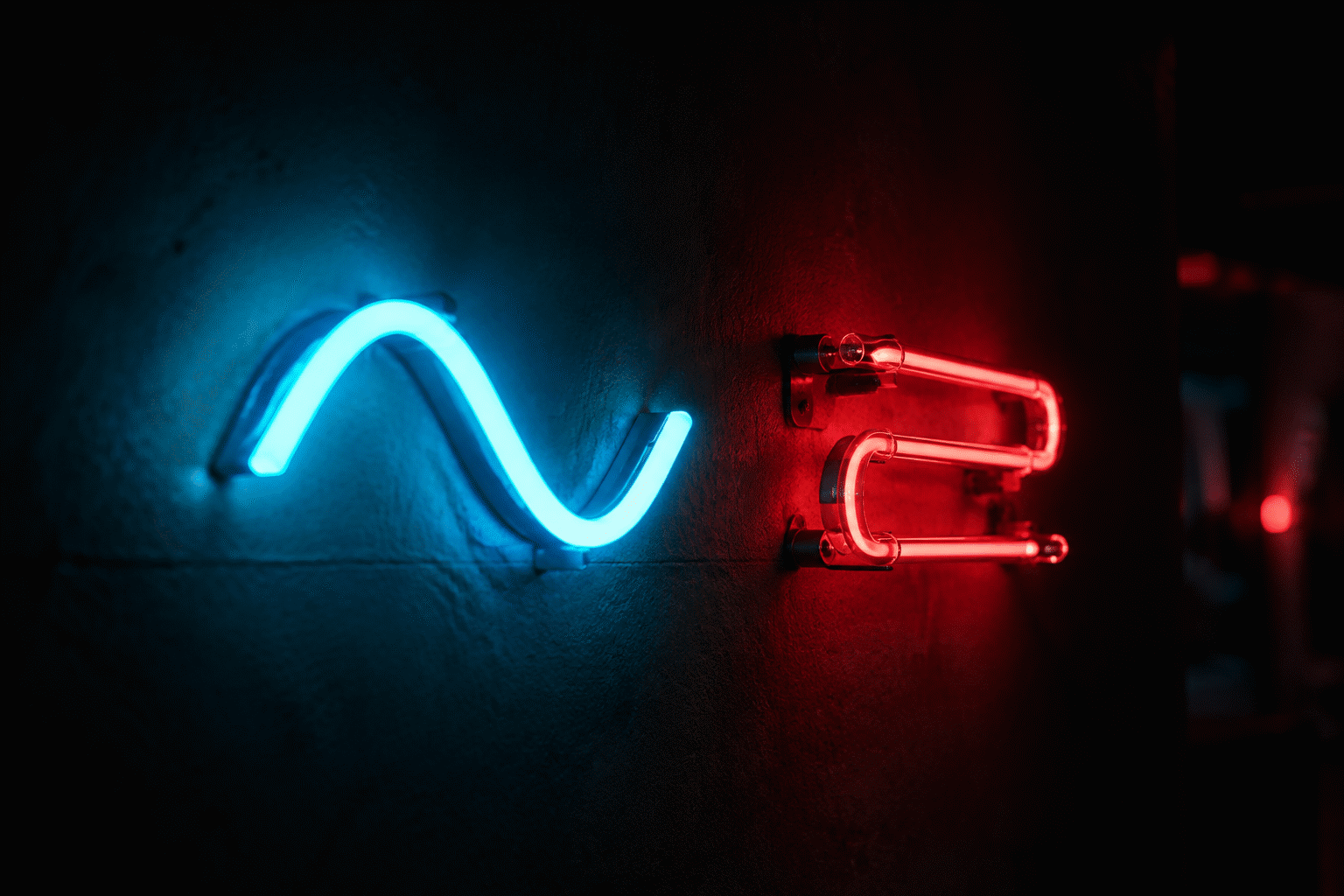
- The halo. A gas discharge throws light differently than diodes in silicone — a deeper, warmer, slightly organic radiance with genuine 360-degree tube emission. At close range and in dark rooms, the difference is visible to anyone who looks.
- The living quality. Real tubes micro-flicker at start, hum faintly, warm up. LED’s flawlessness reads, to some eyes, as sterile; glass’s imperfections read as alive — the vinyl-vs-tube-map of lighting.
- Craft and permanence. A hand-bent glass sign is an artisan object with serviceable decades and heritage value (the craft, the vintage market). It’s the medium of landmarks, museums, and serious storefronts.
- Daylight presence. Unlit, a glass sign is still a designed glass object; LED signs unlit read closer to hardware.
The Case for LED (Where It Wins Decisively)
- The economics. A custom sign at $150–300 against $500–2,000+ for the same words in glass — the difference that moved the entire home and event market (cost structure).
- The safety architecture. 12 volts you can hand to a teenager installing; kilovolts you legally-and-wisely don’t (safety). Homes, bedrooms, and events run on this fact.
- The control layer. Dimming without color shift, RGB color changes, app schedules — native because the technology was born with electronics (dimming, smart signs).
- The practicalities. Cool-running (walls, kids, pets), lightweight (every mounting method), shippable without freight anxiety (packaging), outdoor-ratable by material choice (waterproofing), and maintainable with a screwdriver (repair economics).
- The visual gap — mostly closed. Quality high-density flex at proper viewing distance reads as neon; the difference lives at close range and in side-by-side purist scrutiny. For most rooms and most eyes, LED’s approximation has crossed the “good enough” threshold into “indistinguishable in practice” — assessment consistent with the market’s migration.
The Verdict by Use Case
| You’re buying for… | Verdict | Why |
|---|---|---|
| Bedroom / home decor | LED, no contest | Safety, dimming, price, the entire modern genre |
| Wedding / event | LED | Transport, battery power, one-event economics |
| Storefront / business | LED for most; glass for heritage brands | LED wins ROI and maintenance; glass wins identity and landmark ambitions |
| Bar / restaurant with retro identity | Either — glass if budget and installer exist | The halo earns its keep where atmosphere is the product |
| Landmark / museum / collector | Glass | Craft and permanence are the requirements |
| Content creation / gaming | LED | RGB, dimming, camera-safe, cheap to iterate |
| Sign you’ll move annually | LED | Silicone travels; glass dreads |
| Heritage building restoration | Glass | Period authenticity, code and all |
The Question Under the Question
“Which is better” usually hides “which is better for the wall I have and the money I’m spending” — and that answer is almost always LED for the modern buyer, with glass reserved for the cases in the table’s lower rows. The market already voted: the custom-sign industry is majority-LED because the technology democratized the aesthetic Georges Claude’s craft once priced at department-store levels (the history). But the department stores — and the bars, museums, and collectors keeping the craft alive — still commission glass, and long will.
Both worlds are browsable from here: the LED custom builder for the ninety-percent case, and our custom LED collection for the catalog version of the same decision.
Mixed Collections: When One of Each Is the Answer
The comparison’s practical resolution — the households and businesses that run both technologies deliberately:
The heritage-and-daily pattern. A vintage glass piece as the anchor (the bar’s authentic script, the collector’s restored classic — the vintage tier) plus LED signs for everything daily: the bedrooms, the seasonal accents, the experimental pieces. The glass satisfies permanence and craft; the LED satisfies change and quantity. The pattern dominates vintage-collector households, where the museum piece glows on occasions and the living collection rotates.
The statement-and-system pattern. Commercial installations running glass for identity (the storefront’s authentic craft piece — the medium’s halo effect on brand perception is real (the business logic)) and LED for operations: menu boards, wayfinding, seasonal promotions, the signage that changes. The glass justifies the premium where identity lives; LED’s economics win everywhere transience does.
The purist-and-practical household. One partner’s craft standards (glass only in shared spaces, the depth and flicker mattering aesthetically (the visual case)) meeting the other’s practical ones (LED in every bedroom, on every schedule (the smart tier)) — resolved by zone rather than argument. The living room runs heritage; the bedrooms run software.
The collector’s arc. Many glass collectors arrived through LED: the first custom sign teaches the aesthetic, the vintage bug follows, the collection bifurcates naturally (the collecting path). The reverse arc exists but thinner — glass owners adopting LED for utility spaces rather than sentiment. The market’s two technologies function as each other’s farm system.
The maintenance asymmetry in practice. Mixed-collection households learn the schedule split fast: LED pieces run the consumer rhythms (the maintenance guide) while glass pieces run the professional calendar — service visits budgeted annually, the craft relationship maintained. The two schedules coexist easily because they rarely touch: different rooms, different clocks, same glow.
The mixed answer’s summary: the technologies stopped competing the moment LED won the volume — what remains is complementarity, with each medium doing what it’s structurally best at. Choosing “LED or glass” today is usually choosing proportions, not sides.
FAQ: LED vs Glass Neon
Is LED neon better than glass neon? For most modern uses — homes, events, most businesses — yes: a third the cost or less, 12-volt safety, native dimming and RGB, silicone durability, and self-install. Glass wins on halo depth, craft character, daylight presence, and heritage value where those matter.
What’s the main difference between LED and glass neon signs? The light source: glass neon is gas discharge in hand-bent glass tubes driven by kilovolt transformers; LED neon is diode strips in silicone tubing at 12–24 volts. Same visual language, different physics, economics, and safety domains.
Do LED neon signs look as good as real neon? At typical viewing distance, quality LED reads as neon — the market’s migration is the evidence. Up close and side-by-side, glass throws a deeper, more organic halo that purists (correctly) notice. How much that difference matters depends on your wall and your eyes.
Which lasts longer, LED or glass neon? Glass, potentially: well-serviced tubes run for decades (the gas doesn’t burn away — tubes age at the electrodes and seals). LED runs 30,000–50,000 hours before meaningful fade. In practice LED’s maintenance-free years often beat glass’s serviced decades on hassle-adjusted lifespan.
Why is glass neon so much more expensive? Artisan labor — hand bending, vacuum processing, kilovolt engineering, professional installation — plus the trade’s scarcity. The craft premium is the price of hands and flame (the full breakdown).
Can LED neon signs be used outdoors? Yes, at the right rating — IP65/67 sealed builds with UV-stable silicone handle full weather, where glass outdoor installs are engineering projects. The waterproofing guide covers the ratings.
The Comparison FAQ, Extended
Can you mix glass and LED signs on one wall? Visually, yes with discipline — the technologies’ glow characters differ most at close range (the visual case), so mixed walls work when the glass piece anchors and LED pieces accent at distance, or when dimming harmonizes their brightness registers. The mixed collection’s deeper pattern: households and businesses increasingly run both deliberately, each medium doing its structural best (the mixed patterns).
Which technology holds its value? Glass, resoundingly — the craft tier appreciates as heritage (the vintage economics) while LED signs are consumables in value terms (the technology improves fast enough that used pieces price as outdated rather than classic). Buy glass for the object and its future; buy LED for the glow and the present. Only one of the two purchases is also an asset.
Is glass neon really being phased out? No — the craft persists as premium and heritage work: authentic storefronts, restorations, the art tier, and collectors keep the trade’s benches busy (the craft’s state). What ended was glass’s volume era. The phase-out narrative confuses market share with market existence: glass went from everywhere to special, and special has its own economics.
Sources & Further Reading
- Solid-State Lighting (U.S. Department of Energy) — DOE reference on LED efficacy and lifetime.
- Neon sign (Wikipedia) — the consolidated public record of neon-sign history and technology.
- Mercury (U.S. EPA) — federal guidance on mercury exposure and safe handling.
Pricing based on CustomNeon’s current catalog (2026); custom quotes come live from the sign builder.