Neon Signs vs LED Strip Lights: Which Wall Wins?
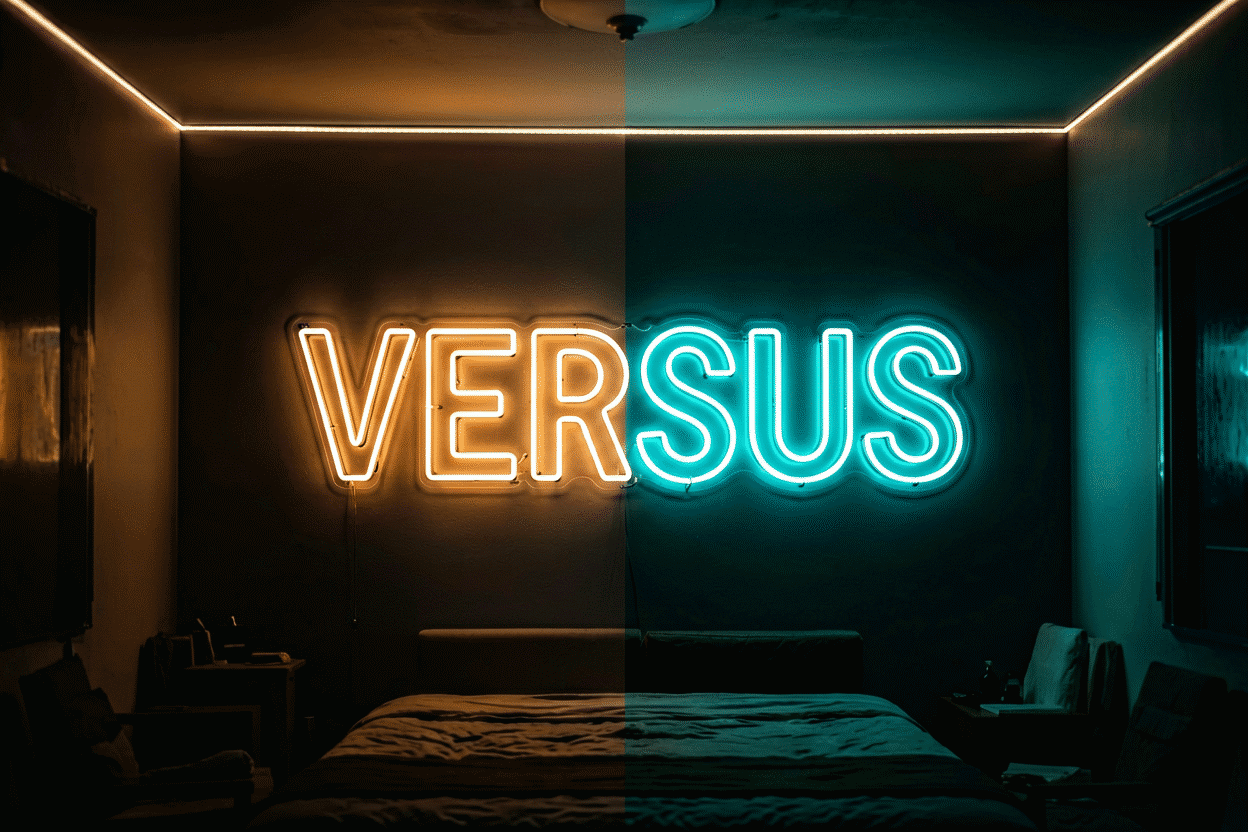
A neon sign is a finished statement — your words or a shape, glowing as a designed object. LED strip lights are raw atmosphere — flexible ribbons of light that wash walls, ceilings, and furniture edges in color. Choosing between them isn’t a quality contest; it’s a purpose contest: signs say things, strips set moods. The sign wins when the wall needs a focal point with meaning; the strips win when the room needs ambient color and the budget is a quarter the size. And the genuinely good answer, for a lot of rooms, is both.
This is the comparison for the decision you’re actually making at the store — the technology-generation comparison (glass vs LED neon) lives separately at LED vs glass neon.
What Each One Actually Is
Neon sign: LEDs (or gas, in glass neon) formed into a specific finished shape — letters, an icon, a logo — mounted to an acrylic backing, arriving as a complete designed object. It’s decor with a message: your name, your word, your symbol, glowing (design yours).
LED strip light: a generic ribbon of LED emitters on adhesive tape, cuttable to length, that you install along edges and surfaces. It’s lighting infrastructure, not an object — what it “says” is whatever the room’s architecture says, illuminated.
The Five-Dimension Comparison
| Dimension | Neon sign | LED strip |
|---|---|---|
| What it delivers | A focal object with meaning | Ambient color washes |
| Typical cost | $100–300 custom | $20–80 per room’s worth |
| Install | Mount one object (guide) | Run tape along edges — skill is in hiding runs |
| Visual role | The thing you look at | The thing that makes everything else look good |
| Customization | Your exact words/design | Color, brightness, and that’s the vocabulary |
| Flexibility | Fixed at order | Repositionable, re-shapeable anytime |
| Control | Remote/app dimming (guide) | Same, plus zone and music modes |
| Failure mode | One object, repairable (economics) | A dead segment means re-running |
| Statement value | High — personal, specific | Low — atmospheric, universal |
When the Strip Wins (Honestly, Often)
The strip-light case is real, and rooms full of only-neon are missing it:
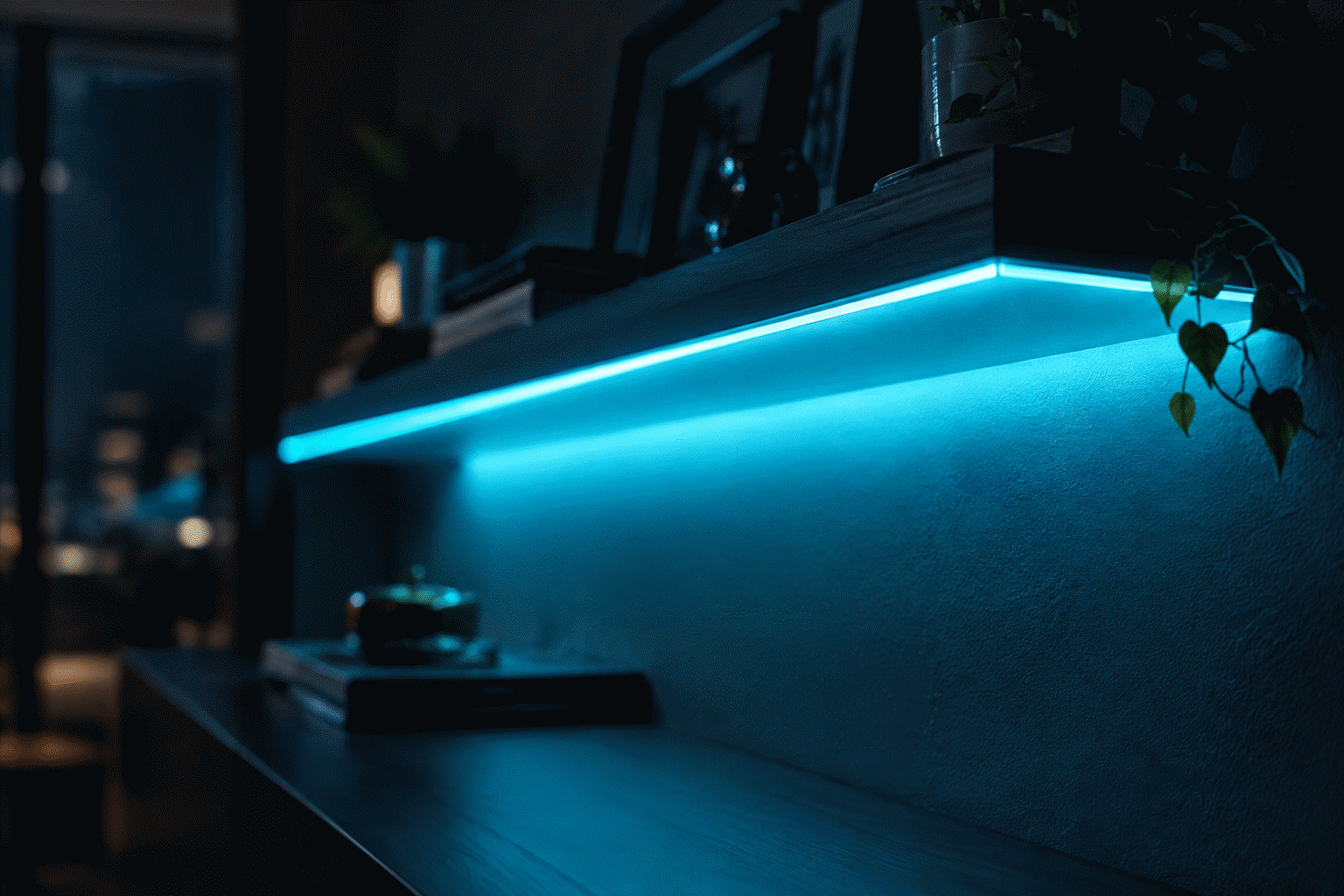
- The wash effect: strips behind headboards, under shelves, along coves deliver room-scale color that a sign physically cannot — the sign glows at one spot; the strip glows everywhere. For mood-first rooms (the bedroom color guide maps this layer), strips are the atmosphere engine.
- Budget arithmetic: $40 of strip lights transforms a room’s evening mode; a $200 sign makes one wall meaningful. Different purchases, both valid.
- Flexibility: renters and re-decorators re-shape strip installations weekly; a sign is a commitment to one wall and one message.
- The architecture play: strips make the room’s own lines glow (ceilings, steps, desk edges) — interior-design moves that no sign replaces.
When the Sign Wins (Why It’s Not Just Expensive Strip)
- Meaning: the strip cannot say your name, your word, or your brand. Specificity is the sign’s entire value proposition — it’s the difference between lighting and content.
- The focal point: rooms need something to look at; strips make everything else look good but are themselves invisible infrastructure. The sign is the destination the strips serve.
- Finished-ness: a sign arrives complete — designed, mounted, done. Strip installs live or die on your cable-hiding craftsmanship (the discipline).
- Photographs: in the camera frame, the sign is the subject; the strips are the grade (shooting glow).
- Daylight presence: strips are invisible off; a cut-to-shape sign is a designed object even unlit (backing aesthetics).
The Right Answer Is Often Both (The Layered Wall)
The rooms that photograph best — content setups, gaming walls, the aesthetic-era bedroom — run both technologies in their proper roles:
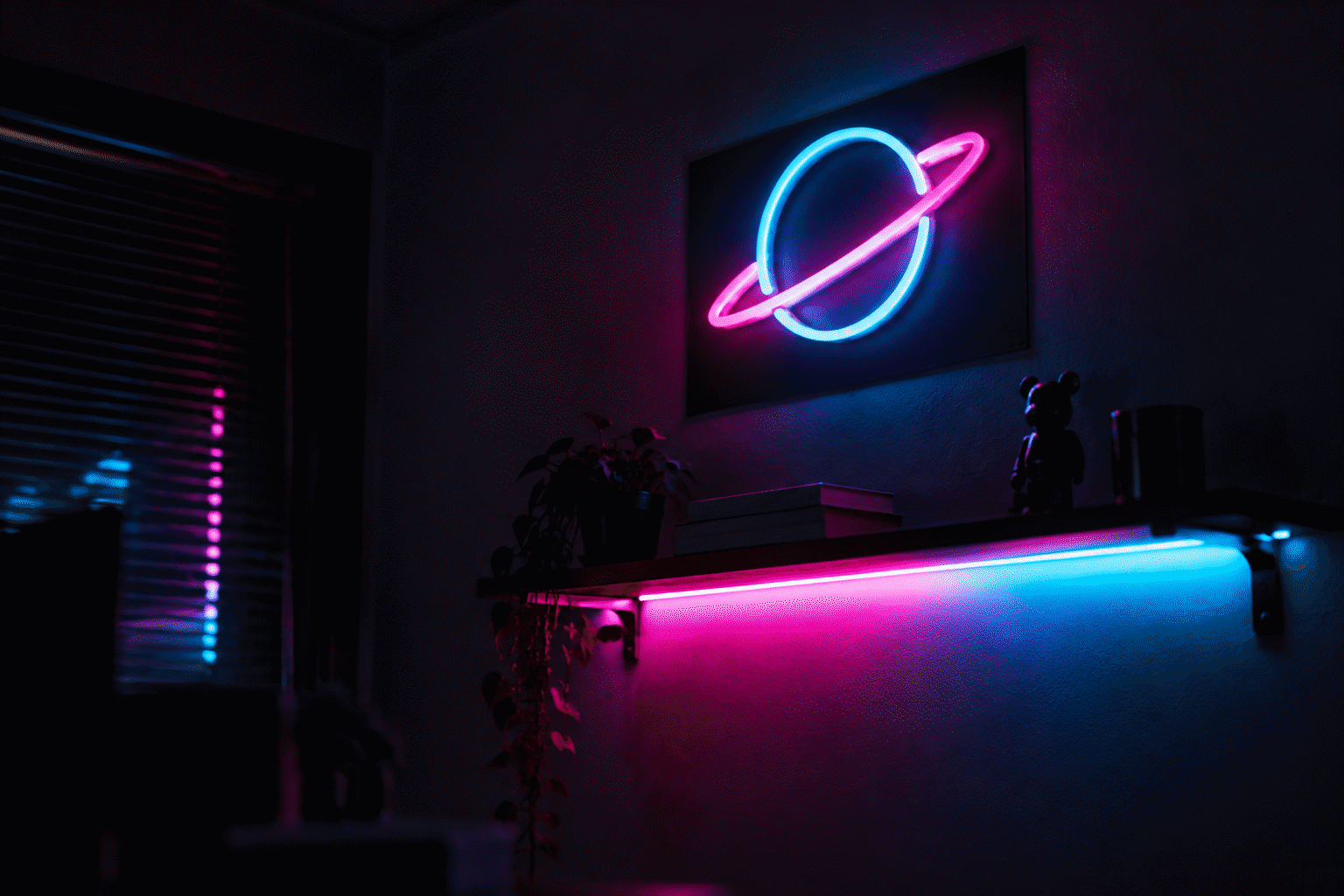
- The sign as the focal point: your wordmark or icon, centered, dimmable warm (the color logic)
- The strips as the atmosphere layer: behind-monitor bias lighting, under-shelf washes, cove runs in a complementary hue (gaming-wall patterns)
- One control philosophy: both dimmed for evening — strips and sign on the same schedule keeps the room coherent (dimming systems)
The combination delivers what neither alone can: a wall with something to say, bathed in the color that says it best.
The Sixty-Second Decision
- Wall needs a focal point with meaning → sign
- Room needs ambient color transformation → strips
- Budget under $60 → strips now, sign later
- Content/gaming wall → both, layered
- You change decor monthly → strips
- You want the thing that’s yours → sign — and it starts in the custom builder
Room Recipes: Three Completed Layer Setups
The both-technologies answer, as finished room recipes with parts lists:
The gaming battlestation (the classic layering). Base: LED strips behind the desk and monitor (bias lighting, the atmosphere wash) in a single cool hue. Statement: one LED neon sign — gamertag or icon — at the wall’s center (the gaming color logic). Accent: a second small strip under the shelf line, synced to the first. Control: everything on compatible dimmers, one evening scene (the layered method). Parts budget: $40 strips + $120–180 sign — the complete content-wall look at under $250.
The bedroom calm corner (the warm version). Base: warm-white strip behind the headboard (the hotel-glow wash at 2700K (the temperature logic)). Statement: a script wordmark or moon icon in warm white or soft pink above (the bedroom canon). No accent layer — restraint is this recipe’s third ingredient. Both layers dimming to the same 15% evening level. Budget: $25 strip + $100–150 sign — the most-photographed bedroom aesthetic at its honest price.
The home bar (the full ensemble). Base: amber strip along the shelf undersides (bottle-backlighting, the bartender’s wash). Statement: the vintage-register script sign — brand-era vocabulary in classic red or warm white (the bar canon). Accent: a small icon piece (stein, arrow) at the corner, plus the strip’s dimmer set to the evening register. Budget: $35 strips + $150–250 sign set — the room that reads as a pub on a condo budget.
The recipes’ shared grammar: strips wash, signs speak — the atmosphere layer goes on the architecture (edges, coves, undersides), the statement layer on the wall where eyes land (the division of labor). Control harmony is the finish work: both layers dimming together is what reads as designed rather than installed. Pick the recipe’s register (cool-content, warm-calm, amber-social), price it honestly, and the both-technologies answer assembles in an evening.
FAQ: Neon Signs vs LED Strips
Are neon signs better than LED strip lights? Different tools: signs deliver a meaningful focal object (your words, glowing); strips deliver room-wide ambient color. Signs win on statement and finished design; strips win on cost, coverage, and flexibility.
What’s the difference between LED neon signs and LED strips? LED neon signs shape light into a finished designed object on a backing; strips are generic adhesive ribbons installed along surfaces. Same diode technology, opposite product philosophy: content versus atmosphere.
Can LED strips look like neon? Approximately — strips in diffused aluminum channels or behind coves produce continuous line-glow, but they can’t form letterforms or stand alone as objects. For the neon look as a sign, that’s what LED neon flex (the sign material) exists for.
Which is cheaper, a neon sign or LED strips? Strips by far — $20–80 transforms a room versus $100–300 for a custom sign. The purchases solve different problems: atmosphere budget versus statement budget.
Should I use both neon signs and LED strips in one room? Yes, when layered deliberately: the sign as focal point, the strips as ambient wash in complementary colors, both on the same dimming schedule — the standard recipe for content walls and aesthetic bedrooms.
Do neon signs or LED strips last longer? Comparable LED lifespans (30,000–50,000 hours each); the practical difference is repairability — a sign’s faults concentrate in swappable parts (the economics), while strip failures usually mean re-running sections. The strips-versus-sign verdict, restated for the deciding buyer: strips for atmosphere and budget, signs for meaning and focus, both for the rooms that photograph best (the full comparison) — and the three recipes above prove the both-answer assembles in an evening at under $250. Whichever layer you buy first, buy it deliberately: the wall that starts with a chosen glow ends designed, and the wall that starts with whatever was cheap ends redone (design the first layer here).
The Final Recommendation, Personalized
If you stream or create: the both-answer, prioritizing the sign first (your words matter more than wash) — the recipes price the complete build under $250. If you decorate on a budget or rotate often: strips now, the sign when the room stabilizes. If you furnish a forever-home: the sign as focal point, strips as the atmosphere layer, both on the dimming schedule. And if you want the simplest possible strong start: one custom sign in the room’s dominant activity zone, dimming included — the strip question can wait until the wall tells you it needs washing too.
Every recommendation above shares one root: light with meaning beats light alone, and light alone beats no light at all — start where your budget and your wall agree.
Sources & Further Reading
- Solid-State Lighting (U.S. Department of Energy) — DOE reference on LED efficacy and lifetime.
- Neon sign (Wikipedia) — the consolidated public record of neon-sign history and technology.
Pricing based on CustomNeon’s current catalog (2026); custom quotes come live from the sign builder.