22 Business Sign Ideas by Industry and Budget

Every industry has its neon canon — the signs that trade’s century of storefronts converged on, plus the modern pieces the content era added. This is the cross-industry idea sheet: what works by trade, what it says, and where each piece’s budget lands. It’s the hub tier — each industry’s deep-dive links out from here.
The shopping lives at open signs; the decision playbook at small business neon signs.
Food & Drink: Ideas 1–6
- The restaurant’s phrase wall — “EAT” or the house specialty in glow (the restaurant canon): the table-side wall that photographs every plate.
- The café’s morning tier — “But First, Coffee” and the cup icon (the café canon): the register that owns the morning trade.
- The bar’s script — the house beer or the establishment’s name in amber (the bar canon): the evening trade’s street presence.
- The pizzeria’s slice — the icon tier that needs no translation (the pizza tier).
- The ice cream cone — the icon that sells to the minivan at 30 feet (the tier).
- The bakery’s warm register — “FRESH” or the pastry icon in amber (the bakery canon): the smell’s visual echo.
Beauty & Personal Care: Ideas 7–9
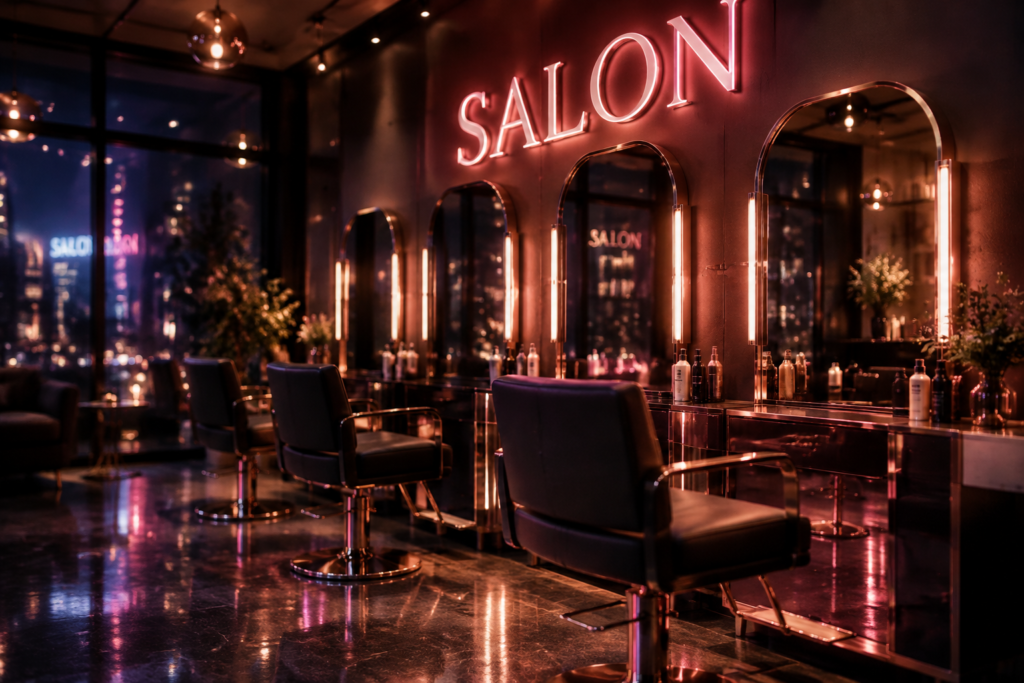
- The salon’s phrase tier — “Beauty Begins Here” and the script registers (the salon canon): the mirror-wall tier that photographs every client.
- The barbershop’s pole-adjacent — the trade’s blue-red or the revival’s nameplate (the barber canon): the walk-in trade’s century signature.
- The nail studio’s aesthetic — the pink-and-chrome tier (the nail canon): the content-era trade’s photographic register.
Retail & Style: Ideas 10–13
- The boutique’s brand piece — the shop’s name in its own aesthetic (the retail canon): the merchandise’s frame.
- The clothing store’s fitting-room tier — the phrase that photographs the try-on (“You Look Amazing”): the retail content engine (the retail guide).
- The tattoo studio’s edge — the trade’s iconography in bold registers (the tattoo canon): the trade whose brand IS the aesthetic.
- The smoke shop’s tier — the leaf and the coded registers (the smoke-shop canon): the trade-specific palette discipline.

Nightlife & Entertainment: Ideas 14–16
- The nightclub’s marquee — the venue’s name over the floor (the nightclub canon): the room’s headline.
- The venue’s “LIVE” tier — the music-status piece (the music canon): the calendar’s street signal.
- The arcade/entertainment tier — the game-era iconography (the gaming crossover): the fun-trade’s native language.
Services & Professional: Ideas 17–19
- The gym’s motivation wall — “No Excuses” over the racks (the gym canon): the fitness trade’s retention piece.
- The office lobby’s calm tier — the warm-white professional register (the office canon): the trust trades’ restraint.
- The dental-medical’s careful piece — the friendly register that never reads novelty (the tier): the trust trades’ specific discipline.
The Cross-Industry Tier: Ideas 20–22
- The open sign — every trade’s first purchase (the guide): the status tier that converts the street.
- The logo custom — every trade’s brand piece (the customizer takes files): the photographable tier that builds memory.
- The trade-show portable — the travel tier for the industries that sell off-site (the trade-show canon): the booth’s beacon.
The Budget Map
By tier across industries: open signs $60–200 (every trade), phrase-and-icon pieces $100–300 (the canon above), logo customs $150–500 (the brand tier), interior programs $500–1,500 (the atmosphere tier) (the full brackets). Every industry’s working program starts with the cross-industry trio (open, logo, trade phrase) and builds toward the photographable interior — the sequence the playbook covers in depth (the small-business guide).
The Industry Deep-Dive Index
The hub’s links, organized for the buyer who knows their trade and wants the depth: food & drink – restaurant, cafe, coffee shop, pizza, bakery, ice cream, bar, nightclub; beauty & care – hair salon, barber, nail salon, tattoo, dental; retail & style – retail, clothing, smoke shop; fitness & venues – gym marketing, music; commercial – storefront, trade show, office.
Each deep-dive runs the same structure (the trade’s registers, the placement logic, the trade-specific rules) with the industry’s specifics – the hub stays the cross-industry layer, and the depth lives one click down.
The Cross-Industry Trio, Justified Again
Every industry’s program starts with the same three purchases, and the trio’s justification bears repeating: the open sign (the conversion tier – $60-200, the walk-in’s beacon, the guide); the logo custom (the brand tier – $150-500, the photographable identity, the customizer); the trade phrase (the voice tier – $100-300, the piece that says what you do in your trade’s own register). The trio runs $300-800 by ambition, converts the street, brands the room, and voices the trade – the program’s foundation at every industry in the table above (the playbook).
The trio’s completion rate: the fourth purchase (the interior program) is where the budgets stall, and the stall is usually right – the trio earns the interior’s budget through its measured returns (the measurement logic), and the program that jumps to the interior before the trio’s returns arrive is decorating rather than marketing.
FAQ About Business Sign Ideas
What’s the best neon sign for a business? The trade phrase — the piece that says what you do in your trade’s own register (the canon above). The logo custom is the brand tier; the open sign is the first purchase.
How much do business neon signs cost? The working trio lands $300–700; the interior program adds $500–1,500 by ambition (the brackets). The jobs-per-piece metric beats dollars-per-sign.
What color for my industry? Trade-mapped (the business palette): food’s warm-appetite registers, beauty’s pink-chrome, nightlife’s bold, professional’s warm-white restraint.
Where do I find my industry’s full canon? The industry links above (restaurant through dental) — each trade’s deep-dive with its own ideas, placements, and trade-specific rules. The hub stays here; the depth links out.
What neon sign is best for my business? The trade phrase – the piece that says what you do in your trade’s own register (the industry canon above): the restaurant’s “EAT,” the salon’s compliment, the gym’s “No Excuses,” the bar’s script. The open sign runs beneath it (every trade’s first purchase); the logo custom runs above it (every trade’s brand tier). The three-piece trio – open, phrase, logo – is the working program at every industry in the table, and the trade’s specific guide (linked above) carries the placements and the rules that make each trade’s trio work.
How much does a business neon sign cost? The working trio runs $300-800 (the open sign at $60-200, the logo custom at $150-500, the trade phrase at $100-300) – the program’s foundation at every industry (the playbook). The interior atmosphere tier adds $300-1,500 by ambition; the glass commissions and the full storefront programs run the premium tiers (the brackets). The budget’s discipline matters more than its size: the jobs-per-piece metric (every piece with a job and an audience) separates the working program from the wall art at every spend level.
What is the cheapest neon sign for a business? The entry tier’s working floor: the open sign at $60-120 (the conversion piece – the business’s first and cheapest customer-acquisition asset), the small phrase piece at $60-150 (the trade’s voice at the entry bracket), and the first custom tier at $150-250 (the brackets). The cheap-and-working combination – the open sign plus one phrase piece at $120-270 total – covers the street’s conversion and the trade’s voice at the budget every business runs (the trio’s logic above). The cheap-and-failing tier (the bargain bin’s novelty pieces) costs the credibility the real signage exists to build – the cheapest sign is the one that works, and the working floor starts at the open sign.
How much yearly maintenance should a shop sign line item cover? For LED storefront pieces the honest number is close to zero hardware-wise: a quarterly wipe with the microfiber and an adapter swap around year four of dawn-to-midnight service. Traditional glass runs a different ledger — figure one technician visit annually to check transformers and re-gas any fading bends, usually $150-300 — and either way the sign budget’s real annual cost is cleaning labor, not repair.
Should the sign be designed for the camera or the sidewalk? Both, and the order matters: size and letter height get set by across-the-street legibility first, then the camera tier gets layered in — a dimmable warm setting for evening shoots, a mounting height that keeps phone photos from catching the ceiling, and a clear two-foot dead zone in front for the selfie stance. The pieces engineered only for Instagram date the fastest; the ones engineered for the street keep earning both audiences.
The Cross-Industry Trio vs the Trade-Specific Program
The business sign program’s two depths, compared:
| Decision axis | The cross-industry trio | The trade-specific program |
|---|---|---|
| The pieces | The open sign, the logo, the trade phrase | The trade’s full canon (the salon’s mirror tier, the restaurant’s phrase wall) |
| The budget | $300-800 (the foundation) | $500-1,500+ (the depth) |
| The guidance | This hub (the trio’s logic above) | The trade’s dedicated guide (linked above) |
| The timeline | The first year’s quarters (the playbook) | The program’s maturity |
| The audience coverage | The street, the brand, the voice | Plus the browsing path, the content engine, the trade’s specifics |
| The buyer | Every business starting | The business compounding |
The two depths’ sequencing: the trio first (every trade’s foundation – the conversion, the identity, the voice), the trade program second (the depth the trio’s returns fund). The hub-and-spoke structure mirrors the purchase order: this page for the start, the trade guides for the compound – and the business that follows the sequence builds the program at the pace its returns set (the measurement logic).
The trade-specific programs’ advantages (the salon’s mirror piece converting the appointment, the restaurant’s phrase wall photographing every plate – each guide’s specifics) arrive only on the trio’s foundation – the trade depth that skips the foundation decorates a room nobody converted (the case).
Sources & Further Reading
- Neon sign (Wikipedia) — the consolidated public record of neon-sign history and technology.
Pricing based on CustomNeon’s current catalog (2026); custom quotes come live from the sign builder.